

What are the top JaneApp alternatives for health and wellness practitioners?
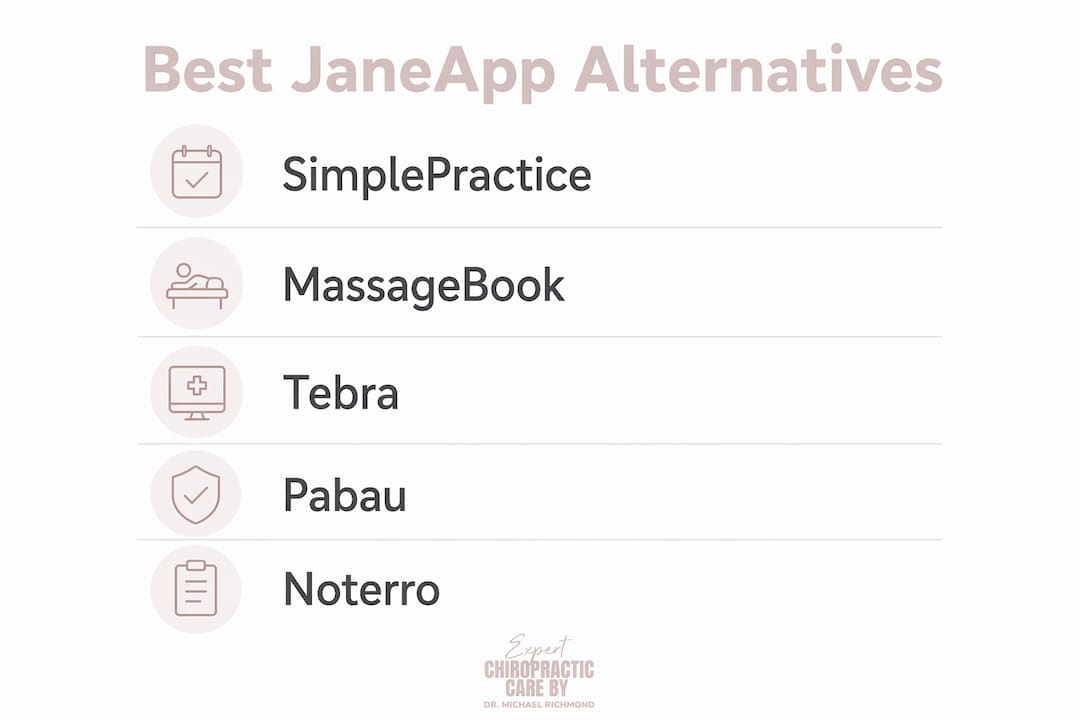
The strongest JaneApp alternatives in 2026 are SimplePractice, MassageBook, Tebra, Pabau, and Noterro. Each targets a different slice of the health and wellness market, and the right pick depends almost entirely on your billing model, practice size, and specialty. JaneApp works well for Canadian allied health and cash-pay wellness clinics, but US insurance billing gaps, limited API access, and a lack of specialty-specific compliance tools push many US practitioners toward purpose-built alternatives.
| Software | Best For | Key Features | Starting Price | Practice Size |
|---|---|---|---|---|
| MassageBook | Massage therapists | Outcall booking, marketing tools, SOAP notes | $20/month | Solo to small business |
| Noterro | Solo practitioners, small clinics | Mobile-first, location-based scheduling | $28.05/month | Solo to small clinic |
| SimplePractice | Mental health, cash-pay practices | Client portal, billing, telehealth | $29/month | Solo to mid-size |
| Vagaro | Wellness studios, spas, salons | Booking, marketing, analytics | $29/month | Solo to mid-size |
| ClinicSense | Small wellness and therapy clinics | Client communication, appointment management | $25/month | Small clinic |
| CareCloud | Mid to large billing-heavy practices | Revenue cycle management, claim tracking | — | Mid to large |
| Juvonno | Documentation-focused practices | SOAP notes, integrated billing | — | Small to mid-size |
| Power Diary | Scheduling-focused clinics | Flexible scheduling, workflow tools | — | Small to medium |
| Writeupp | Operational efficiency | Workflow automation, clinical documentation | — | Small to medium |
| Medesk | Patient communication | Patient portal, engagement tools | — | Small clinic |
| Cliniko | Allied health, multi-site | Multi-site scheduling, invoicing | — | Small to large |
| WellnessLiving | Med spas, aesthetic clinics | Marketing automation, inventory | Not publicly listed | Medium to large |
| Pabau | Aesthetic clinics, med spas | End-to-end workflows, CRM, compliance | $69/user/month | Small to large |
| Tebra | US insurance billing practices | Revenue cycle management, denial management | Not publicly listed | Small to large |
| ChiroTouch | Chiropractic clinics | Chiropractic EHR, integrated billing | Not publicly listed | Small to large |
| TheraNest | Mid-size behavioral health groups | Flat-rate pricing, group practice tools | Not publicly listed | Mid-size groups |
| Sessions Health | Solo and small therapy practices | Freemium plan, transparent per-claim pricing | $39/month | Solo to small group |
| Carepatron | Small to medium medical practices | Notes, scheduling, billing | Not publicly listed | Small to medium |
| Acuity Scheduling | Appointment-focused practices | Calendar integration, flexible scheduling | Not publicly listed | Solo to small |
| Mindbody | Wellness studios, spas | Client management, marketing | Not publicly listed | Small to large |
| GlossGenius | Solo wellness, small spas | Client management, payments | Not publicly listed | Solo to small |
| AestheticsPro | Med spas, aesthetics | Marketing, compliance tracking | Not publicly listed | Small to large |
| DrChrono | Customizable EHR needs | Mobile EHR, flexible templates | Not publicly listed | Small to large |
| Amplify | Workflow automation | Advanced integrations, automation | Not publicly listed | Medium to large |
| Booker by Mindbody | Spa and wellness client management | Client engagement, marketing | Not publicly listed | Small to large |
| PatientNow | Med spas, wellness centers | Patient communication, marketing | Not publicly listed | Small to large |
| Practice Harbor | Therapy clinics, small groups | Flexible pricing, therapy tools | Not publicly listed | Small group |
| Psylio | Solo therapists, small mental health | Note-taking, scheduling | Not publicly listed | Solo to small |
| GO rendez-vous | Integration-focused clinics | Scheduling, integration support | Not publicly listed | Small to medium |
| Zanda | Therapy clinics, allied health | AI-powered notes, billing | Not publicly listed | Small to medium |
| OptiMantra | Allied health specialties | Appointment management, documentation | Not publicly listed | Small to medium |
| CentralReach | ABA and compliance-heavy therapy | Compliance workflows, billing | Not publicly listed | Medium to large |
| Goldie | Documentation-focused therapy | Note-taking, scheduling | Not publicly listed | Solo to small |
| NextGen Office | Enterprise-class clinics | EMR, integrated billing | Not publicly listed | Medium to large |
| GoReminders | Appointment reminder needs | Automated reminders, confirmations | Not publicly listed | Any size |
| Doctoralia for Specialists | Specialist patient acquisition | Referral management, booking | Not publicly listed | Specialist clinics |
| Klara | HIPAA-compliant messaging | Secure patient communications | Not publicly listed | Small to large |
| Unified Practice | Solo health providers | Simple billing, notes | Not publicly listed | Solo to small |
| CounSol | Mental health therapists | Secure messaging, telehealth | Not publicly listed | Solo to small |
| Doxy.me | Telehealth-first practices | Free tier, HIPAA video sessions | Not publicly listed | Solo to small |
| Epic EMR | Large multi-specialty health systems | Enterprise EMR, revenue cycle | Not publicly listed | Large enterprise |
| Practice Fusion | Small practices, cost-effective EHR | Free EHR, billing add-ons | Not publicly listed | Small to mid-size |
| eClinicalWorks | Mid to large integrated clinics | EHR, patient engagement, interoperability | Not publicly listed | Mid to large |
| ModMed EMR | Specialty medical clinics | Specialty-specific workflows | Not publicly listed | Small to large |
| Allscripts EMR (Veradigm) | Large health organizations | Analytics, revenue management | Not publicly listed | Large enterprise |
How do the leading JaneApp alternatives compare on features and pricing?
The gap between JaneApp and its top competitors becomes clearest when you look at three specific areas: US insurance billing compliance, workflow automation depth, and specialty-specific tooling. JaneApp handles scheduling and documentation well for cash-pay and Canadian allied health practices, but PT-specific billing compliance features like the 8-minute rule, KX modifier tracking, and prior authorization automation are absent. For US insurance-based clinics, that absence translates directly into rejected claims.
SimplePractice for mental health and cash-pay practices
SimplePractice is the dominant platform for solo and small-group US therapy practices. Its client portal lets patients book appointments, complete intake forms, join telehealth sessions, and pay from a single URL, which is something JaneApp's portal does not match for US-based therapists. US insurance billing through SimplePractice is significantly more polished than JaneApp's, with cleaner clearinghouse integration and ERA posting. The platform starts at $29/month for solo practitioners, though group practices above ten clinicians often find its reporting too shallow.

Pro Tip: If you are a solo therapist switching from JaneApp primarily because of billing friction, SimplePractice's Essential plan at $29/month covers the core billing and portal features without paying for tools you will not use.
MassageBook for massage therapists
MassageBook was built by a massage therapist, and that origin shows in every feature decision. Outcall booking with location-based rules, driving distance filters, and tap-to-pay are native to the platform. JaneApp offers no equivalent for mobile massage practitioners. At $20/month, MassageBook costs less than half of JaneApp's starting price, and it includes a website builder, SEO tools, automated email campaigns, and a professional massage business directory. AMTA and ABMP members get additional discounts.
Tebra for US insurance billing
Tebra (formerly Kareo) was built by a billing company, and its revenue cycle management infrastructure reflects that history. Claim tracking, denial management, and ERA posting are all more developed than JaneApp's. The PatientPop acquisition added patient acquisition and reputation management tools on top of the billing core. Practices switching from JaneApp primarily because of insurance billing pain, especially those handling workers' compensation or multiple commercial payers, consistently land on Tebra as the most natural fit.

Pabau for aesthetic clinics and med spas
Pabau starts at $69/user/month for aesthetic clinics and med spas and covers end-to-end medical aesthetic workflows that JaneApp simply does not address: consent forms, before-and-after photo management, treatment records, and marketing automation built specifically for aesthetic practices. WellnessLiving similarly targets med spas with marketing automation and inventory management. Neither platform is cheap, but for clinics where compliance documentation and client retention tools are revenue-critical, the per-user cost justifies itself quickly.
Noterro for solo and mobile practitioners
Noterro's mobile-first design and location-based booking rules make it a natural fit for practitioners who work across multiple sites or offer mobile services. At $28.05/month with a 14-day free trial, it covers scheduling, billing, documentation, and patient communication without charging extra for core features that other platforms gate behind add-on fees. Mobile clinics specifically benefit from location-based appointment scheduling and travel distance rules that general platforms like JaneApp do not offer.
Sessions Health for budget-conscious therapy practices
Sessions Health offers a freemium plan covering up to three active clients, making it the most accessible entry point in this category. The Professional plan runs $39/month for the first practitioner, with additional practitioners at $29/month each. Electronic claims cost $0.19–$0.25 per claim, and real-time eligibility checks run $0.15 per report. That per-transaction model works well for practices with lower claim volume. For a small group of ten practitioners, Sessions Health runs roughly $300–$500/month versus SimplePractice's $900–$1,500/month at the Plus tier.
CareCloud for revenue cycle management
CareCloud is a higher-priced revenue cycle management option designed for mid-to-large practices with complex billing needs by a significant margin, but it is also the most mature billing infrastructure available outside of enterprise EMR systems. Dedicated claim tracking, denial management, and advanced revenue cycle reporting make it the right call for mid-to-large practices where billing complexity is the primary operational challenge.
Which additional JaneApp alternatives suit niche or emerging practice needs?
Beyond the most-cited platforms, several alternatives address specific practice types that the mainstream options underserve.
- ChiroTouch is purpose-built for chiropractic clinics, with chiropractic-specific EHR templates and integrated billing. For a chiropractic practice, it eliminates the workarounds that general platforms like JaneApp require.
- TheraNest (now operating as Luminare in some markets) uses flat per-practice pricing rather than per-clinician fees. At eight or more clinicians, that pricing model becomes significantly cheaper than JaneApp or SimplePractice.
- CentralReach serves ABA therapy providers and other compliance-heavy therapy specialties with workflow tools built around regulatory requirements.
- OptiMantra covers a range of allied health specialties with flexible appointment and documentation management, useful for clinics that do not fit neatly into mental health or physical therapy categories.
- Doxy.me offers a free tier for HIPAA-compliant video sessions, making it the lowest-friction entry point for practices that need telehealth without a full practice management overhaul.
- GlossGenius targets solo wellness practitioners and small spas with a clean, client-friendly interface and integrated payment tools.
- GoReminders works as a standalone automated reminder service that layers on top of existing practice management software, useful for practices that want better appointment confirmation without switching platforms entirely.
- Klara focuses on HIPAA-compliant patient messaging, filling the communication gap for clinics that have a separate EHR but need secure two-way texting.
- Acuity Scheduling handles appointment management with strong calendar integrations and is a practical choice for practices that primarily need scheduling without full EHR functionality.
- Goldie and Psylio both target solo therapists and small mental health practices with lightweight note-taking and scheduling tools at accessible price points.
- Doctoralia for Specialists addresses patient acquisition through referral management and specialist booking, a need that general practice management platforms rarely address directly.
- CounSol provides secure messaging and telehealth for mental health therapists, with a client portal built around therapy-specific communication needs.
- Unified Practice and Practice Harbor both offer simple, low-cost billing and notes for solo and small group providers who find larger platforms over-engineered for their needs.
- NextGen Office, Epic EMR, eClinicalWorks, ModMed EMR, and Allscripts EMR (Veradigm) all serve larger or more specialized medical organizations where a full EMR with interoperability and analytics is the requirement, not a wellness-focused scheduling tool.
- Practice Fusion offers a free EHR option with billing add-ons, making it one of the few genuinely no-cost starting points for small practices.
- DrChrono provides a mobile-friendly, customizable EHR that suits practices needing flexible charting templates across specialties.
- Amplify and GO rendez-vous both emphasize integration and automation capabilities, useful for clinics building cross-system workflows.
- Booker by Mindbody and Mindbody itself serve wellness studios and spas with combined booking and marketing tools, though Mindbody's pricing and complexity tend to suit larger operations.
How to choose the right JaneApp alternative for your clinic
The single biggest mistake practitioners make when switching from JaneApp is evaluating software by feature count rather than workflow fit. A platform with fifty features you will never use is worse than one with ten that match exactly how your clinic operates.
Start with your billing model. Cash-pay practices have the most flexibility. Insurance-based practices, especially physical therapy clinics, need software with native US billing compliance. PT-specific billing gaps in general wellness platforms lead directly to denied claims, and no amount of scheduling convenience offsets that cost. If you bill Medicare or commercial payers for PT, OT, or SLP services, your shortlist should start with platforms that handle the 8-minute rule, KX modifier tracking, and prior authorization natively.
Match the platform to your practice size. A platform that fits a solo practitioner can become a bottleneck for a multi-location clinic. Multi-site reporting, staff permission levels, and cross-location scheduling become critical as you grow. Evaluate those features before you commit, not after you have migrated your patient records.
Assess automation depth honestly. Most entry-level practice management platforms offer appointment reminders and basic task automation. True workflow automation requires API-level integrations and webhooks. If you want to trigger downstream actions outside the platform, like updating a CRM when a patient books or sending a referral fax automatically, you need a platform with a documented REST API. Many traditional PM systems do not have one.
- Prioritize platforms with a free trial or demo that mirrors your actual workflow, not a guided sales demo.
- Confirm HIPAA compliance and data security certifications before signing any contract.
- Ask specifically about data migration support and timelines. Some platforms charge for migration; others include it.
- Check whether insurance billing features are included in the base plan or gated behind add-ons.
- For group practices, test multi-clinician scheduling and reporting before committing.
Pro Tip: Before requesting a demo, map out your three most time-consuming weekly tasks. Ask the vendor to show you exactly how their platform handles each one. If they cannot demonstrate it live, assume it does not work the way they describe.
What do experts say about choosing practice management software for wellness clinics?
Practitioners who have switched platforms more than once tend to share a consistent observation: the features that looked impressive in a demo are rarely the ones that determine day-to-day satisfaction. The features that matter are the ones you use every single session.
Billing compliance is non-negotiable for insurance-based practices. General wellness platforms like JaneApp are built around cash-pay and direct-billing workflows. US insurance billing compliance requirements, including 8-minute rule automation, KX modifier threshold tracking, MIPS quality measure reporting, and prior authorization workflows, are simply absent from most wellness-first platforms. For a PT clinic billing Medicare, that gap produces rejected claims at scale.
API access separates entry-level from scalable platforms. Group practices with five to fifteen clinicians need platforms offering API access and webhooks for advanced billing workflows. Without that, automation is limited to what the platform's native tools support, which is usually appointment reminders and basic form triggers. Practices planning to integrate their PM software with external CRMs, analytics tools, or referral systems should treat API documentation as a required feature, not a bonus.
- Solo practitioners prioritize ease of use, pricing, and client portal quality.
- Group practices need multi-clinician scheduling, staff permissions, and reporting depth.
- Multi-disciplinary clinics benefit from platforms that handle multiple billing types without requiring separate software for each specialty.
- Mobile and outcall service providers need location-based scheduling rules that most general platforms do not offer.
The "all-in-one" label can obscure real gaps. A platform that covers scheduling, billing, documentation, and marketing in one dashboard sounds ideal. But all-in-one coverage at a surface level is not the same as depth in any one area. A med spa that needs consent form management, before-and-after photo storage, and aesthetic-specific compliance tracking will find that most all-in-one wellness platforms handle none of those well. Matching the platform to your specific billing model and clinical workflow beats chasing the longest feature list every time.
Client portals vary more than vendors admit. SimplePractice and Healthie offer the strongest client portals for therapy practices, allowing patients to book, complete intake forms, join telehealth sessions, and pay from a single URL. JaneApp's portal is functional but less polished for US-based patients. For practices where the client experience drives retention, portal quality is worth testing directly with a real patient workflow before committing.
Key Takeaways
The best JaneApp alternative is the one that matches your billing model, practice size, and specialty, not the one with the most features.
| Point | Details |
|---|---|
| Billing model drives the choice | Insurance-based PT clinics need 8-minute rule and KX modifier support; cash-pay practices have far more flexibility. |
| Practice size determines scalability | Solo practitioners can use lightweight tools like Sessions Health or MassageBook; multi-location clinics need API access and multi-site reporting. |
| Automation requires API access | True cross-system workflow automation needs webhooks and a documented REST API, which many entry-level platforms lack. |
| Specialty-specific tools matter | Massage therapists fit MassageBook; aesthetic clinics fit Pabau; chiropractic practices benefit from ChiroTouch's purpose-built EHR. |
| Sparkmed's chiropractic approach | For chiropractic care in North Miami, Sparkmed offers affordable, experienced treatment without requiring insurance, starting at $25 per adjustment. |
The feature list is not the problem
The most common mistake in this comparison process is treating software selection as a feature-matching exercise. You open a comparison table, count checkmarks, and pick the platform with the most boxes filled. That logic fails almost every time.
The real question is not "does this platform have billing?" It is "does this platform handle billing the way my clinic actually bills?" A physical therapy clinic that bills Medicare needs 8-minute rule automation and KX modifier tracking built into the workflow, not bolted on as an afterthought. A massage therapist who does outcall work needs location-based booking rules, not a generic appointment form. A med spa needs consent form management and before-and-after photo storage, not a generic document upload field.
JaneApp is a genuinely good platform for the practices it was designed for: Canadian allied health clinics, cash-pay wellness providers, and small multi-disciplinary teams that do not need deep US insurance billing compliance. The practitioners who struggle with it are usually not using the wrong software in an absolute sense. They are using software built for a different practice model than the one they run.
The platforms that consistently earn the strongest reviews in their respective categories, SimplePractice for mental health, MassageBook for massage therapy, Tebra for insurance-heavy billing, Pabau for aesthetic clinics, do so because they were built around a specific workflow rather than trying to serve every workflow at once. That specificity is what makes them worth the switch.
Sparkmed offers a different kind of care for chiropractic patients
If you are a chiropractic practitioner or a patient looking for affordable, experienced care in North Miami, the software comparison above covers the management side of the equation. The clinical side is where Sparkmed comes in.
Sparkmed specializes in chiropractic care and post-accident recovery, with spinal adjustments starting at $25 without requiring insurance. The clinic focuses on trauma recovery after car accidents, with experienced practitioners, modern equipment, and treatment plans built around fast, measurable results. Services are available in English, Spanish, and Creole, and booking an appointment is straightforward. For chiropractic-specific care that does not require navigating a complex software platform or insurance process, Sparkmed provides a direct, affordable path to treatment. Learn more about transparent chiropractic pricing and what to expect from your first visit.