
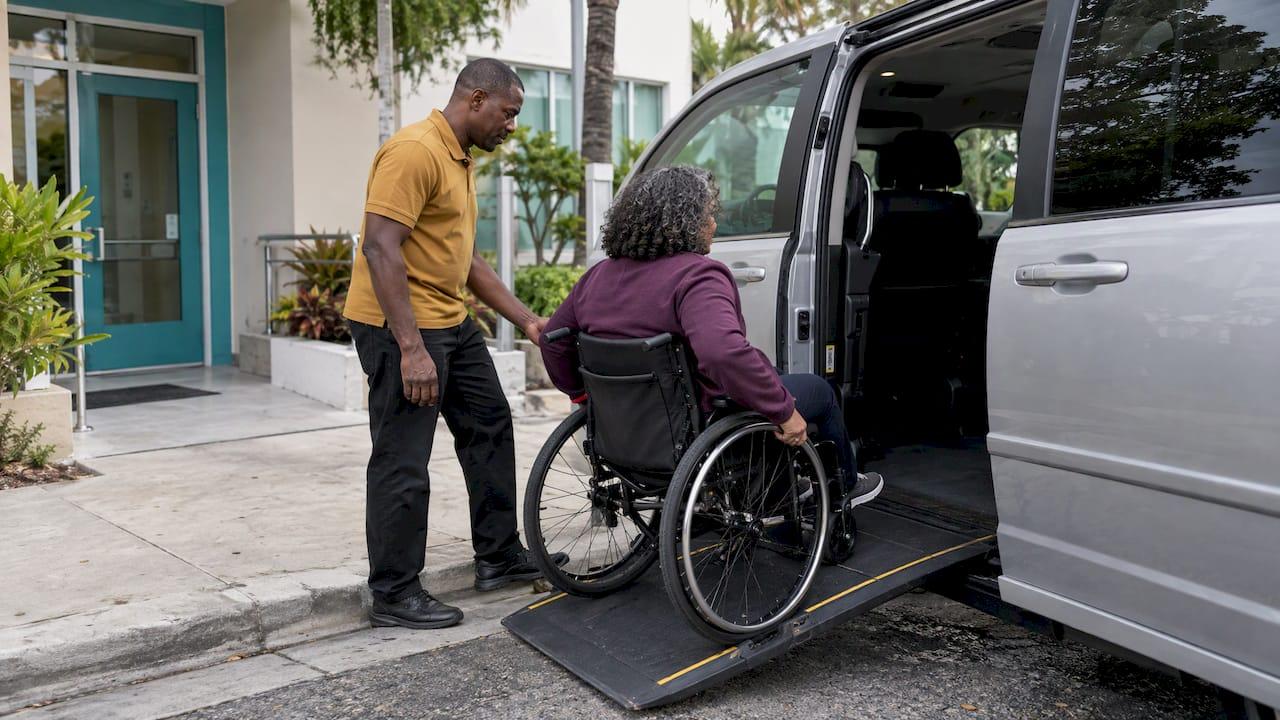
If you are hurt and have no car, or no safe way to drive, you have four realistic ways to reach a medical appointment in Miami: a Medicaid-covered ride, Miami-Dade County's paratransit service, an app-based medical ride such as Uber Health, or a ride arranged by the clinic itself. The right one depends on your coverage, how much help you need getting in and out of a vehicle, and how soon you need to be seen. At Spark Chiropractic in North Miami, we offer free transportation services and Uber Health rides for patients, so for appointments with us the ride can be settled in the same conversation as the booking.
This guide explains each option in plain terms, what it costs, how far ahead you must plan, and how to ask for the right level of help.
TL;DR
- Non-emergency medical transportation (NEMT) is a prearranged ride to a medical visit for people who are stable and do not need an ambulance. Call 911 for anything urgent.
- Florida Medicaid covers NEMT for eligible members with no other way to get to a covered service. Routine rides generally need about three business days' notice.
- Miami-Dade's Special Transportation Service (STS) is door-to-door paratransit for eligible riders at $3.50 per trip.
- Uber Health is app-based and has no sign-up fee, but its drivers are not trained to give medical assistance, so tell the booker what help you need.
- For chiropractic care after a car accident, work injury or fall, we can arrange transportation to your visit with us in North Miami.
Table of Contents
- What non-emergency medical transportation actually means
- Your four options in North Miami at a glance
- Medicaid NEMT in Florida
- Miami-Dade STS paratransit
- Uber Health, regular Uber and NEMT: what is different
- What medical transportation costs in Florida
- How to arrange a ride to your appointment
- Getting to a chiropractor after a crash, a fall or a work injury
- What we offer patients in North Miami
- Our perspective
- FAQ
- Sources
What non-emergency medical transportation actually means
NEMT is a ride to or from a medical appointment that is planned in advance. It is for people who are medically stable but cannot drive, do not have a car, or cannot get there safely on their own after an injury. It sits between two things people often confuse it with:
- An ambulance. Emergency transport is for life-threatening situations. Chest pain, loss of consciousness, severe bleeding or suspected spinal cord injury after a crash means calling 911, not booking a ride.
- An ordinary rideshare. A regular rideshare takes you from A to B. A medical ride is booked for a health visit, and some versions add wheelchair-accessible vehicles, escorts or billing to a health plan.
The label also covers a wide range of vehicles. Sedans suit most patients with neck, back or shoulder pain who can walk and sit. Wheelchair vans suit people who cannot transfer easily. Stretcher transport is a separate, more medical level of service and is priced accordingly.
One point from federal Medicaid guidance is useful here: the Centers for Medicare & Medicaid Services (CMS) notes that care does not always mean a hospital emergency department. Its Medicaid transportation guide lists group practices, ambulatory care settings and community clinics as other destinations. A chiropractic office is part of that outpatient picture.
Your four options in North Miami at a glance
| Option | Who it suits | Typical cost | Notice needed |
|---|---|---|---|
| Medicaid NEMT | Medicaid members with no other transportation | Covered by the plan for eligible trips | Routine rides: at least 3 business days |
| Miami-Dade STS paratransit | Riders with disabilities who qualify under the ADA | $3.50 per trip | Generally advance booking; same-day only case by case |
| App-based medical ride (Uber Health) | Patients who can ride in a standard or accessible vehicle | Usage-based; no sign-up fee | Booked by you or by the provider's office |
| Ride arranged by the clinic | Patients of that clinic | Ask the clinic | Arranged at booking |
The sections below explain each, in the order most injured patients ask about them.
Medicaid NEMT in Florida
If you have Florida Medicaid, transportation to covered care is part of your benefit. The Florida Agency for Health Care Administration (AHCA) says Medicaid reimburses medically necessary non-emergency transportation for an eligible recipient, and for an attendant or escort when one is required, who has no other means of transportation to a Medicaid-covered service. It is a minimum covered service in every Managed Medical Assistance and Long-Term Care plan.
Three things to know before you rely on it:
- "No other means" is the test. CMS explains that the federal rule is not a promise to pay for any ride. It is an assurance that members with no other way to get there can reach covered care, and states must use the least costly and most appropriate mode for the person's needs, first looking at free options such as a family member or friend. Expect to be asked whether someone can drive you.
- Two delivery systems. Florida's NEMT waiver, renewed for July 1, 2025 through June 30, 2027, delivers rides through fee-for-service for people not in managed care and through managed care plans for those enrolled in one. Which number you call depends on how you are enrolled, so check your member card or plan handbook.
- Plan ahead. One Florida plan transportation handbook (May 2025) says routine rides should be scheduled at least three business days ahead, while urgent rides can be requested at any time and same-day rides can take up to three hours. Handbooks differ by plan and region, so use the phone number printed on your own card.
When you call, give the level of help you need, any special needs and whether you need a car seat. If you use a wheelchair, say so, because the driver must secure it correctly.
Medicaid also covers medically necessary chiropractic care in Florida. AHCA's chiropractic services rule describes up to 24 visits per year plus X-rays, with a $1 copayment per office visit per day unless exempt, and it requires a practitioner licensed under Chapter 460 of Florida Statutes. That rule is dated January 2019, so confirm current limits with your plan.
Miami-Dade STS paratransit
STS is the county's shared-ride service for people whose disability prevents them from using regular bus or rail. Miami-Dade County describes it as ADA-compliant, door-to-door, available throughout most of the county, 24/7, at $3.50 per trip, including for medical appointments.
The practical limits matter for an injured patient:
- You must be approved as an STS rider first, so it does not help with a one-time need next week.
- The rider's guide says same-day service is not generally available, though it may be approved case by case for verifiable non-life-threatening medical needs.
- Wheelchair riders who can transfer safely to a sedan may ride as ambulatory passengers, and a subscription can be set up if you take the same trip at least once a week. That suits a recurring treatment schedule.
Because it is shared-ride, expect pickup windows rather than a precise time. Build in extra time before an appointment.
Uber Health, regular Uber and NEMT: what is different
People search for this comparison because the three sound alike.
Regular Uber is a consumer app. You book for yourself, pay by card, and the price changes with demand.
Uber Health is the version healthcare organizations and care teams use to book rides for patients. The patient does not need to have the app or a smartphone, because a clinic, case manager or caregiver can schedule the trip from a dashboard. Uber Health says there is no sign-up fee and all fees are usage-based, that NEMT rides use upfront pricing, and that extra fees such as cancellation or return fees can apply.
Traditional NEMT is a ride from a transportation provider, usually paid by Medicaid or another plan, often with wheelchair or stretcher vehicles and drivers trained for patient handling.
The difference that decides most cases is the level of help. Uber Health states that its drivers go through background checks, license and identity verification, driving record reviews and annual re-screening, but they are not trained in CPR, medical assistance or specialized patient handling because the trips are for non-emergency passengers. That makes it a good fit for the large group of patients who can walk, sit and ride in a car, which covers most people with neck pain, back pain or soreness after a collision. If you need lifting, a ramp or a stretcher, say so when booking so the right vehicle is arranged.

On cost, Uber Health's North Miami page lists an average UberX trip price of about $20 under dynamic pricing as of its February 2026 listing, and notes that wheelchair-accessible program fees may apply in some markets. Treat that as a reference point only: the price you see before you confirm is the one that counts.
What medical transportation costs in Florida
Costs depend on who pays and which vehicle you need.
- Medicaid members: the plan pays for eligible trips, so the question is eligibility and notice, not price.
- Sedan or app-based rides: usage-based, shown upfront when the booking tool offers it.
- Ambulance-level transport: AHCA's 2025 transportation fee schedule lists non-emergency ground ambulance at $137.96 for basic life support and $192.73 for advanced life support. Negotiated transportation service is paid as negotiated. These are Medicaid reimbursement rates, not what a private company necessarily charges, and they are the 2025 schedule.
- County paratransit: $3.50 per trip for approved STS riders.
If you are paying out of pocket, ask for the total, including return trips and any wait time, before you agree to the ride.
How to arrange a ride to your appointment
This is the routine that works whichever option you use.
- Decide the level of help. Can you walk to the curb and sit in a car? Do you need a wheelchair-accessible vehicle? Is someone coming with you? This one answer chooses the vehicle.
- Check your coverage first. If you have Medicaid, call the transportation number on your member card. Medicaid sets the notice window, and asking early prevents a missed visit.
- Confirm the pickup and return. Give the exact address, building entrance and a phone number that will be answered. Ask how the ride home is handled, because a return trip is often a separate booking or fee.
- Book around the appointment, not the clock. Plan to arrive early. Shared services use pickup windows, and a missed slot can mean losing a treatment that was hard to get.
- Keep the confirmation. Save the booking number or message in case the driver is late.
- If you were just in an accident, write down your symptoms and get seen promptly. Our guide on what to do after a car accident in North Miami lays out the first steps, and our article on booking a doctor ride shows how to match your coverage to a single call.
When the appointment is with us, step 1 to 3 happen at once. We cover the ride when you book, and our overview of how Uber Health works for clinics explains how the app-based side is set up.
Getting to a chiropractor after a crash, a fall or a work injury
Transportation is one of the quiet reasons injured people delay care. After a collision your car may be in the shop, or driving may hurt. Delay can make soreness harder to document and treat, so removing the ride problem is worth doing early.
For care in North Miami, the main points are:
- You do not need a medical-van level of service for most spinal care. Most patients ride in a standard vehicle.
- Treatment is usually a series of visits, which makes recurring transportation more important than a single trip. If you use STS, ask about a subscription trip. If you are with us, tell us your schedule when you book.
- Choose a licensed provider. Our guide to checking a car accident doctor's license and PIP in Miami explains what to confirm before your first visit, and our page on PIP insurance and chiropractic care in North Miami covers how that coverage applies.
If you live near Miami Shores, see our page on a car accident chiropractor near Miami Shores.
What we offer patients in North Miami

SPARK Chiropractic has more than 20 years of experience treating accident victims. Patients can reach us in English, Spanish or Creole, and we bill insurance directly with thorough injury documentation for claims. Transportation to your visit is part of how we make care reachable: we offer free transportation services and Uber Health rides in North Miami.
Our published prices are simple. A chiropractic adjustment is $45 per visit, and shockwave therapy is $75 per session. Monthly wellness plans are Essential at $149 per month, Performance at $249 per month and Elite at $399 per month. See our pricing page for what each includes, and our services page for ultrasound, electrical stimulation, traction and decompression, massage therapy and auto accident evaluation. If you are paying without insurance, what you will pay for a chiropractor without insurance in Miami goes through the numbers.
Ready to book? Start at sparkmed.net and tell us you need a ride, and we will plan it with your appointment.
Our perspective
Most of the patients who come to us after a collision are not asking for anything complicated. They want to be seen soon, they want a price they can understand, and they want to get here without making their pain worse.
That is why we treat the ride as part of the care. A treatment plan only works if the patient can attend the visits, and for an injured person without a car, transportation is often the first barrier. We offer free transportation services and Uber Health rides in North Miami so that the barrier is handled at the same time as the booking.
We also think clear answers matter. Our team speaks English, Spanish and Creole, our prices are published, and after more than 20 years of treating accident victims we know how closely a claim depends on good injury documentation. We bill insurance directly and document each case thoroughly.
If you are hurt, do not wait on a ride to start. Call us, tell us where you are coming from, and we will work out the rest with you.
Spark
FAQ
Is Uber Health the same as NEMT?
No. Uber Health is a ride-booking platform that healthcare organizations use to schedule trips for patients, often in standard sedans. Traditional NEMT is a medical transportation service, usually paid by Medicaid, with vehicles and drivers suited to wheelchairs or higher levels of assistance. Which one fits depends on how much help you need getting in and out of the vehicle.
Who can use Uber Health in North Miami?
The patient does not need the app, because a clinic, caregiver or care team can book the ride for them. Eligibility is set by the organization booking it, not by a public application. If you are a patient of ours, call us when you book and we will tell you how your ride works.
How do I get to the doctor in Miami without a car?
Use the option that matches your coverage and your mobility. Medicaid members can call the transportation number on their card and should allow about three business days for routine rides. People with a qualifying disability can apply for county STS paratransit at $3.50 per trip. If you are seeing us, ask us to arrange the ride with your appointment.
Does Medicaid pay for a ride to a chiropractor in Florida?
Florida Medicaid covers medically necessary non-emergency transportation to Medicaid-covered services for members with no other means of transportation. It also covers medically necessary chiropractic care within set visit limits. Confirm the current rules with your own plan before booking.
When should I call 911 instead of booking a ride?
Call 911 for chest pain, trouble breathing, loss of consciousness, heavy bleeding, new weakness or numbness, or any condition that could be life-threatening. Medical rides are for planned, stable appointments.
Sources
- CMS: Assurance of Transportation, a Medicaid Transportation Coverage Guide (SMD 23-006)
- Florida AHCA: Non-Emergency Transportation Services
- Florida AHCA: NEMT waiver renewal 2025-2027
- Florida AHCA Member Handbook for NEMT (May 2025)
- Florida AHCA: Chiropractic Services rule 59G-4.040
- Miami-Dade County: Benefits for STS customers
- STS Rider's Guide
- Florida AHCA: 2025 Transportation Services Fee Schedule
- Uber Health: NEMT in North Miami
- Uber Health: Frequently Asked Questions