

Most maintenance chiropractic care lands somewhere between once a month and once every three months, but the right interval depends on where you are in recovery, how you responded to active treatment, and what your reassessments show. Research on clinician-controlled schedules found that regular visits reduced bothersome low-back pain days by a modest amount per year, at the cost of a small number of extra visits. The exact number that fits you comes from tracking results, not from a generic calendar rule.
TL;DR:
- Evidence shows maintenance chiropractic visits may reduce bothersome low-back pain days by about 13 days over a year, but benefits vary based on patient profile.
- Typical schedule patterns include every 2 to 4 weeks shortly after active care, monthly, or every 2 to 3 months, adjusted according to reassessment outcomes.
- Maintenance intervals are determined by outcome measures like pain scores, disability indexes, and functional goals, not just patient complaints or time elapsed.
- Red flags such as new numbness, weakness, or severe unrelenting pain require immediate medical attention rather than continuation of maintenance care.
- Cost and effectiveness depend on tracking outcomes and adjusting schedules proactively, with personalized plans often starting tighter and stretching out as stability is confirmed.
Table of Contents
- What Is Maintenance Chiropractic Care, and Who Actually Needs It?
- What Do Studies Actually Show About Visit Frequency and Outcomes?
- What Are the Common Maintenance Schedule Patterns?
- How Do Chiropractors Decide on Your Interval?
- How Do I Build My Own Maintenance Schedule?
- What Happens During a Typical Maintenance Visit?
- How Much Does Maintenance Care Cost, and How Do You Know It's Working?
- What Symptoms Mean You Should Stop or Change Your Maintenance Plan?
- How Spark Builds a Maintenance Plan With You
- Ready to Build a Maintenance Plan That Actually Fits You?
- Sources
- FAQ
What Is Maintenance Chiropractic Care, and Who Actually Needs It?
Maintenance care is a clinician-scheduled set of visits that continues after your initial pain has improved. The goal isn't fixing a new injury. It's preventing a relapse or keeping a chronic condition from creeping back toward where it started. Chiropractors sometimes describe this as secondary or tertiary prevention: you already had the problem, treatment brought it under control, and now the visits exist to keep it that way.
That distinction matters because maintenance care isn't for everyone who's ever seen a chiropractor. A systematic review of maintenance care literature found it's typically scheduled every one to three months, and roughly 30% of Scandinavian chiropractic patients use it in some form. The people who tend to benefit most share a few traits:
- A history of recurrent or episodic low back pain or neck pain, rather than a single isolated flare.
- A strong response to the initial round of active treatment, with clear improvement before tapering.
- A pattern of prior relapses when treatment stopped too early.
- A preference for ongoing symptom management over chasing a full "cure," which many long-term patients report as their actual goal.
Maintenance care sits apart from two other models worth knowing. Active or acute treatment is the front-loaded phase right after injury or flare, often involving visits two to three times a week while symptoms are at their worst. Symptom-guided care, sometimes called call-when-needed treatment, means you book a visit only when pain flares back up. Maintenance care is scheduled proactively regardless of whether you feel a flare coming, which is the entire point.
What Do Studies Actually Show About Visit Frequency and Outcomes?
The clearest experimental evidence comes from the Nordic Maintenance Care program, a pragmatic randomized controlled trial comparing clinician-controlled maintenance visits against symptom-guided treatment for people with recurrent or persistent low back pain. The result was measurable but modest.
The Nordic Maintenance Care finding: Patients on a clinician-controlled maintenance schedule experienced about 13 fewer days of bothersome low-back pain over 12 months than those using symptom-guided care, according to the pragmatic randomized controlled trial published in PLOS One. That benefit came at the cost of a few additional visits per year, a modest trade-off in visit count for reduction in bad days.
That's a real signal from a controlled trial, but it applies specifically to patients who fit the recurrent, persistent low back pain profile the study enrolled. It doesn't mean everyone gets the same 13-day benefit, and the study doesn't establish that more visits automatically means more relief across every condition.
The systematic review backing much of this field adds a caution that matters: maintenance care is used fairly widely in practice, but the evidence supporting specific schedules is mixed, and cost-effectiveness data remain sparse. In plain terms, researchers know maintenance care helps some patients, but haven't nailed down the ideal dose for most conditions or confirmed it's the most cost-efficient path for everyone.
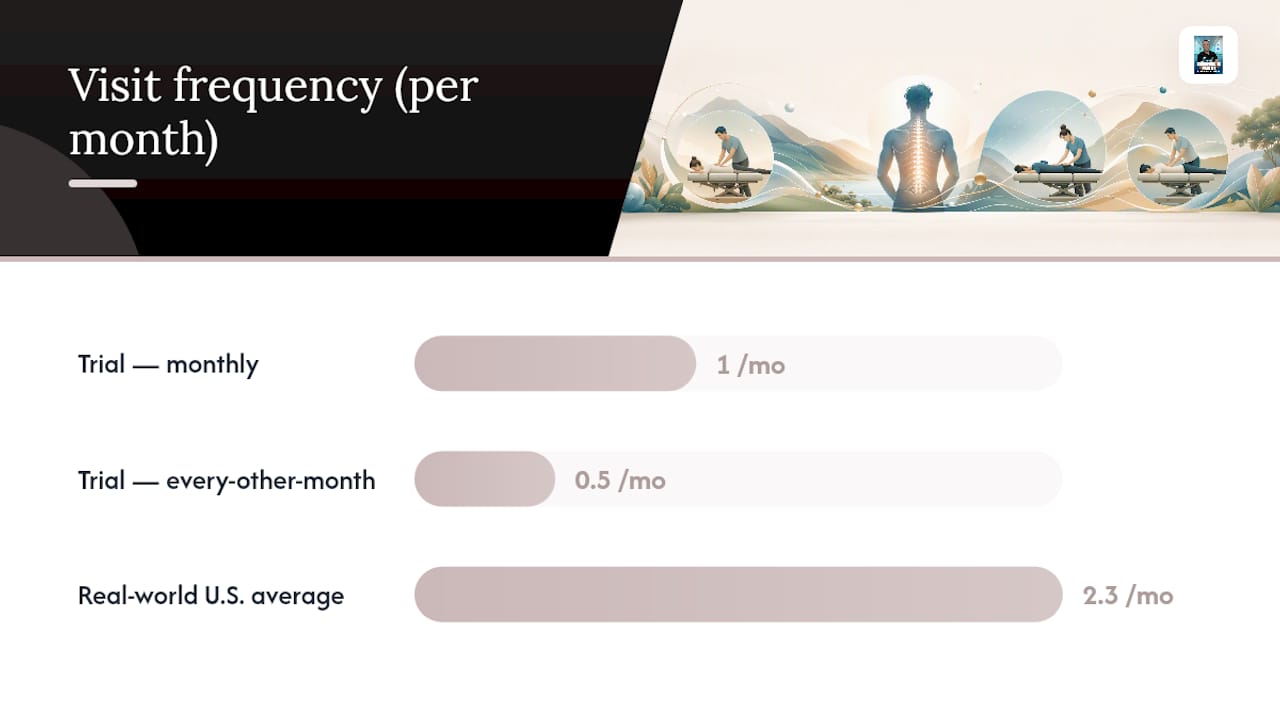
Real-world data paints a different picture of frequency than the trial protocols. An observational longitudinal study of U.S. patients with chronic low-back and neck pain found average utilization around 2.3 visits per month, notably more frequent than the monthly or every-other-month intervals used in many controlled trials. Frequency varied by baseline function, stage of care, and even which chiropractor the patient saw. The same study noted something important about patient motivation: many people using ongoing care were aiming to maintain their current symptom level, not chase a full cure.
A few takeaways stand out across this research:
- Trial-based schedules (often monthly or every 1 to 3 months) tend to be more conservative than what shows up in everyday U.S. practice.
- The observed visit frequency reflects a real-world mix of patient goals, stages of care, and practitioner style, not a universal prescription.
- Evidence quality is strongest for recurrent low back pain; it's thinner for other conditions people sometimes seek maintenance care for.
What Are the Common Maintenance Schedule Patterns?
Clinicians tend to work from a handful of named intervals rather than inventing a new schedule for every patient. Knowing these patterns helps you understand what your chiropractor is proposing and why.
- Short-interval maintenance (every 2 to 4 weeks). This is common right after finishing active treatment, especially for patients with higher baseline pain or a recent history of frequent flares. It gives the clinician more frequent checkpoints while your body adjusts to less intensive care.
- Monthly maintenance. The most commonly cited default in the literature, and a reasonable middle ground between access and cost for patients with a stable but recurrence-prone condition.
- Low-intensity maintenance (every 2 to 3 months). Suited to patients who've stayed symptom-free for an extended stretch and whose function has held steady across several reassessments.
- Symptom-guided care. Not a fixed interval at all. You book when something flares. It costs less in visits overall but trades away the proactive prevention effect the Nordic trial measured.
Pro Tip: Ask your chiropractor which pattern they're using and why, then ask what result would move you up or down a tier. If they can't answer both questions, you're not really on a schedule, you're just showing up.
Most patients don't stay on one pattern forever. It's normal to start at a shorter interval right after active care, then stretch out as reassessments confirm steady progress.
How Do Chiropractors Decide on Your Interval?
The concept clinicians lean on most is Maximum Therapeutic Improvement, or MTI, the point where continued active treatment stops producing meaningful gains. Reassessment typically happens at the end of an active care plan, often by the fourth visit or after several weeks, according to chiropractic duration-of-care guidance. Hitting MTI is usually the trigger for shifting from active treatment into a maintenance schedule.
From there, clinicians track a specific set of outcome measures rather than relying on how you feel in the moment:
- Pain intensity scales, tracked visit to visit.
- Condition-specific disability scores like the Oswestry Disability Index (ODI) for low back pain or the Neck Disability Index (NDI) for neck pain.
- Days with bothersome pain over a defined window, the same metric the Nordic trial used as its primary outcome.
- Progress against your own stated goals, whether that's returning to a specific activity or simply staying out of the flare cycle you were in before treatment.
Several factors push intervals shorter. A history of frequent flares, high physical activity or a demanding job, and incomplete functional gains at reassessment all argue for tighter spacing between visits. Factors that stretch intervals longer include stable function across two or more reassessments, a long stretch without a flare, and straightforward cost or time constraints on the patient's side.
When symptoms worsen instead of holding steady, that's not something a good clinician quietly absorbs into the existing plan. Documented decline, whether it's rising pain scores, a drop in function, or new symptoms, is what justifies extending active care again or reworking the maintenance interval entirely, rather than just continuing on autopilot.
How Do I Build My Own Maintenance Schedule?
You don't need to accept a generic monthly slot just because it's the most common. A workable maintenance plan follows four steps, and most chiropractors will walk through them with you if you ask directly.
- Set the primary goal. Decide whether you're aiming for pain reduction, maintaining current function, or specifically preventing the kind of relapse you've had before. This shapes everything downstream.
- Confirm MTI and record a baseline. Before shifting into maintenance, your clinician should confirm you've plateaued in active care and log where your pain, disability score, and function stand right now, so future visits have something concrete to compare against.
- Choose a starting interval based on your profile. Higher baseline symptoms or a recent flare history points toward the shorter 2 to 4 week interval; a stable, low-symptom profile points toward monthly or even every 2 to 3 months.
- Set a reassessment checkpoint and a trigger threshold. Pick a concrete point, after two maintenance visits, or at three months, and a specific number that would change the plan (for example, bothersome-pain days rising instead of falling).
Three sample schedules illustrate how this plays out for different situations:
- Recurrent low back pain, clinician-controlled: Monthly visits with a formal reassessment at three months, checking ODI score and days with bothersome pain against baseline. This mirrors the pattern the Nordic trial used.
- Well-controlled episodic patient: Every 2 to 3 months, with the understanding that any new flare shortens the interval back down until stability returns.
- Post-accident recovery maintenance: Shorter intervals (every 2 to 4 weeks) for the first one to two months after finishing active care, then stretching toward monthly as reassessments confirm steady progress. This pattern shows up often in patients transitioning out of car accident or injury treatment, where residual instability is common even after acute pain resolves.
None of these schedules are locked in permanently. The whole system only works if reassessment actually happens on schedule instead of becoming a formality.
What Happens During a Typical Maintenance Visit?
A maintenance visit is shorter and less intensive than an active-care session, but it's not just a quick adjustment and out the door. According to Mayo Clinic's overview of chiropractic adjustments, the core technique, manual manipulation of the spine to improve alignment and function, stays consistent whether you're in active treatment or maintenance. What changes is everything around it.
A typical maintenance visit includes:
- A brief, focused reassessment rather than the full intake workup you got at the start of care.
- A targeted adjustment or manual therapy addressing whatever the reassessment flags.
- Short exercise or lifestyle coaching, often just a check-in on whether you're keeping up with home exercises.
- Documentation of your current status against your baseline, feeding directly into the next scheduling decision.
Active treatment series run longer and hit harder. Multiple techniques per session, closer spacing, and a heavier emphasis on resolving the immediate problem rather than monitoring a stable one. Maintenance care is deliberately lighter, and clinicians use what they find at each visit to decide whether your current interval still fits or needs adjusting.
How Much Does Maintenance Care Cost, and How Do You Know It's Working?
Billing for maintenance care usually takes one of three shapes: a per-visit fee, a wellness or maintenance plan with a set monthly rate, or occasional insurance coverage when the visits are documented as medically necessary rather than purely preventive. Insurance carriers often treat maintenance visits differently from active treatment, sometimes classifying them as wellness care that requires separate documentation or isn't covered at all.
Because coverage is inconsistent, tracking whether the visits are actually paying off matters more here than in almost any other part of chiropractic care. The same outcome measures clinicians use to decide your interval work just as well for you to judge value:
- Pain intensity scores over time, not just how you feel on a given day.
- ODI or NDI scores, which quantify function rather than relying on a gut sense of "better."
- Days with bothersome pain per month, the same metric the Nordic trial tracked as its primary outcome.
- Whether you're hitting your own stated activity goals, whether that's lifting your kids, returning to a sport, or just sleeping through the night.
A practical rule worth setting from day one: agree on a threshold in advance, no improvement over a defined period, or a rise in bothersome days, that automatically triggers a conversation about changing frequency. Waiting until you're frustrated to bring it up wastes months of visits that may not be earning their cost.
What Symptoms Mean You Should Stop or Change Your Maintenance Plan?
Maintenance care assumes your condition is stable. Certain symptoms mean that assumption no longer holds, and they call for immediate medical evaluation rather than sticking to the existing schedule.
- New or worsening numbness, tingling, or weakness in an arm or leg.
- Loss of bowel or bladder control.
- Severe pain that doesn't ease with rest or position changes, especially at night.
- Unexplained weight loss, fever, or other signs unrelated to a musculoskeletal issue.
- A new injury or trauma, even a minor one, layered on top of an existing condition.
Beyond these red flags, a more common signal is quieter but just as important: your condition declining, or function dropping despite visits continuing on schedule, without any of it improving. If pain scores or disability measures move the wrong direction across two consecutive reassessments, that's a cue to revisit the plan, not push through it. Any of the symptoms above warrants prompt evaluation, imaging if indicated, or a referral, before returning to a maintenance schedule.
How Spark Builds a Maintenance Plan With You
Every maintenance schedule Spark sets starts the same way: after active care ends, not before. We reassess where you actually stand, then build an interval around that, not around a default calendar slot. For patients coming out of recovery, that often means starting tighter and stretching out only once reassessments confirm steady progress.
Multilingual support means the reassessment conversation happens in the language you're most comfortable in, which matters when you're being asked to describe subtle changes in pain or function. Patients are encouraged to track their own outcomes between visits, so the next reassessment isn't guesswork. If your numbers hold steady, we stretch the interval. If they don't, we adjust before you've spent months on a plan that isn't earning its keep.
— Spark
Ready to Build a Maintenance Plan That Actually Fits You?
A generic monthly slot is easy to sell and hard to justify if nobody's checking whether it's working. Spark's chiropractic adjustments start at $45 per session, and our Essential, Performance, and Elite wellness plans are built around the same reassessment logic covered above, not a fixed interval you're locked into regardless of results. If your maintenance needs go beyond adjustments, massage therapy, ultrasound, and electrical stimulation are available as part of a broader plan.
If you're managing your own practice's patient scheduling and want more people finding you in the first place, chiropractic-specific SEO support is worth a look. For patients ready to get a real, individualized schedule instead of a guess, book an evaluation with Spark and we'll set your first reassessment checkpoint before you leave the building.
FAQ
How Often Do You Need Maintenance Chiropractic Care?
Most schedules fall between once every two to four weeks and once every three months, depending on your history and reassessment results. Clinician-controlled monthly visits are the pattern used in the Nordic Maintenance Care trial, while U.S. observational data show many patients averaging closer to 2.3 visits per month.
What Counts as Maintenance Chiropractic Care?
Maintenance care refers to clinician-scheduled visits that continue after your pain has already improved, aimed at preventing relapse rather than treating a new problem. It differs from active treatment, which addresses a current injury or flare, and from symptom-guided care, where you only book when something hurts.
What Are the Red Flags That Mean I Should See a Doctor Instead?
New numbness, weakness, loss of bowel or bladder control, unrelenting night pain, fever, or unexplained weight loss all warrant immediate medical evaluation rather than a routine maintenance visit. A new trauma or injury layered onto an existing condition is another reason to pause maintenance care and get reassessed.
How Long Does It Take to Feel Better After a Chiropractic Adjustment?
Many patients notice some relief within a day or two of an adjustment, though full benefit often builds over a series of visits during active treatment. Once you're stable enough to move into maintenance care, most clinicians reassess by the fourth visit or at the end of the active phase to confirm you've reached maximum improvement.