

A follow-up chiropractic adjustment typically runs between $60 and $150 per visit in the U.S. when you're paying cash, while your first visit costs more, usually in the $100 to $300 range, because it includes a consultation, exam, and sometimes X-rays. A short treatment course of multiple visits generally falls within a few hundred to a couple thousand dollars, depending on add-ons. CareCredit's data puts the national average consultation at $152 with follow-up exams averaging $76, though your state and clinic model swing that number significantly. Clinics like Sparkmed in North Miami illustrate how far cash pricing can drop when a practice builds its business model around self-pay patients rather than insurance billing.
- Follow-up adjustment: $60–$150 per visit
- Initial/new-patient visit: $100–$300
- Short course (multiple visits): typically from several hundred to over a thousand dollars total
Key Takeaways
Out-of-pocket chiropractic care in the U.S. typically costs $60 to $150 per follow-up visit and $100 to $300 for an initial visit, with total course costs shaped heavily by add-ons like imaging.
| Point | Details |
|---|---|
| Know your baseline range | Budget $60–$150 per follow-up visit and $100–$300 for your first visit before booking. |
| Course costs scale with intensity | A basic 6–12 visit plan runs roughly $360–$1,800; imaging and specialty modalities push totals higher. |
| Ask about cash discounts first | Many clinics knock 10–20% off billed rates for self-pay patients who ask directly. |
| Question every add-on | Supplements, devices, and extra imaging are often optional; confirm necessity before agreeing. |
| Sparkmed models transparent cash pricing | Its $25 adjustment offer and published wellness plans show what genuinely affordable self-pay care looks like in North Miami. |
Table of Contents
- How Much Does a Chiropractor Cost Without Insurance, Visit by Visit?
- Why Do Chiropractor Prices Vary So Much by Clinic?
- What Does a Full Treatment Plan Actually Cost?
- How Can You Lower Your Chiropractic Costs Without Insurance?
- What Should You Ask Before Booking a No-Insurance Visit?
- How Sparkmed's Cash Pricing Shows What Affordable Care Looks Like
- What Other Costs Might Show Up on Your Bill?
- What This Guide Gets Right That Most Advice Misses
- Get Affordable Chiropractic Care in North Miami with Sparkmed
- Sources
How Much Does a Chiropractor Cost Without Insurance, Visit by Visit?
Your first appointment costs more than every visit after it, and there's a reason for that. A new-patient visit usually bundles a health history intake, a physical exam, orthopedic and neurological testing, and often a same-day adjustment. Some clinics also recommend X-rays at this stage, which can push the initial visit toward the top of the $100 to $300 range cited across industry cost guides.
Once you're an established patient, pricing simplifies. A standard adjustment, the hands-on spinal manipulation most people picture when they think "chiropractor," typically costs $60 to $150 per visit without insurance. That fee generally covers the adjustment itself and a brief check-in, not extended treatment time or added therapies.
Add-ons change the math fast:
- Full-spine X-rays often cost several tens to a few hundred dollars depending on how many views are taken. MRI referrals are usually billed separately by imaging centers and can be several hundred dollars or more. Ultrasound or electrical stimulation sessions commonly cost a few tens of dollars. Spinal decompression therapy and therapeutic massage add-ons also tend to range from tens to around a hundred dollars per session.
CareCredit reports a national average chiropractic consultation cost of $152, with follow-up exams averaging around $76. But those are national blends. A clinic in a high-cost metro area can charge nearly double what a rural practice charges for the identical service, which is exactly why the next section matters.
Why Do Chiropractor Prices Vary So Much by Clinic?
Two patients can walk into two different clinics for the same adjustment and pay wildly different amounts. The gap usually comes down to five factors.
- Geography. Urban centers and coastal metro areas run higher than rural regions, sometimes by $20 to $40 per visit.
- Clinic model. Cash-only practices, chiropractic franchises, private specialty practices, and student teaching clinics all price differently based on overhead and target patient volume.
- Provider experience. A chiropractor with decades of practice and advanced certifications in specialties like sports rehab may charge more than a newer associate.
- Treatment complexity. A simple neck adjustment costs less than a visit requiring imaging review or a multi-modality treatment plan.
- Insurance billing overhead. Clinics built around insurance claims often carry higher administrative costs baked into their sticker price, even for cash patients, compared to practices designed for straightforward self-pay.
Pro Tip: Always ask whether the quoted price assumes insurance billing in the background. A clinic that's structured for cash-pay from the ground up, rather than one just offering a "self-pay rate" on top of insurance pricing, usually has a genuinely lower baseline cost.
What Does a Full Treatment Plan Actually Cost?
Per-visit prices only tell part of the story. What you actually spend depends on how many visits your condition requires, and research on chiropractic care shows that visit frequency varies by how acute or chronic the issue is. Three scenarios show how the totals shift.
- Conservative scenario (4 to 6 visits). A mild, short-lived issue like minor stiffness might resolve in 4 to 6 follow-up visits at $70 average each, landing around $280 to $420 plus the initial visit fee.
- Typical acute-care scenario (about 12 visits). Acute low-back or neck pain commonly involves more frequent visits early on, tapering off over several weeks. At 12 visits averaging $90 each, that's roughly $1,080, plus a $200 initial visit, for a total near $1,280.
- Intensive scenario (imaging plus specialty modalities). Add an MRI referral, decompression therapy, and electrical stimulation across a 12 to 16 visit plan, and totals can climb past $2,000, largely driven by imaging costs rather than the adjustments themselves.
Beyond active treatment, many patients shift to a maintenance or wellness plan, often running $50 to $150 monthly depending on visit frequency.
How Can You Lower Your Chiropractic Costs Without Insurance?
The sticker price on a clinic's rate sheet is rarely the final number. A few straightforward moves can meaningfully cut what you pay.
- Ask directly for the cash or self-pay price. Many clinics offer a standard discount of 10% to 20% off their billed rate for patients paying out of pocket, according to industry cost reporting.
- Look into prepaid packages or monthly wellness plans, which often bring the per-visit cost down noticeably compared to paying one visit at a time.
- Consider a teaching or student clinic if one operates near you. Rates at supervised student clinics can run as low as $10 to $25 per visit.
- Use HSA or FSA funds to pay with pre-tax dollars, which effectively lowers your net cost even though the sticker price stays the same.
- Ask about payment plans or financing for larger treatment courses that involve imaging or extended care.
Pro Tip: Not every add-on is clinically necessary. Before agreeing to ultrasound, decompression, or electrical stimulation on top of your adjustment, ask what specific outcome it's meant to improve. If the answer is vague, it's reasonable to decline and reassess after a few standard adjustments.
For more tactics specific to self-pay patients, Sparkmed's guide on chiropractic cost saving strategies walks through additional scheduling and package options.
What Should You Ask Before Booking a No-Insurance Visit?
A five-minute phone call before your first appointment can save you hundreds of dollars later. Ask these questions directly.
- What's the exact price for the initial visit, and what does it include?
- What's your standard follow-up adjustment rate, and is there a cash discount?
- Is imaging routinely recommended for a case like mine, and how much does it cost?
- How many visits do you typically expect before reassessing my progress?
- Are there cancellation fees, and do you offer prepaid package pricing?
Watch for red flags: a hard sell on a long, expensive package before any exam, pressure toward imaging that doesn't seem clinically tied to your symptoms, or vague answers about the provider's credentials. A reasonable itemized estimate upfront prevents most billing surprises.
How Sparkmed's Cash Pricing Shows What Affordable Care Looks Like
Sparkmed, based in North Miami, built its pricing around patients paying without insurance from the start. Its promotional $25 chiropractic adjustment offer gives a concrete example of how far cash pricing can drop when a clinic designs its rates for self-pay patients rather than tacking a discount onto insurance-based billing.
- Transparent, published pricing instead of a quote you only get after booking
- Multilingual support in English, Spanish, and Creole for North Miami's patient base
- Wellness plan options aimed at ongoing, affordable maintenance care
- Convenient booking, including Uber Health transport for patients recovering from injury
A clinic's pricing model tells you more than its rate sheet does. When the entire practice is structured around cash-pay patients, from booking through the exam room, the savings tend to be real rather than a temporary promotional gimmick.
Sparkmed's approach to transparent pricing reflects the same principle covered throughout this guide: ask what a clinic's model is actually built around before you assume the price on the wall is the price you'll pay.
What Other Costs Might Show Up on Your Bill?
The per-visit fee is rarely the whole bill. A few extra line items tend to surprise first-time cash-pay patients.
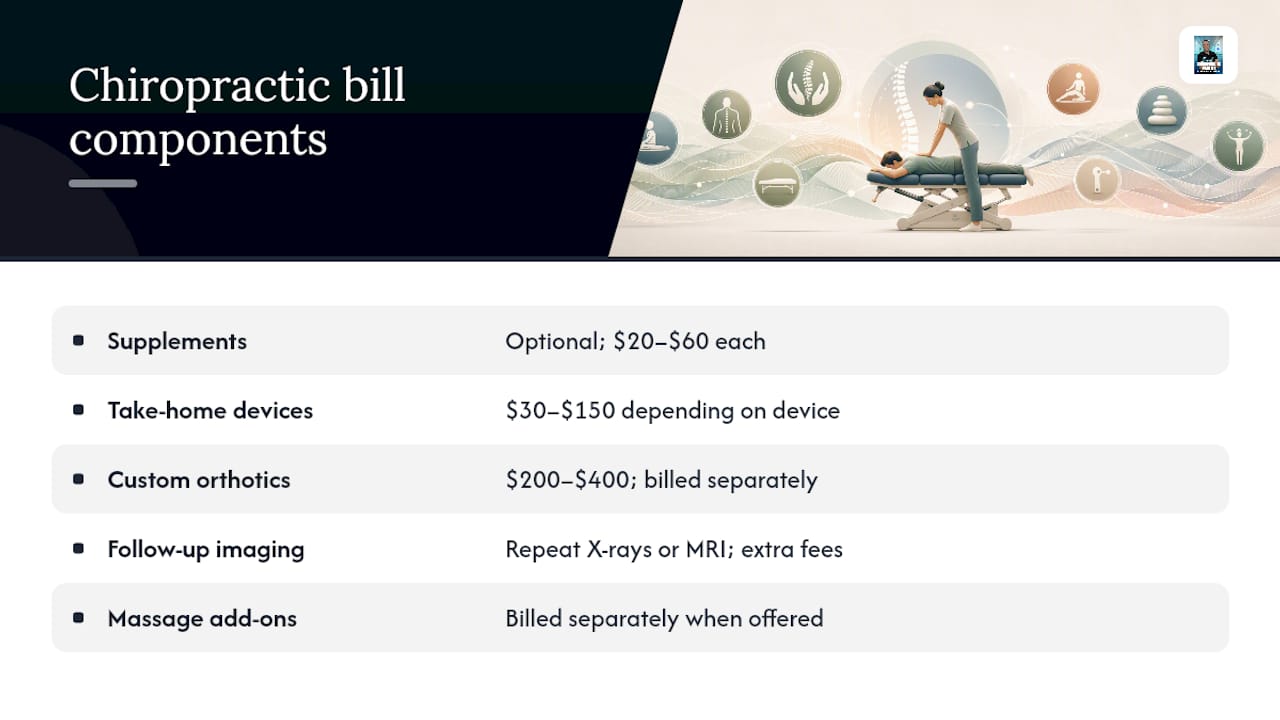
Supplements and nutritional products. Some chiropractors sell vitamins, protein powders, or anti-inflammatory supplements during your visit. These are almost always optional, and prices range widely, often $20 to $60 per product. You're never required to buy them to continue treatment.

Take-home devices. Lumbar support pillows, posture correctors, cervical traction devices, or TENS units sold for home use can add $30 to $150 to your total spending, depending on the device.

Custom orthotics. If a chiropractor recommends custom shoe inserts for gait or posture issues, expect a separate charge, often in the $200 to $400 range, billed apart from your regular visits.
Follow-up imaging. If your condition doesn't improve as expected, a clinic might recommend repeat X-rays or a referral for MRI, each carrying its own fee beyond the original imaging cost.
Massage or bodywork add-ons. Many clinics offer massage therapy as a paired service. It's billed separately from the adjustment itself, even when scheduled back to back.
None of these are automatically bad value. But they're also not automatically necessary. Before agreeing to anything beyond the adjustment itself, ask what problem it solves and whether a lower-cost alternative, like a stretching routine or complementary self-care approach, might address the same issue.
What This Guide Gets Right That Most Advice Misses
Most articles on chiropractic pricing hand you a single national average and call it done. That's not particularly useful when you're the one holding the bill, because averages hide the two things that actually determine your total cost: how many visits your condition needs, and whether the clinic's business model is built around cash patients or insurance claims.
The conventional advice, "shop around for the lowest price," undersells how much a clinic's structure matters more than its rate card. A cash-first practice with a transparent $25 promotional adjustment can beat an insurance-oriented clinic's "discounted self-pay rate" every time, because the entire cost structure was built differently from day one.
If you're paying out of pocket, prioritize two things before anything else: get an itemized estimate before your first visit, and ask how many visits the clinic expects before reassessing. Those two questions, more than any discount code or wellness plan, protect your wallet.
— Spark
Get Affordable Chiropractic Care in North Miami with Sparkmed
Sparkmed built its pricing for exactly the reader who just finished this article: someone paying cash who wants to know the real number before booking. Its $25 chiropractic adjustment offer removes the guessing game entirely, and its wellness plans give you a predictable monthly cost instead of a surprise bill after each visit.

If you're recovering from a car accident, work injury, or slip-and-fall in North Miami, Sparkmed also offers Uber Health transport and multilingual support in English, Spanish, and Creole, so getting to your appointment isn't another obstacle on top of the injury itself. Sparkmed's approach mirrors why self-pay adjustments make sense for many patients: transparent pricing, no insurance paperwork, and no waiting on claim approvals to start feeling better.
Visit Sparkmed's site to check current pricing and book your first adjustment.
This article is general information, not a substitute for advice from a qualified doctor. Consult a qualified healthcare professional about your own circumstances before acting on anything here.
Sources
- Chiropractic Treatment Costs — CareCredit
- NIH PMC article on chiropractic care and visit frequency
- How Much Does a Chiropractor Cost? (rates & hidden fees) — InsureHint