

You can book an effective, low-cost chiropractic adjustment today by choosing a cash/flat-fee clinic or a short package plan, asking three targeted questions before you confirm, and showing up prepared to avoid surprise charges. The fastest path: (1) pick your payment model, cash/flat-fee, package/membership, or insurance; (2) call or book online and ask what the first visit costs, what's included in the fee, and whether there are cancellation or add-on charges; (3) confirm what to bring so the clinician can proceed without ordering extra tests.
Cost anchors to keep in mind: follow-up adjustment visits in the U.S. typically run in a moderate to high-price range without insurance, while initial visits cost more because they include an intake exam. Sparkmed's advertised no-insurance adjustment in North Miami is a real example of what a cash/flat-fee promotional model looks like in practice. That price point exists because the clinic skips the insurance billing overhead entirely, which is exactly the kind of model worth targeting when you want to schedule budget adjustments without the runaround.
- Step 1: Choose cash/flat-fee, package/membership, or insurance billing.
- Step 2: Call or book online. Ask: (a) total cost for the first visit, (b) what's included, (c) cancellation/no-show fee.
- Step 3: Confirm what to bring (ID, any recent imaging, a one-sentence symptom goal) to avoid extra charges at the door.
Table of Contents
- What does a chiropractic adjustment actually cost in the U.S.?
- How do you find and book an affordable adjustment step by step?
- What payment options actually keep adjustments affordable?
- Where are you most likely to find genuinely low-cost adjustments?
- What should you bring to avoid surprise charges?
- When is a low-cost adjustment not the right call?
- Sparkmed: a recommended affordable option in North Miami
- Key Takeaways
- The real cost of not asking the right questions
- Ready to book your affordable adjustment at Sparkmed?
- Useful sources
What does a chiropractic adjustment actually cost in the U.S.?
The price gap between an initial visit and a follow-up is the first thing to understand. Initial visits cost more because they bundle a physical exam, health history intake, and sometimes X-rays into the fee. Follow-up visits are where the real scheduling leverage lives.
| Visit Type | Typical U.S. Range (no insurance) | Notes |
|---|---|---|
| Initial/first visit | Typically $70–$150 including exam, intake, possible imaging | Pricing reflects bundled services for new patients |
| Follow-up adjustment | Usually $40–$80 per visit, varies by region and clinic | Most common range across U.S. clinics |
| Promotional/cash-pay | Commonly $20–$50 introductory offers; no insurance required | Introductory rates for new patients only |
| Package/membership | Often $35–$60 per visit across multiple visits | Prepaid and membership discounts bring average per-visit cost lower |
Promotional pricing at relatively low rates is more common than most people realize. Clinics offer these rates because they eliminate insurance billing overhead, which can add significant administrative cost per claim. Sparkmed's $25 adjustment offer is a working example of this model in North Miami.
A few factors that push prices lower:
- Weekday midmorning slots tend to be cheaper at clinics that use demand-based pricing, where off-peak times carry a lower rate.
- Cash payment removes the billing layer entirely and often unlocks a discount the posted rate doesn't show.
- Package prepayment drops the per-visit cost by spreading clinic overhead across multiple confirmed appointments.
Stat to know: Follow-up chiropractic visits in the U.S. commonly fall in a moderate to higher price range without insurance, but promotional cash-pay models can bring rates down to much lower levels per visit.
How do you find and book an affordable adjustment step by step?
The search itself takes less time than most people expect. The bottleneck is usually knowing what to ask once you find a clinic.
Where to look first:
- Search for "cash-pay chiropractic" or "no-insurance chiropractic adjustment" plus your city. These terms surface clinics that have already opted out of insurance billing and typically post flat fees.
- Check clinic websites for a visible price list. Booking software like Amelia displays slot-level pricing directly in the booking form, so you can see cheaper time slots before you commit.
- Look for student clinics affiliated with chiropractic colleges in your area. Supervised student clinics charge significantly less than private practices.
- Community health centers and federally qualified health centers sometimes include chiropractic services on a sliding-scale fee.
- Use Google Calendar appointment pages that clinics publish. These pages often reveal available slots and, at clinics with demand-based pricing rules, lower-cost off-peak times show up directly.
The three-question booking script (copy this):
That's it. Three questions, one call. If the person on the phone can't answer all three clearly, ask to speak with the billing coordinator before you book.
Timing tips:
- Midweek mornings (Tuesday through Thursday, 9 AM–11 AM) are the lowest-demand windows at most clinics. Some use pricing rules tied to booking lead time and time slot, so booking 48–72 hours ahead in an off-peak window can reduce your rate.
- Avoid booking same-day if you want the lowest price. Last-minute slots at busy clinics sometimes carry a premium.
- For scheduling that supports consistency and long-term cost savings, anchor your appointments to a recurring time block in your week rather than booking ad hoc each time.
Before you hang up or confirm online, verify:
- Total out-the-door price for the first visit
- Whether X-rays are billed separately
- What the cancellation window is (24 hours is standard; missing it often costs $25–$50)
- Whether a package or membership is available and what it includes
Pro Tip: Ask specifically: "Do you have a first-visit discount or a package rate I can lock in today?" Clinics that use practice management software like Jane App can set patient-specific default discounts that apply automatically to every future visit once you're in the system. You won't get that rate unless you ask.

What payment options actually keep adjustments affordable?
Not all payment models save you the same amount. Here's how they compare in practice.
Payment categories:
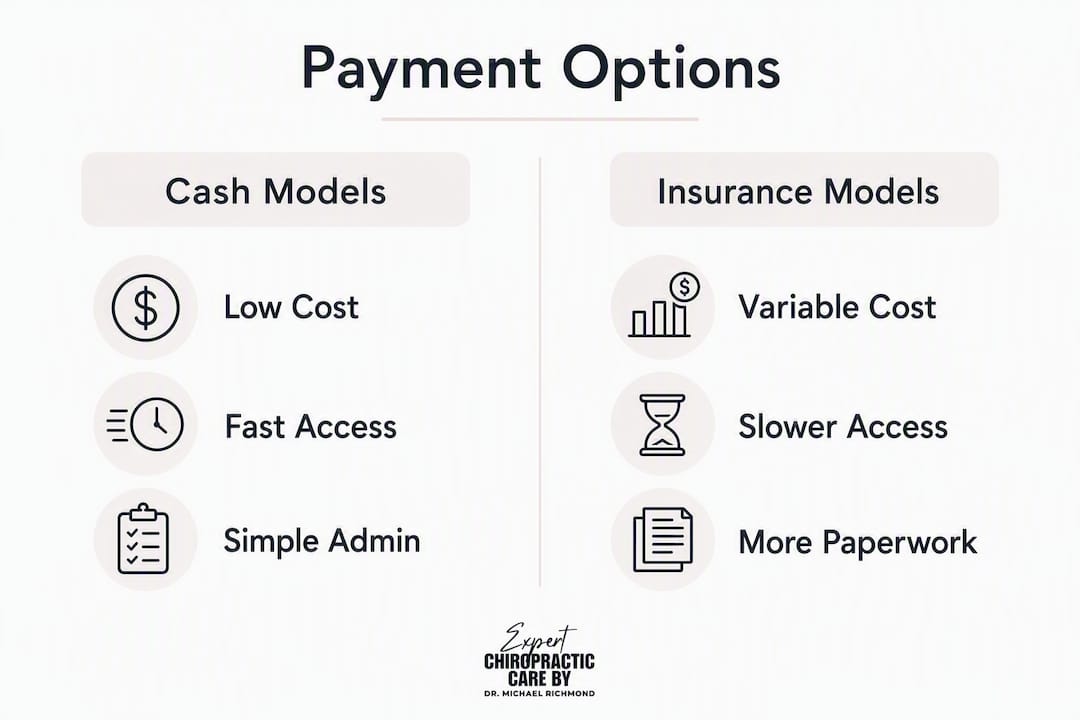
- Cash/flat-fee: Pay per visit at a posted rate. No insurance paperwork, no prior authorization, no waiting. Best for promotional pricing and one-off visits.
- Package/membership: Prepay for a block of visits (typically 6–12) at a reduced per-visit rate. Clinic software can lock in your discounted rate so it applies automatically each time.
- Sliding-scale/community clinics: Fee based on income. Requires documentation but can bring costs to $10–$30 per visit.
- Payment plans: Some private clinics split a treatment package into monthly installments. Ask whether interest applies.
- HSA/FSA: Chiropractic adjustments are an eligible expense under most Health Savings Account and Flexible Spending Account plans. Pay cash at the clinic and reimburse yourself tax-free.
- Insurance (copay/deductible model): Can be cost-effective if your plan covers chiropractic and your deductible is already met. Adds administrative steps and sometimes requires prior authorization.
| Payment Model | Typical Out-of-Pocket | Speed to Appointment | Admin Overhead | Best When |
|---|---|---|---|---|
| Cash/flat-fee | Typically $40–$80 per visit | Same day or next day | None | Promotional pricing; no insurance |
| Package/membership | Often $35–$60 per visit | Same day after purchase | Minimal | Regular care; multiple visits planned |
| Sliding scale | Typically $10–$30 per visit | Moderate wait times due to intake process | Moderate | Low income; community clinic available |
| HSA/FSA | Same as cash | Same as cash | Minimal | Tax-advantaged reimbursement |
| Insurance | Copay + deductible | 1–5 days (prior auth) | High | Deductible already met; plan covers chiro |
For transparent pricing that reduces overhead, cash-pay models consistently deliver the fastest access and the lowest administrative friction. The tradeoff is that you pay upfront rather than spreading cost through a claims process.
Pro Tip: Skip insurance billing for your first visit if a promotional cash rate is available. Pay out of pocket, keep your receipt, and submit it to your insurer as an out-of-network claim later if your plan allows it. You get the promotional price AND preserve the option to recover some cost. Ask the clinic for an itemized superbill at checkout.
Where are you most likely to find genuinely low-cost adjustments?
The highest-probability sources, roughly in order of how quickly you can access them:
- Cash/flat-fee clinics with posted promotional pricing: The fastest path. Sparkmed's $25 no-insurance adjustment in North Miami is one example. Search "[city] + cash chiropractic adjustment" to find comparable offers locally.
- Promotional introductory offers: Many clinics advertise a discounted first visit ($29–$49) to attract new patients. These are real offers, but confirm whether the exam fee is included or billed separately.
- Student chiropractic clinics: Attached to accredited chiropractic colleges. Supervised by licensed faculty. Fees are typically a fraction of private-practice rates.
- Community health centers: Federally Qualified Health Centers (FQHCs) offer sliding-scale fees based on income. Not all include chiropractic, but many do.
- Walk-in or urgent-care-style chiropractic clinics: Some clinics operate on a walk-in model with flat fees posted at the door. No appointment needed, no insurance required.
- Online booking platforms with slot-level pricing: Clinics using booking software that displays pricing by time slot let you choose the cheapest available window directly from the booking page.
Pro Tip: Before booking any promotional offer, ask one question: "Is the exam fee included in that price, or is it billed separately?" A $25 adjustment with a $75 mandatory new-patient exam is a $100 visit. The total out-the-door number is the only number that matters.
What should you bring to avoid surprise charges?
Preparation at home directly affects what happens at the front desk. Arriving without the right documents or with a vague complaint is one of the most common reasons first-visit costs run higher than expected.
Bring these:
- Photo ID and insurance card (even if you're paying cash, some clinics require ID for records)
- Any recent imaging (X-rays, MRI reports from the past 12–24 months) so the clinician doesn't need to order new ones
- A list of current medications and any relevant medical history
- A one-sentence symptom goal: "I have lower back pain on the left side that limits my ability to sit for more than 20 minutes." Patients who state a specific, concise goal typically avoid unnecessary diagnostic testing and keep first-visit costs lower.
Confirm before you arrive:
- Ask whether X-rays are included in the quoted fee or billed separately.
- Confirm the cancellation window and the no-show fee in writing (text or email).
- Ask whether the adjustment itself is included in the first-visit fee or whether the first visit is exam-only.
- Verify the clinic's payment methods (cash, card, HSA/FSA).
Simple prep steps at home:
- Avoid heavy exercise the morning of your appointment.
- Stay hydrated. Spinal tissue responds better when you're not dehydrated.
- Wear loose, comfortable clothing so the clinician can assess your posture and range of motion without asking you to change.
- Write down your top two or three symptoms and when they started. Specificity saves time and money.
For a deeper look at structuring your chiropractic visits for faster recovery, the treatment plan itself matters as much as the first appointment.

When is a low-cost adjustment not the right call?
Affordable care is the right choice for most routine musculoskeletal complaints. But there are situations where a quick, inexpensive adjustment is the wrong first move.
Stop and seek higher-level care immediately if you have:
- Progressive neurologic deficits: worsening numbness, tingling, or weakness in your arms or legs
- New severe weakness in a limb that appeared suddenly
- Loss of bladder or bowel control (possible cauda equina syndrome — this is an emergency)
- Suspected fracture: recent trauma, osteoporosis history, or severe localized pain after a fall
- Signs of infection: fever, night sweats, unexplained weight loss alongside spine pain
- Severe, unrelenting pain that does not change with position
- Symptoms following a high-impact accident where imaging has not yet been done
If any of these apply, ask the clinic to refer you to urgent care or an emergency department rather than proceeding with an adjustment. A responsible clinic will do this without hesitation.
Before you book any low-cost adjustment, a basic safety screen should happen. An inexpensive visit should never mean skipping the clinical intake that identifies contraindications. If a clinic skips the health history entirely and goes straight to the table, that's the real red flag.
For guidance on when chiropractic care is appropriate after an accident, the timing and type of injury matter significantly.
Sparkmed: a recommended affordable option in North Miami
Sparkmed, located in North Miami, is built around exactly the kind of transparent, accessible pricing this article describes. The clinic's advertised $25 chiropractic adjustment requires no insurance and no prior authorization. You pay a flat fee, you get the adjustment.
What Sparkmed offers that's worth noting:
- Multilingual support — in English, Spanish, and Creole, so the intake process is clear regardless of your primary language
Booking is straightforward. Visit the clinic's online booking page or call directly. Mention the $25 no-insurance adjustment when you book to confirm the promotional rate applies to your visit. The clinic handles accident recovery, work injuries, slip-and-fall cases, and general musculoskeletal pain, so the intake process is designed for a range of presentations. A clear online booking flow means you can confirm your slot, your price, and what to bring before you ever walk through the door.
Key Takeaways
Choosing a cash/flat-fee or package model and asking three specific questions before you book is the fastest, most reliable way to schedule affordable chiropractic adjustments without surprise charges.
| Point | Details |
|---|---|
| Choose your payment model first | Cash/flat-fee and package plans consistently deliver lower out-of-pocket costs than insurance billing for most routine visits. |
| Ask three questions before booking | Total first-visit cost, what's included, and the cancellation fee — get all three answered before confirming. |
| Confirm the out-the-door price | Promotional rates ($20–$50) can include hidden exam fees; always verify the total before you arrive. Most clinics charge $70–$150 for a first visit, while follow-ups range from $40–$80, but verifying the all-in fee avoids surprises. |
| Prepare a one-sentence symptom goal | A specific, concise complaint reduces unnecessary testing and keeps first-visit costs lower. |
| Sparkmed's $25 adjustment | Sparkmed in North Miami offers a $25 no-insurance adjustment with transparent pricing, multilingual support, and online booking. |
The real cost of not asking the right questions
Most people overpay for chiropractic care not because affordable options don't exist, but because they book without asking the three questions that matter. The promotional pricing is out there. The cash-pay models are real. The packages that drop your per-visit cost to $35–$60 are available at clinics that will never mention them unless you ask.
What patients consistently underestimate is the compounding value of consistency. A $25 adjustment you attend twice a week for six weeks costs less than a $150 visit you attend once and abandon because the price felt unsustainable. The clinics that build affordable care into their model, flat fees, no insurance overhead, transparent pricing, are doing something structurally different from the ones that bill insurance and post a rate nobody actually pays.
The other thing worth saying plainly: low cost does not mean low quality. The $25 adjustment at Sparkmed uses the same spinal manipulation techniques as a $150 visit elsewhere. The difference is the billing model, not the clinical skill. If you've been avoiding chiropractic care because you assumed it was out of reach financially, the cash-pay market in most U.S. cities has moved significantly in your direction.
Ready to book your affordable adjustment at Sparkmed?
Sparkmed makes the booking process as direct as the pricing. No insurance required, no lengthy intake forms before you can confirm a slot, and no surprise fees at checkout.
Here's how to secure your appointment: visit Sparkmed's booking page or call the clinic directly. When you reach the front desk, mention the $25 no-insurance adjustment to confirm the promotional rate. If you're interested in a wellness package for multiple visits at a reduced per-visit rate, ask about that at the same time. The clinic serves patients in English, Spanish, and Creole, and Uber Health transport is available if you need a ride. For additional cost-saving strategies specific to chiropractic care, the Sparkmed blog covers payment options, treatment timelines, and what to expect at each stage of recovery.
Useful sources
- Flexible Pricing for Appointments: How to Price by Demand — explains how slot-level and demand-based pricing works in appointment booking software.
- Price Adjustment Rules | Zenbooker Help Center — details how clinics configure pricing rules by time, territory, and lead time.
- Discounts and Price Adjustments | Jane App — covers how clinics set patient-specific default discounts and recurring membership pricing.
- Fit Wellness Visits Into Your Schedule | Evo Youthful — practical advice on scheduling consistency and reducing long-term care costs.
- Website Optimization for Healthcare | Klyr Media — covers how clear booking pages and visible pricing improve patient access to promotional rates.
For clinic-specific posts on payment options, visit frequency, and recovery timelines, the Sparkmed blog covers these topics in depth for North Miami patients.