

Patient testimonials in healthcare are firsthand accounts from patients that describe their care experience, and they are the single most persuasive trust signal a practice can publish. 78% of new patients report that positive testimonials significantly increase their likelihood to choose a practice. That number alone explains why healthcare administrators can no longer treat testimonials as a nice-to-have feature. The role of patient testimonials in healthcare spans trust building, patient engagement, local SEO, and regulatory compliance. This guide breaks down each dimension with the specificity that healthcare professionals need to act on it.
How do patient testimonials influence trust and patient engagement in healthcare?
Patient testimonials reduce fear and uncertainty by acting as social proof that bridges clinical claims and emotional safety. When a prospective patient reads that someone with a similar injury recovered through a specific treatment, anxiety drops and confidence rises. 63% of consumers trust real patient stories more than traditional advertising. That gap between storytelling and advertising is not a marketing preference. It reflects a fundamental difference in credibility.
Testimonials also humanize clinical services in a way that procedure descriptions cannot. A spinal adjustment sounds clinical in a brochure. The same procedure described by a patient who returned to work after a car accident sounds like a solution. Storytelling in healthcare marketing increases patient engagement and trust by giving prospective patients a recognizable human context for their own situation.

The practical impact on booking rates is measurable. Healthcare providers using patient reviews see 20%–40% higher booking rates compared to those without active review programs. Authentic patient content also improves website dwell time, which signals relevance to search engines and lifts organic rankings.
Key mechanisms that drive testimonial effectiveness:
- Peer validation: Patients trust other patients more than they trust providers on clinical outcomes.
- Specificity: Testimonials naming a condition, treatment, or location outperform vague praise.
- Recency: Fresh testimonials signal an active, attentive practice.
- Placement: Testimonials placed at key decision points on a website convert better than those buried in a dedicated reviews page.
Pro Tip: Capture testimonials immediately after a positive appointment. Point-of-service collection yields higher quality and quantity than delayed digital follow-up requests.
What are the benefits and challenges of using patient testimonials in healthcare marketing?
The benefits of testimonials in healthcare extend well beyond reputation management. Testimonials that include location names, treatment types, and condition descriptions contribute directly to local SEO. A testimonial mentioning "chiropractic care after a car accident in North Miami" functions as keyword-rich content that search engines index alongside your service pages. Strategic placement of testimonials at key decision points improves both conversion rates and local search visibility.
Testimonials also help practices overcome patient objections before the first call. A prospective patient who is nervous about a procedure reads that another patient felt comfortable and saw results. That story removes a barrier that no FAQ page can address. Practices managing patient feedback actively see 20%–40% higher conversion rates, and storytelling campaigns can boost conversions by up to 29%.
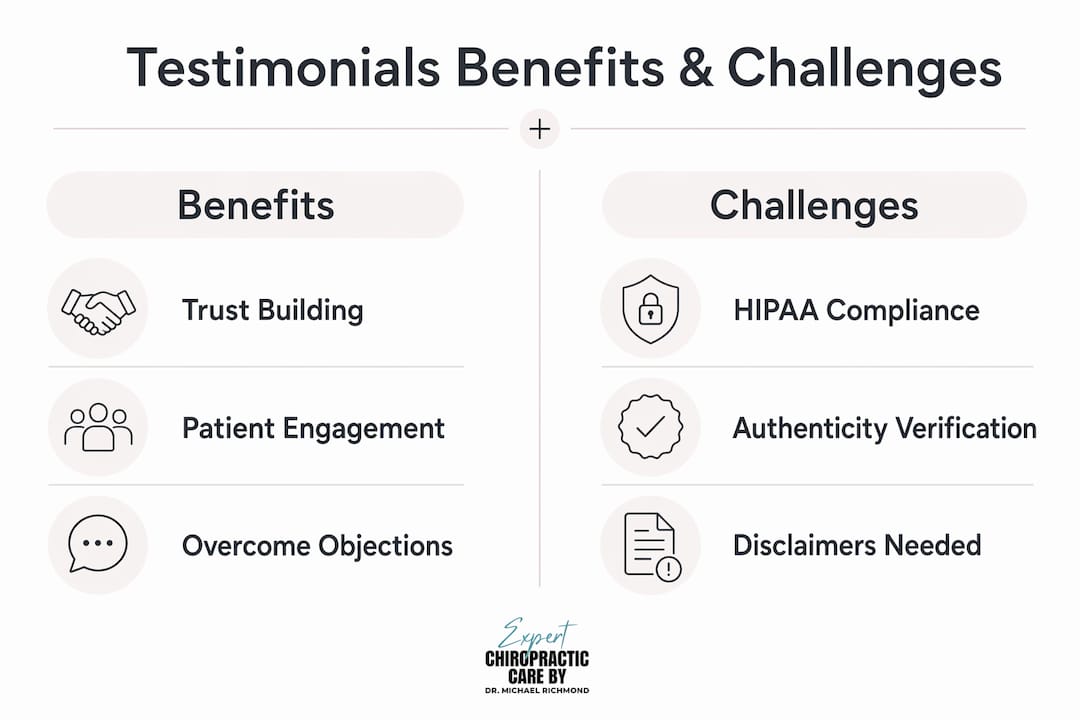
The challenges are real and carry legal weight. The FTC mandates that testimonials be truthful, typical, and clearly disclosed when any material connection exists. The FDA adds another layer: testimonials that imply a treatment cures or guarantees a specific outcome can trigger enforcement action.
Common pitfalls to avoid:
- The substantiation trap: A testimonial claiming "this treatment cured my chronic pain" implies medical effectiveness. That claim requires scientific evidence the practice likely cannot provide.
- Privacy breaches: Publishing a patient's name, photo, or identifiable details without written consent violates HIPAA.
- Incentivized testimonials without disclosure: Offering a discount for a review and not disclosing it violates FTC rules.
- Outcome language: Phrases like "I was completely healed" or "my condition disappeared" cross from experience sharing into clinical claims.
Pro Tip: Add a brief disclaimer beneath every testimonial: "Individual results vary. This reflects one patient's personal experience and is not a guarantee of outcomes." That single sentence separates experience narratives from clinical claims and reduces regulatory risk significantly.
How can healthcare providers collect and manage patient testimonials effectively and compliantly?
The first distinction every administrator needs to make is between a review and a testimonial. A review is a short, often unsolicited rating on Google, Healthgrades, or Yelp. A testimonial is a detailed, curated account that a practice actively requests, edits for clarity, and publishes on its own channels. That distinction matters because detailed testimonials require signed authorization under HIPAA when they reveal identifiable information.
A compliant testimonial collection process follows these steps:
- Request at the right moment. Ask immediately after a positive appointment, before the patient leaves the clinic or within 24 hours by text or email.
- Use a written consent form. The form should specify where the testimonial will appear, whether the patient's name and photo will be used, and that they can withdraw consent at any time.
- Separate experience from outcomes. Guide patients to describe how they felt, what the process was like, and how their daily life changed. Avoid prompts that lead to outcome claims.
- Add disclaimers at publication. Every testimonial on your website or social media should carry a disclaimer clarifying that results are individual.
- Maintain a consent archive. Store signed authorizations alongside the published testimonial. Audits and complaints require documentation.
| Collection method | Best use case | Compliance note |
|---|---|---|
| In-clinic verbal request with written follow-up | High-satisfaction patients post-appointment | Requires written consent before publishing |
| Automated email or SMS after visit | High volume practices | Must include opt-out and consent link |
| Video testimonial with signed release | Website and social media campaigns | Requires separate video release form |
| Google or Healthgrades review request | General reputation building | Reviews are public; no HIPAA authorization needed unless you respond with patient details |
Pro Tip: Integrate your consent form into your existing patient intake or discharge paperwork. Patients are already signing documents at that moment, and response rates are significantly higher than standalone requests sent days later.
Testimonials placed on individualized care pages perform better than those on generic review aggregators because they reach patients already researching a specific treatment. That context match increases conversion.
How do patient testimonials compare to other patient experience measurement tools?
Patient testimonials are qualitative narratives. Patient-reported experience measures, known as PREMs, are validated survey instruments that generate quantitative data across standardized dimensions like communication, wait times, and care coordination. Both tools measure patient experience, but they answer different questions.
PREMs tell you how many patients felt heard. Testimonials tell you why one patient felt heard and what that meant for their recovery. The Australian Commission on Safety and Quality in Health Care notes that positive patient experiences correlate with lower readmission rates and fewer complications. That finding validates the clinical relevance of patient experience data beyond marketing.
| Tool | Format | Primary use | Limitation |
|---|---|---|---|
| Patient testimonials | Narrative, qualitative | Trust building, marketing, SEO | Not statistically generalizable |
| PREMs | Structured survey, quantitative | Quality improvement, benchmarking | Lacks personal context and story |
| Patient interviews | In-depth qualitative | Research, service redesign | Time-intensive, small sample |
| Star ratings (Google, Healthgrades) | Numeric, aggregate | Reputation, search visibility | No clinical depth or specificity |
Testimonials reveal personal contexts that clinical data misses entirely. A patient who rates their experience 5 stars on Google and a patient who writes three paragraphs about recovering from a car accident and returning to their job are providing fundamentally different types of information. The narrative version is what converts a prospective patient who is in the same situation.
The most effective practices use both tools. PREMs drive internal quality improvement. Testimonials drive external trust and patient acquisition. Treating them as substitutes misses the distinct value each provides. Reviewing chiropractic patient testimonials alongside structured feedback gives administrators a complete picture of patient experience.
Key Takeaways
Patient testimonials are the most credible trust signal in healthcare marketing, and their impact on booking rates, SEO, and patient engagement is measurable and well-documented.
| Point | Details |
|---|---|
| Trust and conversion | 78% of new patients are more likely to choose a practice with positive testimonials. |
| Compliance is non-negotiable | HIPAA authorization and FTC disclosure rules apply to all published testimonials. |
| Collect at point of service | Immediate post-appointment requests yield higher quality and more detailed testimonials. |
| Separate experience from outcomes | Disclaimers and careful language prevent the substantiation trap and FDA risk. |
| Testimonials complement PREMs | Use narratives for marketing and structured surveys for internal quality improvement. |
What I've learned about testimonials that most healthcare guides get wrong
Most articles on this topic treat testimonials as a marketing checkbox. Collect a few, post them on your website, done. That approach misses the deeper function testimonials serve in a clinical setting.
The practices I've seen build genuine trust through testimonials share one habit: they treat the collection process as part of patient care, not as a marketing task. When a staff member asks a patient how they're feeling at discharge and then says, "Would you be willing to share that story so other patients know what to expect?", the request feels natural. It honors the patient's experience rather than extracting it for promotional use.
The compliance piece is where I see the most avoidable mistakes. Administrators often assume that because a patient volunteered a positive comment, it's safe to publish. The moment you add a name, a photo, or a specific condition to that comment, HIPAA applies. The consent form is not bureaucracy. It protects both the patient and the practice.
My honest view: the practices that will build the strongest reputations over the next five years are those that create a continuous feedback loop. Collect testimonials. Use PREMs to identify service gaps. Feed those insights back into care delivery. Then collect more testimonials. That cycle turns patient experience data into a genuine competitive advantage, not just a marketing asset.
— Spark
Sparkmed's approach to patient testimonials and trust
Sparkmed works with patients in North Miami who are recovering from car accidents and seeking chiropractic care. Patient stories are central to how Sparkmed communicates the real impact of its treatments, from spinal adjustments to personalized wellness plans.
Sparkmed publishes patient testimonials with full attention to HIPAA compliance and FTC disclosure standards, so every story on the site reflects a genuine, authorized account. Healthcare professionals looking to understand how a patient-centered practice builds trust through authentic feedback can explore Sparkmed's patient resources for a practical example of compliant, effective testimonial use. The goal is not volume of reviews. It is the right stories, told honestly, placed where prospective patients need them most.
FAQ
What is the role of patient testimonials in healthcare?
Patient testimonials build trust by providing authentic social proof that helps prospective patients make informed care decisions. They humanize clinical services and directly influence booking rates and practice growth.
Are patient testimonials subject to HIPAA?
Yes. Detailed testimonials that include identifiable patient information require signed HIPAA authorization before a practice can publish them. Short, anonymous reviews on public platforms like Google do not require authorization.
How do testimonials differ from patient reviews?
Reviews are short, unsolicited ratings posted on third-party platforms like Google or Healthgrades. Testimonials are detailed, curated accounts that a practice actively requests and publishes on its own channels, requiring consent and compliance steps.
What is the substantiation trap in healthcare testimonials?
The substantiation trap occurs when a testimonial implies that a treatment cures or guarantees a specific medical outcome. That claim requires scientific evidence, and publishing it without evidence creates FTC and FDA compliance risk.
When is the best time to request a patient testimonial?
The best time is immediately after a positive appointment, either in person at discharge or within 24 hours by text or email. Point-of-service requests consistently yield higher response rates and more detailed accounts than delayed follow-ups.