

If you've been dealing with chronic pain and found that chiropractic adjustments brought only short-term relief, the problem likely wasn't chiropractic care itself. It was the absence of a plan built around you. Why choose individualized chiropractic care over a generic protocol? Because your body, history, and pain patterns are unlike anyone else's, and research confirms that treating them that way produces measurably better results. This article breaks down what personalized chiropractic care actually looks like, what the clinical evidence says, and how you can make sure you're getting the kind of care that moves the needle on your recovery.
Table of Contents
- Key takeaways
- Why individualized chiropractic care is different
- What the research says about personalized chiropractic
- Personalized care vs. generic protocols
- How to find and engage truly personalized care
- My perspective on what individualized care really means
- Continue learning with Sparkmed
- FAQ
Key takeaways
| Point | Details |
|---|---|
| Personalization drives better outcomes | Patient selection and tailored interventions consistently improve spinal therapy results compared to standard protocols. |
| Plans evolve with your progress | Effective individualized care shifts from symptom relief to mobility, then to self-management coaching as you improve. |
| Combined approaches outperform adjustments alone | Pairing spinal manipulation with self-management coaching reduces disability more than manipulation by itself. |
| Evidence backs the approach | EBCC (evidence-based chiropractic care) integrates research, clinical expertise, and your preferences into every decision. |
| You play an active role | Patients who communicate goals and progress help clinicians adapt plans, producing faster and more durable recovery. |
Why individualized chiropractic care is different
Most people picture chiropractic care as a chiropractor performing the same neck or back adjustment on every patient who walks through the door. That picture is outdated, and it explains why some patients plateau early. What is individualized chiropractic, at its core? It's a structured process where your specific condition, history, lifestyle, and goals shape every clinical decision made on your behalf.
Here's how a well-designed individualized plan actually comes together:
-
Comprehensive intake and history review. Before any hands-on work begins, a thorough medical history is collected. Previous injuries, medications, surgical history, and lifestyle factors all inform which interventions are safe and appropriate for you specifically.
-
Physical examination and diagnostic testing. Range of motion, neurological testing, and posture analysis identify the root cause of your pain rather than just its location. Imaging may be ordered when clinically indicated, because treating a disc herniation and treating muscle tension require entirely different approaches.
-
Customized intervention selection. Chiropractic care tailored to you might include spinal adjustments, soft tissue work, corrective exercises, posture coaching, or a combination. No two plans look alike because no two patients present identically.
-
Scheduled frequency and duration benchmarks. A personalized plan defines how often you'll be seen and for how long, with specific milestones built in. This prevents indefinite sessions with no measurable progress.
-
Re-evaluation checkpoints. Treatment plan checkpoints are used to decide whether to continue, modify, or escalate interventions based on your actual response. This data-driven approach replaces guesswork with evidence.
Pro Tip: At your first appointment, ask your chiropractor to explain the specific goals for your plan and when your first re-evaluation will happen. If they can't answer that clearly, it's a signal the plan may not be truly individualized.
What the research says about personalized chiropractic
The evidence supporting individualized chiropractic care is more specific than most people realize. It doesn't just say "chiropractic works." It specifies when it works, for whom, and under what conditions.
A VA evidence review found that patient selection and tailoring are the primary variables that make spinal manipulative therapy outcomes more consistent. In other words, the same technique applied to the wrong patient at the wrong stage produces poor results. Applied to the right patient with the right support? The results improve significantly.
The PACBACK randomized clinical trial published in JAMA found that self-management with spinal manipulation produced better disability outcomes than spinal manipulation alone. That finding matters because it tells us that the adjustment is only part of the equation. Without coaching and patient education woven into the plan, results are consistently weaker.
A secondary analysis of a pragmatic clinical trial involving U.S. military personnel found that adding chiropractic to standard medical care led to meaningful improvement in sleep, physical function, and social function at 52 weeks. Not just less pain, but broader life improvements over time.
"Evidence-based chiropractic care rests on three pillars: research evidence, clinical expertise, and patient preferences. All three must be present for care to be truly individualized." — Ontario Chiropractic Association EBCC Framework
What does this mean practically? A few things worth paying attention to:
- Spinal manipulation alone, without individualized context, produces inconsistent and often temporary results
- The EBCC framework treats personalization as a clinical standard, not a marketing feature
- Long-term outcomes often span multiple health domains, requiring the plan to adapt as your condition changes
- Shared decision-making, where you and your chiropractor agree on goals and approaches, is itself a clinical variable that improves outcomes
Personalized care vs. generic protocols
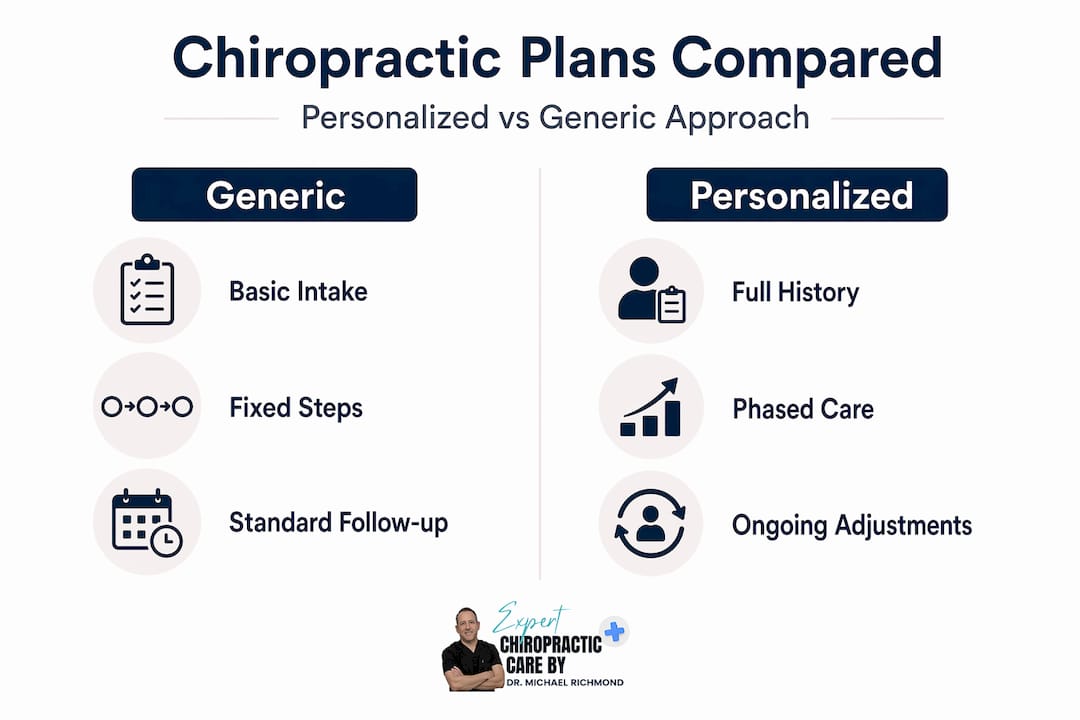
Here's a direct comparison that illustrates why the customized chiropractic treatment approach produces different results than a standardized one.
| Feature | Generic protocol | Individualized plan |
|---|---|---|
| Assessment depth | Basic intake | Full history, exam, and diagnostics |
| Intervention selection | Fixed technique set | Selected based on condition and response |
| Goal setting | General ("reduce pain") | Specific, measurable milestones |
| Comorbidity consideration | Rarely addressed | Integrated into plan design |
| Plan evolution | Static | Adjusted at re-evaluation checkpoints |
| Patient education | Minimal | Built into every phase of care |
| Long-term focus | Symptom management | Function, mobility, and self-management |
Generic protocols exist because they're operationally efficient. But follow-up and plan adjustments are precisely what separate patients who recover fully from those who cycle in and out of pain relief without lasting progress.
One of the most meaningful differences involves phased care. An individualized plan typically moves through distinct stages: early focus on reducing acute symptoms and restoring basic mobility, followed by building strength and endurance, then transitioning to self-management coaching and maintenance. This phased model reflects what the evidence recommends and what patients actually need as they heal.
Comorbidities also change the picture entirely. A patient managing diabetes alongside a lumbar disc issue needs a different activity progression than a healthy 30-year-old with the same disc finding. Individualized care accounts for that. Generic protocols generally don't.
Pro Tip: Ask your provider whether your plan will shift focus as your pain decreases. A plan that stays the same from visit one through visit twenty is not responding to your progress. That's a red flag worth raising.
How to find and engage truly personalized care
Knowing why personalized care matters is one thing. Knowing how to identify it and advocate for yourself is another. Here's what to look for and ask.
-
Expect a thorough first visit. Your initial assessment should include a health history review, physical examination, and a discussion of your specific goals. If your first appointment is mostly adjustments with minimal intake, the plan that follows may not reflect your actual condition.
-
Ask about measurable goals. A plan should specify what success looks like: reduced pain by a certain percentage, restored range of motion, return to a specific activity. Vague goals produce vague results.
-
Expect education, not just treatment. Plans that include self-management and patient education components consistently outperform those that don't. You should leave appointments knowing what to do between visits, not just how you felt during them.
-
Know when a referral is appropriate. Good chiropractors recognize when a condition exceeds chiropractic scope and refer accordingly. If red flags like severe neurological symptoms, unexplained weight loss, or bladder dysfunction are present, imaging and specialist evaluation should happen before or alongside chiropractic care.
-
Give ongoing feedback. Your responses between visits are clinical data. If something isn't working, say so. Clinicians using a genuinely individualized model want that information because it informs their next decision.
-
Watch for indefinite scheduling. Effective individualized care avoids open-ended treatment without defined endpoints. If no re-evaluation is ever scheduled and the plan never changes, it's not truly personalized.
My perspective on what individualized care really means
I've seen a lot of patients arrive after months of generic chiropractic treatment that left them frustrated and skeptical. And I understand why. When care doesn't account for your history, your movement patterns, or your goals, the results feel arbitrary. Because they are.
What I've learned is that the word "individualized" gets used loosely. For it to mean something, the plan has to include education and self-management from the start, not just adjustments. It has to have real checkpoints where someone asks: is this working, and what does the data say? And it has to shift over time as you improve.
The patients I've seen make the most durable progress are the ones who understood that chiropractic care built around their goals isn't just about feeling better after an appointment. It's about building toward a point where they need less care, not more. That shift in mindset changes everything. If your current plan doesn't seem to be heading anywhere specific, it's worth asking why.
— Spark
Continue learning with Sparkmed

Living with chronic pain means every decision about your care matters. Sparkmed publishes in-depth resources designed specifically for people navigating chiropractic care, injury recovery, and long-term wellness. Whether you're trying to understand what your treatment plan should include, how to track your progress, or what questions to ask at your next appointment, the Sparkmed blog covers it with the same evidence-based depth this article does. From assessment guides to long-term wellness strategies, these resources are built to help you make informed decisions at every stage of your recovery. Explore the blog and take your next step with clarity.
FAQ
What is individualized chiropractic care?
Individualized chiropractic care is a patient-specific treatment approach that combines clinical assessment, diagnostic findings, and patient goals to build a structured plan with defined interventions, timelines, and measurable outcomes. It evolves over time based on your progress and response.
Why does personalization improve chiropractic outcomes?
Patient selection and tailoring are the key variables that make spinal manipulative therapy produce consistent results. Without personalization, the same technique applied to different patients produces unpredictably different outcomes.
Is chiropractic care more effective when combined with coaching?
Yes. The PACBACK trial found that clinician-supported self-management combined with spinal manipulation reduced disability more than manipulation alone, confirming that education and coaching are not optional add-ons but core components of effective care.
How long does an individualized chiropractic plan usually take?
Duration depends on your condition, goals, and response to treatment. Most well-structured plans include re-evaluation checkpoints every four to six weeks, with total duration typically ranging from six weeks to several months depending on complexity and progress.
What should I ask to make sure my care is truly personalized?
Ask your chiropractor to explain your specific diagnosis, the measurable goals of your plan, when your first re-evaluation is scheduled, and what role self-management will play in your recovery. Clear answers to those four questions indicate a genuinely individualized approach.