

Yes, jaw pain after a car accident can signal a TMJ injury, and it deserves the same urgency as any other collision injury. Whiplash forces and direct blows to the face or jaw both stress the temporomandibular joint. See a doctor promptly, describe the jaw symptoms specifically, and start a written record now. A systematic review and meta-analysis found TMD pain in nearly 19% of people in the acute phase after whiplash, and some clinics offer an accessible first stop for that early exam.
TL;DR:
- Immediate evaluation at an emergency room is crucial if you experience jaw impact or swelling, especially if you hit the steering wheel, dashboard, or airbags deployed near your face.
- Symptoms of TMJ injury can appear delayed by days, weeks, or even a year after the crash, making ongoing monitoring and follow-up essential.
- Most TMJ injuries respond well to conservative treatments such as rest, anti-inflammatories, jaw exercises, and physical therapy, with surgery being a last resort.
- Severe signs like uncontrollable bleeding, apparent jaw deformity, or nerve numbness require urgent emergency care without delay.
- Documenting symptoms, taking photos, and keeping a detailed log from the day of the crash helps protect insurance claims and guides timely medical intervention.
Table of Contents
- What Should You Do First After a Crash if Your Jaw Hurts?
- What Are the Warning Signs of a TMJ Injury?
- How Does a Car Accident Actually Injure the Jaw Joint?
- How Do Doctors Diagnose TMJ Problems After a Crash?
- What Treatments Actually Help TMJ Pain After a Crash?
- How Some Clinics Approach Post-Accident TMJ and Jaw Pain
- How Long Does TMJ Pain Last After a Car Accident?
- What Should You Know About Insurance and Documentation for TMJ Claims?
- When Is Jaw Pain After a Crash a Medical Emergency?
- A Clinician's Note on Post-Crash Jaw Pain
- Get a Jaw and Neck Evaluation After Your Accident
- Sources
What Should You Do First After a Crash if Your Jaw Hurts?
Jaw pain rarely tops the priority list at the scene of a crash. Adrenaline is flooding your system, and a bruised knee or a stiff neck usually shouts louder than a sore jaw joint. That is exactly why so many TMJ injuries after car accidents get missed in the first 24 to 48 hours.
Here is the order that protects both your health and your ability to prove what happened later.
- Get checked at the ER or urgent care the same day, especially if you hit the steering wheel, dashboard, or an airbag deployed near your face. Ask specifically for a jaw and bite assessment, not just a general trauma screen.
- See a primary care doctor or chiropractic clinic within the first week even if the ER cleared you, since many TMJ symptoms surface after the initial swelling and shock subside.
- Photograph any visible swelling, bruising, or asymmetry the day of the crash and again over the following week, with a timestamp visible in the shot.
- Write a short symptom log daily: jaw clicking, difficulty chewing, ear pain, headaches, and how wide you can open your mouth.
- Collect witness names and contact information at the scene if anyone saw the impact direction, since that detail later helps explain why the jaw absorbed force.
- Switch to a soft diet for the first one to two weeks, use ice for the first 48 hours and heat afterward, and take over-the-counter analgesics as directed on the label.
- Bring your accident report, ER discharge papers, and symptom log to every follow-up appointment so each provider is working from the same timeline.
Pro Tip: Take a short video of yourself opening and closing your mouth the day after the crash. It sounds unnecessary until you need to show a clinician or an insurance adjuster exactly how limited your movement was three weeks in, compared to day one.
Avoid hard chewing, wide yawning, and nail biting during this window. Small mechanical stresses on an already inflamed joint tend to slow healing more than most people expect.
What Are the Warning Signs of a TMJ Injury?
Jaw pain is the obvious symptom, but it is rarely the only one. Post-traumatic TMJ disorder tends to travel with a cluster of related complaints that people often chalk up to separate problems.
- Jaw pain or tenderness, especially with chewing or talking
- Clicking, popping, or grinding sounds when opening or closing the mouth
- Jaw locking, either open or closed
- Ear pain or a feeling of fullness, often mistaken for an ear infection
- Headaches, particularly at the temples or behind the eyes
- A bite that suddenly feels different, or teeth that no longer meet the way they used to
- Neck pain or stiffness alongside jaw symptoms
One detail catches most people off guard: TMJ symptoms after a crash often show up late. A scoping review for Canadian dental professionals found onset can be delayed by days, weeks, or even up to a year after the collision, which is why clinicians recommend monitoring well beyond the initial recovery period. Adrenaline and more visible injuries mask jaw problems in the first days; inflammation and muscle guarding reveal them later, so a clean exam on day one doesn't rule out TMJ trouble developing afterward.
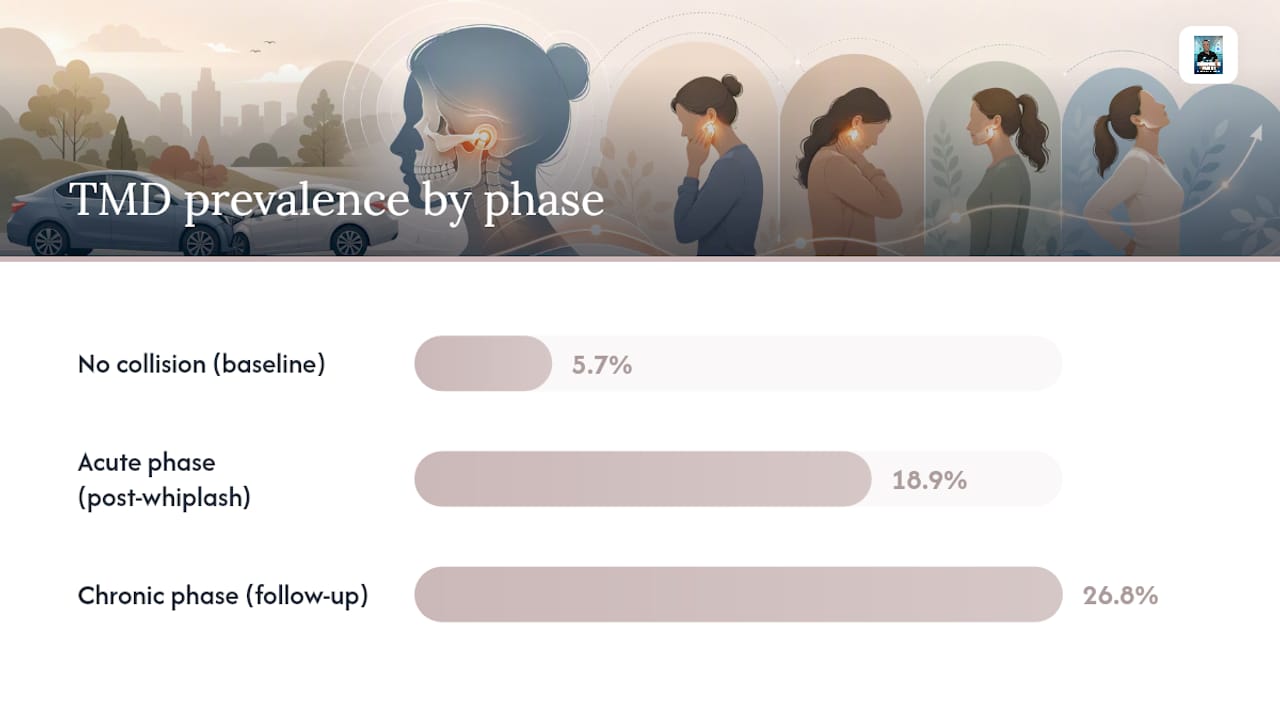
That prevalence gap is worth sitting with. The same meta-analysis referenced above found TMD pain prevalence climbs from 18.9% acutely to 26.8% in people tracked long term after whiplash, against a 5.7% baseline in people who weren't in a crash. Symptoms are not just showing up more; they are staying longer for a meaningful share of patients.
Some signs mean stop waiting and go straight to urgent or emergency care: severe facial swelling that is getting worse, visible jaw misalignment, numbness in the face or lips, or pain so severe it is not responding to basic care. Those are outlined in more detail further down.
How Does a Car Accident Actually Injure the Jaw Joint?
The TMJ sits at the hinge of your jaw, just in front of your ear, and it is more vulnerable in a crash than most people assume. Several distinct mechanisms can damage it, sometimes stacking on top of each other in a single collision.
- Whiplash and the craniocervical connection: the same rapid neck extension and flexion that strains cervical muscles also pulls on the muscles and ligaments that stabilize the jaw. A narrative literature review found moderate evidence that whiplash raises the risk of developing TMD, and patients with whiplash-related TMJ problems tend to show more limited jaw opening and more muscle tenderness than people with TMJ issues from other causes.
- Direct trauma: a blow from the steering wheel, dashboard, side window, or an aggressively deploying airbag can strike the jaw directly, or force the teeth together hard enough to jolt the joint itself.
- Intraoral impact: biting down hard on the tongue or cheek during the crash, or clenching reflexively at the moment of impact, transfers force through the jaw in a way that can strain the joint capsule.
- Muscle guarding and referred pain: the body tenses reflexively after trauma, and jaw muscles that clench in response to neck pain can develop their own dysfunction over time, sometimes described as a form of central sensitization.
A 2026 literature review on whiplash and TMJ function points to functional and neurophysiological mechanisms linking neck injury to jaw dysfunction, not just mechanical force at the moment of impact. That is part of why jaw pain and neck pain so often arrive together after a crash rather than as isolated complaints.
Certain factors raise the odds of a TMJ injury or slow recovery: how severe the impact was, whether the headrest was properly positioned, and whether you had any TMJ symptoms before the crash. Women are also more frequently affected by TMJ disorders generally, a pattern that holds true in post-traumatic cases as well.
How Do Doctors Diagnose TMJ Problems After a Crash?
A TMJ exam is more hands-on than most people expect. Clinicians rely primarily on physical assessment, not imaging, to make the initial diagnosis.
- Palpation of the jaw muscles and the joint itself to locate tenderness
- Range-of-motion measurement, tracking how many millimeters you can open your mouth and whether that movement is straight or deviates to one side
- Listening for joint sounds, including clicking, popping, or grinding during movement
- Bite assessment, checking whether your teeth meet the way they did before the accident
These are standard components of a TMD-focused clinical exam, and they can usually be done in a single visit.
Imaging enters the picture selectively. MRI is useful when a clinician suspects disc displacement or soft-tissue damage inside the joint; CT is reserved for suspected fractures. Here is the part that surprises a lot of patients: MRI findings of disc displacement show up in some people with no symptoms at all, so an image alone cannot prove the crash caused your specific pain. It has to be paired with the exam findings and a clear timeline connecting the accident to when symptoms started.
That timeline is exactly why getting checked early matters beyond just feeling better sooner. A baseline exam close to the crash date, even a normal one, becomes the reference point every later comparison gets measured against. Without it, a clinician evaluating you three months later has no way to know how much has changed.
What Treatments Actually Help TMJ Pain After a Crash?
Treatment for post-accident TMJ almost always starts conservative, and for good reason: most cases respond to non-invasive care without ever needing a procedure.
First-line care typically includes:
- Resting the jaw and sticking to a soft diet for the first several weeks
- NSAIDs or other prescribed anti-inflammatories to reduce swelling and pain
- Targeted jaw exercises to restore range of motion gradually
- Physical therapy or chiropractic care aimed at the neck and jaw together, since the two are so often linked
- Occlusal splints or night guards fitted by a dentist to reduce clenching and joint strain
Mayo Clinic's overview of TMJ symptoms and causes backs this conservative-first approach, and Cleveland Clinic's guidance on TMD lays out a similar escalation path when initial care isn't enough.
Pro Tip: If your jaw and neck both hurt, treat them as one problem, not two. Chiropractic care that addresses cervical alignment alongside jaw-focused exercises tends to outperform jaw-only treatment, because the muscles supporting both structures overlap more than people realize.
When conservative care stalls, a dentist or oral surgeon may step in with occlusal therapy, custom splints, or a more detailed bite evaluation. This is also the point where interventional options get discussed: arthrocentesis (flushing the joint with fluid to reduce inflammation), corticosteroid injections, or, in select clinical trials, botulinum toxin injections to relax overactive jaw muscles. These sit a step above physical therapy but well below surgery.

Surgery is the last resort, reserved for cases involving an actual jaw fracture requiring open reduction and internal fixation, or refractory internal derangement that hasn't responded to months of conservative and interventional treatment. Most patients never reach this stage. The whiplash pain recovery guide covers complementary self-care steps that pair well with in-clinic treatment during this recovery window.
How Some Clinics Approach Post-Accident TMJ and Jaw Pain
Sparkmed treats jaw pain after a crash as part of the same evaluation as neck and spine injuries, not as an afterthought. That matters because so many TMJ symptoms trace back to the same whiplash mechanism causing the neck pain that usually brings someone in the door first.
A typical first visit includes:
- A focused exam of the jaw and cervical spine together, checking range of motion, tenderness, and joint sounds
- Functional testing to see how the neck and jaw move as a unit, since compensating for one often strains the other
- Rapid referral to imaging or to a dental or oral surgery specialist if the exam turns up red flags like suspected fracture or severe internal joint damage
For most patients, treatment starts with manual therapy and targeted exercises rather than anything invasive. If a splint or occlusal appliance seems like the better fit, Sparkmed coordinates that referral rather than making the patient figure out where to go next on their own. The chiropractic tips guide for post-accident recovery walks through what that first-visit process tends to look like in practice.
Cost and access shouldn't be the reason someone skips an early exam. Sparkmed's North Miami clinic offers an affordable initial chiropractic adjustment that does not require insurance, along with multilingual support in English, Spanish, and Creole, so language isn't a barrier to getting checked quickly after a crash.
How Long Does TMJ Pain Last After a Car Accident?
Recovery timelines vary more than most patients expect going in. Some jaw pain resolves in a few weeks with conservative care. Other cases settle into a longer pattern that takes months to fully clear, and a smaller group develops symptoms that persist well past the six-month mark.
The prevalence numbers explain part of that spread. The same meta-analysis on TMD after whiplash trauma found mean TMD pain prevalence of 18.9% in the acute phase and 26.8% among people followed into the chronic phase, compared with 5.7% in people who hadn't been in a collision. Symptoms are not just common right after a crash; a meaningful share of people are still dealing with them later.
Several factors tend to predict a longer road: how severe the initial impact was, whether treatment started early or was delayed, and whether TMJ symptoms existed before the accident at all. Delayed onset plays a role here too, since symptoms that surface weeks after the crash sometimes get missed in early follow-up and go untreated longer than symptoms present from day one.
The practical takeaway is monitoring, not just initial treatment. Because onset can lag behind the accident by weeks or longer, a single clean exam right after the crash isn't the end of the conversation. Follow-up checks over the following months catch the cases that develop slowly, before they become harder to treat. The step-by-step whiplash recovery guide breaks down what that longer monitoring window typically looks like alongside neck injury recovery.
What Should You Know About Insurance and Documentation for TMJ Claims?
Insurance adjusters look for gaps, and jaw injuries are especially easy to under-document if you're not paying attention early on. A consistent paper trail from the day of the crash forward does more to protect your claim than almost anything else you can control.
- Get evaluated quickly and go back for follow-ups, since delayed treatment is one of the most common reasons insurers push back on jaw injury claims.
- Keep copies of every record: ER notes, imaging reports, referral letters, and receipts for splints, physical therapy, or procedures.
- Ask each provider for referral notes that explicitly connect your jaw symptoms to the accident, not just a general injury description.
- Track costs as they come in, since TMJ care can involve imaging, splint fabrication, physical therapy sessions, and occasionally interventional procedures, and insurers want an itemized picture, not a lump estimate.
- Disclose any prior TMJ history honestly, since insurers commonly flag pre-existing conditions, and an honest, documented distinction between old and new symptoms holds up better than an omission that surfaces later.
A practical overview of jaw injury claims notes that settlement value varies widely depending on severity and documentation quality, which is exactly why the record-keeping habit matters more than any single form you fill out. This is general information, not legal advice specific to your case; an attorney familiar with your state's rules can speak to what your documentation actually supports.
When Is Jaw Pain After a Crash a Medical Emergency?
Most TMJ symptoms after a crash are urgent, not emergencies. But a few signs mean you skip the wait-and-see approach entirely.
- Visible jaw deformity or a jaw that looks noticeably out of alignment
- Uncontrolled bleeding from the mouth or face
- Any difficulty breathing or a sense that your airway feels blocked
- Numbness or tingling across the face, which can point to nerve involvement
- Complete inability to open or close your mouth
- Severe, escalating pain that isn't responding to basic care at home
If you notice any of these, go to the emergency room or call emergency services. Do not wait for a scheduled appointment.
A Clinician's Note on Post-Crash Jaw Pain
Most jaw pain we see after a crash follows a similar arc: it starts quiet, gets dismissed as "just soreness," and then either fades on its own or turns into something that needed treatment three weeks earlier than the patient sought it. The prevalence numbers back that pattern up. Nearly one in five people has measurable TMD pain in the acute phase after whiplash, and more than one in four still has it if you check back later.
What we push patients toward isn't complicated: get the exam early, even if the pain feels minor, and keep a record of how things change week to week. That record does two things at once. It helps a clinician catch a slow-developing problem before it hardens into a chronic one, and it gives you something concrete if you ever need to explain what happened to an insurer. Waiting rarely costs nothing. It usually costs the easier version of recovery.
— Spark
Get a Jaw and Neck Evaluation After Your Accident
Sparkmed's North Miami clinic gives you a direct path to that early exam without the cost barrier that keeps people waiting. The initial chiropractic adjustment is priced at $25 with no insurance required, so you can get your jaw and neck checked within days of the crash instead of weeks.
A visit typically covers a focused exam of your jaw and cervical spine, functional testing to see how the two are working together, and a referral to imaging or a dental specialist if anything in the exam warrants it. Bring your accident report, any ER paperwork, and the symptom log you've been keeping since the crash. Multilingual support in English, Spanish, and Creole means language never has to slow down the process, and Uber Health transport is available if getting to the clinic is a barrier on its own.
Explore the full range of post-accident chiropractic services Sparkmed offers, and book an appointment while your symptoms and timeline are still fresh enough to document clearly.
Sources
The prevalence figures and clinical guidance in this article draw from a small set of sources worth knowing by name. The systematic review and meta-analysis on TMD after whiplash supplies the acute and chronic prevalence percentages. The narrative literature review on whiplash and TMJ and the 2026 literature review on whiplash's impact on TMJ function explain the underlying mechanisms. Mayo Clinic and Cleveland Clinic provided the clinical framework for symptoms, exams, and standard treatment pathways referenced throughout.
This article is general information, not a substitute for advice from a qualified doctor. Consult a qualified healthcare professional about your own circumstances before acting on anything here.
- Prevalence of Temporomandibular Disorder Symptoms After Whiplash Trauma—A Systematic Review and Meta‐Analysis
- The relationship of whiplash injury and temporomandibular disorders: a narrative literature review