
Hip pain after a car accident can range from a minor muscle strain to a fracture or joint dislocation, and the difference matters immediately. If you cannot bear weight, see visible deformity, or feel spreading numbness or weakness, go to the emergency room now. If none of that applies, schedule a medical evaluation within the week and start tracking your symptoms today.
TL;DR:
- Hip fractures and dislocations require immediate emergency care, especially if the leg appears shortened, rotated, or if there is worsening numbness or weakness.
- Injuries from crashes often align with the impact mechanism, such as dashboard impacts causing acetabular fractures or posterior dislocations, and soft-tissue injuries tend to develop days later.
- Persistent pain after a crash may stem from labral tears or bursitis, which typically worsen over weeks, while fractures and dislocations can take months to heal with proper treatment.
- Early imaging and thorough documentation of symptoms are crucial for effective treatment and provide essential evidence if insurance or legal issues arise.
- Conservative care, including NSAIDs, physical therapy, and targeted injections, is effective initially, with surgery reserved for severe fractures, dislocations, or persistent soft-tissue injuries.
Table of Contents
- What Causes Hip Pain After a Car Accident?
- Why Does Hip Pain Show Up Days Later?
- How Do Doctors Diagnose a Hip Injury After a Crash?
- What Treatments Actually Work for Post-Crash Hip Pain?
- How Long Does Hip Pain Last After an Accident?
- What Should You Do After a Crash to Protect Your Health and Your Claim?
- Spark's Take on Post-Accident Hip Care
- Book a Hip Evaluation With Spark
- Sources
- FAQ
What Causes Hip Pain After a Car Accident?
The hip absorbs force in a crash the way a shock absorber does, except shock absorbers are designed for it and hip joints are not. A seatbelt locks across your pelvis on impact, transmitting crash energy directly into the hip flexors and the sacroiliac joint. A bent knee braced against the dashboard drives force backward through the femur into the socket. Side impacts compress the hip laterally against the door or center console.
Each mechanism tends to produce a different injury. That connection between how you hit and what you hurt is worth knowing, because it helps explain why doctors ask so many questions about the crash itself.
- Femoral neck or intertrochanteric fractures, common in high-speed collisions or when the leg is pinned at impact
- Acetabular fractures, from direct force through the femur into the pelvic socket, often from dashboard impact
- Posterior hip dislocation, the classic "dashboard injury," where a bent knee jams backward and pops the femoral head out of the socket
- Labral tears, from twisting or shearing forces during the crash, sometimes not obvious until weeks later
- Trochanteric bursitis, inflammation over the outer hip point from direct impact against a door or seatbelt
- Hip flexor or adductor strains, from bracing or sudden deceleration loading the muscles across the front of the hip
Clinical reviews of pelvic and hip trauma describe this staged pattern consistently: systematic assessment moving from emergency evaluation through imaging to rehabilitation, because the injury type dictates everything that follows.
Why Does Hip Pain Show Up Days Later?
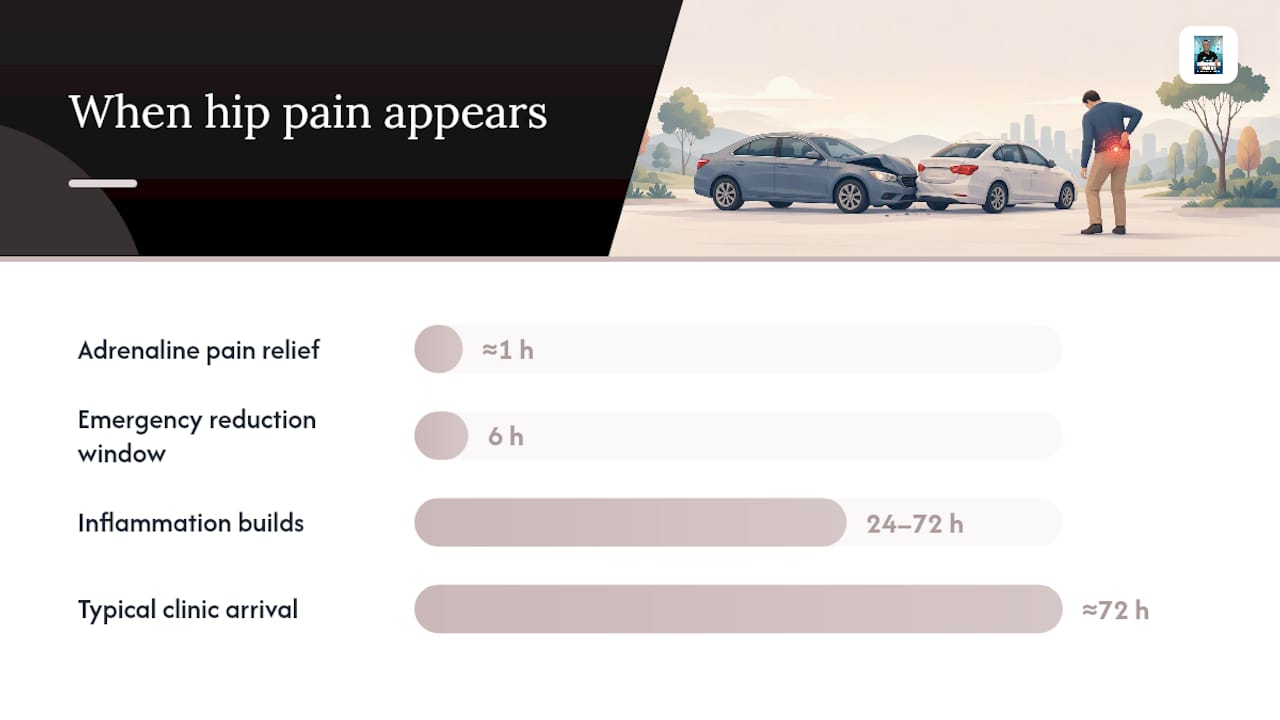
Adrenaline is a decent painkiller for about an hour. It floods your system during the crash, blunts pain signals, and then wears off, letting real inflammation take over. That inflammatory response typically builds over 24 to 72 hours, which is exactly why people who felt "fine" at the scene end up limping into a clinic three days later.
Where the pain shows up often points to what is going on:
- Deep groin pain that worsens with hip flexion often points to an intra-articular problem like a labral tear or early joint irritation.
- Tenderness over the outer hip point that hurts to lie on suggests trochanteric bursitis.
- Clicking, catching, or a locking sensation during movement is a classic labral tear signal.
- Sharp pain with any weight-bearing raises concern for fracture and needs same-day evaluation.
Certain symptoms skip the "wait and see" phase entirely. Call 911 or go to the ER if you cannot bear any weight on the leg, notice the leg looks shortened or rotated oddly, develop numbness or weakness that is getting worse, or lose bowel or bladder control. A posterior hip dislocation in particular is a true emergency: reduction ideally happens within six hours, because delay raises the risk of avascular necrosis from interrupted blood flow to the femoral head.
How Do Doctors Diagnose a Hip Injury After a Crash?
A physical exam comes first, and it is more specific than a general "does this hurt" poke. Clinicians typically run through:
- FABER test (flexion, abduction, external rotation), which stresses the joint and sacroiliac region
- FADIR test (flexion, adduction, internal rotation), which often reproduces labral tear pain
- Log roll test, gently rotating the leg to check for joint irritation without weight-bearing
- Trendelenburg test, watching pelvic drop while standing on one leg to assess hip abductor strength
- Neurovascular checks: pulses, sensation, and reflexes down the leg
Imaging fills in what the exam cannot. A plain X-ray is the first step and catches most fractures and dislocations, matching what Mayo Clinic outlines for hip fracture as standard first-line testing. CT gives a more detailed look at complex fracture patterns, especially around the acetabulum. MRI or MR arthrogram becomes necessary when X-rays look clean but pain persists, since labral tears and some soft-tissue injuries frequently slip past standard ER X-rays entirely. Ultrasound can assess tendons and bursae, and a diagnostic injection sometimes settles the question when imaging is ambiguous. Temporary relief after an injection tells a clinician they found the actual pain generator.
What Treatments Actually Work for Post-Crash Hip Pain?
The treatment path starts conservative and escalates only when the evidence supports it. That is not a compromise. A 2026 quality improvement study found that a standardized multimodal, NSAID-first protocol reduced opioid-first prescribing and improved pain scores in acute motor vehicle accident injuries, which backs up what most orthopedic guidelines already recommend.
- First-line care: NSAIDs or acetaminophen, alternating ice and heat, and protected weight-bearing rather than strict bed rest
- Rehab-first approach: physical therapy targeting hip mobility, strengthening the abductors, and retraining gait, with functional goals like sitting comfortably, standing without pain, and walking normal distances
- Image-guided injections: used both to pin down the pain source and to deliver targeted anti-inflammatory relief when a specific structure is identified
- Surgical repair: reserved for displaced fractures, dislocations that will not reduce, or labral tears that fail weeks of conservative rehab
Coordinated care tends to outperform a single-provider approach. Orthopedics, physical therapy, pain management, and chiropractic care can each address a different piece of a hip injury, and graded, goal-based rehab plans that rebuild everyday movement patterns lower the odds that an acute injury turns into chronic pain.
Pro Tip: Keep a simple daily log of what movements hurt and what your pain level is on a 1 to 10 scale. That single habit gives your care team the clearest picture of whether treatment is actually working, week over week.
How Long Does Hip Pain Last After an Accident?
Recovery timelines vary sharply by injury type. A soft-tissue strain typically eases in 2 to 6 weeks. Labral tears and tendon injuries often run 6 to 12 weeks or longer, especially if surgery enters the picture. Fractures and dislocations are measured in months, not weeks, and surgical recovery depends heavily on the procedure and your baseline health.
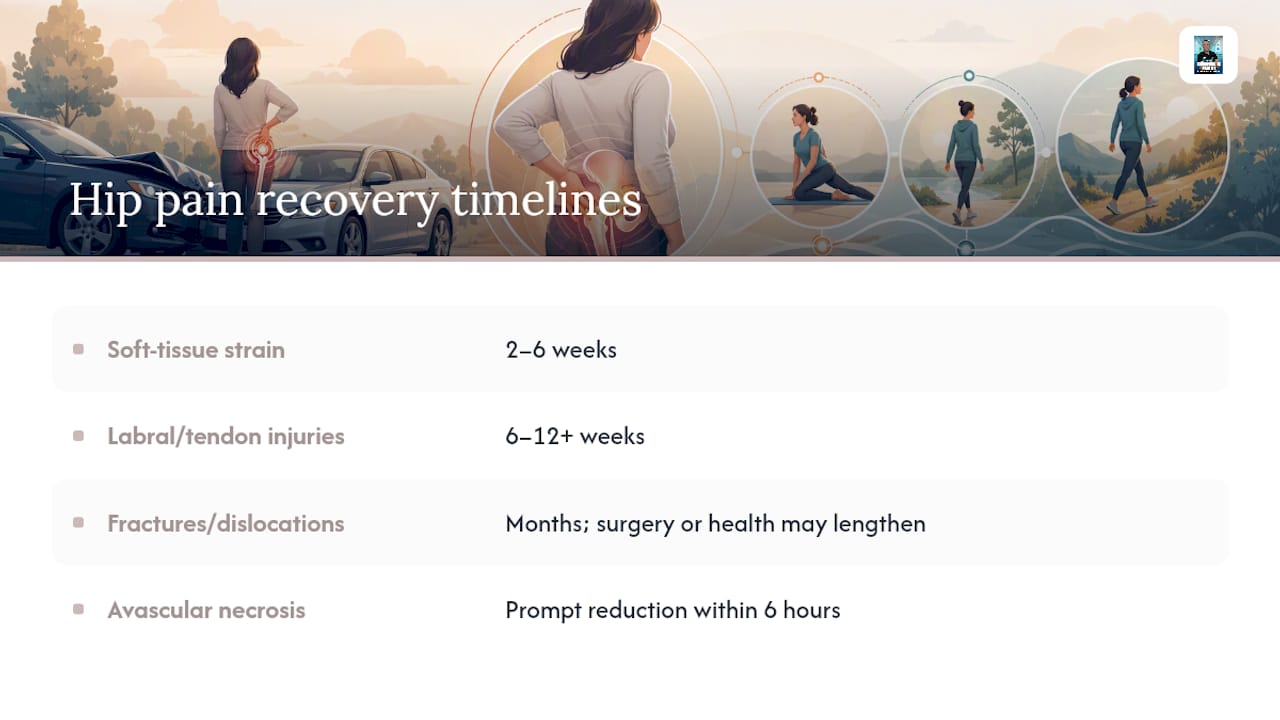
One complication deserves specific attention: avascular necrosis after a hip dislocation, where the femoral head loses blood supply and bone tissue begins to die. This is exactly why prompt reduction within six hours matters so much for dislocations. If pain has not meaningfully improved by the timeline your provider expects, or if you develop new numbness, weakness, or worsening deformity, that is your signal to go back for re-evaluation rather than wait it out.
What Should You Do After a Crash to Protect Your Health and Your Claim?
The steps you take in the first days shape both your recovery and any insurance or legal outcome later. Handle them in this order:
- Get evaluated and imaged promptly. Early imaging, whether X-ray or MRI, establishes a baseline and creates a timestamped record connecting the injury to the crash.
- Document everything. Save ER notes, imaging reports, clinic visit summaries, pharmacy receipts, photos of visible injury or bruising, and a daily symptom log noting pain levels and missed work.
- Follow up in writing with your insurer. Report the injury promptly, keep copies of every communication, and request prior authorization for treatments if your policy requires it.
- Consider legal advice if things stall. If treatment gets denied, your disability drags on longer than expected, or the insurer disputes that your hip pain came from the crash, a consultation with an attorney is worth the hour. Medical care still comes first; documentation just makes the rest of the process easier later.
Early, thorough documentation is frequently the deciding factor in insurance and legal disputes over causation, and it costs you nothing but a few extra minutes at each appointment.
Spark's Take on Post-Accident Hip Care
Most hip injuries we see after a crash get missed on the first pass, not because anyone did anything wrong, but because an X-ray that looks clean does not rule out a labral tear or soft-tissue injury. The approach leans on trauma-focused assessment, a rehab-first plan built around your actual daily movements, and documentation that supports your claim if questioned later. That combination, evaluation, imaging referrals when warranted, physical therapy coordination, and paperwork done right the first time, is what keeps a strained hip from turning into a chronic problem... If your symptoms have not eased on schedule or something feels off, get evaluated.
— Spark
Book a Hip Evaluation With Spark
Spark built its new-patient visit around exactly the situation this article covers: a hip that hurts differently than it did before the crash. Your first visit includes a focused exam, a review of any imaging you already have, and a treatment plan built around your actual pain pattern, not a generic template. If you're weighing whether that soreness needs a professional look, Spark's team of specialists handles trauma-focused evaluations daily and documents every visit the way an insurance claim needs it documented.
Unlike a general practitioner visit where hip pain might get a quick script and a "see how it feels" send-off, Spark treats crash-related hip pain as its own category, with imaging coordination, a rehab plan, and paperwork built for claims from day one. If persistent hip pain or reduced tendon flexibility is part of your picture, it's worth reading how tendon injuries can develop after a crash too. Book your evaluation through Spark's services page and get a clear plan instead of a guess.
This article is general information, not a substitute for advice from a qualified doctor. Consult a qualified healthcare professional about your own circumstances before acting on anything here.
Sources
- Traumatic dislocation of the hip — Harvard Health
- Management of pelvic and hip injuries — NCBI Bookshelf
- Hip fracture — Mayo Clinic
FAQ
What are the signs of hip trauma after a crash?
Deep groin pain, difficulty bearing weight, visible deformity, clicking or locking with movement, and tenderness over the outer hip point are the main signs, and any inability to walk needs same-day evaluation.
How long does hip pain last after a car accident?
Soft-tissue strains usually improve in 2 to 6 weeks, labral tears and tendon injuries often take 6 to 12 weeks or longer, and fractures or dislocations can take months to fully heal.
What are two signs of a fractured hip?
Sharp pain that prevents any weight-bearing on the leg and visible deformity, such as the leg appearing shortened or turned outward, are the two clearest signs of a hip fracture.
How can I tell if my hip is strained or torn?
A strain usually causes dull, aching pain that eases with rest, while a labral tear tends to produce sharp groin pain with clicking, catching, or a locking feeling during movement, especially when the leg rotates inward.
Should I go to the ER or schedule a regular appointment?
Go to the ER for red flags like inability to bear weight, visible deformity, worsening numbness, or loss of bladder control; otherwise, schedule an evaluation within the week and track your symptoms in the meantime.