
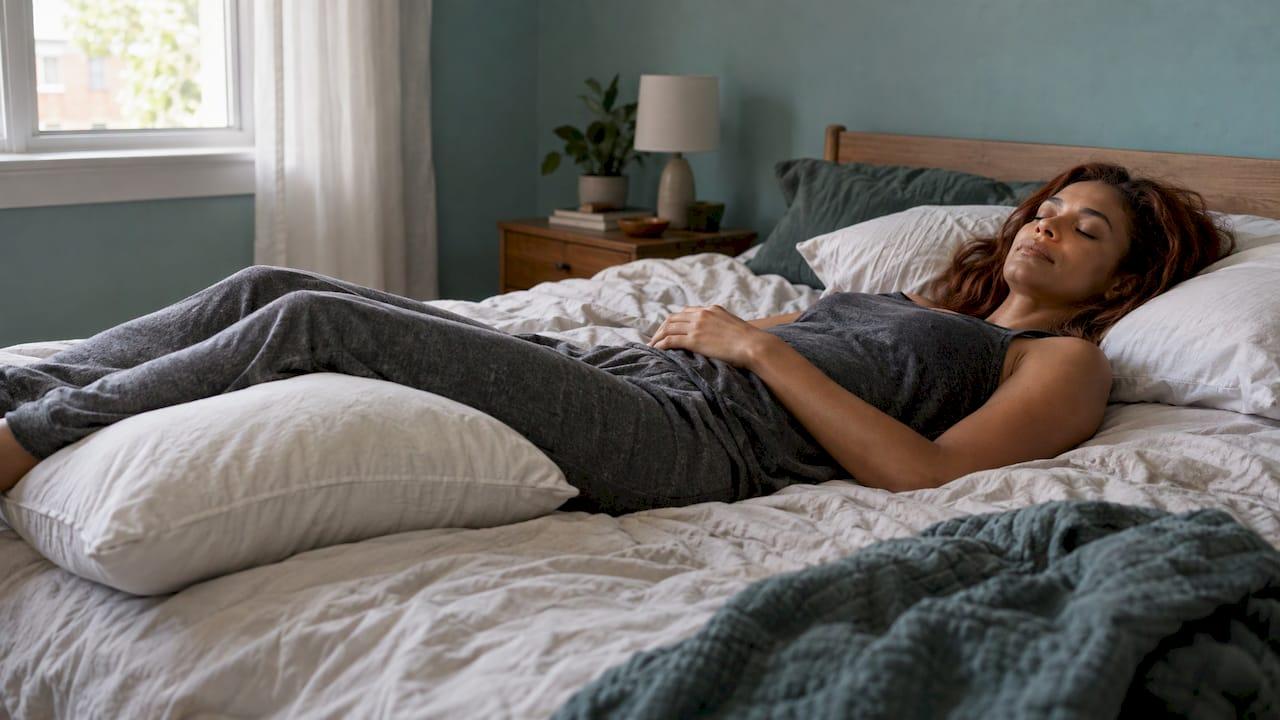
For most people with back pain, the best sleep position is lying on your back with a pillow under your knees, or on your side with a pillow between your knees. Stomach sleeping is the position to change. Pillows, mattress and how you roll over in bed matter nearly as much as the position itself. If your pain started with a car accident, a fall or a work injury, we can evaluate it at our North Miami clinic, so you are not just trying to out-sleep it.
TL;DR
- Sleeping on your back with one pillow under your head and one under your knees is the position Keck Medicine of USC names best for avoiding back pain.
- Side sleeping with your knees slightly bent and a pillow between them is an equally good choice, and often the most comfortable for lower back pain.
- Stomach sleeping flattens the spine's natural curve and twists the neck. If you can't give it up, add a pillow under your hips and lower stomach.
- Poor sleep and pain feed each other, so fixing your setup helps both the night and the recovery.
- Pain that follows an accident, or that keeps getting worse, deserves a proper evaluation rather than another new pillow.
Table of Contents
- The short answer: two good positions and one to change
- Sleeping on your back
- Sleeping on your side
- Sleeping on your stomach
- Quick comparison
- Does the type of pain change the answer?
- Pillows and mattress: the setup that holds the position
- How you get in and out of bed counts
- Why your back hurts when you wake up
- Why sleep matters for healing
- When pain keeps you awake
- A night-time setup you can use tonight
- Where care at our clinic fits in
- Our perspective
- FAQ
- Sources
The short answer: two good positions and one to change
Medical centers agree on more than you might expect. Keck Medicine of USC says lying flat on your back, with a pillow under your head or neck and another under your knees, is best for avoiding back pain. It ranks side sleeping with the legs straight second, and calls stomach sleeping the worst for the spine, according to the spine surgeon it interviewed (Keck Medicine of USC).
Cleveland Clinic lands in the same place: the most helpful positions for the back are on your side with knees partly bent, or on your back, provided you don't have sleep apnea. Mayo Clinic and the Sleep Foundation add details for the lower back specifically, covered below.

There is one honest caveat. A Cleveland Clinic physician points out that no single position guarantees a pain-free morning, and that people should experiment with positions and pillows until they find what works (Cleveland Clinic). Think of the positions below as a starting menu, then adjust to your body.
Sleeping on your back
Back sleeping spreads your weight along the whole spine. Cleveland Clinic says it puts the least pressure on the spine of any position (Cleveland Clinic).
The key is support in two places:
- Under the knees. A small pillow there keeps the lower back from arching too much, which can happen when your legs lie flat, especially if your hamstrings are tight (Cleveland Clinic). Northwestern Medicine says it reduces stress on the spine and supports the natural curve of the lower back (Northwestern Medicine).
- Under the head. The pillow should keep your head in a neutral position, not tipped forward or back. The VA suggests a supportive pillow that aligns the neck with the spine (Veterans Health Library).
If your lower back still feels unsupported, Mayo Clinic suggests a small rolled towel under your waist for extra support (Mayo Clinic).
One exception: Cleveland Clinic recommends back sleeping only if you don't have sleep apnea. If you snore heavily or have been told you stop breathing at night, favor your side and bring it up with your doctor.
Sleeping on your side
Side sleeping is the most popular position, and the one where small mistakes add up. The Sleep Foundation names it the best position for lower back pain: a slight bend in the knees and a pillow between them.
Why the pillow matters: without it, your top leg drops forward and pulls on the pelvis. Northwestern Medicine says a firm pillow between the knees keeps the upper leg from pulling the spine out of alignment and eases stress on the hips and lower back (Northwestern Medicine).
Cleveland Clinic adds a few refinements (Cleveland Clinic):
- Don't tuck your chin to your chest.
- Stretch out a little instead of curling into a tight fetal position.
- Use a pillow thick enough that your head and neck stay level, not drooping toward the mattress.
- Alternate sides, because sleeping only on one side can create imbalances over time.
Harvard Health gives a handy target for low back pain: back or side, with knees and hips both flexed to about 90 degrees (Harvard Health). Treat that as the upper end of the bend, not a requirement to curl up tight.
Sleeping on your stomach
Stomach sleeping is the hardest on your spine. It counters the natural curves and forces you to turn your neck for hours, which Keck Medicine of USC says can cause neck and upper back pain (Keck Medicine of USC). The Sleep Foundation adds that the lower abdomen can sink into the mattress, stretching the back out of alignment.
So yes, sleeping position can cause upper back pain, mostly through the twisted neck.
If you can't fall asleep any other way, make it less harmful rather than fighting it all night:
- Put a pillow under your hips and lower stomach, as Mayo Clinic suggests (Mayo Clinic).
- Use a thin head pillow, or none, so your neck isn't cranked upward. Mayo says to use a head pillow only if it doesn't strain your back.
- Try training yourself to a side position with a body pillow hugged in front of you, so you have something to lean on instead of rolling forward.
If you have osteoporosis, a short daily posture plan for osteoporosis can help you adjust how you hold your body in the daytime, which makes a new night-time position easier to settle into.
Quick comparison
| Position | Best for | What to add | Watch out for |
|---|---|---|---|
| On your back | Most back pain, especially lower back | Pillow under knees, neutral head pillow, optional rolled towel at waist | Sleep apnea; legs lying flat arching the back |
| On your side | Lower back pain, hip strain | Firm pillow between knees, slight knee bend | Tucked chin, tight curl, always the same side |
| On your stomach | Last resort only | Pillow under hips and lower stomach, thin or no head pillow | Twisted neck, sagging stomach |
Does the type of pain change the answer?
Sometimes. A physician quoted in Prevention magazine says nerve-based pain, like a herniated disc, tends to feel better on the back with knees bent and cushioned by pillows. For non-nerve pain such as arthritis, she recommends side sleeping with knees at about 90 degrees and a pillow between them (Prevention). If you don't know which kind of pain you have, that is a good reason to get examined instead of guessing.
Pillows and mattress: the setup that holds the position
A perfect position on a bad surface still fails. Two points from the research:
- Head pillow. Northwestern Medicine says it should support the natural curve of your neck. One that is too high can strain the back, neck and shoulders, and pillows should be replaced about once a year (Northwestern Medicine).
- Mattress. A University of Cincinnati physician explains that a mattress that is too soft can let the spine sag, while one that is too firm may not support its natural curves and can cause stiffness (University of Cincinnati). Cleveland Clinic notes that a damaged or sagging mattress can let the lower abdomen sink and pull the back out of line (Cleveland Clinic).
A practical test: lie in your chosen position and notice whether your head, ribs and pelvis feel level, or whether one area sags or tilts. Add or remove a pillow until nothing is being stretched.
How you get in and out of bed counts
Most people think about the position and forget the transitions. Northwestern Medicine advises against twisting or bending at the waist when you turn over. Move your whole body as one unit, keep your belly pulled in and tight, and bend your knees toward your chest as you roll (Northwestern Medicine). When pain flares, this alone can take the edge off the sharp twinge that wakes you at 3 a.m.
Why your back hurts when you wake up
If you sleep on your back and still wake up sore, the position is only one suspect. Cleveland Clinic lists several contributors to morning back pain: sleep position, lying immobile for hours, an unsupportive mattress or pillow, an underlying condition, or pregnancy (Cleveland Clinic).
Lying still for seven to eight hours can leave you stiff and inflamed, so the first movements of the day hurt. That is why gentle stretches in the morning, or a little light yoga, are a common suggestion (Sleep Foundation). Stretches or yoga before bed may also ease muscle tension, according to the University of Cincinnati physician (University of Cincinnati).
Conditions that can affect both sleep and morning back pain include degenerative disk disease, fibromyalgia, spinal arthritis, and spinal problems like sciatica, stenosis or a herniated disk (Cleveland Clinic). Medical News Today makes a similar point: morning pain can come from posture, mattress or pillows, but may also signal an underlying condition (Medical News Today).
So if you have fixed your pillows and position for a couple of weeks and still wake up hurting, or the pain began after a collision or a fall, the problem probably isn't your bed.

Why sleep matters for healing
Pain and sleep have a two-way relationship. Cleveland Clinic says pain can disrupt sleep, and poor sleep can leave you with more pain (Cleveland Clinic). The University of Cincinnati physician says lack of sleep impairs the body's ability to heal and can aggravate existing lower back problems (University of Cincinnati).
Some numbers show how much it can matter:
- In a 2026 prospective cohort study of athletes with musculoskeletal injuries, good sleepers returned to play in an average of 31.8 days versus 42.6 days for poor sleepers. Better sleep was also linked with lower pain and shorter rehabilitation (Pain, Joints, Spine journal).
- A conference abstract in the British Journal of Sports Medicine reports that sleeping under 8 hours is related to 1.7 times more risk of injury and a worse recovery after training (BJSM).
Those studies looked at athletes, not office workers or accident patients, but the direction is consistent with what the medical centers say: protect your sleep while you recover. If your sleep has fallen apart after a crash, our article on sleep problems after a car accident goes through the causes and what helps. For neck pain specifically, see how to sleep with whiplash on your back or side.
When pain keeps you awake
Even with a good setup, some nights hurt. Harvard Health suggests that if pain wakes you, give your body time to settle, listen to soft music or read, and avoid screens, since blue light suppresses melatonin (Harvard Health).
The Sleep Foundation adds basic sleep hygiene: a consistent schedule, care with alcohol and caffeine, relaxation methods, less noise and light, and gentle stretches in the morning.
For spasms, heat can also help in the evening. Our guide to using heat for back spasms explains how to apply it safely. For a broader routine, try the daily spinal health checklist.
Pain that follows a car accident, a work injury or a slip and fall, pain with numbness or weakness in a leg or arm, or pain that keeps getting worse, calls for a professional evaluation rather than more home adjustments.
A night-time setup you can use tonight
- Pick back or side, whichever you fall asleep in more easily.
- Back: pillow under the knees, a head pillow that keeps your neck level, and a rolled towel at the waist if your lower back feels hollow.
- Side: firm pillow between the knees, a slight bend, chin relaxed, and a head pillow as thick as the gap between your ear and the mattress.
- Roll as one unit, with knees toward your chest.
- Give it two weeks, changing one thing at a time, and alternate sides.
- Stretch gently on waking instead of jumping out of bed.
Where care at our clinic fits in
If you're in North Miami and your back pain started with a collision, a work injury or a fall, we can look at what is happening underneath. We offer an auto accident evaluation, spinal adjustments at $45 per session, and therapies such as ultrasound, electrical stimulation, traction or decompression, massage therapy and shockwave therapy at $75 per session. Monthly wellness plans are $149 (Essential), $249 (Performance) and $399 (Elite). You can see the full list on our services page and our pricing page.
Our team has over 20 years of experience treating accident victims. We offer English, Spanish and Creole support, direct insurance billing with thorough injury documentation for claims, and Uber Health transport in North Miami. To book a chiropractic adjustment, start from our homepage.

Our perspective
Most of the patients we meet have already tried the pillow fixes. They sleep on their sides, they bought a new mattress, and they still wake up in pain. That tells us the bed is often not the whole story.
The advice in this article is a good starting point, and we want you to use it. Better positioning takes strain off tissues that are already irritated. But after a car accident or a fall, joints and muscles can be stiff, guarded and irritated in ways a pillow can't change. A hands-on evaluation and a spinal adjustment, along with therapies like ultrasound, traction or shockwave, are designed to address the cause so that sleeping gets easier.
That is why we pair care with practical help: clear pricing, English, Spanish and Creole support, and transport in North Miami so getting to the appointment isn't one more obstacle. Good sleep and good care work best together.
Spark
FAQ
What is the best sleep position to avoid back pain?
Lying on your back with a pillow under your head and another under your knees is the position Keck Medicine of USC recommends. Side sleeping with a pillow between your knees is a close second and often best for lower back pain. Avoid sleeping on your stomach where you can.
Why does my lower back hurt when I sleep on my back?
Legs lying flat can let your lower back arch too much, and a soft or sagging mattress can pull your spine out of line. Lying still for seven to eight hours can also leave you stiff. Try a small pillow under your knees and check how your mattress supports you.
Can my sleeping position cause upper back pain?
Yes. Stomach sleeping forces you to turn your neck for hours, which can cause neck and upper back pain. Switching to your back or side, with a pillow that keeps your head level, takes that twist out.
Why does my back ache after I wake up?
Common contributors are your sleep position, lying immobile for hours, and an unsupportive mattress or pillow. Underlying conditions such as degenerative disk disease or fibromyalgia can also play a part. If the ache continues after you fix your setup, get it evaluated.
Sources
- The Best and Worst Sleep Positions for Back Pain, Keck Medicine of USC
- Sleeping positions that reduce back pain, Mayo Clinic
- Best Sleeping Positions for Pain, Cleveland Clinic
- Why Is My Back Pain Worse in the Morning? Cleveland Clinic
- Back Safety: Sleeping Positions, Veterans Health Library
- How to sleep with lower back pain, University of Cincinnati
- Sleeping better when you have pain, Harvard Health
- Good Sleeping Posture Helps Your Back, Northwestern Medicine
- How to Sleep With Lower Back Pain, Sleep Foundation
- Lower Back Pain After Sleeping, Sleep Foundation
- How to Sleep With Lower Back Pain, Prevention
- Waking up with lower back pain, Medical News Today
- Effect of Sleep Quality on Sports Injury Recovery Rate, Pain, Joints, Spine
- Sleep and injury abstract, British Journal of Sports Medicine