
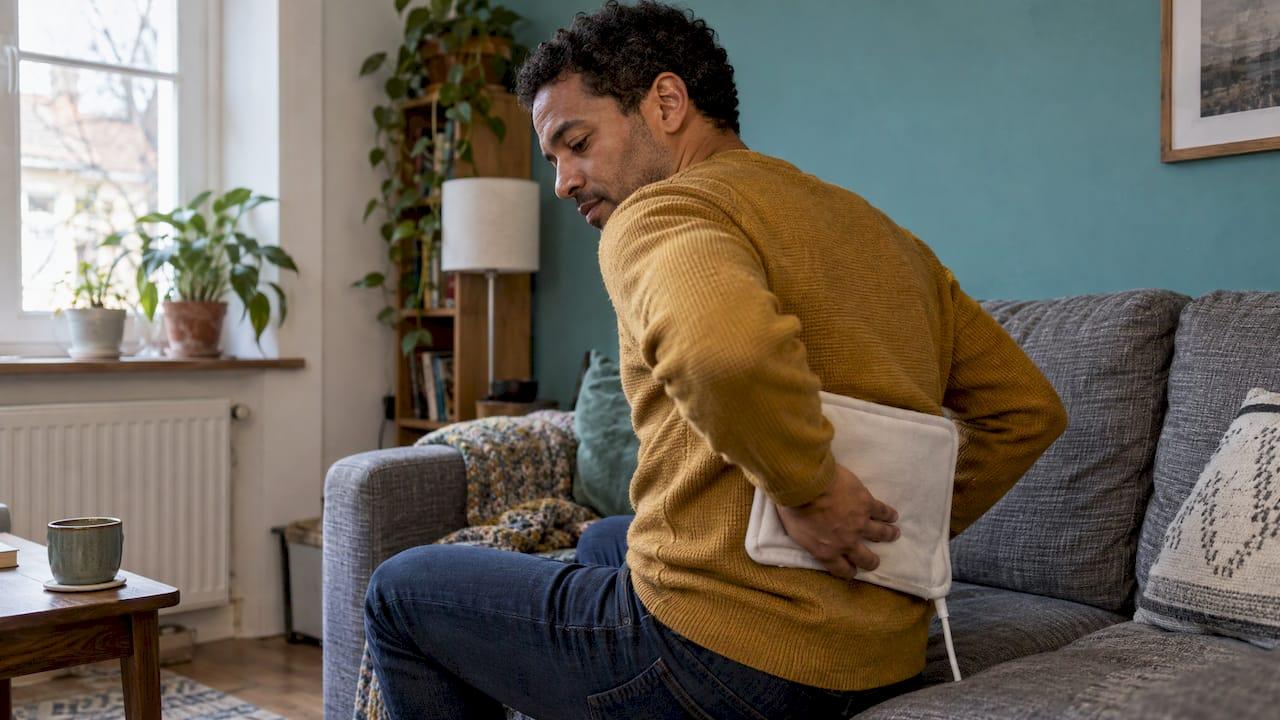
Heat is a sensible first move for most back spasms. Apply a heating pad or warm wrap over the tight area for 15 to 20 minutes, keep a layer of cloth between the pad and your skin, and repeat a few times a day. The exception is a fresh injury, such as a car accident, a fall or a sudden strain. In those cases the first 48 hours call for a different approach, and some symptoms mean you should see a provider instead of treating it yourself. This guide covers timing, temperature, safety and the point where home care stops being enough.
TL;DR
- Heat relaxes a tight muscle by increasing blood flow. For spasms from muscle tension or stiffness, it is a well-supported first choice.
- Use heat for 15 to 20 minutes at a time, never more than 30 minutes in one session, with a barrier between the pad and your skin.
- Do not sleep on a heating pad, lie on it, or use it on numb skin. For the first 48 hours after an injury, heat is usually held back and cold is used instead.
- Numbness, weakness in a leg, or loss of bladder or bowel control means getting care right away.
- Spasms after a car accident or fall deserve an evaluation, not just a heating pad.
Table of Contents
- Why heat calms a back spasm
- What the research says about heat for low back pain
- How to use a heating pad on a back spasm
- How hot is too hot, and how long is too long
- Who should be careful with heat
- When cold is the better choice
- Spasm after a car accident, fall or work injury
- When a spasm needs a provider, not a heating pad
- What helps once the spasm has eased
- Our perspective on heat and back spasms
- Get the spasm checked at Spark
- FAQ
- Sources
Why heat calms a back spasm
A spasm is a muscle that contracts and will not let go. The muscle tightens, circulation to it drops, and the tightness itself becomes painful. Heat works on that loop. A physician at Mount Nittany Health explains that heat increases blood flow to the area, which relaxes tight muscles and improves flexibility. Ice does something different: it constricts blood vessels, reduces swelling and dulls the nerve signals that carry pain.
Medicine's own guidance is consistent here. MedlinePlus says that for a muscle spasm, heat will relax the muscle at first, and ice may help later once the first spasm has passed and the pain has eased. Johns Hopkins Medicine adds that heat reduces joint stiffness and muscle spasm, which makes it useful when muscles feel tight.
Heat also does not need to reach deep to be useful. Harvard Health notes that the goal of most heat therapy is to raise tissue temperature by about 9 to 12°F. That is a gentle, comfortable warmth, not a hot one.

What the research says about heat for low back pain
Heat is one of the few home treatments with real trial evidence behind it.
- A 2021 network meta-analysis of 46 randomized trials with 8,765 participants found that, in the short term, heat wraps were among the most effective non-drug treatments for acute and subacute non-specific low back pain, compared with an inactive treatment.
- The American College of Physicians guideline says that, based on moderate-quality evidence, heat wraps give a moderate improvement in pain and disability compared with placebo for acute and subacute low back pain.
- A June 2026 Michigan Quality Improvement Consortium guideline states that heat applied to painful areas may reduce pain from muscle spasm. It also notes that up to 90% of acute low back pain episodes resolve within 6 weeks regardless of treatment.
That last point matters for how you think about a spasm. Most spasms ease on their own, and heat makes the days in between more comfortable and more mobile. If you want a broader look at what supports healing, our guide to managing back pain at home covers movement, posture and daily habits. Clinics that treat low back pain also describe how heat fits into low back pain treatments, which helps when you are deciding what else to add.
How to use a heating pad on a back spasm
This is the routine we suggest for a muscle spasm with no recent injury and none of the warning signs listed further down.
- Check the pad. Make sure the cord, plug and cover are in good shape. Replace a worn or old pad.
- Add a barrier. Use the pad's cover, or a thin towel or cloth between the pad and your skin. Cleveland Clinic suggests wrapping the heat or ice in a towel or pillowcase.
- Start on low or medium. Warm is the target. If you can feel it burning or pulsing, it is too hot.
- Apply for 15 to 20 minutes. Mount Nittany Health recommends 15 to 20 minutes at a time, with safety covers and a barrier. UCSF puts the outer range for topical heat at 5 to 30 minutes at most.
- Stop and move gently. After the session, walk or do light stretches. The Michigan guideline advises staying active and avoiding bed rest (Grade A evidence).
- Repeat later. Wait for the skin to return to normal temperature, then you can repeat several times a day. Cleveland Clinic suggests reapplying after 20 to 30 minutes of rest.
Place the pad on top of the sore area while you sit or recline against it, not while you lie on top of it. Mount Nittany Health advises against lying on a heating pad or falling asleep with one on.
Pad, wrap or warm towel: which form to use
All three deliver the same thing: surface warmth. The difference is practical.
| Option | Best for | Practical notes |
|---|---|---|
| Electric heating pad | Sitting or reclining at home | Adjustable settings. Keep a cloth barrier and never use it while asleep. |
| Adhesive heat wrap | Moving around, work, travel | Studied in the trials above. Follow the package timing. |
| Warm, damp towel | A quick option with no electricity | Cools fast, so it needs re-warming. Use comfortably warm, never hot. |
| Warm shower or bath | Whole-back loosening before stretching | Easy to control the temperature. Stand or sit up slowly afterward. |
How hot is too hot, and how long is too long
The limits are not arbitrary, and they are worth knowing.
- Temperature. UCSF lists a maximum of 104°F (40 to 45°C) for topical heat. Harvard Health says temperatures above 113°F can become painful and above 122°F can burn skin.
- Time. A peer-reviewed review of heating pad skin injuries says safe practice is 15 to 20 minute intervals and never more than 30 minutes in one session. It also says the pad belongs on top of the body part, not underneath it, because trapped heat raises the temperature and the risk of a skin change called erythema ab igne.
- Skin changes. That same review notes that erythema ab igne, a mottled, net-like skin discoloration, comes from prolonged exposure to a heat source. It is usually painless and has a good outlook, but skin cancers have rarely been reported within these lesions. If you notice a lasting mottled pattern where you use a pad, show it to your doctor.
- Fire safety. The Electrical Safety Foundation International reports that heating pads and electric blankets cause almost 500 fires a year in the US, nearly all involving electric blankets over ten years old. It advises replacing worn or old pads, not covering them during use, and never leaving them unattended or using them while sleeping.
Who should be careful with heat
Heat is gentle for most people, but not everyone. UCSF lists these as situations where heat is not appropriate: bleeding, skin that has been burned or radiated, vascular disease, deep vein thrombosis, and use over topical menthol or medicated ointments.

Johns Hopkins Medicine also advises extra care if you have nerve damage from diabetes or another health problem, because you may not feel a burn developing. If any of these apply to you, ask your primary care provider before using a heating pad on your back.
In practice, this means checking your skin after each session. It should look pink at most, never red, blistered or patchy.
When cold is the better choice
Timing decides it. For a brand-new injury, cold comes first.
- Johns Hopkins says heat should not be used for the first 48 hours after an injury.
- Harvard Health says cold works well in the hours right after an injury and can reduce inflammation and muscle spasm. It advises no more than 20 minutes at a time, four to eight times a day for the first two days.
- Mount Nittany Health puts ice at the first 72 hours after a strain, then heat for ongoing stiffness, chronic pain or morning stiffness.
- UCSF notes cold can also help muscle spasms, at about 59°F for up to 20 minutes, and lists poor circulation, peripheral vascular disease and Raynaud's phenomenon as reasons not to use it.
Plenty of people simply alternate. Cleveland Clinic and the Spinal Surgery Blog-style guidance both come to the same practical point, which is to use whichever feels better. If you want the cold protocol in detail, see our guide to cold therapy for the first 48 to 72 hours. A related, neck-focused version is in our ice or heat decision protocol. Some wellness providers also discuss PEMF and what research shows for pain when readers look beyond heat and cold.
A simple way to decide
| Situation | Start with |
|---|---|
| Tight, stiff back with no recent injury | Heat |
| Morning stiffness or a lingering ache | Heat |
| Spasm after a sudden strain, fall or collision, first 48 to 72 hours | Cold, then reassess |
| Swelling or a feeling of warmth at the injury | Cold, and get it checked |
| Cannot tell which feels better | Try each for a short session and keep the one that eases the spasm |
Spasm after a car accident, fall or work injury
A back spasm after a collision is not the same as one from sitting too long. Muscle guarding is often the body's response to an injury to the soft tissue or the joints of the spine, and the pain may show up hours or days later. Heat can make you more comfortable once the first 48 hours have passed, but it does not tell you what was hurt.
If the spasm followed a car accident, a slip and fall or a workplace injury, get it evaluated before you settle into a routine of heat alone. An exam documents what happened, which also matters if you later need records for a claim. Our overview of chiropractic care for back pain after accidents explains what an evaluation looks at, and our guide to relieving whiplash pain covers the neck side of the same collisions.
When a spasm needs a provider, not a heating pad
Get care right away for any of these, according to Cleveland Clinic:
- Loss of bladder or bowel control
- Muscle weakness in your arms or legs
- Numbness or weakness on one side of the body
- Loss of balance or coordination, or loss of feeling in a limb
WebMD's list of back pain red flags adds numbness or tingling in the groin, pain with fever, pain that travels down the back of the leg, a history of cancer, unintentional weight loss, pain that wakes you at night, and pain lasting more than a month.
Emergency symptoms go to the ER or 911. For the rest, the Michigan guideline says to consider referral to a multidisciplinary back pain program if pain or disability persists beyond 4 weeks.
Medication alongside heat
If heat and ice leave you still sore, MedlinePlus says NSAIDs such as ibuprofen or naproxen can help, and a provider can prescribe antispasm medicines for more severe cases. The ACP guideline reports that NSAIDs bring a minor improvement in pain and function, and muscle relaxants help pain in the short term. Check with your doctor or pharmacist first if you have stomach, kidney or heart conditions or take blood thinners.
What helps once the spasm has eased
Spasms that keep returning usually point to something upstream: a stiff joint, weak supporting muscles, long hours seated or an old injury that never fully settled. The ACP guideline recommends superficial heat (moderate-quality evidence), massage, acupuncture or spinal manipulation (low-quality evidence) as non-drug options for acute or subacute low back pain.
That is the logic behind combining home heat with hands-on care. These guides go further:
- 10 ways to relieve back pain fast
- A 6 to 12 week non-surgical care roadmap
- The advantages of spinal adjustments
- A daily spinal health checklist
Harvard Health also describes deeper heat: a physical therapist can use ultrasound or shortwave energy to warm tissue about two inches below the surface, compared with about an inch for surface heat. That is one reason in-clinic therapies exist for spasms that a pad cannot reach.
Our perspective on heat and back spasms
At Spark, we see heat as a good tool and a poor diagnosis. A heating pad can ease a spasm tonight. It cannot tell you why your back locked up in the first place.
Most of the patients we meet in North Miami come in after a car accident, a slip and fall or a work injury. For them, our advice is to use cold in the first couple of days, add gentle warmth after that, and get examined early. We have over 20 years of experience treating accident victims, and we document injuries thoroughly so your records are ready if you need them for a claim.
When a spasm needs more than home care, our approach is designed to go further: spinal adjustments, ultrasound, electrical stimulation, traction, shockwave therapy and heat and cold therapy in the office, with massage therapy when it fits. We offer support in English, Spanish and Creole, and Uber Health transport in North Miami for patients who need a ride.
Heat first, then a plan. That is how we think about back spasms.
Spark
Get the spasm checked at Spark
If your spasm began with an accident, or it has not eased after a few days of heat and gentle movement, we can help. Our chiropractic adjustments are listed at $45 per visit, and shockwave therapy is $75 per session. Monthly wellness plans are listed at $149 (Essential), $249 (Performance) and $399 (Elite). You can see everything on our pricing page or browse our full list of services, including auto accident evaluation, ultrasound and traction.
Ready to book? Start with a chiropractic adjustment at Spark and tell us when the spasm started and what caused it. If it was a collision, our shockwave therapy for car accident injuries page explains how that treatment is used in recovery, and our page on massage therapy after a car accident covers another option.
FAQ
Is heat or ice better for muscle spasms in the back?
For a spasm without a recent injury, heat is usually the better start because it relaxes the muscle. For a new injury, use cold for the first 48 to 72 hours, then heat. Cleveland Clinic says either can be used on back spasms for 20 to 30 minutes, so go with whichever feels better.
How long should I leave a heating pad on a back spasm?
Keep sessions to 15 to 20 minutes and never longer than 30. Use a cloth barrier, keep the setting low to medium, and take a break before reapplying. Never fall asleep with a heating pad on, since that is when burns and skin changes develop.
Should I use heat right after a car accident?
Not in the first 48 hours. Johns Hopkins advises against heat in that window, and cold is used instead. Because accident-related pain can signal injury to the spine's soft tissues, get examined as soon as you can rather than relying on home care.
Can a heating pad make a back spasm worse?
Used correctly, it should not. Problems come from overuse or the wrong timing: heat on a fresh, swollen injury, sessions that run too long, a pad that is too hot, or use on numb skin. If pain grows, the skin turns red or blistered, or you get numbness or weakness, stop and call a provider.
Sources
- Back Spasms: Causes, Treatment (Cleveland Clinic)
- Charley horse (MedlinePlus)
- Effectiveness of treatments for acute and subacute low back pain (PubMed)
- Low Back Pain: ACP Practice Guideline (AFP)
- Management of Acute Low Back Pain in Adults (Michigan Quality Improvement Consortium)
- Noninvasive Treatments for Low Back Pain: A Clinical Practice Guideline
- Back pain: Heat or ice? (Mount Nittany Health)
- Erythema Ab Igne due to Heating Pad Use (PMC)
- Treating Pain with Heat and Cold (UCSF)
- Ice Packs vs. Warm Compresses For Pain (Johns Hopkins Medicine)
- Heating Pads and Electric Blankets Safety (ESFI)
- Cold versus heat for pain relief (Harvard Health)
- Back Pain Symptoms (WebMD)
- Low back pain treatments
- PEMF for pain research