
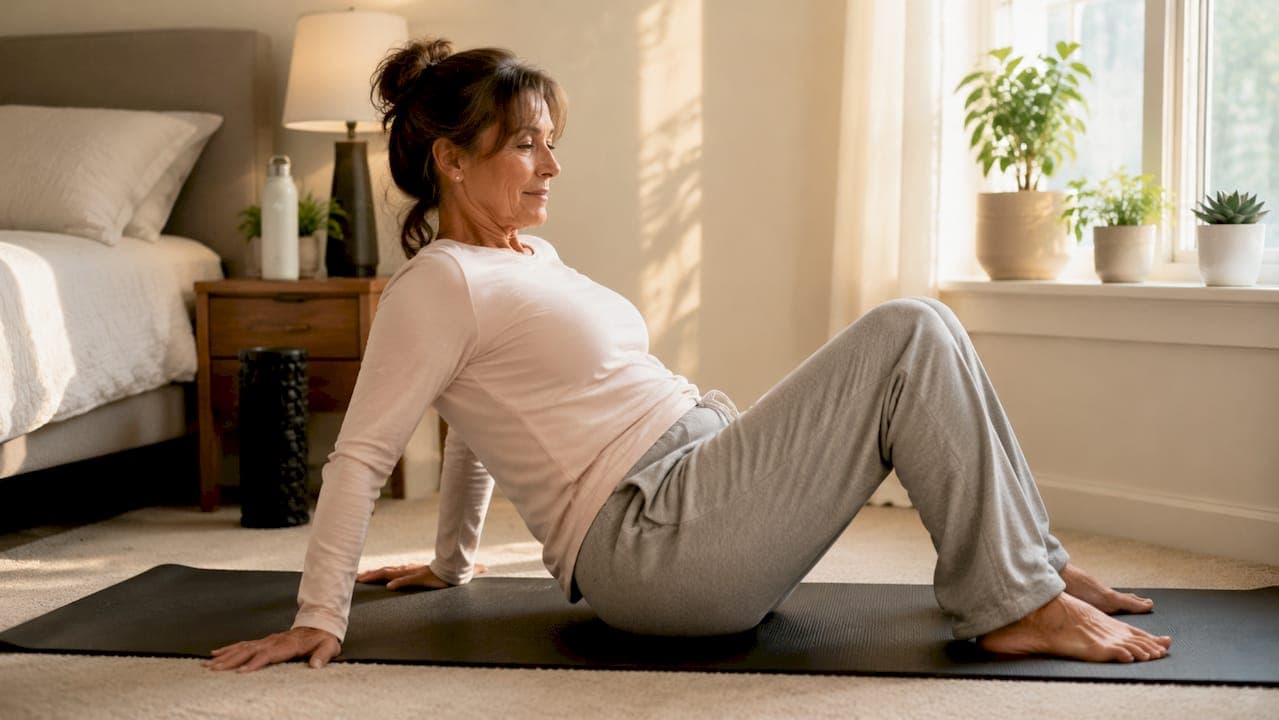
Back pain management at home is defined as applying targeted exercises, controlled movement, and self-care techniques to reduce discomfort and restore function without aggressive clinical intervention. Back pain is one of the most common reasons people miss work or limit daily activity, yet most cases of non-specific mechanical back pain respond well to consistent home care. Clinical research confirms that exercise over 16 weeks ranks among the highest-efficacy approaches for chronic pain relief. Knowing how to manage back pain at home correctly, with the right techniques and realistic expectations, makes a measurable difference in how fast you recover.
What exercises and stretches relieve back pain at home?
Exercise is the single most effective tool for reducing back pain at home. A systematic review confirmed that 15–20 minutes per session, 6–7 times per week, produces the strongest results for managing chronic low back pain. That frequency is more important than intensity. Short, daily sessions beat long, infrequent workouts every time.
Start with core control, not strength
Home exercise programs should begin with core control before advancing to strength training. Core control exercises build spinal stability first, which reduces pain and protects against further injury. Jumping straight into strength work before your spine is stable increases the risk of a flare-up.
The following progression works well for most people with non-specific back pain:
- Pelvic tilts. Lie on your back with knees bent. Gently flatten your lower back against the floor and hold for 5 seconds. This activates deep stabilizing muscles without loading the spine.
- Knee-to-chest stretch. Pull one knee gently toward your chest and hold for 20–30 seconds. Repeat on both sides. This reliefs tension in the lower back and hip flexors.
- Cat-cow stretch. On hands and knees, alternate between arching and rounding your back slowly. This improves spinal mobility and is especially useful during flare-ups.
- Bird-dog. From hands and knees, extend one arm and the opposite leg simultaneously. Hold for 5 seconds, then switch. This builds core stability without compressing the spine.
- Glute bridges. Lie on your back, feet flat on the floor. Lift your hips until your body forms a straight line from shoulders to knees. This strengthens the glutes and lower back together.
Pro Tip: Gentle, controlled motion works better than aggressive stretching. Avoid pushing into sharp pain during any exercise. Sharp pain triggers muscle spasms and sets back your recovery.
| Exercise category | Primary effect |
|---|---|
| Core control (pelvic tilts, bird-dog) | Builds spinal stability and reduces pain signals |
| Mobility stretches (cat-cow, knee-to-chest) | Improves range of motion and eases stiffness |
| Strengthening (glute bridges, deadbugs) | Supports the spine and reduces future flare-ups |
| Maintenance stretches (hip flexor, hamstring) | Prevents tightness that pulls on the lower back |

How does movement and activity management help back pain recovery?
Active recovery is more effective than bed rest for back pain. Complete inactivity causes joint stiffness and muscle weakening, both of which make pain worse over time. Gentle movement keeps blood flowing to injured tissues and prevents the cycle of stiffness that prolongs recovery.
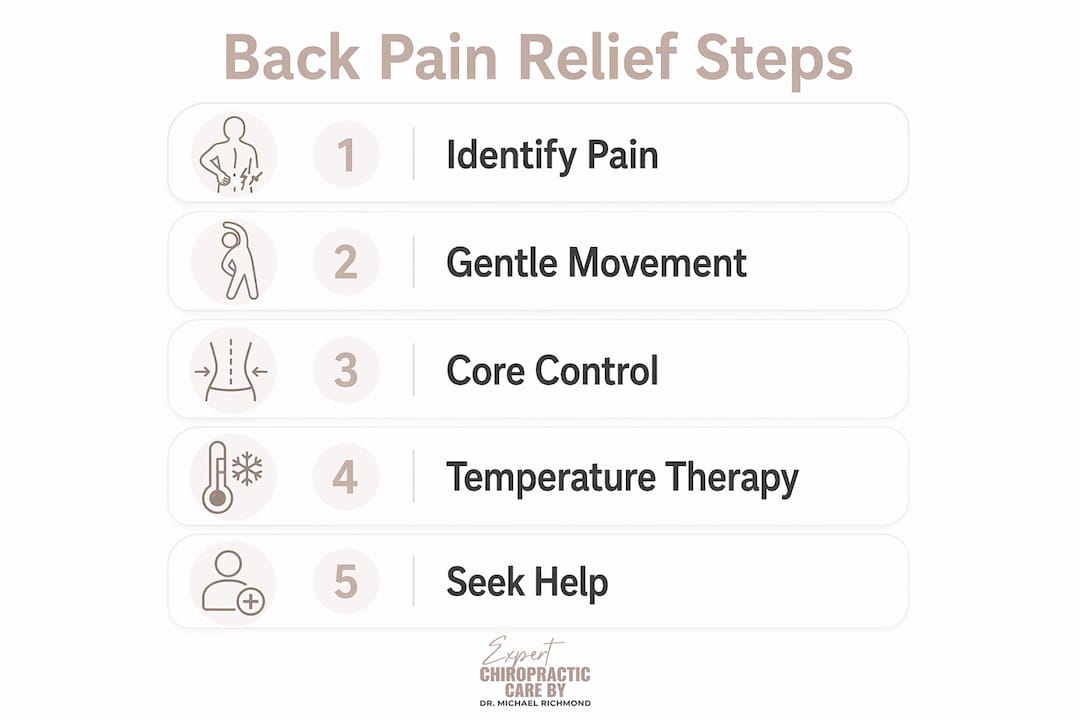
Safe movement habits that protect your spine
How you move throughout the day matters as much as your exercise routine. Rolling to your side, dropping your legs over the bed edge, and pushing up with your arms is the safest way to get out of bed with acute back pain. Twisting your waist while sitting up puts direct strain on the lumbar discs.
Lifting safely follows the same principle. Bend at the hips and knees, keep the object close to your body, and never twist while holding weight. These habits reduce spinal load on the most vulnerable structures.
Key movement practices to build into your day:
- Take a movement break every 30–60 minutes if you sit for long periods. Regular activity breaks reduce future flare-ups and decrease reliance on pain medication.
- Avoid sitting in one position for more than an hour. Prolonged static posture compresses spinal discs and tightens the hip flexors.
- Walk short distances regularly. Even 5–10 minutes of walking improves circulation and keeps the spine mobile.
- Check your posture during recovery when sitting. Your lower back should maintain a slight inward curve, not flatten against the chair.
"Weight management and regular movement breaks are critical to long-term back pain control. Lifestyle changes reduce flare-ups and decrease medication reliance." — Harvard Health
Pro Tip: Set a phone timer every 45 minutes as a movement reminder. Standing up and walking to another room for 2 minutes is enough to reset spinal pressure and reduce stiffness.
What home treatments complement exercise for back pain relief?
Home treatments for back pain work best when combined with exercise, not used as a replacement. The most evidence-supported options are temperature therapy, topical pain relief, and mind-body techniques.
Temperature therapy: ice first, then heat
Ice therapy for 15–20 minutes within the first 48 hours of a flare-up reduces inflammation effectively. After 48 hours, switching to heat relaxes tight muscles and improves blood flow to the area. The Rule of Comfort applies here. If heat worsens a throbbing sensation, go back to ice. Your body's response is the most reliable guide.
Practical home treatments that reduce pain and stiffness:
- Heat packs or warm baths. Apply for 15–20 minutes to relax muscle spasms. Use a cloth barrier between heat and skin to prevent burns.
- Topical creams. Over-the-counter options containing menthol or diclofenac reduce local pain without systemic side effects. Apply directly to the painful area.
- Gentle massage. Self-massage with a foam roller or tennis ball against a wall targets tight muscles in the lower back and glutes. Avoid direct pressure on the spine itself.
- Relaxation techniques. Diaphragmatic breathing and progressive muscle relaxation reduce the stress response that amplifies pain perception. Even 5 minutes of focused breathing lowers muscle tension.
Statistic callout: A 16-week exercise program achieves a SUCRA score of 97.9 for chronic back pain relief effectiveness. That number places consistent exercise above most passive treatments in clinical rankings. Home treatments accelerate comfort, but exercise drives the actual recovery.
For ongoing guidance on spinal health daily habits, combining temperature therapy with movement produces faster results than either approach alone.
When should you seek medical advice for back pain?
Most back pain improves within a few weeks of consistent home care. Certain symptoms, however, signal that something more serious may be happening and require prompt professional evaluation.
Seek medical advice immediately if you experience any of the following:
- Morning stiffness lasting more than 30 minutes, which can indicate inflammatory arthritis rather than mechanical pain.
- Pain that is worse at night or wakes you from sleep, which may suggest a structural or systemic cause.
- Unexplained fever combined with back pain, which raises the possibility of spinal infection.
- Unexplained weight loss alongside back pain, which warrants investigation for serious underlying conditions.
- Numbness, tingling, or weakness in the legs, which can indicate nerve compression requiring clinical assessment.
"These red-flag symptoms predict serious underlying causes requiring prompt evaluation. Do not wait for them to resolve on their own." — Chartered Society of Physiotherapy
Mechanical back pain, the most common type, typically improves with movement and does not produce these warning signs. If your pain follows a clear pattern, worsens with specific positions, and eases with rest or gentle movement, it is likely mechanical. When symptoms fall outside that pattern, check the chiropractic red flags list and consult a healthcare provider without delay.
Key takeaways
Consistent daily exercise combined with controlled movement and targeted home treatments is the most effective approach to managing back pain at home.
| Point | Details |
|---|---|
| Exercise frequency matters most | Aim for 15–20 minutes of back pain relief exercises, 6–7 days per week, for best results. |
| Start with core control | Begin with stability exercises like pelvic tilts and bird-dog before advancing to strength work. |
| Keep moving, avoid bed rest | Active recovery with gentle movement heals faster than complete rest, which causes stiffness. |
| Use temperature therapy correctly | Apply ice in the first 48 hours, then switch to heat unless heat worsens throbbing pain. |
| Know the red flags | Seek professional care immediately for night pain, morning stiffness over 30 minutes, or fever. |
What I've learned from watching people manage back pain at home
Most people approach back pain with one of two extremes. They either push through sharp pain because they think movement always helps, or they stop moving entirely because rest feels safer. Both approaches slow recovery.
The research is clear that gentle, repeated motion outperforms aggressive stretching for non-specific back pain. What the research cannot fully capture is how much patience this requires. Progress in the first two weeks is often invisible. Pain does not drop in a straight line. Some days feel worse than the day before, and that is normal. The people who recover fastest are not the ones who work hardest. They are the ones who show up consistently, stay within their pain threshold, and adjust when something is not working.
The other thing I have seen repeatedly is that people underestimate lifestyle factors. Taking a 5-minute walk every hour sounds too simple to matter. It does matter. Weight management and movement breaks reduce flare-up frequency more reliably than any single exercise. The boring, repeatable habits are the ones that produce lasting results.
If you are three weeks in and still struggling, that is not a sign that home care has failed. It is a sign that you may need a professional assessment to rule out something structural or to get a program tailored to your specific pattern of pain.
— Spark
Sparkmed's resources for spinal health and pain management
Back pain that does not respond to home care within a few weeks deserves professional attention.

Sparkmed specializes in chiropractic care and spinal health in North Miami, offering spinal adjustment services starting at $25, with no insurance required. The team works with patients recovering from accidents and everyday back pain alike, building personalized plans that complement what you are already doing at home. For ongoing guidance, the Sparkmed blog covers spinal health, pain management strategies, and recovery advice backed by current clinical research. When home therapy reaches its limit, professional care picks up where it leaves off.
FAQ
How long does it take to see results from home back pain exercises?
Most people notice meaningful improvement within 4–6 weeks of consistent daily exercise. A 16-week program produces the highest long-term relief for chronic back pain.
Is it safe to exercise during a back pain flare-up?
Gentle movement is safe and recommended during most flare-ups. Avoid exercises that push into sharp pain, and stick to low-load movements like cat-cow stretches and walking until the acute phase passes.
How often should I do back pain relief exercises at home?
The optimal frequency is 6–7 sessions per week, with each session lasting 15–20 minutes. Daily short sessions outperform longer, less frequent workouts.
What are the red flags that mean I should stop home treatment?
Stop home treatment and seek medical advice if you experience pain worse at night, morning stiffness over 30 minutes, fever, unexplained weight loss, or leg weakness. These symptoms require prompt professional evaluation.
Does heat or ice work better for back pain?
Ice works better in the first 48 hours to reduce inflammation. Heat is more effective after that point to relax tight muscles. If heat increases throbbing pain, switch back to ice.