
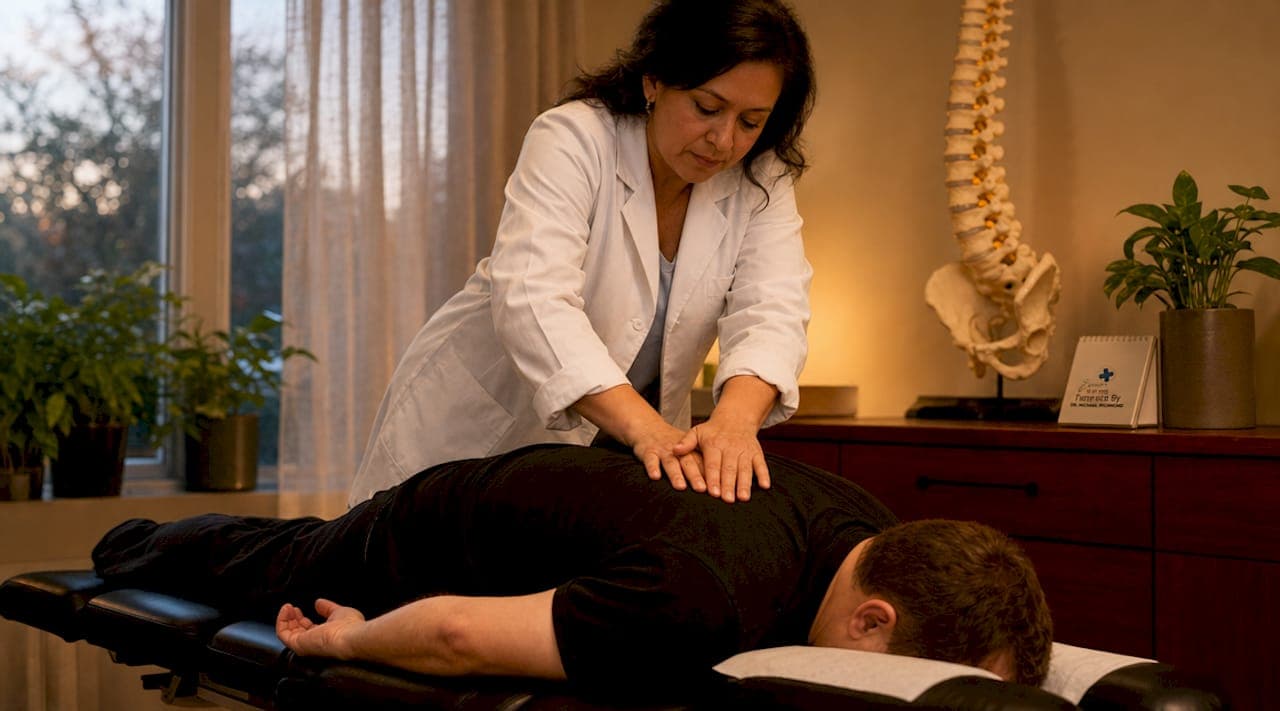
Spinal adjustment, formally called spinal manipulative therapy (SMT), is a hands-on technique in which a licensed clinician applies controlled force to specific vertebral joints to restore motion, reduce pain, and improve musculoskeletal function. The advantages of spinal adjustments extend well beyond simple back pain relief. Chiropractors, physical therapists, and osteopathic physicians all use SMT to address conditions ranging from chronic low back pain and neck stiffness to tension headaches and post-accident soft tissue injuries. Recent clinical evidence from Cochrane and JAMA confirms measurable short-term gains in both pain scores and physical function, making spinal adjustments one of the most studied non-drug therapies available today.
1. Measurable short-term pain relief
The primary advantage most patients seek is pain reduction, and the research supports it. A 2026 Cochrane review of 26 randomized controlled trials involving 6,070 adults found a mean difference of -4.16 points on a 100-point pain scale compared to placebo at approximately one month. That is a modest but clinically real reduction. For someone dealing with daily chronic low back pain, even a four-to-six-point drop translates to fewer missed workdays and better sleep quality.
Pro Tip: Track your pain score on a 0-to-10 scale before each session and after two weeks. Concrete numbers help your provider adjust the treatment plan faster than verbal descriptions alone.

The benefits of spinal adjustments for pain are most consistent in the short term. Long-term relief requires pairing adjustments with active self-care strategies, which later sections address in detail.
2. Improved physical function and reduced disability
Pain relief and functional recovery are not the same thing. The same Cochrane review found a standardized mean difference of -0.22 in disability scores, indicating moderate improvement in daily function. That means patients reported better ability to bend, lift, walk, and perform routine tasks after SMT. Functional gains matter more than pain scores for most working adults and parents.
Spinal alignment advantages in this context are practical. When vertebral joints move more freely, the surrounding muscles do not have to compensate with chronic tension, and the result is a wider range of motion across the whole body.
3. Reduced reliance on opioid medications
One of the most significant spinal alignment advantages in the current healthcare climate is the reduction in opioid use. Patients who use chiropractic care first for low back pain are 90% less likely to rely on opioid medications. That statistic reflects a structural shift in how pain is managed, not just a preference. Opioid dependency carries serious long-term risks including tolerance, withdrawal, and overdose, so any therapy that reduces that pathway has outsized public health value.
For patients in North Miami and across the U.S., this makes spinal adjustments a front-line option worth discussing with a provider before filling a prescription. Sparkmed specifically structures its care plans around non-pharmacologic recovery, which aligns directly with this evidence.
4. Enhanced nervous system signaling
Spinal adjustments do more than move bones. They influence the neural pathways that run through and alongside the vertebral column. Adjustments enhance spinal motion and improve nervous system signaling between the spine and brain, which can reduce the intensity of pain signals reaching conscious awareness. This is why many patients report feeling lighter or more alert immediately after a session, even before inflammation has had time to resolve.
The neurological mechanism involves both local and central effects. Locally, joint mobilization reduces mechanoreceptor firing that contributes to pain. Centrally, SMT appears to stimulate endorphin release, providing a natural analgesic effect without any pharmaceutical intervention.
5. Better muscle coordination and body awareness
The nervous system benefits extend beyond pain. Improved muscle coordination, balance, and body awareness are documented outcomes of regular spinal adjustments. When spinal joints are restricted, the brain receives distorted proprioceptive feedback, meaning your body's sense of its own position becomes less accurate. This contributes to poor posture, compensatory movement patterns, and increased injury risk.
Restoring joint motion through SMT recalibrates that feedback loop. Athletes use this principle deliberately. Seniors benefit from it as a fall-prevention strategy. For anyone recovering from a car accident, improved coordination accelerates the return to normal movement patterns. Sparkmed's chiropractic care for seniors covers this in detail for older patients managing chronic mobility challenges.
6. Autonomic nervous system regulation
Beyond the musculoskeletal system, spinal adjustments may influence autonomic functions. Research identifies potential modulation of parasympathetic pathways linked to digestion, mood regulation, and immune responses via vagus nerve activity. This is an emerging area of research, not a settled clinical fact, but the hypothesis is grounded in anatomy. The vagus nerve runs adjacent to the cervical spine, and cervical adjustments may directly affect its tone.
Patients sometimes report improvements in sleep quality, digestion, and stress tolerance after a course of SMT. These effects are harder to measure in clinical trials but are consistent enough in practice to be worth noting.
7. Neck pain and headache relief
Spinal adjustments are not limited to the lumbar region. Cervical adjustments reduce muscle tension and improve joint motion in the neck, which directly addresses two of the most common complaints: cervicogenic headaches and chronic neck stiffness. Cervicogenic headaches originate from restricted upper cervical joints and refer pain into the skull, temples, and behind the eyes. SMT targeting C1-C3 joints reliably reduces their frequency in clinical practice.
For patients who spend long hours at a desk or who sustained whiplash in a car accident, cervical adjustments combined with postural correction offer a targeted path to relief that anti-inflammatory medications cannot fully replicate.
8. Accelerated recovery from car accident injuries
Post-accident soft tissue injuries, including whiplash, lumbar sprains, and disc irritation, respond well to early SMT intervention. Spinal adjustments improve joint flexibility, reduce localized inflammation, and boost circulation to injured tissues. The Sparkmed spinal adjustment recovery guide outlines how this process works in the weeks following a collision.
Early mobilization of injured spinal segments prevents the formation of scar tissue adhesions that can permanently limit range of motion. Waiting too long to begin care is one of the most common mistakes accident victims make, often because they assume rest alone is sufficient.
9. Posture correction and spinal alignment
Chronic poor posture creates predictable patterns of joint restriction and muscle imbalance. Spinal adjustments address the joint restriction component directly, while the advantages of spinal alignment extend to reduced loading on intervertebral discs and decreased risk of degenerative changes over time. A spine that moves through its full range distributes compressive forces more evenly across each segment.
This is why spinal adjustments are not just a pain treatment. They function as a structural maintenance strategy. Maintaining daily spinal health habits alongside regular adjustments produces better long-term outcomes than either approach alone.
10. Safety profile compared to other interventions
One concern patients raise is whether spinal adjustments are safe. The 2026 Cochrane review reports no serious complications related to SMT across multiple randomized controlled trials. Serious harms appear rare when adjustments are performed by licensed practitioners following standard clinical protocols. Minor side effects such as temporary soreness at the treated site are common and typically resolve within 24 hours.
Compare this to the risk profile of long-term NSAID use, which includes gastrointestinal bleeding and cardiovascular events, or opioid therapy, which carries addiction risk. For most patients with musculoskeletal pain, SMT presents a favorable risk-to-benefit ratio.
11. Greater outcomes when combined with self-management
The PACBACK randomized clinical trial published in JAMA studied 1,000 participants and found that self-management with manipulation produced better disability reduction than spinal manipulation alone. Specifically, 67% of patients in the supported self-management group achieved a 50% or greater reduction in disability, compared to 54% in the manipulation-only group. That 13-percentage-point gap is clinically meaningful.
The practical implication is clear. Spinal adjustments work best as one component of a broader care plan that includes patient education, therapeutic exercise, and behavioral coaching. Providers who deliver adjustments in isolation, without addressing movement habits and psychosocial factors, are leaving measurable outcomes on the table.
Pro Tip: Ask your chiropractor for a home exercise program at your first visit. Patients who perform prescribed exercises between sessions consistently outperform those who rely on in-office treatment alone.
Proactive health self-management combined with professional SMT represents the current best-practice model for musculoskeletal recovery.
Key takeaways
Spinal adjustments deliver the strongest results when combined with clinician-guided self-management, therapeutic exercise, and consistent follow-up care.
| Point | Details |
|---|---|
| Short-term pain relief | SMT reduces chronic low back pain scores modestly but measurably within one month per Cochrane 2026 data. |
| Opioid reduction | Patients who start with chiropractic care are 90% less likely to use opioid medications for pain. |
| Nervous system effects | Adjustments improve neural signaling, endorphin release, and muscle coordination beyond the treated joint. |
| Safety record | No serious complications were observed across multiple RCTs; minor soreness is the most common side effect. |
| Combined care wins | PACBACK trial data shows 67% disability reduction with self-management plus SMT versus 54% with SMT alone. |
What I've learned from watching patients recover with and without full care plans
After working alongside chiropractors and seeing hundreds of recovery trajectories at Sparkmed, the pattern is unmistakable. Patients who come in expecting the adjustment itself to fix everything tend to plateau around week three. Patients who treat the adjustment as one tool in a larger recovery strategy, including sleep, movement, and stress management, keep improving past the point where most clinical trials stop measuring.
The research confirms this, but the research also understates it. The PACBACK trial measured disability at 12 months, which is a reasonable window. What it cannot capture is the difference between a patient who returns to full activity versus one who remains cautious and deconditioned for years. That difference almost always comes down to whether the provider built a real self-management plan or just scheduled the next appointment.
I also think the opioid comparison deserves more attention than it gets. A 90% reduction in opioid reliance is not a minor footnote. It is the central argument for why spinal adjustments belong in primary care pathways, not just specialty clinics. Every patient who avoids opioid dependency because they started with SMT is a success story that never gets counted in a pain scale.
The honest limitation is this: spinal adjustments do not produce dramatic, permanent results for everyone. Technique variability, treatment frequency differences, and individual anatomy all affect outcomes. The patients who benefit most are those who engage actively, communicate clearly with their provider, and track progress beyond just asking "does it hurt less today?" Functional markers, sleep quality, and activity tolerance tell a more complete story.
— Spark
Start your recovery with expert spinal care at Sparkmed
Sparkmed provides licensed chiropractic care in North Miami with a focus on real recovery outcomes, not just temporary relief. Whether you are managing chronic back pain, recovering from a car accident, or looking to improve your overall spinal function, the team at Sparkmed builds individualized care plans that combine spinal adjustments with active self-management support. Adjustments start at $25 and do not require insurance. Explore the Sparkmed blog for evidence-based guides on spinal health, injury recovery, and chiropractic treatment strategies. When you are ready to take the next step, booking a consultation is straightforward and available in English, Spanish, and Creole.
FAQ
What is a spinal adjustment and how does it work?
A spinal adjustment is a hands-on technique in which a licensed clinician applies a controlled, targeted force to a restricted vertebral joint to restore motion and reduce pain. The force stimulates mechanoreceptors, reduces pain signaling, and triggers endorphin release for natural relief.
How many sessions are needed to see benefits?
Most patients notice measurable pain and function improvements within the first four to six sessions, based on clinical trial data showing effects at approximately one month. Individual results vary depending on the condition, severity, and whether self-management exercises are included.
Are spinal adjustments safe?
The 2026 Cochrane review found no serious complications across multiple randomized controlled trials of spinal manipulative therapy. Minor temporary soreness at the treated site is the most commonly reported side effect.
Can spinal adjustments help after a car accident?
Spinal adjustments are a standard component of post-accident recovery care, addressing whiplash, lumbar sprains, and soft tissue injuries by restoring joint mobility and reducing inflammation. Early intervention prevents scar tissue formation and supports faster return to normal function.
Do spinal adjustments work better with other treatments?
The PACBACK trial found that combining spinal manipulation with clinician-supported self-management produced a 67% disability reduction rate, compared to 54% with manipulation alone. Adjustments deliver the best outcomes as part of a broader care plan that includes exercise and patient education.