
If you're dealing with neck stiffness, back pain, or limited mobility after a crash, this guide to spinal adjustment after car accident recovery is exactly what you need. Car accidents stress your spine in ways that don't always show up immediately. Whiplash, disc compression, and vertebral misalignment can quietly worsen over days or weeks without proper care. The good news is that evidence-based chiropractic care, when timed and structured correctly, can meaningfully reduce pain and restore function. Here's what you need to know to recover safely and effectively.
Table of Contents
- Key Takeaways
- Guide to spinal adjustment after car accident: what to do first
- Step-by-step spinal adjustment process after a crash
- Supporting therapies that improve adjustment outcomes
- Common mistakes in spinal adjustment recovery
- What recovery actually looks like over time
- My honest perspective on spinal adjustment after crashes
- Ready to start your spinal recovery at Sparkmed?
- FAQ
Key Takeaways
| Point | Details |
|---|---|
| Get evaluated within 14 days | Florida's PIP rule requires initial treatment documentation within 14 days to preserve insurance benefits. |
| Red flags mean stop and seek emergency care | Numbness, weakness, or bladder issues after a crash require immediate medical attention before any spinal adjustment. |
| Adjustments work best with other therapies | Combining spinal manipulation with exercise and massage produces significantly better outcomes than adjustments alone. |
| Follow-up care dramatically speeds recovery | Consistent chiropractic follow-up can accelerate recovery by 40% compared to skipping reassessments. |
| Realistic timelines matter | Most patients see measurable improvement in pain and mobility within 4 to 12 weeks of structured spinal therapy. |
Guide to spinal adjustment after car accident: what to do first
Before any chiropractor touches your spine, there are a few non-negotiable steps you need to take. Skipping them doesn't just risk your health. It can cost you financially too.
Get a proper medical evaluation
The single most important thing after a car accident is prompt medical evaluation, even if you feel fine the next morning. Adrenaline masks pain. Swelling builds slowly. What feels like minor soreness on day one can reveal a significant disc injury by day three.
More urgently, neurologic symptoms like numbness, limb weakness, difficulty walking, or any loss of bladder control require emergency care, not a chiropractic appointment. These are signals of potential spinal cord involvement, and manipulation in that context could make things much worse.
Watch for these red flag symptoms after your accident:
- Numbness or tingling running into your arms or legs
- Sudden weakness in your hands or feet
- Loss of bladder or bowel control
- Severe headache that starts at the base of the skull
- Difficulty maintaining your balance while standing or walking
If you have any of these, go to the emergency room before anything else. Once serious injury is ruled out, you can begin planning chiropractic care post-accident with confidence.
Understand the Florida 14-day rule
If you live in Florida, Florida Statute 627.736 requires that you receive initial medical treatment within 14 days of your accident to qualify for Personal Injury Protection benefits. Miss that window and your insurer can legally deny coverage for the entire course of chiropractic care and rehabilitation.
Failing to document symptoms within this period is one of the most common and costly mistakes accident victims make. When you see your provider, be specific. Describe every symptom, where it started, when it started, and how it affects your daily function. That documentation becomes your medical record and your insurance lifeline.
Pro Tip: Write down every symptom you notice in a notes app immediately after the accident, before your first appointment. Pain patterns, sleep disruption, and limited range of motion all belong in that record.
Step-by-step spinal adjustment process after a crash
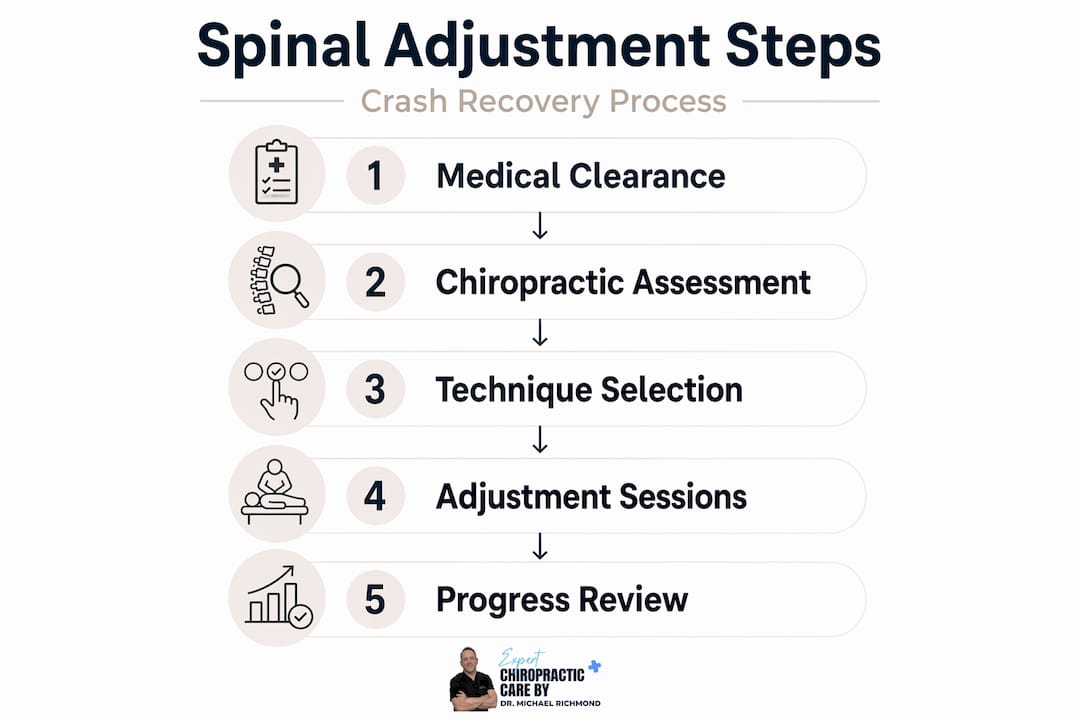
Once you have medical clearance and your documentation is in order, spinal care can begin. Here's what the process actually looks like.
Step 1: Initial chiropractic assessment
Your first visit is not an adjustment session. It's an assessment. The chiropractor will review your accident details, examine your posture, test your range of motion, and likely order X-rays or refer for MRI imaging to see what's happening structurally. This step determines whether you have spinal misalignment, disc involvement, or soft tissue injury requiring a specific approach.

Step 2: Understanding the adjustment techniques used
Not all spinal adjustments are the same. The technique used depends on your injury type, pain level, and recovery stage.
| Technique | Best for | Key feature |
|---|---|---|
| Diversified technique | General misalignment, acute pain | Manual high-velocity, low-amplitude thrust |
| Flexion-distraction | Disc herniation, lumbar issues | Gentle decompression using a specialized table |
| Chiropractic BioPhysics (CBP) | Cervical curve restoration, whiplash | Combines adjustments, traction, and exercises |
CBP protocols in particular have shown sustained improvements in posture and disability measures for whiplash patients even three months after treatment. For cervical injuries specifically, high-velocity cervical manipulation has demonstrated measurable improvement in cervical flexion, lateral bending, and pain scores in randomized clinical trials.
Step 3: Session structure and frequency
Most post-accident spinal adjustment plans run three to five sessions per week for the first two to four weeks, then taper based on your progress. Each session typically lasts 20 to 45 minutes. The chiropractor may use soft tissue work to prepare the muscles before adjusting, which makes the adjustment more effective and less uncomfortable.
Step 4: Your role before and after each session
You're not passive in this process. Before each session, hydrate well and avoid heavy exercise the same morning. After an adjustment, mild soreness is normal for 24 to 48 hours. Applying ice for 15 minutes can help. Avoid sitting for long periods immediately after treatment, and do the mobility exercises your provider assigns between visits.
Pro Tip: Keep a simple symptom log between visits. Note your pain level on a 1 to 10 scale each morning. That data helps your chiropractor refine the treatment plan and often shortens your total recovery timeline.
You can also read more about evidence-based chiropractic methods that have the strongest research support for post-crash spinal care.
Supporting therapies that improve adjustment outcomes
Spinal adjustments work best when they're part of a broader plan. Think of them as the cornerstone, not the whole building.
Multimodal care that combines manual therapy, guided exercise, and self-management consistently outperforms manipulation alone for neck pain and whiplash recovery. The 2016 Journal of Manipulative and Physiological Therapeutics guidelines formalized this, replacing older single-modality protocols for good reason.
Therapies that complement spinal adjustment well include:
- Therapeutic massage: Massage combined with spinal adjustments reduces muscle guarding, decreases inflammation, and improves the pressure environment around the spine, all of which help adjustments hold longer.
- Corrective exercises: Targeted exercises rebuild the muscular support around realigned vertebrae. Without this, the spine tends to drift back toward its dysfunctional position. Focus on cervical stabilizers and deep core work.
- Posture correction: Many accident patients develop guarded, forward-head postures that compound spinal strain. Addressing this through structured exercises and ergonomic awareness is part of real recovery.
- Stress and sleep management: Chronic stress keeps muscles tense and slows tissue healing. Poor sleep does the same. These aren't soft concerns. They directly affect how quickly spinal tissue repairs.
"Combining spinal adjustment with active therapies like exercise and soft tissue work isn't just better practice. It's what the research consistently shows produces the most durable recovery outcomes after car accidents." You can explore pain management therapy options that complement your chiropractic care for a fuller picture of multimodal approaches.
Common mistakes in spinal adjustment recovery
Even patients who commit to chiropractic care post-accident can make mistakes that set them back. Here are the most frequent ones, and how to sidestep them.
-
Waiting too long to start. Every day without care is a day your body adapts to the injury in compensatory patterns. Muscle tension hardens, joints stiffen, and inflammation compounds. One study found that patients who delay medical evaluation after rear-end collisions often present with worse outcomes months later.
-
Missing the 14-day insurance window. As covered earlier, this single mistake can strip you of thousands of dollars in covered care. There's no workaround once the deadline passes.
-
Expecting one adjustment to fix everything. Car accident spinal injuries develop over time. Recovery follows the same trajectory. Most patients need four to twelve weeks of structured care, not a single session.
-
Returning to full physical activity too fast. Gym sessions, heavy lifting, and high-impact activities before your spine has stabilized risk re-injury. Let your chiropractor clear you before resuming anything strenuous.
-
Not reporting new or worsening symptoms. If you develop new pain patterns, increased numbness, or any neurologic symptoms mid-treatment, contact your provider immediately. These signals indicate your treatment plan needs adjusting, not that you should push through.
What recovery actually looks like over time
Realistic expectations make better patients and better recoveries. Here's how spinal alignment after accident treatment typically progresses.
| Timeline | Expected progress |
|---|---|
| Week 1 to 2 | Initial pain reduction, decreased muscle spasm, improved sleep |
| Week 3 to 4 | Noticeable mobility gains, reduced reliance on pain medication |
| Week 5 to 8 | Functional improvement in daily activities, postural changes beginning |
| Week 9 to 12 | Structural spinal alignment measurable via imaging, strength rebuilding |
| After 12 weeks | Maintenance phase, reassessment of long-term spinal health goals |
Progress is tracked through a combination of posture assessments, patient-reported outcomes, and imaging. CBP protocol outcomes, for example, are verified using standardized cervical X-ray measurements at scheduled intervals. This data guides treatment modifications and confirms whether the spine is actually shifting toward better alignment.
Consistent follow-up care is not optional in this process. Research shows chiropractic follow-up accelerates recovery by up to 40% compared to patients who skip reassessments. Your provider needs to see how you're responding to adjust technique, frequency, and supplemental therapies accordingly.
If you're not seeing any meaningful change by week four, that's a signal worth discussing directly with your chiropractor. Good clinical care is adaptive, not rigid.
My honest perspective on spinal adjustment after crashes
I've worked with enough post-accident patients to know that the ones who recover fastest aren't always the most injured or the least. They're the ones who showed up consistently, communicated openly, and understood that adjustments alone weren't the whole answer.
What I've seen over and over is that patients who treat spinal adjustment as a passive experience, something done to them rather than with them, tend to plateau. The ones who do the assigned exercises between visits, track their symptoms, and ask questions recover faster and more completely.
I also want to be direct about a misconception I encounter constantly. Spinal adjustment is not a standalone fix for car accident injuries. The research I've reviewed, particularly the cervical spine guidelines published in 2016, is clear that manipulation works best as part of a broader plan. Providers who offer only adjustments and nothing else are leaving results on the table.
My honest advice: find a clinic that talks to you about exercise, posture, and lifestyle alongside adjustments. That's what real recovery looks like. Be patient with your spine. It went through something significant.
— Spark
Ready to start your spinal recovery at Sparkmed?
If this guide has helped you understand what spinal adjustment involves after a crash, the next step is getting an in-person evaluation from a chiropractor who specializes in exactly this type of recovery.
At Sparkmed in North Miami, the team works specifically with car accident patients and offers affordable spinal adjustments starting at just $25, with no insurance required. Whether you're two days post-accident or two months out, a proper assessment can identify what your spine needs and build a structured plan around it. The Sparkmed blog also continues to publish updated guides and recovery resources. Check out the full 2026 recovery guide for more on timing, techniques, and what to expect at every stage.
FAQ
What is a spinal adjustment after a car accident?
A spinal adjustment is a controlled, targeted movement applied to a vertebral joint by a chiropractor to restore proper alignment, reduce pain, and improve mobility after a car accident causes spinal misalignment or injury.
How soon after a car accident should I get a spinal adjustment?
You should seek medical evaluation within 24 to 72 hours of your accident and, if cleared, begin chiropractic care as soon as possible. In Florida, starting treatment within 14 days is required to maintain PIP insurance coverage.
How many spinal adjustment sessions do I need after a crash?
Most car accident patients require 3 to 5 sessions per week for the first 2 to 4 weeks, with frequency tapering as recovery progresses. The full course typically spans 4 to 12 weeks depending on injury severity.
Can spinal adjustments make a car accident injury worse?
When performed after proper evaluation and with medical clearance, spinal adjustments are safe. However, patients with undetected fractures, neurologic symptoms, or severe disc herniation must be screened first. This is why a diagnostic assessment before the first adjustment is non-negotiable.
Do spinal adjustments actually realign the spine after an accident?
Yes. Research on CBP protocols shows measurable cervical alignment improvements verified through X-ray measurements, with benefits sustained at three-month follow-up when combined with exercises and mechanical traction.