

Most people feel mild soreness, stiffness, or a passing headache after a chiropractic adjustment, and it typically fades within 24 to 48 hours. Serious complications like nerve damage or artery injury are documented in the research but occur rarely. Prospective studies, systematic reviews, and the NCCIH agree on that basic picture. If you ever develop sudden severe headache, slurred speech, vision changes, or one-sided weakness after an adjustment, treat it as a medical emergency and get to an emergency room immediately.
TL;DR:
- Most side effects, including soreness, stiffness, and mild headache, are temporary, usually resolving within 24 to 48 hours, with worsening symptoms after that requiring medical attention.
- Serious adverse events like artery dissection or nerve injury are rare but require immediate emergency care if neurological symptoms such as severe headache, weakness, or vision loss occur.
- About 30% of patients report some adverse reaction, predominantly mild local discomfort, headache, or fatigue, which are more common with high-velocity manipulation than gentler mobilization.
- Patients with preexisting conditions like severe osteoporosis, spinal cancer, or vascular disease face higher risks and should discuss alternative techniques such as mobilization.
- Responsible practitioners perform pre-treatment screening and explain risks, especially for higher-risk patients, and advise seeking emergency care if unusual or severe symptoms develop afterward.
Table of Contents
- Chiropractic Adjustment Side Effects: What's Normal
- How Often Do Side Effects Actually Happen?
- Rare but Serious Risks and Warning Signs
- Are You at Higher Risk? Contraindications to Discuss First
- What Happens During and After Your Visit
- How Chiropractors Lower the Risk
- Sparkmed's Approach to Screening and Aftercare
- The Clinical Reality: Weighing Likely Benefit Against Rare Harm
- Considering an Evaluation? Here's a Practical Next Step
- Sources
- FAQ
Chiropractic Adjustment Side Effects: What's Normal
Soreness after a chiropractic adjustment is the most common reaction, and it behaves a lot like the ache you get after a hard workout you're not used to. That comparison isn't just a figure of speech. The discomfort often resembles delayed-onset muscle soreness, a normal adaptation response as joints and surrounding tissue adjust to new mechanics, and it settles the same way DOMS does: quickly, and usually without any intervention.
The most frequently reported reactions include:
- Local soreness or tenderness at the site of the adjustment, often in the neck, mid back, or lower back
- Stiffness that makes the area feel tight for a day or so
- Mild headache, usually tension-type rather than severe
- Fatigue or a general tired feeling, sometimes described as similar to how muscles feel after a good stretch session
- Transient radiating discomfort, a brief ache that travels slightly beyond the treated joint
These reactions typically start within a few hours of treatment and resolve within 24 to 48 hours, according to prospective data on chiropractic side effects. If soreness is still getting worse after two days rather than easing up, that's a signal to call your provider rather than wait it out.
Self-care during that window is straightforward. Gentle movement, walking, light stretching, keeps joints from stiffening up. Ice works well on fresh, sharp soreness in the first day; heat is usually more comfortable once it shifts into a dull, stiff ache. Staying hydrated and getting a full night's sleep both support the normal recovery process.
One myth worth retiring: the idea that adjustments release "toxins" into your bloodstream, which supposedly explains the tiredness or achiness afterward. There's no physiological mechanism behind that claim. The fatigue and soreness are tied to musculoskeletal adaptation, not detoxification.
Pro Tip: Keep a simple log of how you feel for the first three visits, noting what eased up fast and what lingered. Patterns matter more than any single reaction, and it gives your chiropractor real data to adjust technique or intensity if needed.
How Often Do Side Effects Actually Happen?
A substantial portion of patients report at least one adverse reaction after spinal manipulation, based on findings from prospective studies. That's a wide spread, and the reason matters: different studies define "adverse reaction" differently, some count anything from mild stiffness to genuine pain, which pushes the numbers in different directions.
About 30% of participants reported adverse symptoms in the UCLA neck pain study, one of the more rigorous randomized trials on this question.
That UCLA trial tracked 280 respondents who together reported 212 adverse symptoms. Within that data, a consistent pattern shows up across the broader research:
- Local discomfort accounts for roughly 66% of reported reactions
- Headache shows up in about 10% of cases
- Fatigue shows up in a similar share, around 10%
- Manipulation (the higher-velocity technique) produced more early reactions than gentler mobilization, with an adjusted odds ratio of 1.44
A systematic review of adverse effects backs up the general shape of these findings: increased pain, headache, tiredness, and radiating discomfort are the most frequently reported effects, and most are mild and short-lived.
Here's the honest caveat researchers keep flagging: these numbers likely undercount reality. Patients don't always report mild symptoms, follow-up periods vary, and many studies rely on self-report rather than clinical exam. None of this proves that manipulation causes every reported symptom either. Correlation and coincidence are hard to fully separate in observational data, which is exactly why the serious-risk conversation below matters.
Rare but Serious Risks and Warning Signs
The risk that draws the most attention, and the most fear, is cervical artery dissection, a tear in the wall of an artery in the neck that can lead to stroke. Case reports and some case-control studies have documented this association after neck manipulation, but the research pool is honest about the uncertainty: dissections also happen spontaneously, and people who already have early dissection symptoms (like neck pain or headache) may be more likely to seek chiropractic care in the first place, which muddies cause and effect.
Establishing true causality is difficult because spontaneous artery dissections occur even without any manipulation, and preexisting neck pain can be both the reason someone seeks care and an early symptom of the dissection itself.
Beyond vascular events, other serious complications reported in the literature include nerve injury, disc herniation, vertebral fracture, and, rarely, hematoma. These are documented, but they are uncommon events relative to the volume of adjustments performed. The systematic review is direct about this: serious harms are real but reliable incidence figures remain elusive.
What matters practically is knowing the red flags that mean stop and seek emergency care, regardless of how recently you had an adjustment:
- Sudden, severe headache unlike any you've had before
- Sudden vision changes, double vision, or loss of vision
- Slurred speech or difficulty finding words
- Sudden weakness or numbness, especially on one side of the body
- Loss of coordination or balance
- Loss of bladder or bowel control
Any of these symptoms warrants a call to 911 or a trip to the emergency department immediately. Don't wait to see if it passes, and don't call your chiropractor first. These are neurological emergencies, and time matters.
Are You at Higher Risk? Contraindications to Discuss First
Certain health conditions raise the risk profile of spinal manipulation enough that a chiropractor should modify or avoid it altogether. Screening for these factors before the first adjustment is standard, responsible practice, not an extra precaution.
- Severe osteoporosis. Weakened bone density increases fracture risk during high-velocity manipulation.
- Spinal cancer or bone-destroying lesions. Any known malignancy affecting the spine changes the risk calculation entirely.
- Unstable spine, from trauma, congenital conditions, or prior surgery, where manipulation could worsen instability.
- Bleeding disorders or active use of anticoagulant medication, which raise the risk of hematoma or bleeding complications.
- Prior vascular disease, including any history of artery dissection or stroke.
- Connective tissue disorders that affect ligament and joint integrity.
- Recent major trauma, where undiagnosed fractures or soft tissue injury may not yet be visible.
- Severe baseline neck disability, which the UCLA neck pain study linked to a much higher risk of neurologic adverse symptoms, with an odds ratio of 5.70.
Tell your provider about every medication you take and every diagnosis you have, even ones that seem unrelated to your spine. A chiropractor can't screen for a risk they don't know exists.
What Happens During and After Your Visit
The adjustment itself is quick: a controlled, targeted force applied to a joint, often accompanied by the popping or cracking sound (that's gas releasing from the joint capsule, not bone grinding on bone). Many patients feel immediate relief in mobility or tension. Some feel mild soreness starting within hours, following the same 24 to 48 hour pattern described earlier.
Aftercare is simple:
- Stay moderately active; gentle walking beats sitting still
- Skip heavy lifting or intense exercise for the rest of the day
- Use ice for sharp, fresh soreness or heat for lingering stiffness
- Over-the-counter pain relievers are fine for mild discomfort if needed
Call your clinic if soreness is worsening past 48 hours or feels different from typical post-adjustment ache. Go to the emergency department, not your chiropractor's office, if you notice any of the red-flag neurological symptoms covered above.
How Chiropractors Lower the Risk
Responsible screening happens before the first adjustment, not after a problem shows up. That means a full health history, a baseline neurological exam, and direct questions about the contraindications above.
- Practitioners weigh manipulation against gentler mobilization, especially for patients with elevated risk factors, since mobilization produced fewer early adverse reactions than high-velocity manipulation in randomized data
- Informed consent should include a real conversation about risks and benefits, not a signature on a form
- If something looks atypical during screening or a response seems out of proportion, imaging or referral to another specialist is the appropriate next step
Pro Tip: Ask your chiropractor directly whether they'd recommend mobilization instead of manipulation for your specific case. A provider who takes that question seriously, and explains the tradeoff, is showing you exactly the kind of clinical judgment you want.
Sparkmed's Approach to Screening and Aftercare
Some clinics treating accident-recovery patients review health history before any adjustment, paying attention to injuries from car accidents, workplace incidents, and slip-and-falls, where undiagnosed trauma is a real concern. Education often happens in multiple languages to avoid screening conversations being lost to a language gap.
If you're recovering from a collision, Why Adjust After a Car Accident: Your Recovery Guide walks through what screening and treatment typically look like in that context. If you're unsure whether your symptoms even warrant a visit, 10 Signs You Need a Chiropractor covers the common indicators worth acting on.
The Clinical Reality: Weighing Likely Benefit Against Rare Harm
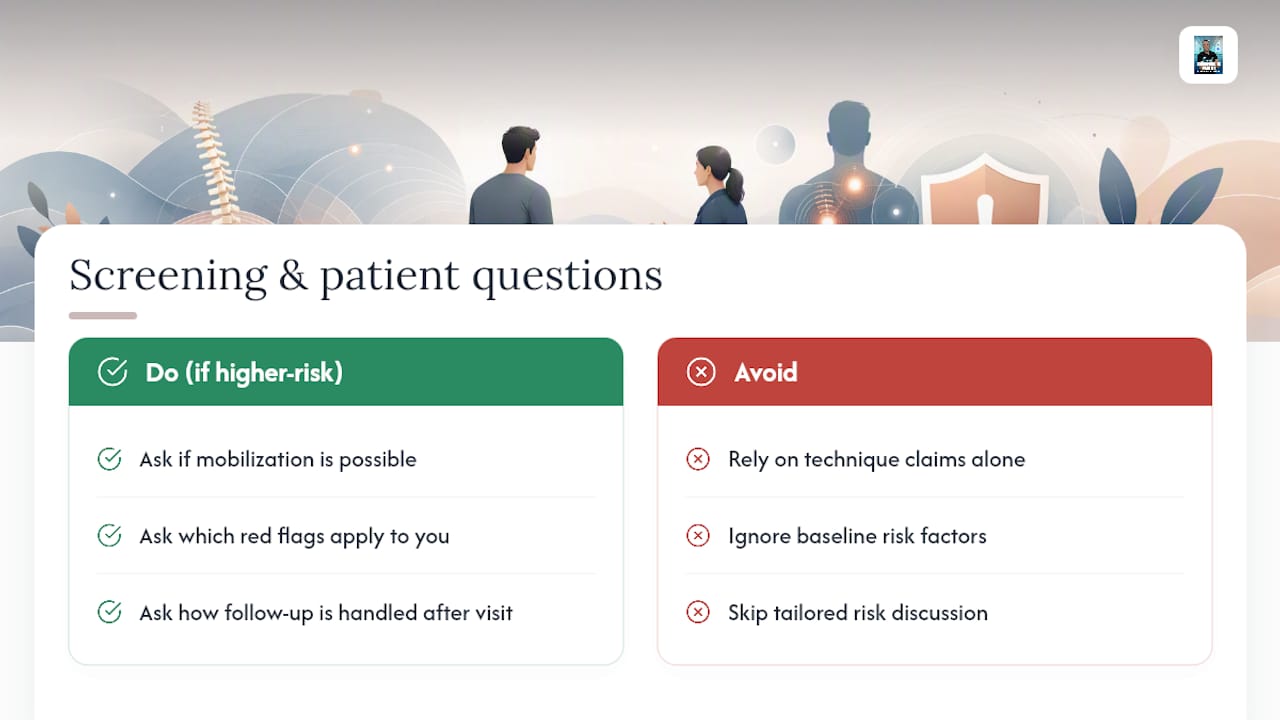
The honest takeaway is unglamorous: side effects are common, mostly mild, and self-limited, while the rare serious harms deserve real respect without tipping into fear. Screening is the lever that matters most here, not the adjustment technique alone. A patient with severe baseline neck disability or a bleeding disorder isn't the same risk profile as a healthy 30-year-old with occasional stiffness, and a good clinician treats them differently.
If you fall into a higher-risk category, ask specifically whether mobilization is an option, what red flags to watch for in your case, and how the clinic follows up after your first visit. Those three questions tell you more about a provider's judgment than any marketing claim ever will.
— Spark
Considering an Evaluation? Here's a Practical Next Step
Sparkmed's model is built for people who need answers fast, not a six-visit workup before anyone addresses their pain. If you're weighing whether chiropractic care is right for you, especially after a car accident, workplace injury, or a fall, a direct evaluation with baseline screening is the way to find out safely rather than guessing from an article.

Sparkmed's chiropractic services include the same screening steps covered above: health history, baseline neurological check, and a conversation about which technique fits your situation, delivered in English, Spanish, or Creole depending on what you need. If this is your first visit, How to Prepare for Your Chiropractic Visit After an Accident covers what to bring and what to expect. The next step is simple: book an evaluation and get a clear answer on your risk profile before your first adjustment.
Sources
The frequency and timeline data throughout this article draws from a prospective study on chiropractic side effects and the UCLA neck pain study, both of which track adverse reactions directly in treated patients. The systematic review of adverse effects synthesizes case reports and larger studies to address rarer, more serious events. For a general patient-facing summary, NCCIH's guidance on spinal manipulation covers both the common and rare outcomes in plain language. A third-party clinic resource on what actually happens during a session offers a complementary patient perspective on short-term reactions.
This article is general information, not a substitute for advice from a qualified doctor. Consult a qualified healthcare professional about your own circumstances before acting on anything here.
- Side effects of chiropractic treatment: a prospective study
- Frequency and clinical predictors of adverse reactions to chiropractic care in the UCLA neck pain study
- Adverse effects of spinal manipulation: a systematic review
- Spinal manipulation: What you need to know | NCCIH
FAQ
What are the potential side effects of neck manipulation?
The most common reactions are local soreness, stiffness, mild headache, and fatigue, usually starting within hours and resolving within 24 to 48 hours. Rare but serious risks include cervical artery dissection and nerve injury, which is why screening for risk factors matters before treatment.
Is it normal to experience flu-like symptoms after a chiropractic adjustment?
True flu-like symptoms with fever aren't a typical or expected reaction, and persistent symptoms should prompt a call to your provider.
Is it normal to faint after a chiropractic adjustment?
Fainting is not a commonly reported reaction in the research on chiropractic care and shouldn't be treated as routine. If you feel lightheaded or faint during or after an adjustment, tell your chiropractor immediately, since this can sometimes signal a vascular issue that needs prompt evaluation.
Is it normal to experience muscle spasms after a chiropractic adjustment?
Mild muscle tightness or spasm can happen as tissue adapts to a new adjustment, similar to soreness after unaccustomed exercise, and it typically eases within a day or two. Spasms that are severe, don't improve, or come with radiating pain or numbness deserve a follow-up call to your clinic.
When should I seek emergency care after a chiropractic adjustment?
Go to an emergency room immediately if you develop sudden severe headache, vision changes, slurred speech, sudden weakness, loss of coordination, or loss of bladder or bowel control. These symptoms point to a possible neurological emergency and should never wait for a callback from your chiropractor's office.