

After a car accident or slip and fall in North Miami, most people assume one chiropractic visit handles everything. It doesn't. Injuries from trauma often involve layers of tissue damage, nerve irritation, and inflammation that don't resolve in a single session. Research confirms that structured follow-up yields 40% faster recovery compared to sporadic or single-visit care, and early intervention within 72 hours reduces long-term disability risk by 60%. This guide breaks down exactly how chiropractic follow-up works, what a realistic plan looks like, and how to adapt it when your situation is more complicated than average.
Table of Contents
- Why chiropractic follow-up matters after accidents
- The typical chiropractic follow-up plan
- Adapting chiropractic follow-up for special cases
- Long-term maintenance, risks, and expert controversy
- What most people miss about chiropractic follow-up
- Get expert, personalized follow-up care near you
- Frequently asked questions
Key Takeaways
| Point | Details |
|---|---|
| Consistent follow-up speeds healing | Following a structured chiropractic plan can reduce pain and disability much faster after injuries. |
| Follow-up plans are phased | Most care starts intensive, then tapers based on progress and individual needs. |
| Care adapts for special cases | Frequency and methods are adjusted for severe injuries, children, elderly, or insurance limits. |
| Maintenance not for everyone | Long-term visits are only helpful for those with recurring or chronic pain—most can taper off. |
| Personalization improves outcomes | Best results come from response-driven adjustments and combining with other therapies. |
Why chiropractic follow-up matters after accidents
One adjustment can bring immediate relief. But relief is not the same as recovery. When trauma hits your spine and soft tissues, the body triggers a healing cascade that takes weeks to complete. Without guided support, that process goes sideways: scar tissue forms improperly, muscles compensate in harmful patterns, and inflammation lingers.
"Early intervention within 72 hours of injury can reduce long-term disability risk by up to 60%, and structured follow-up yields 40% faster recovery outcomes." Efficacy of chiropractic follow-up after injury
The way chiropractors aid recovery after injuries goes well beyond cracking backs. Follow-up visits allow your provider to track inflammation levels, adjust spinal alignment as swelling decreases, and reinforce muscle memory through repeated, targeted treatment. Each visit builds on the last.
Here are the core benefits that consistent follow-up delivers:
- Pain reduction: Repeated adjustments retrain pain signals and reduce nerve compression over time
- Inflammation control: Specific techniques help lymphatic drainage and reduce localized swelling
- Restored function: Mobility improves incrementally with each session, not all at once
- Lower risk of chronic issues: Regular monitoring catches complications before they become permanent
- Better coordination of care: Your chiropractor can flag when you need referrals to other specialists
What's often overlooked is the mental side. Accident trauma doesn't just affect your body. Mental health recovery after accidents is a real, measurable challenge, and chiropractic care that addresses physical pain also reduces the stress load that slows psychological healing. The wellness benefits of chiropractic extend into nervous system regulation, which directly affects mood, sleep, and anxiety after trauma.
When chiropractic follow-up is paired with appropriate medical support and mental health resources, you get a whole-person recovery plan instead of a piecemeal approach.
The typical chiropractic follow-up plan
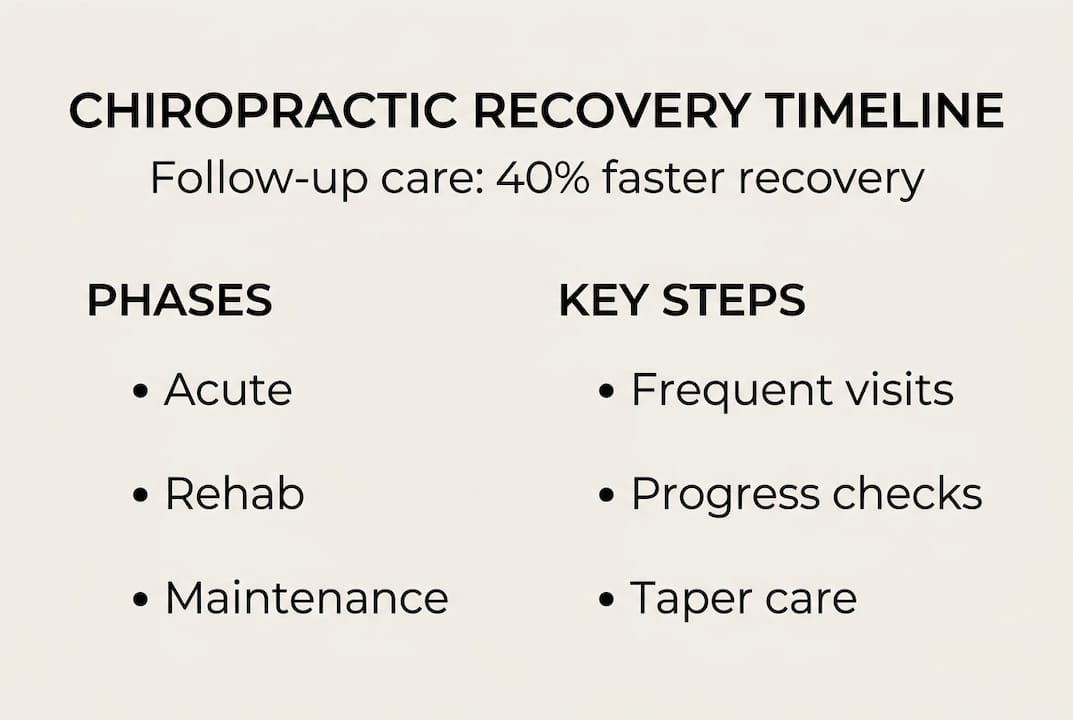
Knowing that follow-up matters is one thing. Understanding what it actually looks like week to week is where most patients feel lost. A structured plan is typically broken into three phases, each with a distinct goal and visit frequency.
Follow-up care after injury is not open-ended. It has shape and direction. Here's how the phases break down:
| Phase | Duration | Visit frequency | Main goal |
|---|---|---|---|
| Acute | 2 to 4 weeks | 2 to 3 times per week | Reduce pain and inflammation |
| Stabilization | 4 to 8 weeks | 1 to 2 times per week | Restore function and strength |
| Maintenance | Ongoing if needed | Monthly or quarterly | Prevent recurrence |
The chiropractic treatment plan structure confirms this phased approach is the clinical standard, not an upsell. Each phase has specific milestones you should be hitting before moving forward.
Here's what to expect within each phase:
- Acute phase: Your chiropractor focuses on pain relief and reducing nerve irritation. Expect gentle adjustments, ice or heat therapy, and possibly soft tissue work. You may feel sore after early sessions. That's normal.
- Stabilization phase: The emphasis shifts to rebuilding strength and restoring normal movement patterns. Exercises may be added. Visits become less frequent because your body is now doing more of the work on its own.
- Maintenance phase: This is optional and case-specific. It's designed for people with chronic pain histories or high re-injury risk. Think of it as periodic tune-ups, not ongoing treatment.
Pro Tip: Before your first follow-up visit, write down exactly where your pain is located, its intensity on a scale of 1 to 10, and any activities that make it worse. This speeds up assessment and helps your provider prepare for chiropractic visit outcomes more accurately.
One critical point: the plan adapts to you. If you're responding faster than average, visits taper sooner. If progress stalls, your chiropractor reassesses rather than just continuing the same approach. Rigid schedules that ignore your actual response are a red flag. Also worth knowing is that chiropractic vs surgery after accidents is a real decision many patients face, and the follow-up plan often determines whether non-surgical care remains viable.

Adapting chiropractic follow-up for special cases
Not every recovery follows the standard three-phase path. Certain factors change the timeline, technique, and even the goal of follow-up care significantly.
Severe injuries such as disc herniations, nerve root compression, or fractures require a much longer runway. Clinical evidence shows these cases can need 12 to 16 or more weeks of care, sometimes 25 to 40 or more visits before meaningful stabilization is reached. The technique set also changes: high-velocity adjustments may be replaced with low-force methods, traction, or decompression therapy.
Pediatric patients (children) and geriatric patients (older adults) both need modified approaches:
- Children's connective tissue is more flexible, so recovery is often faster, but technique must be age-appropriate and very low force
- Older adults may have pre-existing degenerative changes that complicate baseline assessment and slow progress
- Both groups may have limited communication about symptom changes, requiring closer observation between visits
- Medications common in older adults can mask pain signals, making objective measures like range of motion testing more important
Insurance limitations are a practical reality. Most plans cover the acute phase without issue, but coverage often tightens at the 12-week mark. Without documented medical justification, extended visits may be denied. Keep detailed records of your progress notes and make sure your provider documents functional improvements at every visit, not just pain scores.
Pro Tip: If your insurer starts pushing back on continued care, ask your chiropractor for a formal functional assessment report. Objective data like grip strength, range of motion measurements, and activity limitations carries far more weight than pain ratings alone.
If you're experiencing delayed trauma symptoms that show up days or weeks after the accident, make sure your follow-up plan is updated to reflect those new findings. A plan built on week-one symptoms may not be adequate for what's actually happening in week four. Specialized chiropractic for kids and seniors is available at clinics experienced with post-accident care.
Long-term maintenance, risks, and expert controversy
Maintenance chiropractic care generates genuine debate among clinicians. Some providers advocate for monthly visits indefinitely. Others argue that ongoing care without clear goals creates dependency without measurable benefit. Both sides have valid points, and the evidence reflects that complexity.
Maintenance care helps chronic or recurrent cases, but the same research notes that evidence is mixed for long-term plans in acute injuries. If you had a straightforward whiplash and you've fully recovered, monthly adjustments offer little clinical value.
The risks of overtreatment are real:
"Overuse of spinal manipulation in cases that have already resolved can lead to joint irritation, patient dependency, and unnecessary healthcare costs without corresponding benefit."
A more balanced view comes from response-based tapering insights, which support defining clear outcome milestones before starting care and tapering visits based on actual progress rather than a fixed calendar. This approach protects patients from both undertreatment and overtreatment.
Here's a side-by-side comparison to clarify when maintenance care makes sense:
| Patient profile | Maintenance care warranted? | Rationale |
|---|---|---|
| Acute whiplash, fully resolved | No | Goals met, no recurrence risk |
| Chronic low back pain history | Yes | High recurrence risk justifies periodic care |
| Disc herniation with residual symptoms | Maybe | Depends on functional status and pain levels |
| Elderly with degenerative spine | Often yes | Ongoing support preserves mobility |
For more on chiropractic recovery, including how to track your own progress between visits, explore evidence-based resources that give you the tools to be an active participant in your care rather than a passive recipient.
What most people miss about chiropractic follow-up
After working with accident recovery patients for years, the pattern we see repeatedly is this: people either stop too early because they feel better, or they stay too long because the schedule feels safe. Both mistakes cost real time and real money.
The best outcomes happen when care is driven by measurable progress, not comfort or habit. That means setting specific milestones at the start: a target range of motion, a functional activity you want to return to, a pain level you want to sustain. When you hit those targets, you phase out visits. When you stall, you reassess.
The recovery after injuries guide supports this view clearly: combining chiropractic care with home exercise, movement retraining, and where needed, physical therapy, produces better outcomes than chiropractic alone. Follow-up care is most powerful when it's part of a broader plan you're actively engaged in, not something done to you twice a week.
Get expert, personalized follow-up care near you
Knowing the phases and principles of follow-up care is valuable, but putting it into practice requires a provider who actually listens and adapts the plan to your specific injury, history, and goals.

At SPARK Chiropractic in North Miami, we've spent over 20 years helping accident and slip and fall patients rebuild after trauma. We don't use cookie-cutter schedules. We build a follow-up plan around your injury, your response to treatment, and your life. Whether you have insurance or not, we have options that make consistent care accessible. Book a chiropractic consultation and let's map out a recovery plan that actually fits your situation.
Frequently asked questions
How often should I follow up with my chiropractor after an accident?
Most people start with 2 to 3 visits per week for 2 to 4 weeks, then reduce frequency as recovery progresses. The standard acute phase moves into stabilization visits of 1 to 2 times per week over the following 4 to 8 weeks.
Can chiropractic follow-up really speed up my recovery?
Yes. Structured follow-up yields up to 40% faster recovery and dramatically reduces the risk of chronic pain developing from an acute injury.
Is ongoing maintenance care necessary for everyone?
No. Maintenance care is best suited for people with chronic or recurrent conditions. Most acute injury patients do not need long-term maintenance visits once their recovery goals are met.
What if I'm not improving during chiropractic follow-up?
A clinical plateau triggers reassessment or referral to another specialist. Continuing the same plan when progress has stopped is not appropriate care.
Does insurance typically cover chiropractic follow-up care?
Insurance generally covers the acute phase, but may limit extended visits. Coverage often restricts treatment past 12 weeks without documented medical justification from your provider.