

You just got handed a treatment plan after your car accident and it's full of words like "subluxation," "CMT 98941," and "HVLA thrust." If reading that felt like decoding a foreign language, you're not alone. Most people in North Miami who've been in a collision walk out of their first chiropractic visit more confused than when they came in. Understanding these terms isn't just about satisfying curiosity. It directly shapes which treatments you agree to, what your insurance will actually pay for, and how fast you recover.
Table of Contents
- Key chiropractic terms: What you need to know
- Chiropractic manipulative treatment (CMT) codes and insurance
- Popular chiropractic techniques for car accident recovery
- Evidence, risks, and the subluxation debate
- A fresh perspective: What actually helps after a North Miami car accident
- Connect with Spark Chiropractic for your recovery
- Frequently asked questions
Key Takeaways
| Point | Details |
|---|---|
| Decoding adjustment terms | Understanding HVLA, mobilization, and subluxation empowers your recovery process. |
| Navigating CMT codes | Knowing Medicare CPT codes helps you interpret your insurance coverage after accidents. |
| Technique selection matters | The right chiropractic method depends on your injury’s type and severity. |
| Evidence and safety | Research shows chiropractic offers modest benefits and low risks for accident recovery. |
| Smart recovery strategies | Combining chiropractic with physical therapy speeds post-accident progress. |
Key chiropractic terms: What you need to know
Now that you've seen why clarity matters, let's decode the key chiropractic terms you'll encounter from your very first visit.
The term chiropractic adjustment gets used loosely, but it has a precise clinical meaning. A chiropractic adjustment is a controlled, high-velocity, low-amplitude (HVLA) thrust applied to a joint to restore its normal motion, reduce pain, and correct dysfunction. "High-velocity" means the movement is fast. "Low-amplitude" means it covers a very small distance. Think of it like a quick, precise pop rather than a long push.

Mobilization, by contrast, is a low-velocity technique. Your chiropractor moves the joint through its natural range of motion slowly and repeatedly, without the quick thrust. Mobilization feels gentler and is often preferred when inflammation is high, right after an accident.
Subluxation is one of the most debated terms in chiropractic. Traditionally it described a partial dislocation of a vertebra causing nerve interference. Today, many evidence-based chiropractors use it to describe a joint that's not moving correctly, causing local dysfunction and pain. Medicare and most insurance companies still use subluxation as the clinical justification for covered treatment.
Spinal manipulative therapy (SMT) is the umbrella term that covers both adjustments and mobilizations. When you see SMT in research or insurance documents, it can mean either approach.
Here are some of the most common injuries from car accidents that chiropractic care addresses:
- Whiplash: Rapid forward-backward head movement that strains the muscles and ligaments of the neck
- Cervical disc injury: Pressure or damage to the discs between the vertebrae in the neck
- Soft tissue injuries: Sprains and strains of muscles, tendons, and ligaments throughout the spine
- Lumbar sprain: Lower back strain from the sudden jolt of impact
- Thoracic dysfunction: Mid-back stiffness from bracing during a crash
Understanding which injury you have helps you ask better questions. For example, if your chiropractor says you have a cervical subluxation causing whiplash symptoms, you now know that means a neck joint isn't moving correctly and is producing pain and muscle tightness.
"A chiropractic adjustment is a controlled, high-velocity, low-amplitude thrust designed to restore joint motion and reduce pain. It is clinically distinct from mobilization, which uses slower, gentler movement." — Chiropractic Authority
Learning about chiropractic wellness benefits can also help you understand why these treatments go beyond just pain relief and support longer-term recovery after trauma.
Chiropractic manipulative treatment (CMT) codes and insurance
Once you know the essential terms, it's important to understand how they're reflected on your insurance documents and Medicare coverage.
Every chiropractic visit that involves spinal manipulation gets billed with a CPT code (Current Procedural Terminology code). These are standardized numbers used across all healthcare billing. For chiropractic manipulative treatment, these are the key codes:
| CPT Code | Regions Treated | Common Use After Car Accident |
|---|---|---|
| 98940 | 1 to 2 spinal regions | Minor whiplash, isolated neck pain |
| 98941 | 3 to 4 spinal regions | Mid and lower cervical plus thoracic |
| 98942 | All 5 spinal regions | Full-spine trauma involvement |
| 98943 | Extraspinal (ribs, pelvis, extremities) | Shoulder or rib injury from seatbelt |
The five spinal regions are: cervical (neck), thoracic (mid back), lumbar (lower back), sacral, and pelvic. A serious car accident often affects multiple regions, which is why 98941 and 98942 are common in accident cases.
The AT modifier is a two-letter add-on code that Medicare requires. It signals that the treatment is for active care of an acute condition, not routine maintenance. Without the AT modifier, Medicare won't pay for the visit. This is one reason why the terminology matters: if your chiropractor doesn't document your subluxation as acute, your claim could be denied.
Here's how Medicare coverage actually breaks down for chiropractic:
- Covered: Manual manipulation of a subluxation diagnosed by the chiropractor
- Covered with AT modifier: Active treatment of a new or worsening acute condition
- Not covered: Maintenance care once you've plateaued in recovery
- Not covered: X-rays, massage, electrical stimulation, or any physical therapy performed by the chiropractor
This last point surprises many accident victims. Your chiropractor might recommend electrical stimulation or heat therapy alongside adjustments, but Medicare won't pay for those add-ons. Private insurance and personal injury protection (PIP) plans often cover more, but you need to check your specific policy.
Pro Tip: Ask your chiropractor's billing staff which CPT codes they plan to use before your second visit. If your accident injured your neck and lower back, you should expect a code of at least 98941, not 98940. An under-coded visit could reflect inadequate documentation, which can hurt your injury claim later.
You can also explore chiropractic CPT codes and related topics in our blog to get familiar with how billing reflects your actual treatment before you sign any forms.
Popular chiropractic techniques for car accident recovery
Knowing how insurance codes function, let's explore which chiropractic techniques are most commonly applied and why they matter for recovery.
The three most widely used techniques in accident recovery are Diversified, Gonstead, and Cox flexion-distraction. Each has a different approach, and choosing the right one matters for your specific injury.
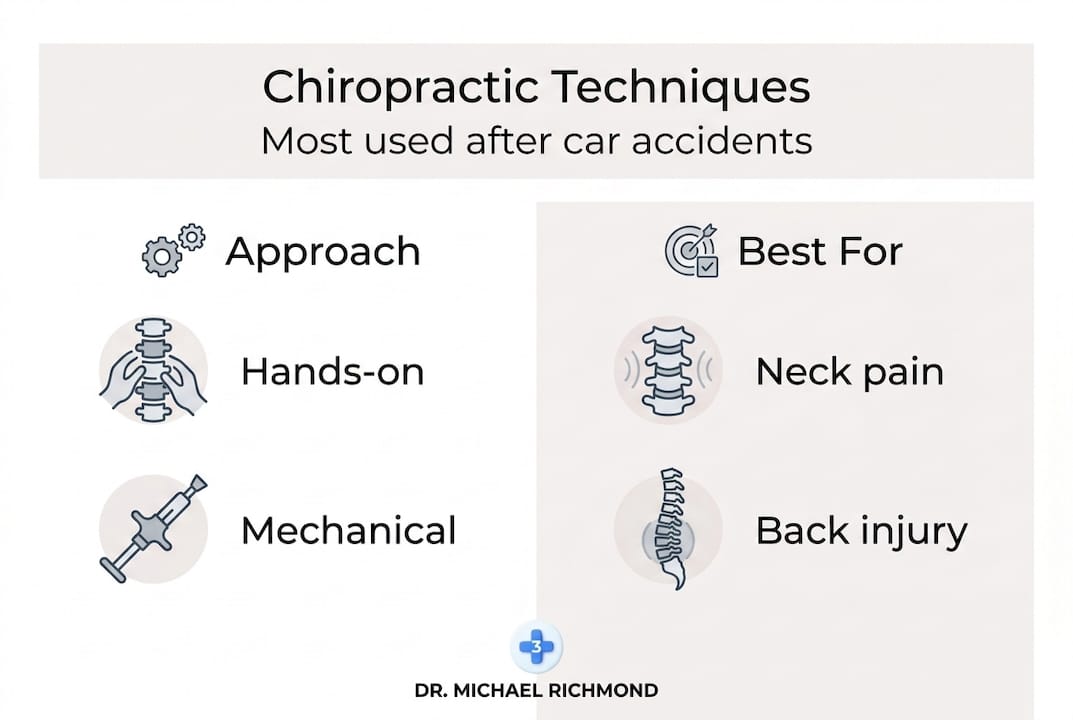
| Technique | Approach | Best For |
|---|---|---|
| Diversified | HVLA thrust, hands-on | General whiplash, cervical and lumbar dysfunction |
| Gonstead | Radiography-based, precise HVLA | Specific misalignments confirmed by X-ray |
| Cox Flexion-Distraction | Slow, rhythmic traction | Disc herniations, stenosis, nerve compression |
Diversified, Gonstead, and Cox techniques are selected based on injury severity, with Diversified being the most commonly used HVLA approach, Gonstead relying on detailed X-ray analysis, and Cox providing a gentler option ideal for disc injuries after a collision.
Here's a more detailed breakdown of when each technique fits best:
- Diversified is the go-to for most car accident patients. It's fast, effective, and well-researched. Your chiropractor uses hands to deliver precise thrusts at specific spinal segments. It's especially effective for restoring range of motion in the neck after whiplash.
- Gonstead involves a thorough analysis including X-rays and a specific instrument called a nervoscope to detect heat differences along the spine. It's highly targeted and takes longer per visit, but the precision can be valuable for complex injuries.
- Cox flexion-distraction uses a specialized table that gently stretches and flexes the spine. This is the method of choice when a disc has been herniated or bulged, since HVLA thrusts can aggravate those injuries.
There are also less common but clinically relevant techniques worth knowing:
- MUA (Manipulation Under Anesthesia) is used for joints that are too restricted or painful to treat while the patient is awake. It's typically performed in a clinical setting with a medical team present.
- Activator Method uses a small, spring-loaded instrument to deliver a low-force impulse to specific points. It's ideal for elderly patients, children, or anyone who is nervous about the traditional popping sound.
- NUCCA (National Upper Cervical Chiropractic Association) focuses exclusively on correcting the alignment of the C1 and C2 vertebrae (the very top of your neck). After a rear-end collision, this area is highly vulnerable, and even a small misalignment can cause headaches, dizziness, and neck pain.
Pro Tip: If you're experiencing dizziness or headaches after your accident, ask specifically whether your chiropractor evaluates the upper cervical spine. Not every practice does, but it can make a significant difference in your recovery.
Exploring how local chiropractors aid recovery gives you a fuller picture of how these hands-on techniques fit into the broader recovery timeline. And if you're wondering whether chiropractic care alone is enough, reading about chiropractic vs surgery after accidents can help you weigh your options with confidence.
Evidence, risks, and the subluxation debate
With a sense of the hands-on techniques, let's examine what the research shows about chiropractic effectiveness, risks, and ongoing debates.
Let's start with the data. Spinal manipulative therapy has been studied extensively. A major Cochrane review on SMT found that SMT slightly reduces chronic low back pain in the short term compared to a sham treatment, with a mean difference of about 4.16 points on a 100-point pain scale. For functional improvement, the evidence is moderate when compared to no treatment at all. These numbers sound modest, but for someone dealing with post-accident pain, even a meaningful reduction in daily discomfort changes quality of life significantly.
What about risks? The evidence is reassuring for most people:
- Most common side effect: Mild soreness or stiffness at the treated area, lasting 24 to 48 hours
- Less common: Temporary increase in local pain following adjustment
- Serious adverse events: No confirmed serious harms were reported in systematic reviews for typical patients
- Relative contraindications: Osteoporosis, blood-thinning medications, or fractures near the target area
Now for the most contested topic in chiropractic: subluxation theory. Traditional chiropractors have long claimed that subluxations interfere with nerve flow and cause systemic disease throughout the body. However, subluxation theory lacks scientific support for causing systemic disease, and modern evidence-based chiropractic has shifted its focus almost entirely to musculoskeletal function rather than claims about organ health or immune function.
"Chiropractic is divided between traditional practitioners who center their practice on subluxation theory and evidence-based clinicians who focus on musculoskeletal pain and function. The research supports the latter approach." — Chiropractic Authority
This split matters for you as a patient. When choosing a chiropractor after your accident, look for a provider whose approach is grounded in documented injury findings, measurable outcomes, and clear billing records. A practitioner who promises to cure your digestion problems or boost your immunity through spinal adjustments is operating outside what the current evidence supports.
For more guidance on what to expect at your appointment, reviewing tips on how to prepare for a chiropractic visit after an accident gives you a practical checklist so your first visit is as productive as possible.
A fresh perspective: What actually helps after a North Miami car accident
Here's a perspective grounded in what actually works for people recovering from car accidents in North Miami.
The single biggest mistake we see is waiting. Whiplash and soft-tissue damage don't always feel serious in the first 24 to 48 hours because inflammation builds gradually. By the time pain peaks, the injury has already set in and early treatment windows have passed. Early evaluation for whiplash also aligns with Medicare's requirement that care be documented as acute rather than maintenance, so documenting your condition early protects both your health and your insurance claim.
The second thing worth saying clearly: chiropractic care works best as part of a broader plan. Combining adjustments with physical therapy exercises, guided stretching, and patient education produces better outcomes than any single approach alone. Patients who understand their care, including the terms, the codes, and the techniques, tend to stay more consistent with their treatment plans. And consistency is what drives real recovery. Chiropractic wellness after an accident is not a passive process. It requires you to show up, ask questions, and take an active role in your healing.
Connect with Spark Chiropractic for your recovery
As you consider the best path for your recovery, here's how Spark Chiropractic can support your journey.
Spark Chiropractic provides evidence-based care specifically designed for car accident victims in North Miami. Whether you're dealing with whiplash, a disc injury, or widespread soft-tissue pain, the team uses the same techniques and documentation standards you've read about in this guide. There's a $25 adjustment offer available without requiring insurance, which removes one barrier to getting started quickly after a collision.
Browse chiropractic insights for additional resources on CPT codes, technique explanations, and recovery timelines. Booking an early evaluation is the smartest first step you can take, and the clinic is ready to help you understand every part of your care plan in plain language.
Frequently asked questions
What is a chiropractic adjustment and how does it differ from mobilization?
A chiropractic adjustment uses a high-velocity, low-amplitude thrust to restore joint movement quickly, while mobilization relies on gentler, slow, repetitive movements that don't involve a thrust.
Do Medicare and insurance cover all chiropractic treatments?
Medicare covers only manual manipulation of a subluxation for acute conditions; routine maintenance care, X-rays, and modalities like electrical stimulation are excluded from Medicare coverage.
Which chiropractic technique is best after a car accident?
Diversified, Gonstead, and Cox techniques are the most common choices; the right one depends on your specific injury, with gentler mobilization or Cox flexion-distraction preferred for disc and soft-tissue injuries.
Are chiropractic treatments safe after car accidents?
Research shows that SMT is associated primarily with mild, short-term soreness and no serious adverse events have been confirmed in systematic reviews for typical patients.
What is the subluxation debate in chiropractic?
Subluxation theory lacks scientific support for causing systemic disease, and most modern, evidence-based chiropractors have shifted their focus to treating musculoskeletal pain rather than making broader disease claims.