
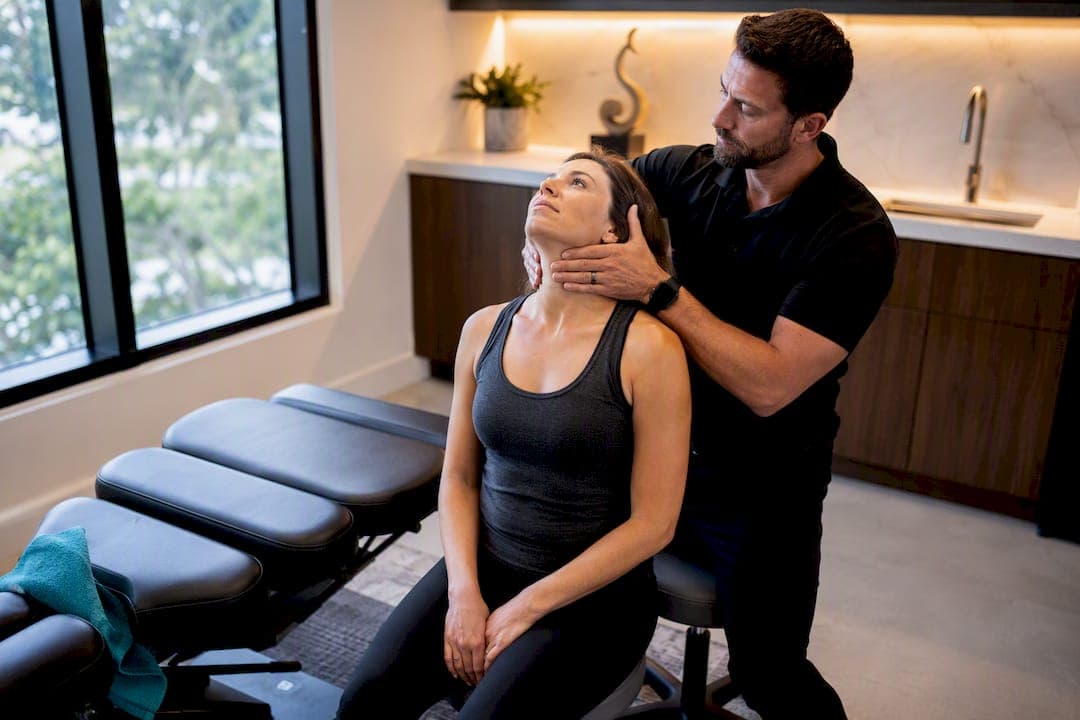
Dizziness after a car accident is common, but it can also be the first sign of a traumatic brain injury, a neck injury, or an inner-ear problem, so it should never be brushed off. Clinicians usually trace it to one of three sources: the vestibular system, the neck, or the brain itself. Call emergency services if you notice confusion, severe headache, vomiting, or weakness. Otherwise, get evaluated within a day or two so the actual cause can be identified and treated.
TL;DR:
- Dizziness after a car accident can result from BPPV, concussion, neck injury, or inner-ear trauma, often occurring simultaneously.
- Symptoms like vertigo lasting seconds are typical of BPPV, while prolonged dizziness usually indicates concussion or cervicogenic causes.
- Accurate diagnosis involves positional testing, neck exams, and imaging only if severe signs are present, with early evaluation improving treatment outcomes.
- Targeted treatments such as Epley maneuvers, vestibular rehab, or neck therapy show high success when tailored to the specific injury.
- Delaying diagnosis or relying on the "wait and see" approach risks chronic symptoms, especially if initial treatment does not include specific maneuvers or rehab.
Table of Contents
- What Causes Dizziness After a Car Accident?
- Vertigo vs. Dizziness: How Symptoms Present and Why They're Delayed
- How Doctors Diagnose the Cause of Post-Accident Dizziness
- Treatment for Post-Accident Dizziness, Matched to the Cause
- What to Do Right After a Crash if You Feel Dizzy
- Emergency Warning Signs You Should Never Ignore
- What Coordinated Care Actually Looks Like in Practice
- Can Dizziness After a Car Accident Become Chronic?
- Anxiety, PTSD, and the Psychological Side of Post-Accident Dizziness
- Common Misdiagnoses in Post-Accident Dizziness
- How Medications Can Affect Dizziness After Trauma
- What to Do Now: Prioritized Next Steps
- Why Fast, Accurate Diagnosis Beats the "Wait and See" Approach
- Get Evaluated for Post-Accident Dizziness
- Sources
What Causes Dizziness After a Car Accident?
Several distinct injuries can produce the same symptom, which is exactly why self-diagnosis after a crash is unreliable. Doctors work through a short list of usual suspects, and often more than one is at play at the same time.
- Benign paroxysmal positional vertigo (BPPV): The jolt of a collision can dislodge tiny calcium crystals (otoconia) inside the inner ear. When they float into the wrong canal, they trigger brief, spinning episodes when you roll over in bed or tip your head back. Episodes typically last seconds, not minutes.
- Concussion or traumatic brain injury: The rapid acceleration and deceleration of a crash can shake the brain against the skull even without a direct head strike. Car crashes are a leading cause of traumatic brain injury, and the resulting damage to brain and vestibular pathways can cause persistent unsteadiness, fog, and light sensitivity.
- Cervicogenic dizziness (whiplash-related): The neck is packed with proprioceptors, sensors that tell your brain where your head is in space. Whiplash disrupts that signal, so it clashes with what your eyes and inner ear report. This mismatch shows up as vague, movement-triggered dizziness, usually alongside neck pain and stiffness.
- Inner-ear injuries: Direct trauma can cause a labyrinthine concussion or, rarely, a perilymph fistula, a small tear that leaks inner-ear fluid. Vascular injury to the vertebral arteries is uncommon but is one reason clinicians rule out serious causes early.
It's entirely normal to have two of these overlapping. A rear-end collision that whips your neck and rattles your head can trigger BPPV and cervicogenic dizziness simultaneously, which is part of why treatment has to be tailored, not generic.
Vertigo vs. Dizziness: How Symptoms Present and Why They're Delayed
"Dizziness" is an umbrella term, and the specific flavor tells clinicians a lot. Vertigo is a false sense of spinning or motion. Presyncope feels like you're about to faint, often with lightheadedness. Disequilibrium is a sense of unsteadiness on your feet without the room spinning.
Timing is a clue, too:
- BPPV episodes are brief, usually seconds, and tied directly to a head position change.
- Cervicogenic dizziness tends to linger for minutes to hours and worsens with neck movement.
- Concussion-related imbalance is often the least predictable, sometimes constant, and can trail off over days or persist much longer.
Why symptoms show up late: Adrenaline surges during and immediately after a crash and can mask pain and dizziness for hours. Delayed onset is common and doesn't mean the injury is minor; it may simply reflect inner-ear inflammation or swelling that takes time to develop.
How Doctors Diagnose the Cause of Post-Accident Dizziness
Getting the diagnosis right matters because BPPV, cervicogenic dizziness, and concussion are treated in completely different ways. A typical workup moves through these steps:
- Red-flag screening first. Clinicians check for signs suggesting bleeding, stroke, or severe TBI before anything else, since emergency evaluation is warranted whenever those are present. CT or MRI imaging is ordered if these signs are found.
- Positional testing. The Dix-Hallpike maneuver or a side-lying variant reproduces the specific eye movements (nystagmus) that confirm BPPV and identify which ear canal is involved.
- Vestibular function tests. Videonystagmography (VNG), rotary chair testing, or vestibular evoked myogenic potentials (VEMP) assess how well the inner ear and its neural connections are working.
- Neck exam. Orthopedic and manual tests check range of motion, muscle guarding, and joint tenderness, since imaging often looks normal even when whiplash is driving the dizziness.
- Specialist referral when needed. Persistent or ambiguous cases get referred to ENT, neurology, or a vestibular physical therapist for deeper testing.
Bring specifics to your appointment: when episodes happen, what triggers them (rolling over, looking up, quick head turns), how long they last, and whether neck pain accompanies them. That detail speeds up an accurate diagnosis considerably.
Treatment for Post-Accident Dizziness, Matched to the Cause
Treatment only works when it's aimed at the right target, and this is where a lot of post-accident care goes wrong by treating "dizziness" as one thing.
- BPPV: The Epley maneuver and related canalith repositioning techniques move the displaced crystals back where they belong. Many patients feel dramatic relief in one or two sessions, but post-traumatic BPPV frequently involves multiple canals and needs repeat maneuvers plus follow-up vestibular rehab to fully resolve.
- Vestibular rehabilitation therapy: A structured program of gaze-stabilization and balance exercises retrains the brain to compensate for inner-ear damage. It benefits patients with labyrinthine injury, concussion-related imbalance, and residual symptoms after BPPV treatment.
- Neck-focused therapy: Manual therapy, targeted mobility exercises, and chiropractic adjustment address the joint and muscle dysfunction behind cervicogenic dizziness. Progress usually tracks with improvement in neck range of motion.
- Concussion management: Relative rest for the first day or two, followed by a graded, symptom-guided return to normal activity under specialist oversight.
- Medication or surgery: Rarely needed, and reserved for specific diagnoses like a confirmed perilymph fistula or severe vestibular migraine.
Pro Tip: Keep a simple symptom log on your phone, noting the time, what you were doing, and how long each episode lasted. That log often shortens the diagnostic process by weeks, because it hands your clinician the pattern instead of a vague memory.
What to Do Right After a Crash if You Feel Dizzy
If dizziness hits at the scene or shortly after, a few simple actions protect you until you can be evaluated.
- Stop driving immediately and get to a safe, stationary spot, whether that's staying parked or sitting down on the curb.
- Avoid sudden head turns or looking up, since fast motion can intensify vertigo symptoms.
- Sip water and breathe slowly. Fast, shallow breathing can add lightheadedness on top of whatever's already happening.
- Rest somewhere quiet and dim if bright lights or noise feel overwhelming.
- Note the time dizziness started and what seemed to trigger it. This helps both your doctor and your insurer later.
- If anything feels seriously wrong, don't wait it out. Call emergency services.
Emergency Warning Signs You Should Never Ignore
Most post-crash dizziness is manageable and not life-threatening, but a specific set of symptoms changes that calculus immediately. Seek emergency care right away if dizziness comes with any of the following:
- Loss of consciousness, even briefly
- A severe or rapidly worsening headache
- Weakness, numbness, or tingling on one side of the body
- Slurred speech or trouble finding words
- Seizures
- Fluid draining from the nose or ears
- Double vision or unequal pupil size
- Sudden, severe vomiting or an inability to walk
These signs can point to a brain bleed, a severe TBI, or a vascular injury, and motor vehicle collisions are among the leading causes of traumatic brain injury, which is exactly why this list exists. Waiting to "see if it passes" is the wrong call when any of these show up.
What Coordinated Care Actually Looks Like in Practice
A first visit for post-accident dizziness should never be a single quick check. At Sparkmed, an initial evaluation typically combines a vestibular assessment, a hands-on neck exam, and a concussion screen, because a multidisciplinary look at all three systems is often what actually finds the cause. From there, the treatment plan gets built around what's actually wrong, not a generic protocol.
Access matters here too. Sparkmed offers a $25 chiropractic adjustment with no insurance required, multilingual support in English, Spanish, and Creole, and Uber Health transport for patients who can't drive themselves in. Practical points worth doing at that first visit:
- Bring your symptom log (timing, triggers, duration) so the clinician isn't reconstructing your history from memory.
- Ask for written documentation of your diagnosis and treatment plan. Insurance claims move faster with a clear paper trail.
- Request a copy of your visit summary for any other specialist you're referred to.
Can Dizziness After a Car Accident Become Chronic?
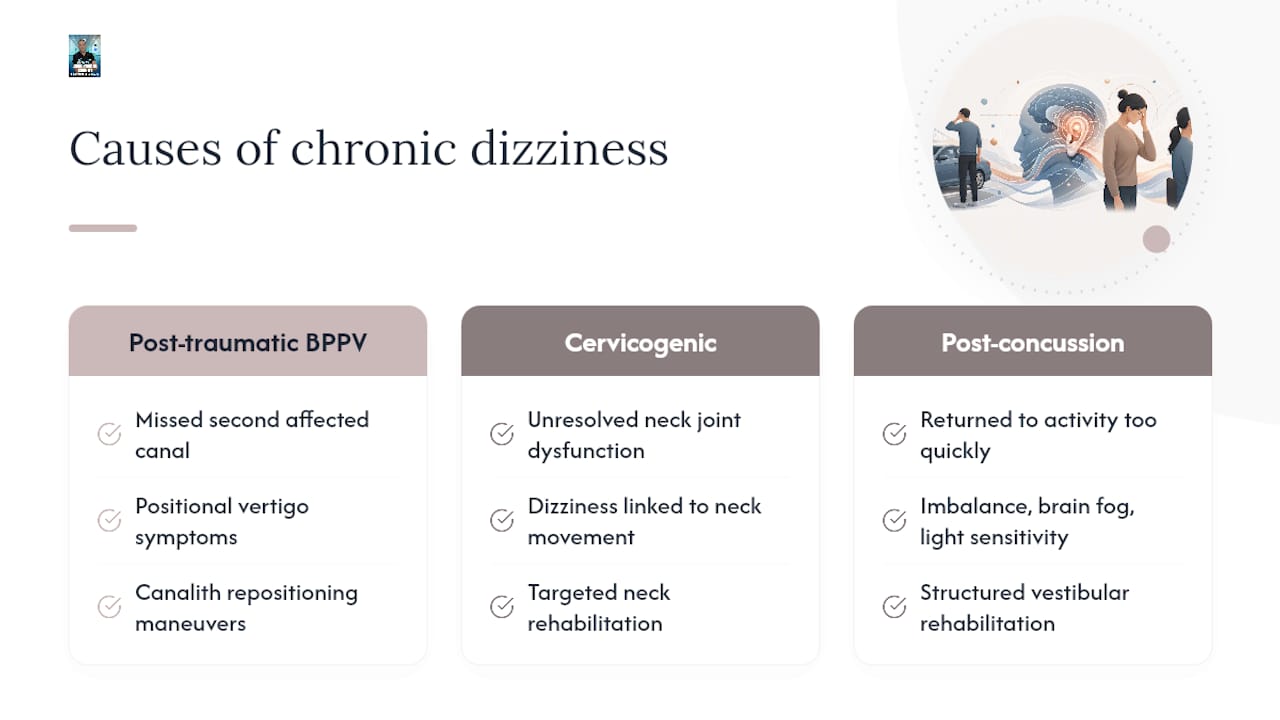
Most post-accident dizziness resolves within weeks once the right treatment targets the actual cause, but a meaningful minority of patients develop symptoms that linger for months. Untreated or partially treated BPPV is a common culprit, particularly when the initial diagnosis missed a second affected canal, something post-traumatic BPPV is known to involve more often than the spontaneous kind. Cervicogenic dizziness that never gets proper neck rehabilitation can also drag on indefinitely, since the underlying joint dysfunction simply doesn't resolve on its own.
Post-concussion syndrome is the other major driver of chronic dizziness. Some patients experience imbalance, brain fog, and light sensitivity for months after the initial injury, particularly if they returned to full activity too quickly instead of following a graded recovery plan. The good news is that chronic doesn't mean untreatable. Patients with persistent symptoms often see real improvement once they get into structured vestibular rehabilitation, even a year or more out from the original crash.
The biggest risk factor for chronic dizziness isn't the severity of the crash. It's the gap between injury and proper diagnosis. Every week spent guessing, or being told "it'll pass," is a week the compensatory mechanisms in the brain aren't being actively retrained. If your dizziness has outlasted a month with no improvement, that's the point to push for a referral to a vestibular specialist rather than waiting longer.
Anxiety, PTSD, and the Psychological Side of Post-Accident Dizziness
Not all post-crash dizziness is purely physical, and treating it as if it is can stall recovery. Anxiety after a collision frequently produces its own lightheadedness through hyperventilation and muscle tension, symptoms that mimic vestibular dizziness closely enough to confuse both patients and clinicians. Some people develop a specific fear of driving or riding in cars, and that anxiety alone can trigger dizzy spells that have nothing to do with inner-ear damage.
Post-traumatic stress disorder complicates the picture further. Hypervigilance and the body's chronic stress response can produce persistent lightheadedness, and the psychological aftermath of a crash sometimes outlasts the physical injuries that caused the original dizziness. This doesn't mean the dizziness isn't real. It means the driver is different, and the fix looks different too.
The practical implication: if vestibular testing and neck exams come back essentially normal but dizziness persists, don't stop at "there's nothing wrong." A brief conversation about anxiety symptoms, sleep quality, and any avoidance behavior (skipping car rides, dreading appointments) often reveals a second track running alongside the physical injury. Addressing both at once, rather than cycling through repeat physical exams, tends to get patients back to normal faster.
Common Misdiagnoses in Post-Accident Dizziness
Post-accident dizziness gets misread more often than most crash-related symptoms, largely because it's genuinely ambiguous and several causes produce near-identical complaints. A few patterns show up repeatedly.
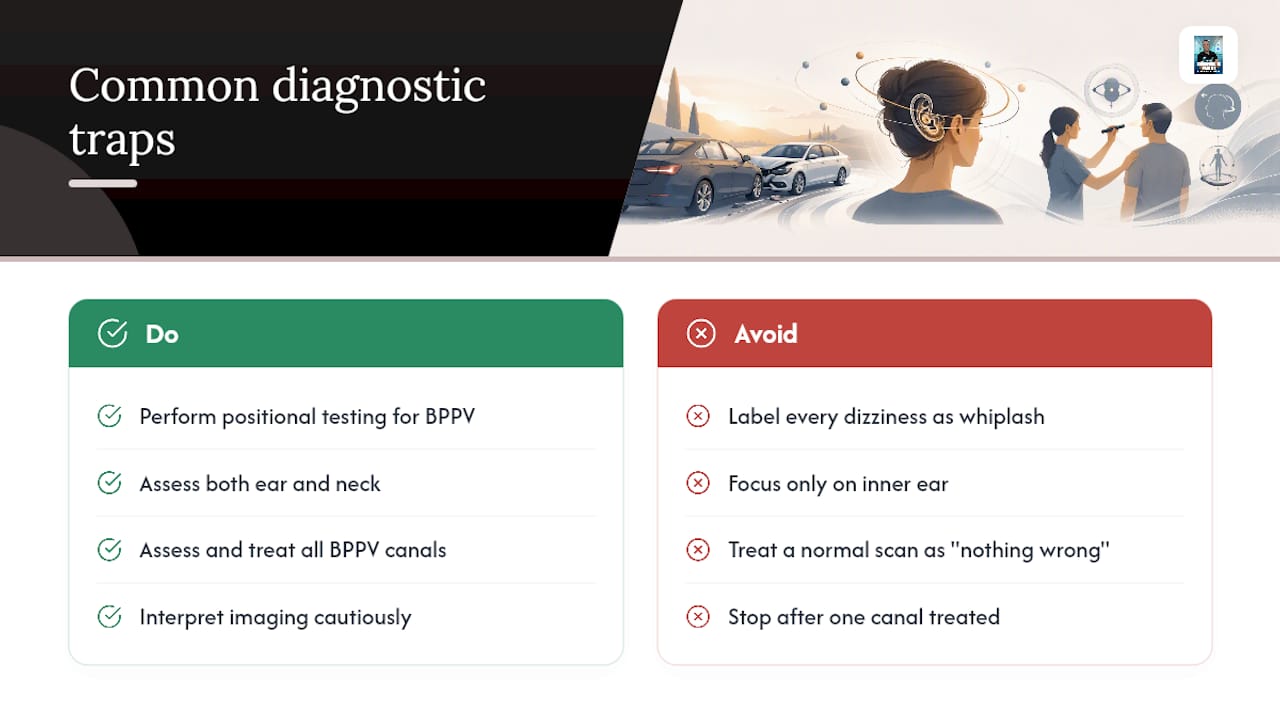
The most frequent miss is treating all dizziness as "just whiplash" without positional testing. This skips BPPV entirely, so a patient who could get near-immediate relief from a five-minute repositioning maneuver instead spends months on neck stretches that were never going to fix an inner-ear problem. The reverse mistake happens too: focusing exclusively on the ear and missing a coexisting neck injury that's also contributing to the symptom picture.
Normal imaging gets over-interpreted as "nothing's wrong." Standard CT and MRI scans frequently look clean in cervicogenic dizziness and in milder concussions, since imaging often fails to reveal a clear structural cause even when the underlying dysfunction is very real. A clean scan rules out the most dangerous causes; it doesn't rule out dizziness.
Multiple-canal BPPV is another frequent trap. A single Epley maneuver addressing only one canal can leave a second, less obvious canal untreated, so symptoms partially improve and then plateau, sometimes read as treatment failure rather than an incomplete diagnosis. And anxiety-driven dizziness sometimes gets dismissed as "all in your head" instead of being recognized as a real, treatable physiological response.
How Medications Can Affect Dizziness After Trauma
Medications prescribed after a crash can add to dizziness independently of the original injury, which makes it harder to tell what's actually causing a given symptom. Opioid painkillers, commonly prescribed for acute whiplash or musculoskeletal pain, list dizziness and sedation among their most common side effects. Muscle relaxants prescribed for neck spasm carry a similar profile.
Blood pressure medications deserve particular attention after a crash, since pain, dehydration, and reduced activity can all shift blood pressure and interact with existing prescriptions to cause lightheadedness on standing. Some antidepressants and anti-anxiety medications, sometimes started after a crash to manage acute stress, can also contribute to dizziness during the first weeks of use.
The practical fix is straightforward: tell every clinician you see the complete list of medications you're taking, including anything started since the accident. If dizziness appeared or worsened after starting a new prescription, mention the timing specifically. Sorting out whether a medication is contributing to symptoms often means adjusting dose or timing rather than stopping treatment altogether, which is a conversation to have with the prescribing doctor rather than a decision to make alone.
What to Do Now: Prioritized Next Steps
Most dizziness after a crash traces to BPPV, whiplash, or a mild concussion, and all three respond well to targeted treatment once correctly identified.
- Rule out emergencies first: if any red-flag symptom appears, call for emergency help without delay.
- Get evaluated within one to two days, even if symptoms feel mild or are easing.
- Bring your symptom log, including triggers and duration, to that first appointment.
- Ask specifically for positional testing and a neck exam, not just a general checkup.
- Expect meaningful improvement within two to four weeks with the right treatment; if you're not improving by then, push for a specialist referral.
Why Fast, Accurate Diagnosis Beats the "Wait and See" Approach
The conventional advice for post-crash dizziness, rest and give it time, works often enough that it's become the default. That's precisely the problem. It works for the cases that would have resolved on their own, and it fails quietly for the ones that needed a specific intervention, like a canalith repositioning maneuver that takes five minutes but never gets attempted because nobody looked for BPPV.
The evidence points toward speed and specificity over patience. A properly sequenced exam, red-flag screening, positional testing, neck evaluation, concussion screen, usually identifies the actual cause within a single visit. That distinction between treating "dizziness" and treating "BPPV in the posterior canal" or "cervicogenic dizziness from C2-C3 dysfunction" is the entire game. Generic advice to rest and hydrate helps marginally with all three; targeted treatment resolves each one.
If there's one thing worth pushing back on, it's the assumption that dizziness following a crash is inherently mysterious or untestable. It isn't. The tools to sort out the cause exist and are well established. The failure point is usually access to a clinician willing to run the full sequence instead of settling for the first plausible explanation.
— Spark
Get Evaluated for Post-Accident Dizziness
If dizziness has followed you home from a car accident, don't guess at the cause. Sparkmed's clinic in North Miami offers coordinated vestibular, neck, and concussion assessments designed specifically for accident recovery, with multilingual support and transportation options for patients who need them. Booking a visit early, rather than waiting to see if symptoms fade, is the step most likely to shorten your recovery.
This article is general information, not a substitute for advice from a qualified doctor. Consult a qualified healthcare professional about your own circumstances before acting on anything here.
Sources
- Dizziness After a Car Accident: What It Means, When to Get Help
- Cervical vertigo and dizziness after whiplash injury - PMC
- Canalith repositioning procedure — Mayo Clinic
- Traumatic brain injury (TBI) — NINDS