

Posture correction after injury is defined as the process of retraining muscles, movement patterns, and daily habits to restore spinal alignment following trauma. Knowing how to improve posture after injury matters because poor alignment prolongs pain, slows healing, and increases the risk of re-injury. The good news is that muscles can be retrained at any age, even after significant injury. With the right combination of targeted exercises, ergonomic adjustments, and consistent habits, meaningful improvement is achievable. This guide covers every stage of that process, from identifying weak muscles to building lasting postural habits.
How to improve posture after injury: which muscles need attention?
Post-injury rehabilitation must begin with identifying the specific muscle imbalances driving poor alignment. Injuries create predictable patterns: some muscles weaken from disuse or guarding, while others tighten in response to pain and compensation.
Muscles that weaken after injury
The upper back, core, and glutes are the three muscle groups most commonly weakened after injury. Weak upper back muscles allow the shoulders to round forward. A weak core fails to stabilize the lumbar spine, causing the lower back to overarch or collapse. Weak glutes shift load onto the lower back and hip flexors, compounding the problem.
Effective exercises for back alignment in these areas include:
- Upper back: Scapula squeezes held for 30 seconds, resistance band rows, and prone Y-T-W raises
- Core: Modified planks, dead bugs, and bird dogs performed with a neutral spine
- Glutes: Glute bridges, clamshells, and standing hip extensions with a resistance band
Corrective exercise protocols produce significant improvements in forward head posture, rounded shoulders, and hyper-kyphosis. Those standardized mean differences confirm that targeted strengthening genuinely shifts postural markers, not just subjective comfort.
Muscles that tighten after injury
The chest, hip flexors, and neck extensors tend to shorten when the body guards an injury. Tight chest muscles pull the shoulders forward. Tight hip flexors tilt the pelvis anteriorly, increasing lumbar curve. Stretching these tissues is just as important as strengthening the opposing muscles.

Effective stretches include a doorway chest stretch held for 30 seconds, a kneeling hip flexor stretch, and a chin tuck for the neck. Perform each stretch gently, without forcing range of motion.
Pro Tip: Before starting any exercise program post-injury, get clearance from your physician or physical therapist. What works for one injury type can aggravate another.
How to safely progress posture exercises during rehabilitation
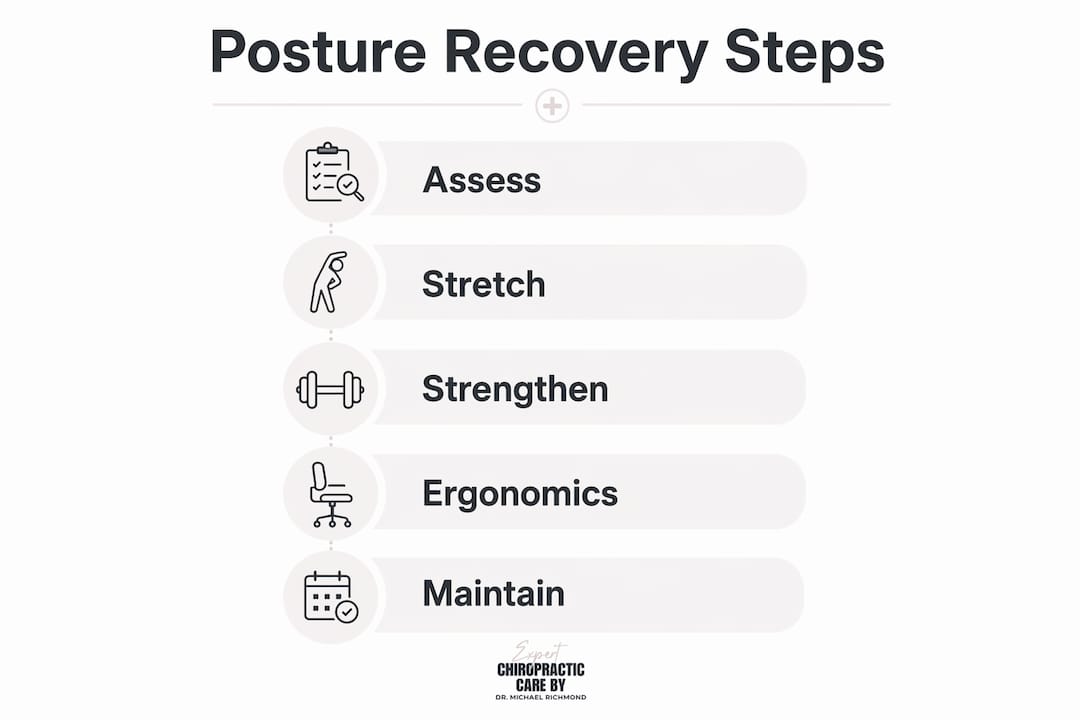
Safe progression is the most overlooked part of posture rehabilitation for recovery. Starting too hard too fast is the leading cause of setbacks. Physical therapy for posture follows a clear sequence: assess, stabilize, strengthen, then load.
- Get a professional evaluation first. A physical therapist or chiropractor can assess your musculoskeletal imbalances and identify which movements are safe at your current stage of healing.
- Start with restorative movements. In the early phase, focus on gentle mobility work: chin tucks, shoulder rolls, and cat-cow stretches. These activate muscles without stressing healing tissue.
- Add stabilization exercises. Once pain allows, introduce scapula squeezes with 30-second holds and modified planks. These build the foundation for more demanding work.
- Progress to resistance training. Resistance band rows and seated rows target the upper back directly. Start with light resistance and increase only when the current level feels controlled and pain-free.
- Listen to your body's signals. Sharp pain, numbness, or tingling during any exercise means stop immediately. Mild muscle fatigue is expected. Joint pain is not.
"Overcorrecting posture by pulling the shoulders back forcefully can increase strain. Balanced alignment with relaxed shoulders is the goal, not a rigid military stance." — posture alignment research
A common mistake in improving stance after injury is forcing the spine into what feels like "perfect" posture. This creates new tension patterns and can worsen discomfort. The string analogy offers a safer mental cue: imagine a string gently pulling upward from the crown of your head, lengthening the spine without forcing any joint into position. This technique promotes natural alignment without the strain of overcorrection.
For patients recovering from whiplash or car accident injuries, the whiplash recovery process requires extra caution with neck and upper back exercises. Always confirm exercise selection with your treating provider before advancing.
What ergonomic adjustments support posture improvement during recovery?
Ergonomic setup is not optional during recovery. You spend hours each day sitting, and every hour in a poor position undoes the work done in your exercise sessions. The right workstation setup actively supports rehabilitation for posture.
| Ergonomic Factor | Recommended Setup |
|---|---|
| Screen height | Top of monitor at or just below eye level |
| Elbow angle | 90 to 120 degrees when typing |
| Feet | Flat on the floor or supported by a footrest |
| Chair back | Lumbar support contacting the natural curve of the lower back |
| Head position | Ears aligned over shoulders, not jutting forward |
Each of these adjustments reduces compensatory muscle strain. When your screen is too low, your head drops forward, loading the cervical spine with extra force. When your elbows are outside the 90–120 degree range, the shoulder and neck muscles work harder than necessary.
Pro Tip: Set a phone alarm every 45 minutes as a posture check-in. Glance at the table above, reset your position, and take a short walk. This one habit prevents hours of accumulated strain.
Footrests, lumbar support cushions, and monitor risers are low-cost tools that make a real difference for patients who sit for work. For desk workers managing recovery, muscle recovery strategies that address both ergonomics and tissue repair are worth reviewing alongside your rehabilitation plan.
The goal is not to sit rigidly in one position all day. The goal is to reduce the load on healing structures so your exercises can do their job.
How do you maintain improved posture long-term after injury?
Posture improvement fails when patients treat it as a short-term fix. Postural variability is now recognized as the healthiest approach, meaning the ability to change positions frequently matters more than holding any single "correct" stance. Static positions, even good ones, create fatigue and strain over time.
Strategies that make posture habits stick include:
- Move every 30 minutes. Micro-movements and position changes every 30 minutes prevent the muscle fatigue that leads to slumping. Stand, stretch, or walk briefly before returning to your task.
- Use posture reminders. Phone alarms, sticky notes on your monitor, or wearable posture devices all work. The specific tool matters less than the consistency of the cue.
- Practice yoga or Pilates. Physical therapy programs that incorporate yoga and Pilates produce better long-term posture outcomes because these practices build body awareness alongside strength and flexibility.
- Check your daily spinal health habits regularly. A structured daily checklist keeps you accountable and catches regression early.
- Keep exercising. The strengthening and stretching work done during rehabilitation must continue after formal therapy ends. Stopping creates the conditions for posture to deteriorate again.
The patients who maintain their gains share one trait: they stopped thinking of posture as something to fix and started treating it as something to practice. That shift in mindset is what separates lasting recovery from repeated setbacks.
Key Takeaways
Improving posture after injury requires consistent strengthening of weak muscles, stretching of tight tissues, ergonomic adjustments, and frequent movement throughout the day.
| Point | Details |
|---|---|
| Target weak muscles first | Strengthen the upper back, core, and glutes before adding load or resistance. |
| Stretch tight tissues | Release the chest, hip flexors, and neck to allow the spine to realign naturally. |
| Progress exercises safely | Start with restorative movements, get professional clearance, and advance only when pain-free. |
| Adjust your workspace | Set screen height, elbow angle, and chair support to reduce daily strain on healing structures. |
| Move frequently | Change positions every 30 minutes to prevent fatigue and reinforce postural variability. |
What I've learned from watching patients rebuild their posture
Most patients arrive expecting posture correction to feel like discipline. They imagine holding their shoulders back all day, fighting their body into a shape it resists. What actually works looks nothing like that.
The patients who recover best are the ones who stop fighting their posture and start building the physical capacity to hold it naturally. When the upper back is strong enough, the shoulders stop rounding on their own. When the core is stable, the lower back stops overarching. The posture follows the strength. You cannot force alignment into a body that lacks the muscle support to hold it.
Patience is the hardest part to teach. Posture changes happen over weeks and months, not days. Patients who check their progress daily get discouraged. Patients who check monthly are usually surprised by how much has shifted. I tell every patient: trust the process more than the mirror.
The other thing I've seen consistently is that people underestimate how much their environment shapes their posture. You can do every exercise correctly and still regress if you spend eight hours a day in a chair that collapses your lumbar curve. Ergonomics and exercise work together. Neither alone is enough.
If you are recovering from a car accident or a traumatic injury, get a professional assessment before you start any program. The role of posture in recovery is well established, but the right starting point depends entirely on your specific injury, your current strength, and your healing stage. A chiropractor or physical therapist can map that out for you in a single session.
— Spark
Posture recovery resources at Sparkmed
Sparkmed's blog covers the full spectrum of post-injury recovery, from spinal health fundamentals to condition-specific rehabilitation advice written by practitioners who work with trauma patients every day.

Patients recovering from car accidents, whiplash, or other injuries can find detailed guidance on posture and spinal health across Sparkmed's resource library. The content is designed for real recovery situations, not generic wellness advice. If you are ready to take the next step, Sparkmed offers $25 chiropractic adjustments with no insurance required, making professional support accessible from the start of your recovery.
FAQ
How long does it take to improve posture after injury?
Meaningful posture improvement typically takes several weeks to months of consistent exercise and ergonomic adjustment. The timeline depends on injury severity, starting strength, and how consistently rehabilitation exercises are performed.
What are the best stretches for posture after injury?
The doorway chest stretch, kneeling hip flexor stretch, and chin tuck are the most effective starting points. These three stretches address the muscle groups most commonly shortened after injury.
How do I sit properly after injury to protect my posture?
Keep your feet flat on the floor, your elbows at 90–120 degrees, and your screen at eye level. Your chair's lumbar support should contact the natural curve of your lower back, and your ears should align over your shoulders.
Can posture really be corrected after a serious injury?
Yes. Muscles and movement patterns can be retrained after injury regardless of age, even when bone structure cannot be changed. Consistent strengthening and stretching produce measurable improvements in alignment.
When should I see a professional for posture rehabilitation?
See a physical therapist or chiropractor before starting any posture correction program after injury. Professional assessment identifies specific imbalances and ensures your exercise plan matches your current healing stage, reducing the risk of setbacks.