

Chronic back pain is defined as back pain that persists for 12 weeks or longer, even after the original injury or cause has been treated. It affects millions of Americans and can disrupt sleep, work, and basic daily movement. The symptoms and causes vary widely, which is why a clear understanding of what you are dealing with matters before you can address it. Knowing whether your pain is mechanical, nerve-related, or degenerative changes everything about how you manage it.
What is chronic back pain, exactly?
Chronic back pain is not a single condition. It is a symptom with multiple possible origins, and the label "chronic" refers specifically to duration, not severity. Harvard Health classifies chronic low back pain as pain lasting 12 weeks or more, distinguishing it from acute pain, which typically resolves within a few weeks with basic care.
The distinction between chronic back pain vs acute pain matters clinically. Acute pain is your body's alarm signal after an injury. Chronic pain is different. It often outlasts the original tissue damage and may involve changes in how your nervous system processes pain signals. That shift is why the same treatment that works for a pulled muscle often fails for chronic conditions.
Chronic low back pain is one of the leading causes of disability in the United States. The effects of chronic back pain extend beyond physical discomfort, affecting mood, sleep quality, productivity, and social participation. Understanding what you have is the first step toward doing something about it.

What are the typical symptoms of chronic back pain?
Chronic back pain symptoms range from mild and persistent to sharp and disabling. UF Health identifies the most common presentations as:
- Dull, aching pain that stays in the lower back and does not fully resolve
- Sharp or stabbing pain that spikes with specific movements like bending or lifting
- Burning or tingling sensations, especially if nerve involvement is present
- Stiffness in the morning or after sitting for long periods
- Weakness in the legs or difficulty standing for extended periods
- Radiating pain that travels down one or both legs, sometimes called sciatica
Symptoms often worsen with prolonged sitting, standing, or physical activity. Some people find relief lying down, while others notice that rest makes the stiffness worse. The pattern of your symptoms gives clinicians important clues about the underlying cause.
Certain symptoms signal something more serious. Fever combined with back pain, sudden loss of bladder or bowel control, numbness in the groin or inner thighs, or pain following a significant trauma all require urgent medical evaluation. These are red flags that rule out infections, fractures, or spinal cord involvement.
Pro Tip: Keep a brief symptom log for two weeks before your appointment. Note when pain peaks, what makes it better or worse, and whether it travels into your legs. That detail helps your provider make a faster, more accurate diagnosis.
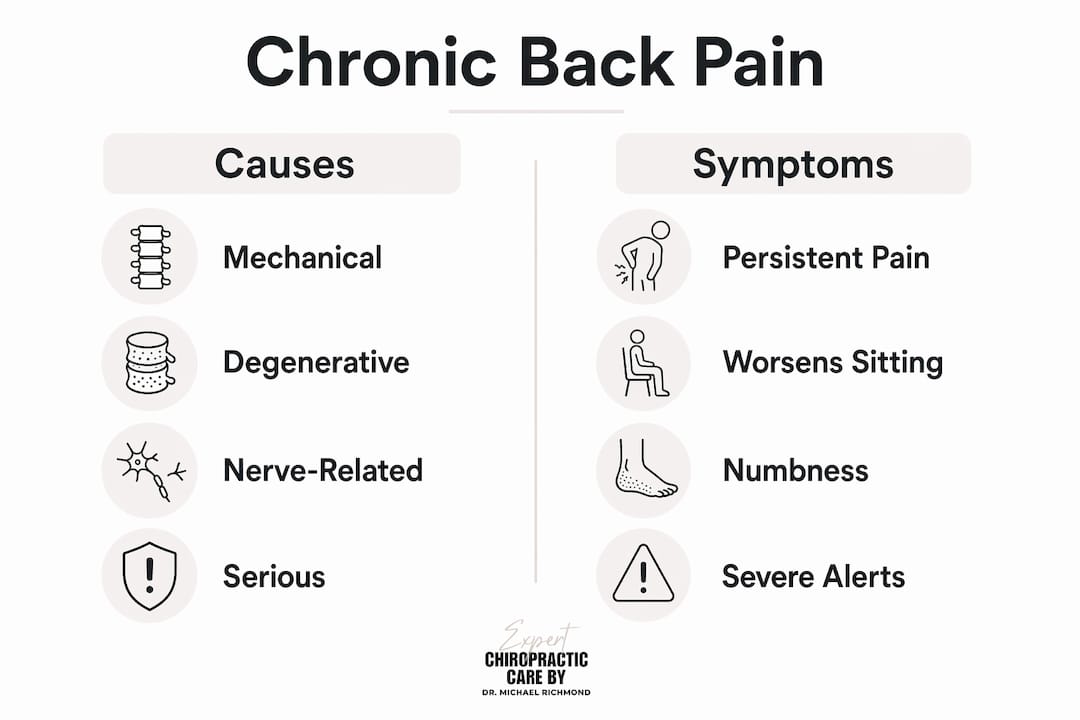
What causes chronic back pain and how do these causes differ?
Chronic back pain causes fall into several distinct categories. Knowing which category applies to you shapes every treatment decision.
Mechanical and musculoskeletal causes
Muscle strain and ligament overload are the most common starting points. Repetitive stress, poor posture, and sudden awkward movements can damage soft tissue. When healing is incomplete or the underlying mechanics are never corrected, acute pain becomes chronic.
Degenerative causes
Arthritis, spinal stenosis (narrowing of the spinal canal), and degenerative disc disease fall into this group. These conditions develop gradually and are more common with age. One critical point from Harvard Health: age-related spine changes frequently appear on imaging in people with no pain at all. That means a scan showing disc degeneration does not automatically explain your symptoms. Clinical evaluation matters more than the image alone.
Nerve-related causes
Herniated discs and radiculopathy (nerve root compression) produce the burning, tingling, and leg pain many people associate with sciatica. These causes require a different treatment approach than pure muscle pain.
Serious underlying causes
Infections, tumors, and inflammatory arthritis conditions like ankylosing spondylitis are less common but cannot be missed. This is why screening for red flags is a standard part of any chronic back pain evaluation.
| Cause Type | Common Examples | Key Feature |
|---|---|---|
| Mechanical | Muscle strain, ligament sprain | Pain tied to movement or posture |
| Degenerative | Arthritis, disc disease, stenosis | Gradual onset, age-related |
| Nerve-related | Herniated disc, radiculopathy | Radiating pain, tingling, weakness |
| Inflammatory | Ankylosing spondylitis | Morning stiffness, improves with movement |
| Serious | Infection, tumor | Fever, weight loss, night pain |
Risk factors that increase your likelihood of developing chronic back pain include obesity, sedentary work, smoking, depression, and a history of prior back injuries.
How can chronic back pain be managed and treated effectively?
The goal of chronic back pain treatment is not always complete elimination of pain. Harvard Health notes that management goals shift in chronic pain toward reducing disability and improving functional outcomes, including sleep, work capacity, and activity tolerance. That reframe matters. Progress looks like doing more, not just hurting less.
Evidence-based treatment follows a clear order of priority:
- Exercise and physical therapy. Movement-based strategies are the most consistently supported treatment for chronic low back pain. Physical therapy targets core strength, flexibility, and movement mechanics. Programs like McKenzie Method and graded exercise therapy have strong evidence behind them.
- Acupuncture. Harvard Health and VA/DoD clinical guidelines both list acupuncture as effective for chronic low back pain. It works best as part of a broader plan, not as a standalone fix.
- Mindfulness-based stress reduction (MBSR). Chronic pain has a psychological component. MBSR, developed at the University of Massachusetts Medical School, reduces pain intensity and improves function in clinical trials.
- NSAIDs and duloxetine. When non-drug approaches are insufficient, NSAIDs or duloxetine may be considered. Duloxetine, sold under the brand name Cymbalta, has FDA approval for chronic musculoskeletal pain.
- Opioids. Clinical guidance strongly discourages opioid use for chronic low back pain in most cases. The risks of dependence and side effects outweigh the modest benefits for this condition.
- Multidisciplinary pain programs. For complex cases, programs combining physical therapy, psychology, and medical management produce better outcomes than any single approach.
You can also explore evidence-based spinal adjustments as part of a broader treatment plan, particularly when mechanical causes are involved.
Pro Tip: Avoid prolonged bed rest. Staying still for more than a day or two after a flare-up slows recovery. Short walks, gentle stretching, and light activity keep tissues mobile and reduce the risk of deconditioning.
When should you seek urgent medical evaluation?
Most chronic back pain is not dangerous. But certain symptoms require prompt evaluation to rule out serious conditions. Do not wait for a scheduled appointment if you experience any of the following:
- Fever with back pain, which can indicate a spinal infection or abscess
- Unexplained weight loss alongside back pain, which raises concern for malignancy
- Significant trauma such as a fall or car accident preceding the pain
- Neurological symptoms including numbness, weakness, or loss of coordination in the legs
- Bladder or bowel dysfunction, which may signal cauda equina syndrome, a surgical emergency
- History of cancer, which increases the likelihood that back pain has a secondary cause
Accurate symptom reporting to your provider is critical. Describe when the pain started, whether it radiates, and any associated symptoms like fever or leg weakness. Vague descriptions lead to delayed diagnoses. Specific descriptions lead to faster, better care.
You can review a detailed chiropractic red flags list to understand which symptoms warrant immediate attention before your next appointment.
What practical steps can you take to live better with chronic back pain?
Living with chronic back pain requires a daily strategy, not just occasional treatment. The following practices reduce flare-up frequency and improve overall function:
- Follow a daily spinal health routine. A daily spinal health checklist covering posture checks, gentle movement, and hydration builds consistency.
- Prioritize core and flexibility training. Exercises like planks, bird-dogs, and cat-cow stretches strengthen the muscles that support your spine without loading it excessively.
- Manage stress actively. Psychological stress amplifies pain perception. Techniques like diaphragmatic breathing, progressive muscle relaxation, and MBSR all reduce the nervous system's pain response.
- Optimize your workspace ergonomics. Chair height, monitor position, and keyboard placement directly affect spinal load during seated work. A lumbar support cushion costs under $40 and reduces lower back strain measurably.
- Pace your activities. Doing too much on a good day often triggers a bad one. Pacing means spreading activity evenly rather than pushing through and then crashing.
- Improve sleep position. Sleeping on your side with a pillow between your knees reduces spinal rotation. Sleeping on your back with a pillow under your knees keeps the lumbar curve neutral.
Pro Tip: Set a timer to stand and move for two minutes every 45 minutes during seated work. That simple habit reduces cumulative spinal load more than any ergonomic chair alone.
Key takeaways
Chronic back pain requires a treatment approach built around the underlying cause and functional goals, not pain elimination alone.
| Point | Details |
|---|---|
| Definition matters | Chronic back pain lasts 12 weeks or longer and differs fundamentally from acute pain in cause and treatment. |
| Symptoms vary widely | Pain can be dull, sharp, burning, or radiating; leg symptoms suggest nerve involvement and need specific reporting. |
| Causes are not one-size-fits-all | Mechanical, degenerative, nerve-related, and serious causes each require different treatment paths. |
| Movement beats rest | Exercise and physical therapy are the most evidence-supported treatments for chronic low back pain. |
| Red flags need urgent care | Fever, neurological symptoms, and bladder or bowel changes require immediate medical evaluation. |
What i've learned after seeing chronic back pain up close
Most people arrive at a clinic expecting a scan to explain everything. They want a clear image showing exactly what is wrong. The reality is more complicated. Spine imaging findings often do not correlate with pain levels. I have seen patients with severe disc degeneration on MRI who function well, and patients with near-normal imaging who are barely able to walk.
What actually moves the needle is individualized care. A treatment plan built around your specific symptoms, your movement patterns, and your daily demands outperforms any generic protocol. That means physical therapy tailored to your mechanics, not a standard exercise sheet. It means addressing sleep and stress alongside the physical component.
The other thing I want you to hear: function improvement is the real goal. If you sleep better, move more freely, and return to activities you had given up, that is success. Waiting for zero pain before calling it progress is a trap. Chronic pain management is a process, and patience with that process is not passive. It is strategic.
— Spark
Ready to take the next step with Sparkmed?
Understanding your condition is the foundation. Getting the right care is what changes your daily life.

Sparkmed's blog covers detailed guides on chiropractic pain management, spinal health, and recovery strategies tailored to people dealing with persistent back pain. Whether you are exploring treatment options for the first time or looking to deepen your understanding of what works, the resources are there for you. Sparkmed is committed to making healthcare information accessible to everyone. Review the accessibility statement to learn how Sparkmed supports all patients in accessing care and information. Your next step toward better function starts with the right information.
FAQ
How long does back pain have to last to be called chronic?
Back pain is classified as chronic when it persists for 12 weeks or longer, regardless of whether the original cause has been treated.
What is the difference between chronic and acute back pain?
Acute back pain typically resolves within a few weeks after an injury. Chronic back pain lasts beyond 12 weeks and often involves changes in how the nervous system processes pain, requiring a different treatment approach.
What triggers chronic back pain flare-ups?
Common triggers include prolonged sitting or standing, poor posture, physical overexertion, psychological stress, and poor sleep. Pacing activities and managing stress reduce flare-up frequency.
Can chronic back pain be treated without medication?
Yes. Evidence-based non-drug treatments including exercise, physical therapy, acupuncture, and mindfulness-based stress reduction are the recommended first-line approaches for chronic low back pain.
When does chronic back pain become a medical emergency?
Back pain combined with fever, sudden bladder or bowel changes, or significant leg weakness requires urgent medical evaluation to rule out serious conditions like cauda equina syndrome or spinal infection.