
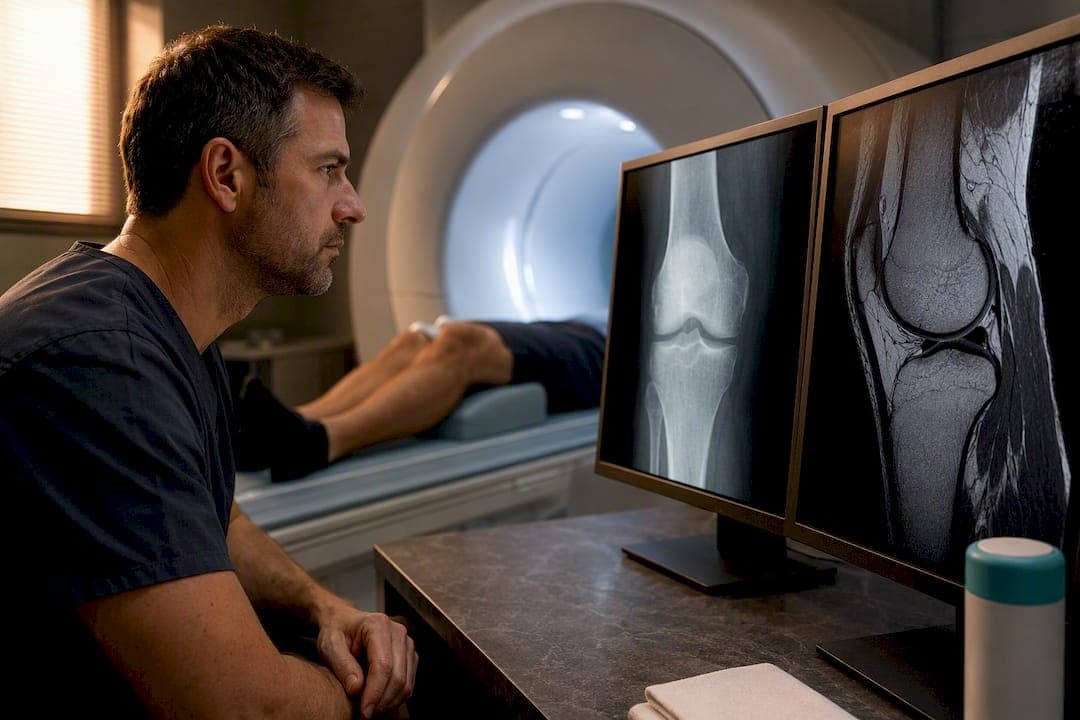
Knee pain after a car accident can mean anything from a minor bruise to a torn ligament or a fractured tibial plateau, and a normal X-ray does not rule out the more serious possibilities. If you cannot bear weight, see visible deformity, feel numbness, or notice heavy swelling, get evaluated immediately. Otherwise, photograph the injury, write down when symptoms started, keep any ER paperwork, and schedule a follow-up if pain or instability lasts more than a few days.
TL;DR:
- MRI is necessary if knee pain persists beyond one to two weeks despite a normal X-ray, as soft tissue injuries are often missed on initial imaging.
- Knee injuries from car crashes often involve ligaments, menisci, or fractures, with specific injury patterns linked to impact direction and force.
- Immediate ER attention is required for deformity, inability to bear weight, numbness, or open wounds, while less urgent symptoms can be evaluated within a few days.
- Conservative treatments like RICE, physical therapy, and chiropractic care are effective first steps, but severe ligament tears or displaced fractures may require surgery.
- Documentation of symptoms, injury timeline, and treatment efforts is vital for insurance claims and legal recovery, especially when soft tissue damage isn't visible on X-ray.
Table of Contents
- How Knee Injuries Happen in Car Crashes
- Common Knee Injuries After a Collision
- Red Flags: Emergency Care vs. a Specialist Visit
- Why X-Rays Alone Often Miss the Real Injury
- Treatment Options: From RICE to Surgery
- Recovery Timeline: What to Expect Week by Week
- Insurance and Legal Considerations Worth Knowing
- How a Chiropractic Clinic Evaluates Post-Accident Knee Pain
- Why Most Knee Pain Guides Get the Order Wrong
- Sources
- FAQ
How Knee Injuries Happen in Car Crashes
The direction and force of impact tell you almost as much as an exam does, as explained in this Fleet Collision Repair The Tampa Manager’s Playbook which details how collision forces affect vehicles and occupants. A dashboard collision drives the tibia backward into the femur, which loads the posterior cruciate ligament and can crack the patella or the tibial plateau. A car that spins or is struck from the side twists the knee while the foot stays planted, and that rotational load is the classic setup for a torn meniscus or ACL.
Other mechanisms leave their own signature:
- Bracing hard against the floorboard before impact can hyperextend the knee, straining the posterior capsule and ligaments.
- Direct blows against the door or center console tend to cause contusions or patellar injury rather than ligament tears.
- A seatbelt or airbag catching the body awkwardly can transmit force sideways through the knee, stressing the MCL or LCL.
One detail clinicians watch for: pain that seems to sit in the knee sometimes starts in the lower back or sacroiliac joint. A full evaluation looks at the hip and spine too, not just the joint that hurts.
Common Knee Injuries After a Collision
Crash-related knee injuries cluster into a handful of recognizable patterns, and each one has a different story to tell.
- ACL tear. Usually from twisting or a sudden pivot; often comes with a pop, immediate swelling, and a feeling that the knee will give out.
- PCL tear. Classic dashboard injury; pain sits deep in the back of the knee, and swelling can develop more gradually than with an ACL tear.
- Meniscus tear. Caused by twisting under load; produces catching, locking, or a sensation of the knee "sticking" partway through motion.
- MCL or LCL tear. From sideways force; pain and tenderness localize to the inner or outer side of the joint.
- Patellar fracture. From direct dashboard or door impact; sharp pain right over the kneecap, often with visible swelling or inability to straighten the leg.
- Tibial plateau fracture. High-force dashboard or bracing injuries; severe pain, swelling, and frequently an inability to bear any weight.
- Bursitis or tendon strain. From repeated friction or a direct blow; produces a dull, localized ache that worsens with kneeling or stairs.
Meniscus tears, partial ligament sprains, and cartilage bruising are the injuries most often missed on a plain X-ray, since X-rays image bone, not soft tissue. That gap is exactly why a "clear" ER film doesn't close the book on knee pain after a car accident.
Red Flags: Emergency Care vs. a Specialist Visit
Some symptoms need attention the same day. Others can wait a few days for a scheduled visit, though they still need one.
- Go to the ER now if you see visible deformity, cannot put any weight on the leg, notice numbness or a cold, pale foot, or have an open wound near the joint.
- See a doctor within a day or two if swelling is significant but you can still move the leg somewhat, or if pain is sharp but stable.
- Book a follow-up within the week if you notice catching, locking, a feeling of the knee buckling, or pain that lingers at rest days after the crash.
It's common for swelling and pain to show up hours or even a day or two after the accident. Adrenaline and the body's initial inflammatory response can mask injury severity in the first few hours, which is one reason Cleveland Clinic recommends monitoring symptoms closely in the days after any trauma, not just at the scene.
Why X-Rays Alone Often Miss the Real Injury
An X-ray is fast and useful for one thing: finding broken bone. It cannot show you a torn ligament, a shredded meniscus, a bruised bone, or damaged cartilage, because none of those show up on plain film.
That's the reasoning behind a statistic worth remembering: MRI is the tool that actually visualizes ACL, PCL, and MCL tears, meniscal damage, cartilage injury, bone bruising, and the kind of microfractures a tibial plateau fracture can hide behind. If your ER visit ended with "the X-ray is normal, go home and rest," and the pain hasn't resolved in a week or two, that's the moment to ask about an MRI rather than assume everything is fine.
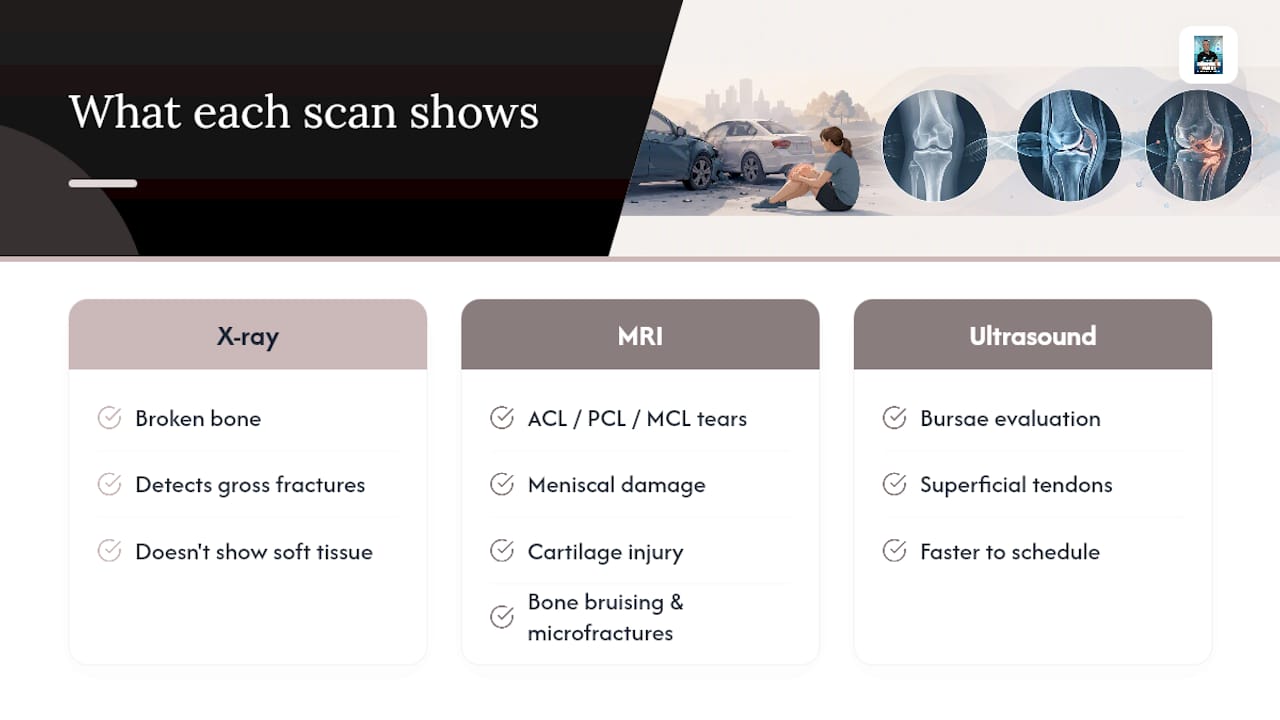
Ultrasound has a narrower but useful role too. It's good for evaluating bursae and superficial tendons, and it's often quicker to schedule than an MRI when a clinician suspects a more surface-level problem. A thorough physical exam, including specific stress and stability maneuvers, usually guides which imaging path makes sense. Emergency departments are built to rule out life-threatening injury first; outpatient follow-up with orthopedics or a musculoskeletal specialist is often where the soft-tissue diagnosis actually happens.
Treatment Options: From RICE to Surgery
Most crash-related knee injuries start with conservative care, and most stay there. RICE (rest, ice, compression, elevation) is still the right first move in the initial days, paired with NSAIDs where appropriate and brief immobilization if the joint feels unstable. From there, early referral to structured physical therapy helps rebuild strength and range of motion before compensatory movement patterns set in.
Chiropractic care fits into this conservative pathway for injuries that don't involve fracture or a complete ligament rupture. Chiropractic treatment for knee pain typically looks at the whole kinetic chain rather than just the joint that hurts, since hip and pelvic alignment directly affect how load moves through the knee. A multimodal approach often combines:
- Manual therapy and joint mobilization
- Therapeutic ultrasound for deeper tissue inflammation
- Kinesiology taping for support during movement
- Individualized home exercise programs to rebuild proximal strength
Pro Tip: Before any conversation about surgery, write down exactly what you can't do anymore, whether that's kneeling, climbing stairs, or standing for a full shift, and bring records of the conservative care you've already tried. Surgeons and insurers both weigh documented functional limits heavily.
Some cases need more than rehab. Corticosteroid or diagnostic injections can help control targeted inflammation. Surgery becomes the standard recommendation for complete ligament ruptures with real instability, displaced fractures, large meniscal tears that cause locking, or multi-ligament injuries. Depending on the diagnosis, that might mean ACL reconstruction, meniscal repair, or fracture fixation with plates or screws, guidance that lines up with standards from the American Academy of Orthopaedic Surgeons.
Recovery Timeline: What to Expect Week by Week
Recovery length depends entirely on which structure got hurt. Minor sprains and contusions typically settle in a few weeks. Partial ligament tears and meniscal injuries managed without surgery usually need several weeks to months of structured rehab before full function returns. Surgical recovery can take many months depending on the procedure and individual healing factors.
A few things reliably slow that timeline down: a delayed diagnosis that let the injury go untreated for weeks, skipping or rushing physical therapy, health conditions like diabetes that affect healing, and reinjury from returning to activity too soon. If you're aiming to return to work or sport, ask your provider for functional testing rather than guessing based on how the knee "feels," since subjective comfort is a poor predictor of joint stability.
Insurance and Legal Considerations Worth Knowing
Documentation is what turns a real injury into a provable one. ER notes, imaging reports, and a clear timeline of when symptoms started and how they progressed are exactly what insurance adjusters and attorneys look for when evaluating a knee injury claim.
Watch your insurer's deadlines closely, and make sure the date you first reported knee symptoms is recorded, even if it wasn't the day of the crash. Gaps in that timeline get used to argue the injury wasn't crash-related.
Consider talking to a personal injury attorney if you're facing lasting disability, medical bills that are stacking up, or if the insurance company is disputing that the crash caused your knee injury. Attorneys typically request the same records: ER and follow-up visit notes, imaging results, physical therapy or chiropractic treatment logs, and any documentation of missed work.
How a Chiropractic Clinic Evaluates Post-Accident Knee Pain
A conservative-care clinic doesn't just look at the knee in isolation. A proper evaluation includes a full-body exam, questions about exactly how the crash happened, and imaging referrals when the mechanism or exam findings suggest something an X-ray won't catch.
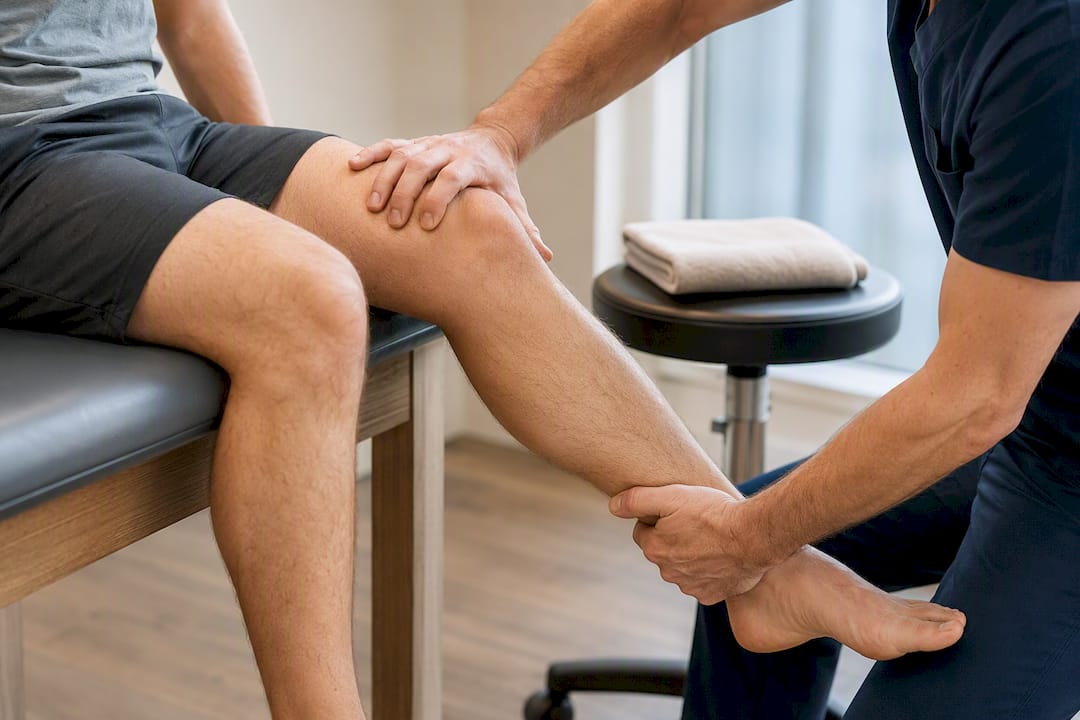
Treatment for eligible cases draws on the same toolkit covered above, manual therapy, ultrasound, kinesiology taping, and individualized rehab, all documented in a way insurers and attorneys can actually use. Bring your ER notes, photos of the injury, and a written timeline to the first visit. When a case needs an orthopedic surgeon or advanced imaging, a clinic focused on accident recovery coordinates that referral rather than leaving you to figure it out alone, a process outlined further in this recovery guide for accident patients.
Why Most Knee Pain Guides Get the Order Wrong
Most articles on this topic explain symptoms first and documentation last, as if the legal and medical sides of a crash injury are separate problems. They aren't. The single biggest mistake patients make isn't skipping treatment, it's treating a normal X-ray as a clean bill of health and letting weeks pass before anyone orders an MRI or a proper orthopedic exam.
The case evidence on chiropractic and multimodal care is real but limited: a documented case of knee pain resolving within 10 days after targeted pelvic manipulation and kinesiology taping is promising, not proof that every knee responds the same way. What the evidence does support clearly is the kinetic-chain approach itself: treating the hip and pelvis alongside the knee, rather than fixating on the joint that hurts.
If there's one habit worth building immediately after a crash, it's documentation. Not because it guarantees a settlement, but because the medical and legal timelines run on the same clock, and a gap in one becomes a gap in both.
— Spark
This article is general information, not a substitute for advice from a qualified doctor. Consult a qualified healthcare professional about your own circumstances before acting on anything here.
Sources
- Reduction of Knee Pain in a 45-Year-Old Woman After Pelvic Manipulation and Kinesiology Taping: A Case Report — PMC
- Knee pain — Cleveland Clinic
FAQ
Is it normal to have knee pain weeks after a car accident?
Yes. Delayed swelling and pain are common because adrenaline and the body's initial inflammatory response can mask injury severity right after a crash, and soft-tissue injuries like meniscal tears often don't show symptoms until inflammation builds over days or weeks.
How much compensation will I get for a knee injury?
There's no fixed figure, since compensation depends on medical costs, lost wages, injury severity, and documented causation. Strong ER records, imaging reports, and a clear symptom timeline are what typically support a stronger claim.
How can I tell if a knee injury is serious?
Watch for visible deformity, inability to bear weight, numbness, a cold or pale foot, catching or locking, or a feeling of the knee giving out. These signs point toward ligament, meniscal, or fracture injuries that need prompt evaluation rather than home care alone.
How long does knee pain last after hitting it?
Minor sprains and contusions typically settle in a few weeks. Partial ligament tears and meniscal injuries managed without surgery usually need several weeks to months of structured rehab before full function returns. Surgical recovery can take many months depending on the procedure and individual healing factors.