

Car crashes produce a predictable set of injuries: whiplash and soft-tissue damage, concussions and traumatic brain injuries (TBI), spinal cord and disc injuries, rib and limb fractures, internal organ trauma, chest injuries, lacerations, burns, and psychological trauma including PTSD. NHTSA reports millions of nonfatal crash injuries every year in the United States, and the sheer volume means most people either experience one of these injuries themselves or know someone who has.
Knowing the examples of common auto injuries matters because some of them look minor at the scene and turn serious within hours. Get emergency care immediately if you or anyone involved has loss of consciousness, new confusion, severe headache, repeated vomiting, breathing difficulty or chest pain, numbness or weakness in limbs, uncontrolled bleeding, or severe abdominal pain
If any of those signs are present, call 911. For everyone else, a medical evaluation within 24–48 hours is still strongly recommended, even when you feel fine at the scene.
Key Takeaways
The most important thing to know after a car crash is that the most serious injuries, including spinal cord damage, internal bleeding, and TBI, can be present without obvious symptoms in the first hours.
| Point | Details |
|---|---|
| Common injuries to watch for | Whiplash, soft-tissue damage, concussion, fractures, internal organ trauma, and PTSD are the most frequent types of car accident injuries. |
| Red flags require ER now | Loss of consciousness, limb weakness, breathing difficulty, or severe abdominal pain after a crash means call 911 immediately. |
| Delayed onset is common | Symptoms from whiplash and concussion often appear 24–48 hours after the crash; get evaluated even when you feel fine at the scene. |
| Conservative care works for most | Chiropractic, physical therapy, and manual therapy are effective first-line treatments for non-surgical musculoskeletal injuries. |
| Sparkmed in North Miami | Sparkmed offers chiropractic adjustments, soft-tissue therapy, ultrasound, and shockwave therapy for post-accident recovery, starting at $25 without insurance. |
Table of Contents
- 1. Whiplash and neck sprain
- 2. Soft-tissue injuries: sprains, strains, and contusions
- 3. Concussion and traumatic brain injury
- 4. Skull fractures
- 5. Spinal cord injuries
- 6. Herniated discs
- 7. Rib fractures and chest injuries
- 8. Internal organ injuries
- 9. Fractures of the limbs and pelvis
- 10. Burns
- 11. Lacerations and facial trauma
- 12. Knee and shoulder injuries
- 13. Psychological trauma and PTSD
- How crash direction shapes the injuries you sustain
- How injuries are evaluated and when to go to the ER
- Typical treatment pathways and recovery expectations
- Conservative and post-acute care options that support recovery
- What a first clinic visit actually looks like
- Sparkmed offers post-accident chiropractic care in North Miami
- Sources
1. Whiplash and neck sprain
Whiplash is a soft-tissue injury to the cervical spine caused by rapid forward-and-back acceleration of the head. It is the most frequently reported injury after rear-end collisions, and symptoms often appear a day or two after the crash rather than immediately.
Symptoms: neck pain and stiffness, reduced range of motion, headaches at the base of the skull, shoulder or upper-back aching.
Severity: mild to moderate in most cases; severe when nerve roots are involved.
Next step: urgent clinic or primary care evaluation within 24–48 hours; imaging if neurological symptoms are present. For targeted relief strategies, see Sparkmed's guide on relieving whiplash pain.
2. Soft-tissue injuries: sprains, strains, and contusions
Beyond the neck, crashes routinely injure muscles, tendons, and ligaments throughout the body. Shoulder, lower-back, and knee soft-tissue injuries are especially common after frontal and side impacts. These injuries do not show on plain X-rays, so a clinical exam is the primary diagnostic tool.

Symptoms: localized pain, swelling, bruising, muscle spasm, stiffness that worsens the day after the crash.
Severity: mild to moderate; can become chronic if left untreated.
Next step: clinical evaluation; conservative care (rest, ice/heat, manual therapy, physical therapy) within the first week.
3. Concussion and traumatic brain injury
A concussion is a mild TBI caused by the brain moving inside the skull, and it can occur without any direct blow to the head. NIH resources note that TBI ranges from mild concussion to severe bleeding or swelling, and that CT or neurology follow-up may be needed even when the skull is intact.
Symptoms: headache, dizziness, nausea, sensitivity to light or noise, memory gaps, difficulty concentrating.
Severity: mild (most concussions) to life-threatening (epidural or subdural hematoma).
Next step: any loss of consciousness, worsening headache, or repeated vomiting requires ER evaluation and CT imaging immediately.
4. Skull fractures
A skull fracture typically results from a direct, high-force impact with the steering wheel, window, or roof during a rollover. It is less common than concussion but always serious.
Symptoms: visible deformity or depression at the impact site, severe localized pain, bruising around the eyes ("raccoon eyes") or behind the ears, clear fluid from the nose or ears.
Severity: urgent to critical.
Next step: call 911; CT imaging in the ER is required.
5. Spinal cord injuries
Spinal cord injuries (SCI) occur when vertebral fractures, dislocations, or disc material compress or sever the cord. High-speed frontal crashes and rollovers carry the greatest SCI risk.
Symptoms: partial or complete loss of movement or sensation below the injury level, burning or stinging pain along the spine, loss of bladder or bowel control.
Severity: urgent to catastrophic; permanent disability is possible.
Next step: do not move the person; call 911 immediately. Immobilization and emergency imaging are required.
6. Herniated discs
A herniated disc happens when the soft inner core of a spinal disc pushes through its outer ring, often compressing a nearby nerve root. Rear-end and frontal crashes both generate enough axial loading to cause disc herniation, particularly in the cervical and lumbar spine. Plain X-rays typically miss this injury entirely; MRI is the preferred diagnostic tool.
Symptoms: radiating pain, numbness, or tingling down an arm (cervical) or leg (lumbar), muscle weakness in the affected limb, localized back or neck pain.
Severity: moderate to severe depending on nerve involvement.
Next step: clinical evaluation followed by MRI if neurological symptoms are present; conservative care or specialist referral based on findings.
7. Rib fractures and chest injuries
Rib fractures are a hallmark of frontal crashes, where the chest strikes the steering wheel or the seatbelt restrains the torso under high force. Multiple rib fractures can cause a pneumothorax (collapsed lung), which is a medical emergency.
Symptoms: sharp chest pain that worsens with breathing or coughing, tenderness over the rib cage, shortness of breath, visible bruising across the chest.
Severity: single rib fractures are painful but manageable; multiple fractures or pneumothorax require ER care.
Next step: any breathing difficulty after chest trauma warrants immediate ER evaluation and chest X-ray or CT.
8. Internal organ injuries
Blunt abdominal trauma from the steering wheel, seatbelt, or dashboard can lacerate or rupture the liver, spleen, or kidneys without any external wound. Internal bleeding is the danger, and it can be life-threatening within hours.
Symptoms: abdominal pain or tenderness, shoulder pain (referred from a ruptured spleen), dizziness, rapid heart rate, signs of shock.
Severity: urgent to critical; internal bleeding can be silent at first.
Next step: any abdominal pain after a crash requires ER evaluation; FAST ultrasound and CT are the primary diagnostic tools.
9. Fractures of the limbs and pelvis
Frontal crashes commonly fracture the femur, tibia, ankle, and wrist as occupants brace against the dashboard or floor. Side impacts can fracture the pelvis, hip, and shoulder. These injuries are usually obvious but can be obscured by adrenaline at the scene.
Symptoms: severe localized pain, swelling, deformity, inability to bear weight or move the limb.
Severity: moderate to severe; open fractures (bone through skin) are emergencies.
Next step: X-ray for suspected fractures; orthopedic consult for displaced or complex breaks.
10. Burns
Vehicle fires, airbag deployment, and chemical spills from ruptured fuel or battery systems can all cause burns. MedlinePlus burn evaluation criteria cover depth, surface area, and inhalation risk, all of which determine whether specialty burn care is required.
Symptoms: redness, blistering, charred or white skin, pain (or absence of pain in deep burns), singed nasal hair or hoarse voice (inhalation injury).
Severity: first-degree burns are minor; full-thickness burns and any inhalation injury are emergencies.
Next step: inhalation injury or burns covering large surface areas require 911 and ER care; smaller surface burns need urgent wound evaluation.
11. Lacerations and facial trauma
Broken glass, deployed airbags, and contact with the steering wheel or dashboard cause cuts, abrasions, and facial fractures. Facial lacerations bleed heavily and can involve the eye, orbit, or jaw.
Symptoms: visible cuts, embedded glass, facial swelling, eye pain or vision changes, jaw pain or difficulty opening the mouth.
Severity: minor to severe depending on depth, location, and whether structures like the eye or airway are involved.
Next step: deep lacerations, eye involvement, or suspected facial fractures require ER evaluation; minor cuts need wound cleaning and tetanus assessment.
12. Knee and shoulder injuries
The knee strikes the dashboard in frontal crashes, tearing the ACL, PCL, or meniscus. Shoulder injuries, including rotator cuff tears and AC joint separations, occur in side impacts and rollovers. Both joints are vulnerable to seatbelt and airbag forces as well.
Symptoms: joint pain, swelling, instability, limited range of motion, clicking or locking (knee).
Severity: moderate to severe; complete ligament tears often require surgery.
Next step: clinical exam and X-ray to rule out fracture; MRI for suspected ligament or meniscus damage.
13. Psychological trauma and PTSD
Crash-related psychological injuries are among the most under-recognized types of car accident injuries. NIMH documents that trauma survivors can develop hypervigilance, intrusive memories, and sleep disturbance after a crash, all hallmarks of PTSD.
Symptoms: anxiety, nightmares, flashbacks, avoidance of driving or vehicles, irritability, difficulty concentrating.
Severity: mild adjustment reaction to full PTSD; symptoms can persist for months without treatment.
Next step: mental-health screening at follow-up visits; referral to a therapist or psychiatrist if symptoms persist beyond a few weeks.
How crash direction shapes the injuries you sustain
Understanding the mechanism behind frequent vehicle injuries helps explain why two people in the same crash can walk away with completely different diagnoses.
Impact vs. penetrating injuries follow different clinical paths. Impact injuries, where the body strikes the vehicle interior, point clinicians toward imaging and neurological checks. Penetrating injuries from glass or metal require wound management, tetanus assessment, and infection monitoring. Separating these two categories early helps focus the diagnostic workup.
Crash direction is the other major variable. Rear-end collisions drive the head forward then backward, loading the cervical spine and producing whiplash and disc injuries. Frontal crashes push the occupant into the steering wheel and dashboard, concentrating force on the chest, abdomen, and lower extremities. Side impacts deliver lateral force directly to the head and thorax, raising the risk of TBI and rib fractures. Rollovers generate multidirectional blunt trauma and carry the highest risk of spinal cord injury.
Picture the body as a pendulum inside a rigid box. When the box stops suddenly, the pendulum keeps moving. The direction the pendulum swings tells you which tissues absorb the most energy.
Pro Tip: Even a minor collision at low speeds can generate enough acceleration-deceleration forces to injure cervical soft tissues. Vehicle damage is a poor predictor of occupant injury, which is exactly why a medical check after even a "minor" crash is worth the time.
How injuries are evaluated and when to go to the ER
Red flags that require 911 or immediate ER care
- Loss of consciousness, even briefly
- Worsening or severe headache after the crash
- Repeated vomiting
- New confusion or disorientation
- Weakness, numbness, or tingling in any limb
- Difficulty breathing or chest pain
- Uncontrolled bleeding
- Severe abdominal pain or tenderness
- Visible bone deformity or protrusion
Any one of these signs means go to the ER now, not to urgent care.
The imaging roadmap
Clinical imaging guidelines support a tiered approach based on suspected injury:
- X-ray: first-line for suspected fractures of the chest, spine, and extremities; fast and widely available.
- CT scan: preferred for acute head trauma, chest injuries, abdominal trauma, and complex spinal fractures; detects bleeding and structural damage that X-ray misses.
- MRI: the standard for soft-tissue and disc evaluation after acute stabilization; detects herniated discs, ligament tears, and spinal cord signal changes that CT cannot show.
- FAST ultrasound: a rapid bedside tool in trauma bays to detect free fluid (blood) in the abdomen; guides the decision for emergency surgery.
- Neurological exam: performed alongside imaging to assess mental status, reflexes, and motor/sensory function.
Why delayed symptoms catch people off guard
Adrenaline suppresses pain perception at the scene. Soft-tissue swelling and disc inflammation build over 24–72 hours. A person who walks away from a crash feeling "fine" can wake up the next morning barely able to turn their head. This is why a medical evaluation within 24–48 hours is recommended after any collision, even one that seems minor.
Typical treatment pathways and recovery expectations
Treatment after a crash follows a logical progression from acute stabilization to active rehabilitation. The right path depends on injury severity, but most people move through at least two of these phases.
Emergency and surgical care covers life-threatening injuries: hemorrhage control, chest tube for pneumothorax, spinal stabilization, and orthopedic surgery for complex fractures. This phase is measured in hours to days.
Immobilization and pain control follows for fractures, severe sprains, and post-surgical recovery. Cervical collars, bracing, and splinting protect healing tissue while anti-inflammatory medications and muscle relaxants manage pain.
Physical therapy and active rehab begins once acute pain is controlled. Guided exercise rebuilds strength, restores range of motion, and reduces the risk of chronic pain. For a detailed look at what post-accident rehab involves, Sparkmed's guide covers goals and timelines.
Chiropractic and conservative care addresses spinal alignment, soft-tissue dysfunction, and nerve irritation in the subacute phase. It is appropriate for most non-surgical musculoskeletal injuries.
Specialist referral (neurosurgery, orthopedics, pain management) is indicated when neurological deficits persist, pain is uncontrolled, or imaging shows structural damage requiring intervention.
Recovery timeline reference
| Injury | Typical acute care | Rough recovery window |
|---|---|---|
| Whiplash (uncomplicated) | Conservative care, manual therapy | 6–12 weeks |
| Concussion (mild) | Rest, graduated return to activity | 2–4 weeks |
| Rib fracture (1–2 ribs) | Pain control, breathing exercises | 6–8 weeks |
| Limb fracture (uncomplicated) | Casting or bracing, PT | 8 weeks |
| Herniated disc (conservative) | PT, chiropractic, possible epidural | 6–12 weeks |
| Spinal cord injury | Acute stabilization, long-term rehab | Months to years; varies widely |
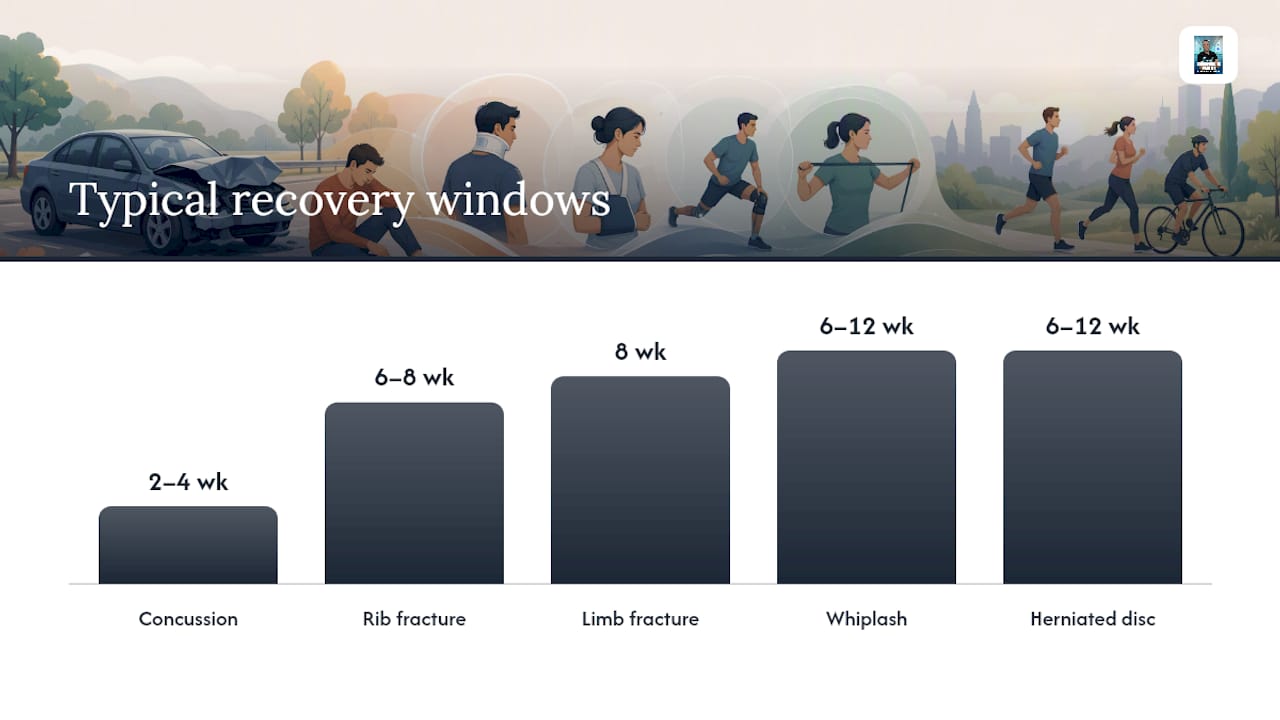
Tracking functional milestones, such as returning to normal sleep, resuming work duties, and regaining full joint range of motion, gives a more useful picture of progress than focusing on a fixed number of recovery days. Sparkmed's guide on tracking recovery progress explains how to document those milestones effectively.
Conservative and post-acute care options that support recovery
For most non-surgical auto injuries, conservative care is not a fallback. It is the primary treatment pathway, and starting it early reduces the risk of chronic pain.
Common modalities
- Spinal manipulation and adjustment: restores joint mobility and reduces nerve irritation in the cervical and lumbar spine; well-suited for whiplash, disc irritation, and facet joint injuries.
- Soft-tissue therapy: myofascial release, trigger point work, and instrument-assisted techniques address muscle guarding and scar tissue.
- Therapeutic exercise: progressive loading of injured structures rebuilds strength and prevents deconditioning.
- Ultrasound and heat/cold therapy: reduce inflammation and improve tissue extensibility in the subacute phase.
- Shockwave therapy: used for stubborn soft-tissue injuries and tendinopathies that do not respond to standard manual therapy.
Conservative care for a moderate whiplash or soft-tissue injury typically involves multiple treatment sessions over several weeks, with periodic reassessment to confirm progress. Functional goals, not symptom elimination alone, guide the plan.
When to escalate
Conservative care is appropriate when there are no neurological deficits and imaging has ruled out structural emergencies. Escalate to specialist care if motor weakness progresses, pain is uncontrolled after 4–6 weeks of consistent treatment, or new neurological signs appear. Physical therapy after a crash can also protect against further damage when started promptly.
What to bring to your first clinic visit
- A written timeline of your symptoms from the crash to the present day
- Any imaging already completed (X-ray, CT, or MRI reports)
- A copy of the police or accident report if available
- Your current medication list
- A brief pain diary noting when symptoms are worst and what makes them better or worse
Pro Tip: Write down your symptoms before your first appointment, not after. Pain and stiffness patterns are easy to underreport in the exam room when a clinician is asking questions. A one-page written summary gives the provider a clearer baseline and helps you document onset timing, which matters for both treatment and any insurance or legal process.
What a first clinic visit actually looks like
A focused intake at a clinic like Sparkmed starts with a structured history: when the crash happened, the direction of impact, what you felt at the scene versus now, and any prior injuries to the same areas. That context shapes everything that follows.
The physical exam covers posture, range of motion, palpation of the spine and soft tissues, and a brief neurological screen checking reflexes, sensation, and grip strength. Red flags are screened first. If anything suggests a missed fracture, cord compression, or internal injury, the immediate step is imaging or ER referral, not treatment.
For patients who clear the red-flag screen, the clinician establishes a baseline functional measure, typically range of motion in degrees and a pain scale tied to specific movements, then outlines a treatment plan with a realistic timeline and clear milestones. Patients who understand what "getting better" looks like in functional terms tend to engage more consistently with their rehab.
Patient preparation bullets:
- Describe your pain in terms of location, quality (sharp, dull, burning), and what makes it worse or better
- Note any symptoms that started after the crash, even ones that seem unrelated (sleep problems, mood changes, jaw pain)
- Ask the clinician what imaging, if any, is recommended and why
- Ask what functional milestone marks the end of the acute phase
- Bring someone with you if you are still experiencing dizziness or cognitive symptoms
Sparkmed's post-accident recovery guide walks through each phase of recovery in detail for patients preparing for their first visit.
Sparkmed offers post-accident chiropractic care in North Miami
If you are dealing with neck pain, back pain, soft-tissue injuries, or any of the musculoskeletal complaints described above after a crash, Sparkmed provides chiropractic evaluation and treatment in North Miami without requiring insurance for the initial adjustment.

The clinic offers spinal adjustments, soft-tissue therapy, ultrasound, shockwave therapy, and heat/cold modalities, covering the full conservative care toolkit for post-accident recovery. Referral pathways to orthopedic and specialist providers are available when imaging or clinical findings indicate a need beyond conservative management. Multilingual support (English, Spanish, and Creole) and Uber Health transport options make access straightforward for local patients.
A $25 chiropractic adjustment is available without insurance. To book an appointment or learn more about post-accident services, visit Sparkmed's clinic resources or browse the Sparkmed blog for additional recovery guidance.
Sources
This article provides general health information and is not a substitute for professional medical advice. After any crash, consult a qualified healthcare provider or visit an emergency room to confirm your specific injuries and appropriate treatment.