

Neck pain recovery step by step is a phased rehabilitation process that restores function, reduces discomfort, and prevents re-injury through guided movement and progressive loading. Most minor neck muscle strains resolve within 4–6 weeks with active management. The key word is active. Waiting passively for pain to disappear is one of the most common and costly mistakes patients make. This guide walks you through each stage of the healing process, from the first 48 hours to full functional recovery, using 2026 clinical evidence and practical techniques you can apply at home or with professional support.
What are the biological healing phases in neck pain recovery?
Your body heals a neck injury in three distinct biological phases. Understanding these phases tells you exactly what to do and when to do it, which is why every effective neck injury rehabilitation plan is built around them.
Phase 1: Inflammation (days 1–3). The body floods the injured tissue with blood and immune cells. Pain and swelling peak during this window. Your job is to protect the area without completely shutting it down. Phased rehabilitation that respects this biology accelerates recovery and prevents re-injury.

Phase 2: Proliferation (days 4–21). New collagen fibers form and begin to align along lines of stress. Controlled movement during this phase is not optional. It guides collagen into organized, functional tissue rather than disorganized scar tissue. Skipping movement here is how people end up with chronic stiffness months after an injury.
Phase 3: Remodeling (week 3 onward). Tissue matures and strengthens under progressive load. This is when you shift from gentle mobility work to actual strengthening exercises. Rushing into heavy loading before this phase causes micro-tears and sets recovery back by weeks.
- Days 1–3: protect, reduce inflammation, avoid full immobilization
- Days 4–21: restore range of motion with controlled, pain-free movement
- Week 3 onward: build strength and neuromuscular control progressively
Pro Tip: Write the date of your injury on your phone's calendar and mark the phase transitions. Knowing you are in "Phase 2" removes the guesswork and keeps you moving on schedule.
Which early-stage self-care techniques promote safe recovery?
The first 24–48 hours set the tone for everything that follows. Initial rest should be limited to 24–48 hours to prevent muscle stiffness and avoid the muscle atrophy that comes with prolonged immobilization. After that window, gentle movement is your best medicine.
Follow these early-stage steps in order:
- Apply cold therapy first. Use an ice pack wrapped in a cloth for 15–20 minutes every 2–3 hours during the first 48 hours. Cold reduces inflammation and numbs acute pain.
- Transition to heat after 48 hours. A warm compress or heating pad for 15–20 minutes relaxes muscle spasm and improves blood flow to healing tissue. You can learn more about applying heat and cold effectively during early recovery.
- Start chin tucks. Sit tall, gently draw your chin straight back (not down), hold for 5 seconds, and release. Repeat 10 times. This activates the deep cervical flexors without stressing injured tissue.
- Add slow neck rotations. Turn your head slowly to the right as far as comfort allows, hold 2 seconds, return to center, and repeat to the left. Do 5 repetitions per side, twice daily.
- Perform shoulder rolls. Roll both shoulders backward in slow circles, 10 repetitions. This releases upper trapezius tension that often compounds neck pain.
- Check your posture. Forward head posture adds up to 60 pounds of effective load on the cervical spine for every inch the head shifts forward. Adjust your workstation so your screen sits at eye level.
- Use OTC medications when needed. NSAIDs and acetaminophen are effective first-line options for symptom relief. Follow package guidelines and do not rely on them as a substitute for movement.
Pro Tip: Set a phone alarm every 45 minutes during your workday. When it goes off, do 10 chin tucks before sitting back down. This single habit prevents the postural collapse that stalls recovery.
How do you progress from gentle movement to strengthening exercises?
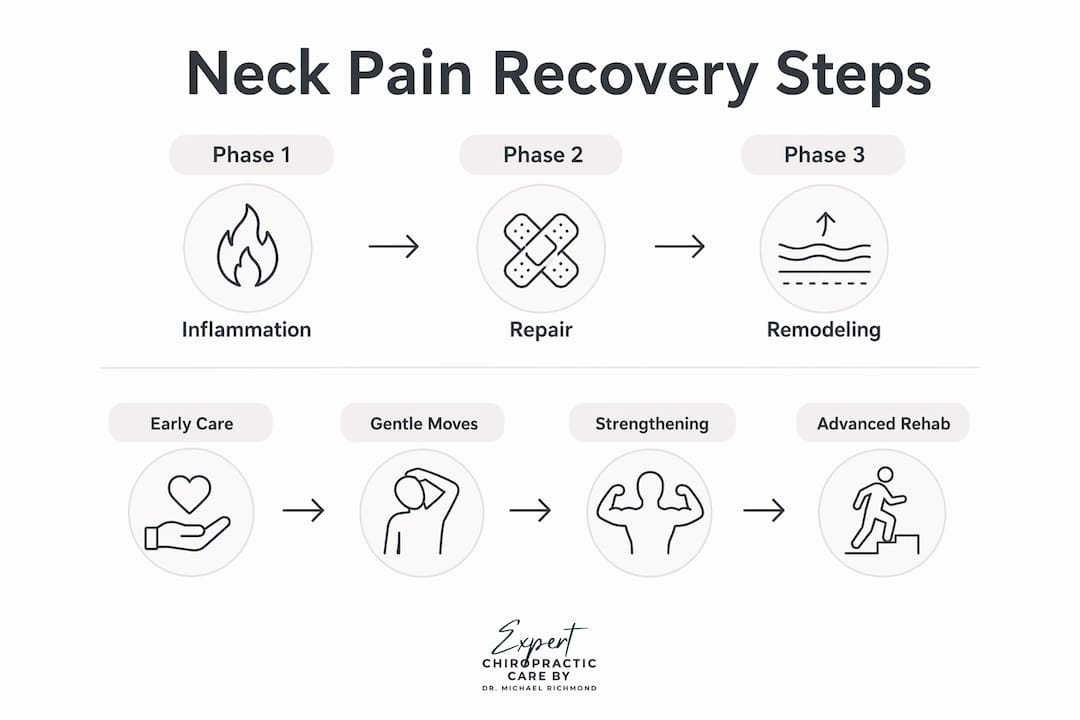
Once you move past the acute phase, the goal shifts from pain control to rebuilding strength and stability. Isometric neck exercises build muscle control and neural confidence safely during this window. They produce analgesic effects and reduce re-injury risk because the muscle contracts without joint movement.
Use the pain traffic light system to guide every session:
- Green: No pain or mild discomfort (0–3 out of 10). Progress as planned.
- Yellow: Moderate pain (4–5 out of 10). Reduce load or range. Do not stop entirely.
- Red: Sharp or worsening pain (6 or above). Stop the exercise and reassess.
Start with these intermediate exercises:
- Isometric side resistance. Place your right hand against your right temple. Press your head into your hand without letting your head move. Hold 5 seconds. Repeat on the left. Do 3 sets of 8 per side.
- Isometric forward resistance. Place both hands on your forehead. Press forward while your hands resist. Hold 5 seconds. 3 sets of 8.
- Shoulder blade squeezes. Sit tall, pull your shoulder blades together and down, hold 5 seconds, release. 3 sets of 12. This targets the lower trapezius and rhomboids, which support cervical posture.
- Thoracic extension over a rolled towel. Place a rolled towel horizontally across your mid-back while lying down. Gently extend over it for 30 seconds. Thoracic spine stiffness forces the neck to overcompensate, so freeing the mid-back directly reduces cervical load.
Pro Tip: Film yourself doing isometric exercises with your phone. Most patients are shocked to see their head actually moving during what they thought was a static hold. Visual feedback corrects form faster than any verbal cue.
What advanced techniques support full functional recovery?
Full recovery means your neck can handle dynamic, unpredictable loads, not just controlled exercises in a quiet room. This phase focuses on neuromuscular retraining and building 360-degree cervical stability.
The vestibular-ocular reflex (VOR) plays a central role here. Neck-eye coordination exercises retrain the connection between your neck muscles, inner ear, and visual system. A simple drill: fix your eyes on a target on the wall, then slowly rotate your head left and right while keeping your gaze locked. Do 3 sets of 10 rotations. This restores the functional stability that static exercises alone cannot address.
Add these advanced elements progressively:
- Full range of motion loading. Use light resistance bands to perform slow, full-range neck movements in all planes. Increase resistance only when you complete 3 sets of 15 with no yellow-light pain.
- Balance and proprioception drills. Stand on one leg while performing slow head rotations. This challenges the neck's role in balance and forces neuromuscular adaptation.
- Scapular stability under load. Progress shoulder blade squeezes to wall push-ups and then to resistance band rows. A stable scapula is the foundation of a stable cervical spine.
- Muscle energy technique (MET) with a professional. A network meta-analysis of 1,224 patients found MET shows statistically significant superiority in reducing chronic neck pain compared to conventional exercise therapy alone. If your recovery plateaus, MET with a trained clinician is the highest-evidence manual therapy option available.
- Maintenance program. Combining exercise and manual therapy produces better outcomes than either approach alone. Build a 10-minute daily maintenance routine and treat it as permanent, not optional.
Breathing mechanics also matter at this stage. Shallow chest breathing overworks the neck's accessory muscles, perpetuating tension long after the original injury heals. Practice diaphragmatic breathing: inhale through your nose for 4 counts, letting your belly expand, then exhale for 6 counts. Do this for 5 minutes daily.
What common mistakes derail neck pain recovery?
Most setbacks in the neck pain healing process come from a small set of predictable errors. Recognizing them early saves weeks of lost progress.
- Over-resting beyond 48 hours. Complete rest beyond 1–2 days is worse than gentle active movement. Muscle atrophy and joint stiffness set in fast.
- Wearing a neck brace too long. Braces are appropriate for acute trauma under medical supervision. Using one for more than a few days trains your muscles to stop working, which is the opposite of recovery.
- Fear-avoidance behavior. Pain does not equal damage. Graded exposure to movement within a pain-free range promotes healing. Avoiding all movement because of fear leads to worse long-term outcomes.
- Ignoring mid-back stiffness. If your thoracic spine is locked up, your neck compensates for every movement. Address both regions together.
- Skipping breathing retraining. Shallow breathing keeps neck accessory muscles in a constant low-level contraction. This is a hidden driver of persistent tension that most patients never address.
"The single biggest predictor of delayed recovery is not the severity of the injury. It is how long the patient avoids movement out of fear. Early controlled activity, even when uncomfortable, consistently outperforms rest."
Seek professional assessment if your pain worsens after two weeks of active management, if you develop numbness or tingling into your arms, or if you experience headaches that worsen with neck movement. These signs require clinical evaluation before continuing a self-directed program. You can find more detail on when neck injuries need attention and how to transition safely to active rehab.
Key Takeaways
Effective neck pain recovery requires phased, active rehabilitation that respects biological healing timelines, progresses from gentle movement to strength training, and includes neuromuscular retraining for lasting results.
| Point | Details |
|---|---|
| Limit initial rest | Rest no more than 24–48 hours; gentle movement after that prevents stiffness and atrophy. |
| Follow the three healing phases | Match your exercises to the inflammatory, proliferation, and remodeling phases for safe progression. |
| Use isometric exercises first | Isometric holds build strength and neural confidence without stressing healing tissue. |
| Address the thoracic spine | Mid-back stiffness forces the neck to overcompensate; treat both regions together. |
| Add neuromuscular training last | Neck-eye coordination and balance drills restore functional stability that static exercises cannot. |
What I've learned from watching patients recover
Most patients arrive expecting a list of exercises. What actually drives recovery is understanding why each step exists. When you know that collagen aligns along lines of stress during days 4–21, you stop skipping your gentle rotations because you understand the biological cost of skipping them.
The patients who recover fastest are not the ones with the mildest injuries. They are the ones who stay curious about their own healing. They track their pain traffic light scores, they notice when their breathing gets shallow under stress, and they ask questions rather than just following instructions blindly.
Generic routines produce generic results. Recovery protocols customized to your tolerance and condition severity consistently outperform one-size-fits-all programs. If a particular exercise consistently lights up yellow or red signals, that is data, not failure. Adjust the load, the range, or the timing, and keep moving forward.
The hardest part of this process is the middle phase, roughly weeks two and three, when the acute pain fades but real strength has not returned yet. Patients feel better and stop their program. Then they re-injure themselves doing something ordinary, like looking over their shoulder while reversing a car. Stay consistent through that window. That is where the real recovery happens.
— Spark
Sparkmed's resources for your neck recovery
Recovering from neck pain is easier when you have the right clinical support behind you. Sparkmed specializes in chiropractic care and post-injury rehabilitation, with practitioners who build individualized recovery programs based on your specific injury, tolerance, and goals.

Whether you are in the early acute phase or working through the advanced neuromuscular stage, Sparkmed's team in North Miami provides spinal adjustments and guided rehab designed to move you through each phase safely. The clinic offers a $25 chiropractic adjustment with no insurance required, making professional support accessible from day one. You can also explore the full library of recovery guides at the Sparkmed blog to deepen your understanding between appointments.
FAQ
How long does neck pain recovery take?
Most non-specific neck muscle strains resolve within 4–6 weeks with active management. Recovery is faster when patients begin gentle movement within the first 48 hours rather than resting completely.
What exercises are safe in the first week of neck pain recovery?
Chin tucks, slow neck rotations, and shoulder rolls are safe during the first week. Keep movements pain-free and within a comfortable range, using the pain traffic light system to guide intensity.
Can I speed up the neck pain healing process?
Yes. Early controlled movement, proper cold and heat therapy, posture correction, and progressing through phased exercises all accelerate healing. Combining exercise therapy with manual therapy produces better outcomes than exercise alone.
When should I see a professional for neck pain?
Seek professional assessment if pain worsens after two weeks of active self-care, if you experience numbness or tingling in your arms, or if headaches worsen with neck movement. These symptoms require clinical evaluation.
What is muscle energy technique and does it help?
Muscle energy technique (MET) is a manual therapy method where the patient actively contracts a muscle against a clinician's resistance. A meta-analysis of 1,224 patients found MET superior to conventional exercise therapy for reducing chronic neck pain.