

Neck injuries are defined as damage to the muscles, ligaments, nerves, or vertebrae of the cervical spine, and why neck injuries need attention becomes clear the moment you understand what is at stake. Left unaddressed, a seemingly minor strain can progress into chronic disability, nerve damage, or a life-threatening vascular event. Car accidents, sports collisions, and even poor posture can trigger cervical trauma. The cervical spine houses the spinal cord and major arteries, making it one of the most vulnerable structures in the body. Acting early is not optional. It is the single most important decision you can make after any neck trauma.
Why neck injuries need attention right away
The cervical spine is not just bone and muscle. It is the gateway between your brain and your body. Any disruption to this structure can affect movement, sensation, and organ function. That is why the importance of neck injury care goes far beyond managing soreness.
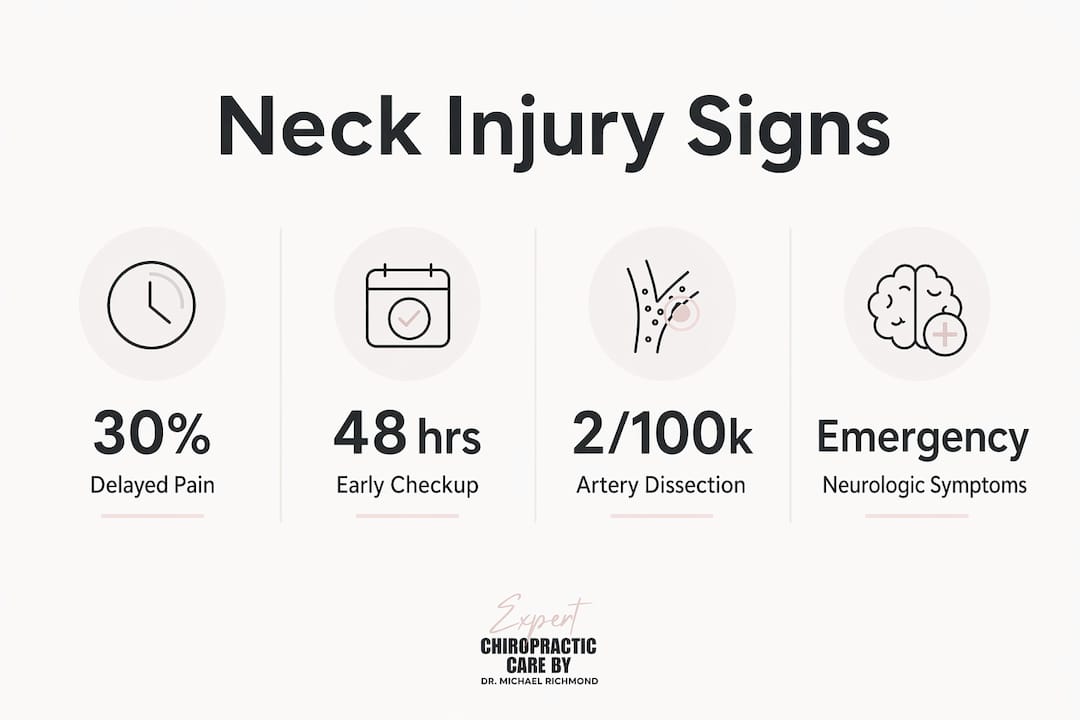
Adrenaline commonly masks neck injury symptoms immediately after trauma. Stiffness, headaches, and radiating pain can appear hours or even days after the initial event. By the time symptoms surface, inflammation has already begun altering movement patterns and complicating recovery.
Patients who delay evaluation often develop what clinicians call maladaptive compensation. The body begins moving around the pain rather than healing it. Muscles tighten, joints stiffen, and the nervous system starts treating abnormal patterns as normal. Reversing that process takes far longer than preventing it.

Pro Tip: If you were in a car accident and feel fine immediately after, still get evaluated within 24–48 hours. Symptom delay is common and clinically documented.
What are the warning signs of a serious neck injury?
Some neck symptoms are urgent. Recognizing the difference between ordinary soreness and a red flag can be the difference between full recovery and permanent damage.
Seek emergency care immediately if you experience any of the following:
- Fever above 101°F combined with neck pain or rigidity. This combination can indicate meningitis, a life-threatening infection of the membranes surrounding the brain and spinal cord. Emergency care is required when fever exceeds this threshold alongside neurological symptoms.
- Sudden loss of bowel or bladder control. This signals spinal cord compression, which is a surgical emergency.
- Weakness, numbness, or tingling radiating into the arms or hands. Electric-shock pain radiating to arms indicates nerve root compression that can cause permanent damage without prompt treatment.
- Difficulty with balance, hand coordination, or fine motor tasks. Hand clumsiness or gait disturbances point to cervical myelopathy, a condition involving spinal cord involvement that requires urgent imaging.
- A sudden, severe "thunderclap" headache with neck pain. A thunderclap headache with neck pain is a vascular emergency. It can signal subarachnoid hemorrhage or cervical artery dissection, both of which are immediately life-threatening.
Cervical artery dissection is rare, affecting about 2 in 100,000 people annually. That rarity makes it easy to dismiss. The problem is that it is a leading cause of stroke in adults under 50, and it can be triggered by something as ordinary as turning your head quickly. Dizziness, slurred speech, or sudden vision changes after neck trauma are reasons to call 911, not wait and see.
Pro Tip: Do not drive yourself to the ER if you have neurological symptoms like sudden weakness or vision changes. Call 911 and stay still.
How does early evaluation improve neck injury recovery?
Early diagnosis changes the entire recovery trajectory. A clinician who evaluates you within the first days of injury can identify structural damage before it becomes permanent, order appropriate imaging, and set a treatment plan that prevents chronic pain from developing.
Clinical guidelines are direct on this point. Neck pain persisting beyond 2 weeks without improvement requires professional evaluation to rule out underlying structural damage. Pain lasting beyond 8 weeks is classified as chronic and is significantly harder to treat. That two-week window is your most important opportunity.
Here is what early evaluation typically involves:
- Physical and neurological examination. A clinician checks range of motion, reflexes, and sensation to identify nerve involvement before imaging is ordered.
- Imaging when indicated. X-rays rule out fractures. MRI identifies soft tissue damage, disc herniation, and spinal cord compression. CT scans assess bone detail in high-impact trauma.
- Specialist referral when needed. Orthopedic surgeons, neurologists, and physiatrists each address different aspects of cervical injury. Early referral prevents months of ineffective self-treatment.
- Initiation of a structured treatment plan. Whether that is physical therapy, chiropractic care, or medication management, starting treatment early reduces the risk of chronic disability.
Research consistently shows that patients who receive early chiropractic intervention after accidents recover faster and with fewer long-term complications than those who delay care. The clinical window for optimal intervention is narrow.
What are common neck injury types and how are they treated?
Understanding neck injury severity requires knowing what type of injury you are dealing with. Each type has a distinct mechanism, symptom profile, and treatment approach.
| Injury Type | Key Symptoms | Primary Treatment |
|---|---|---|
| Muscle strain | Localized soreness, stiffness, limited range of motion | Rest, heat or ice, physical therapy, gradual return to movement |
| Whiplash | Headache, neck pain, shoulder tension, delayed onset | Chiropractic care, supervised exercise, soft tissue therapy |
| Nerve compression (radiculopathy) | Radiating arm pain, numbness, tingling, weakness | Targeted physical therapy, anti-inflammatory treatment, possible epidural injection |
| Cervical fracture | Severe pain, inability to move neck, possible neurological signs | Immobilization, surgical evaluation, specialist management |
| Cervical myelopathy | Balance problems, hand clumsiness, gait changes | Urgent imaging, surgical consultation, structured rehabilitation |
Whiplash is the most common neck injury from auto accidents. Many patients dismiss it as minor because the initial pain is manageable. Without proper care, whiplash can develop into a chronic condition involving persistent headaches, cognitive fog, and reduced range of motion that lasts for years.
Chiropractic care addresses the mechanical component of these injuries. Spinal adjustments restore joint mobility, reduce nerve irritation, and support the body's natural healing process. Physical therapy builds the muscular support structure around the injured area. For fractures or myelopathy, surgical intervention may be the only path to preventing permanent neurological damage.
What are the risks of delaying neck injury care?
Delaying care for a neck injury is not a neutral decision. It is an active choice to allow damage to progress unchecked.
The most immediate risk is the transition from acute to chronic pain. Acute neck pain responds well to treatment. Chronic neck pain, defined as pain lasting beyond 12 weeks, involves central sensitization, where the nervous system itself becomes hypersensitive. At that stage, treatment becomes more complex, more expensive, and less predictable.
Beyond pain, delayed care carries serious structural risks:
- Untreated nerve compression can cause permanent loss of sensation or motor function in the arms and hands.
- Undetected cervical artery dissection can progress to stroke, with consequences ranging from paralysis to death.
- Ignored cervical myelopathy allows spinal cord damage to accumulate, eventually requiring more aggressive surgical intervention.
- Persistent inflammation from untreated soft tissue injury creates scar tissue that limits long-term range of motion.
Patients often underestimate the severity of neck pain and dismiss nerve-related symptoms, delaying essential medical evaluation. That delay is the single most preventable cause of poor outcomes in cervical injury cases.
Common auto accident injuries frequently involve the cervical spine, and the legal and medical consequences of delayed treatment compound over time. Insurance documentation, legal claims, and medical records all benefit from early, consistent care. Waiting weakens every aspect of your recovery.
How can you actively support your neck injury rehabilitation?
Recovery is not passive. The most successful patients are those who engage actively with their treatment plan from the first day.
Current 2026 orthopedic standards, endorsed by StatPearls clinical reviews, reflect a clear shift away from prolonged immobilization. Early activation and supervised exercises post-injury reduce chronic disability and pain. Cervical collars are now reserved for fractures and specific surgical cases, not routine soft tissue injuries.
Here is how to participate effectively in your own recovery:
- Start gentle movement early. Within the first 48–72 hours after a soft tissue injury, gentle range-of-motion exercises reduce stiffness and prevent the nervous system from locking into protective patterns.
- Maintain neutral posture. Keep your ears aligned over your shoulders and your screen at eye level. Forward head posture adds up to 60 pounds of effective load on the cervical spine for every inch of forward displacement.
- Attend every scheduled appointment. Consistency with chiropractic or physical therapy sessions is the strongest predictor of recovery speed. Skipping appointments allows inflammation to reset.
- Track symptom changes. Write down when symptoms worsen, what triggers them, and any new symptoms. This information helps your clinician adjust your treatment plan in real time.
- Avoid high-risk movements. Until cleared by your provider, avoid sudden head rotations, heavy lifting, and activities that reproduce your symptoms.
Pro Tip: Ask your chiropractor or physical therapist for a home exercise program within the first two weeks. Patients who practice between sessions recover measurably faster than those who rely on in-office treatment alone.
Understanding when to see a chiropractor for neck pain is part of taking ownership of your recovery. Professional guidance combined with consistent self-management produces the best outcomes.
Key takeaways
Neck injuries demand immediate professional evaluation because the window for preventing chronic pain, nerve damage, and vascular complications is narrow and closes fast.
| Point | Details |
|---|---|
| Act within 48 hours | Adrenaline masks symptoms; early evaluation prevents inflammation from compounding damage. |
| Know the red flags | Thunderclap headache, fever above 101°F, and radiating arm weakness require emergency care, not a wait-and-see approach. |
| Early care changes outcomes | Pain persisting beyond 2 weeks without improvement needs professional assessment to prevent chronic disability. |
| Match treatment to injury type | Whiplash, fractures, and myelopathy each require different care pathways; a comparison approach prevents under-treatment. |
| Stay active in recovery | Early movement and supervised exercise, per 2026 orthopedic standards, outperform immobilization for most soft tissue injuries. |
What I have learned from watching patients delay care
Working in cervical injury care, the pattern I see most often is not dramatic. It is a patient who felt "okay enough" after an accident, waited three weeks, and then arrived with pain that had spread from their neck into their shoulder and down their arm. By that point, what was likely a straightforward soft tissue injury had developed into a nerve compression problem requiring months of treatment instead of weeks.
The misconception I hear most is that neck pain after an accident is normal and will go away on its own. Some of it does. The problem is that you cannot tell from the outside which injuries will resolve and which will not. Cervical artery dissection can present as mild neck stiffness. Spinal cord compression can begin as vague arm heaviness. These are not conditions you can self-diagnose by waiting.
The other pattern I see is patients who were told to rest and wear a collar, followed that advice, and came in months later with severe stiffness and muscle atrophy. Current clinical evidence is clear: early movement beats immobilization for most neck injuries. Resting too long is not safe. It is a different kind of harm.
My honest advice is this: if you have had any trauma to your neck, get evaluated. Not because every injury is serious, but because the ones that are serious do not always announce themselves clearly. Early evaluation costs you an appointment. Delayed evaluation can cost you years.
— Spark
Start your neck injury recovery with Sparkmed
If you are dealing with neck pain after an accident or a recent injury, Sparkmed provides specialized chiropractic care in North Miami designed for exactly this situation.

Sparkmed's team works with accident victims and injury patients to assess cervical damage early, build structured recovery plans, and reduce the risk of chronic complications. Appointments are available without insurance requirements, and the clinic offers a $25 chiropractic adjustment to get you started. Early care is the strongest tool you have. Explore your recovery options at Sparkmed and take the first step toward a full recovery today.
FAQ
What symptoms mean a neck injury is an emergency?
Seek emergency care immediately for a sudden severe headache with neck pain, fever above 101°F, loss of bowel or bladder control, or sudden arm weakness. These symptoms can indicate vascular emergencies or spinal cord compression requiring immediate intervention.
How long does neck pain take to resolve without treatment?
Most acute neck pain resolves within 1–2 weeks. Pain that does not improve within 2 weeks or lasts beyond 8 weeks requires professional evaluation to rule out structural damage.
Is chiropractic care safe for neck injuries?
Chiropractic care is safe and effective for most soft tissue neck injuries, including whiplash and muscle strain. A qualified chiropractor will assess your injury before treatment and refer you for imaging if structural damage is suspected.
Can a neck injury cause a stroke?
Yes. Cervical artery dissection, which can result from neck trauma or sudden movements, is a leading cause of stroke in adults under 50. Symptoms like dizziness, slurred speech, or vision changes after neck trauma require immediate emergency evaluation.
When should I start exercising after a neck injury?
Current 2026 orthopedic guidelines recommend beginning gentle, supervised movement within the first 48–72 hours for most soft tissue injuries. Early activation reduces chronic disability risk and outperforms prolonged rest or immobilization.