
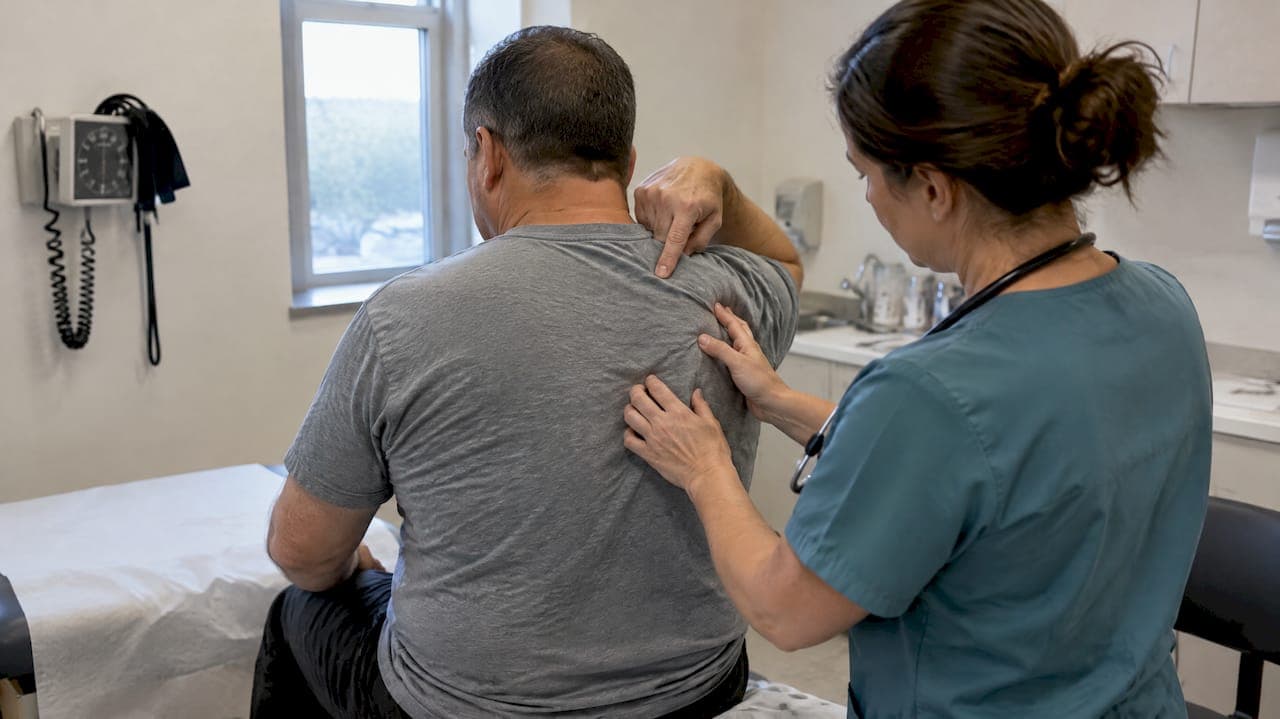
Shoulder blade pain after an accident usually comes from whiplash, a strained muscle, a rotator cuff tear, or in less common cases a fracture or dislocation. If you notice visible deformity, severe weakness, spreading numbness, or trouble breathing, get emergency care now. Without those signs, ice the area, limit heavy movement, and arrange a clinical evaluation within a few days.
TL;DR:
- Most shoulder blade pain after an accident stems from soft tissue injuries like whiplash or rotator cuff strain, with fractures and dislocations being less common.
- Emergency signs include visible deformity, inability to move the arm, severe worsening pain, breathing difficulty, or open wounds revealing bone.
- Initial home care involves ice application, immobilization with a sling if needed, and over-the-counter pain relief, but professional evaluation remains essential.
- Diagnostic imaging varies based on exam findings, with X-rays for fractures and MRI for soft tissue damage, guiding appropriate treatment.
- Most soft tissue injuries improve with conservative care such as rest, physical therapy, and activity modification rather than surgery.
Table of Contents
- What accidents do to cause shoulder blade pain
- Is your pain routine or a sign of something more serious?
- How doctors diagnose shoulder and shoulder blade injuries
- What to do for shoulder pain in the first 48 hours
- From rest to rehab: how shoulder injuries are actually treated
- Getting your shoulder moving again without setbacks
- Our take on treating shoulder blade pain after a crash
- FAQ
- Sources
What accidents do to cause shoulder blade pain
Several distinct injuries can produce pain at or under the shoulder blade, and they do not all feel the same or carry the same urgency.
Whiplash-associated disorders are the most frequently reported cause of referred pain between the shoulder blades after a rear-end collision or similar jolt. The sudden back-and-forth motion strains neck and upper back muscles, and that strain often radiates into the scapular region rather than staying localized to the neck.
A rotator cuff tear can happen when someone braces against a steering wheel, falls during a crash, or is thrown against a seatbelt with force. Sudden weakness when lifting the arm, pain that worsens at night, and a specific catching sensation during overhead motion are typical.
- Whiplash: diffuse upper back and shoulder blade soreness, often worse with neck motion.
- Rotator cuff tear: sudden weakness and pain with lifting, frequently worse at night.
- Scapular fracture: sharp, localized pain from high-energy impact, often with chest injuries.
- Clavicle fracture or AC joint separation: visible deformity, a sagging shoulder, or a bump at the collarbone.
- Labral tear or shoulder dislocation: instability, a feeling the joint might slip, or a visibly out-of-place shoulder.
Scapular fractures are uncommon and typically result from high-energy crashes, and they often accompany rib or lung injuries, which is why clinicians check the chest whenever a scapula fracture is suspected.
Is your pain routine or a sign of something more serious?
Most post-accident soreness improves within days with basic care, but certain signs mean you should not wait.
Seek emergency care immediately if you notice any of the following:
- Visible deformity or a shoulder that looks out of place.
- Inability to move the shoulder or arm at all.
- Rapidly worsening pain or swelling.
- Breathing difficulty or chest pain alongside shoulder pain.
- An open wound with bone visible.
Spreading numbness, tingling, or progressive weakness down the arm can point to nerve or spinal involvement and deserves prompt attention rather than a wait-and-see approach, a concern that also comes up with nighttime nerve-compression symptoms unrelated to trauma.
It is also common for adrenaline to mask pain at the scene, with symptoms appearing or worsening over the following day or two as inflammation builds.
Some whiplash-associated disorders persist well beyond the initial recovery window rather than resolving in days. Most people improve within weeks of a collision, but a share of cases become longer-term and benefit from structured rehabilitation rather than rest alone.
How doctors diagnose shoulder and shoulder blade injuries
A clinician will start with a focused history and physical exam: checking range of motion, pressing for tenderness, and testing circulation and nerve function in the arm and hand.
Imaging depends on what the exam suggests:
- X-ray identifies fractures and checks bone alignment.
- CT scan maps complex bony trauma in more detail, often used for suspected scapular or multi-fragment fractures.
- MRI shows soft-tissue damage such as rotator cuff or labral tears that an X-ray cannot capture.
Clinical exam findings guide which imaging study makes sense first, since ordering every scan for every patient is neither necessary nor efficient.
Where you go matters too. Deformity, severe pain, or breathing trouble belongs in the emergency department. Moderate pain without red flags can usually start at urgent care or a primary care visit, with referral to orthopedics if imaging shows a fracture or significant tear. Getting evaluated promptly also creates a documented medical record, which matters for any insurance or injury claim tied to the accident, a point covered in more detail in guidance on shoulder pain after a crash.
What to do for shoulder pain in the first 48 hours
Before you can get evaluated, a few simple steps reduce discomfort and avoid making things worse.
- Apply ice for 15 to 20 minutes every 2 to 3 hours during the first 48 to 72 hours, always wrapped in a cloth rather than placed directly on skin.
- Use a sling if you suspect a clavicle fracture or dislocation. Immobilization limits movement that worsens pain while you wait for evaluation.
- Consider an over-the-counter option like ibuprofen or naproxen for pain and swelling, or acetaminophen if NSAIDs are not appropriate for you, following the product label and any guidance from your clinician.
- Avoid heat on a swollen area, and never try to push a dislocated shoulder back into place yourself.
Ice packs and OTC NSAIDs help control acute pain, but they do not rule out a fracture or a full-thickness tear, so plan on a professional evaluation regardless of how much relief they provide.
Pro Tip: Take a photo of any visible bruising, swelling, or deformity right after the accident. It helps your clinician track changes and supports your medical record if you file a claim.

From rest to rehab: how shoulder injuries are actually treated
Treatment depends heavily on what the diagnosis turns out to be, and most cases do not require surgery.
Conservative care, meaning rest, activity modification, and progressive physical therapy, is the starting point for the majority of soft-tissue injuries and most rotator cuff tears that are not large or function-limiting. Physical therapy paired with active exercise tends to produce better range-of-motion and functional outcomes than rest alone.
- A sling supports healing for a nondisplaced clavicle fracture or after a reduced dislocation.
- Surgical consultation becomes relevant for displaced fractures, large or function-limiting rotator cuff tears, or shoulders that keep dislocating.
- Injections and other targeted modalities are sometimes used for persistent pain that is not responding to first-line care.
- A displaced clavicle fracture that cannot be managed with a sling alone often needs orthopedic surgical repair.
Recovery after an accident often works best as a coordinated effort. Primary care, physical therapists, and orthopedic specialists each play a role depending on severity, and manual therapy approaches, including chiropractic adjustment and modalities like traction or ultrasound, can fit into that plan alongside active rehabilitation rather than replacing it.
Pro Tip: Ask whoever evaluates you to document both the mechanism of injury and the specific diagnosis. That detail matters later if a claim or a specialist referral depends on it.
Getting your shoulder moving again without setbacks
Once a clinician clears you for movement, the goal shifts from protecting the injury to restoring it gradually.
- Start with pendulum swings and shoulder blade squeezes, which encourage gentle motion without loading the joint, plus light neck range-of-motion work if whiplash is part of the picture.
- Progress to isometric holds once pain allows, building tolerance without moving the joint through a full range.
- Add resistance band work as isometrics become comfortable, focusing on the muscles around the shoulder blade and rotator cuff.
- Move into functional movements, like reaching and lifting patterns tied to daily tasks or work duties, once strength and pain allow.
Stop any exercise that causes sharp or radiating pain, and watch for new numbness or weakness, which can signal that something needs reassessment rather than more repetitions. Avoid heavy overhead loading until a clinician clears you specifically for it.
Return to driving, work, and sports should follow the same pain-limited logic: resume gradually, and if progress stalls for more than a week or two, that is a reason to go back for reevaluation rather than push through. A step-by-step recovery timeline can help set realistic milestones along the way.
Pro Tip: If pain plateaus instead of improving week over week, that plateau is itself useful information, worth mentioning at your next visit rather than waiting it out.
Our take on treating shoulder blade pain after a crash
Shoulder blade pain after an accident gets treated as routine far too often, when the honest answer is that it needs a specific diagnosis before anyone can call it routine. A whiplash strain and a scapular fracture can feel similar in the first 24 hours, and the instinct to rest and wait it out sometimes delays catching the injury that actually needed imaging.

We see this pattern often with accident patients who come to us weeks after a collision because the pain "wasn't that bad at first." At our North Miami clinic, we offer chiropractic adjustments, shockwave therapy, massage therapy, electrical stimulation, ultrasound therapy, traction and decompression, and an auto accident evaluation built specifically around documenting what an accident did to your body, not just treating the ache.
A first visit typically includes a history of the accident, a physical exam, and a written record that can support an insurance claim if you need one. We bill insurance directly and keep documentation thorough so the clinical and claims sides of recovery move together instead of separately.
— Spark
This article is general information, not a substitute for advice from a qualified doctor. Consult a qualified healthcare professional about your own circumstances before acting on anything here.
FAQ
What causes a burning sensation between the shoulder blades?
A burning sensation between the shoulder blades after an accident often points to whiplash-related muscle strain or nerve irritation from the neck. Persistent burning, especially with numbness or tingling down the arm, warrants a clinical evaluation rather than home care alone.
What exercises help relieve shoulder pain at home?
Gentle pendulum swings and shoulder blade squeezes are commonly recommended early movements once a clinician has ruled out a fracture or significant tear. These moves maintain range of motion without loading the joint, and should stop immediately if they cause sharp or radiating pain.
What usually causes upper left back pain after a crash?
Upper left back pain after an accident is most often whiplash-related muscle strain, though it can also reflect a rib or rotator cuff injury on that side. Because chest and rib injuries can mimic shoulder blade pain, a clinical exam helps rule out overlapping injuries.
Why does my right shoulder hurt after an accident?
Right shoulder pain after an accident can come from whiplash, a rotator cuff strain or tear, or less commonly a fracture, depending on how the impact affected that side. Weakness when lifting the arm or pain that worsens at night suggests a rotator cuff issue worth having evaluated.
How much does chiropractic care cost after a car accident?
A chiropractic adjustment through our clinic is $45 per visit, and related services like shockwave therapy are priced separately on our pricing page. Monthly care plans are also available for ongoing accident recovery.
Sources
- Shoulder Trauma (Fractures and Dislocations) - OrthoInfo - AAOS
- Broken collarbone - aftercare: MedlinePlus Medical Encyclopedia