
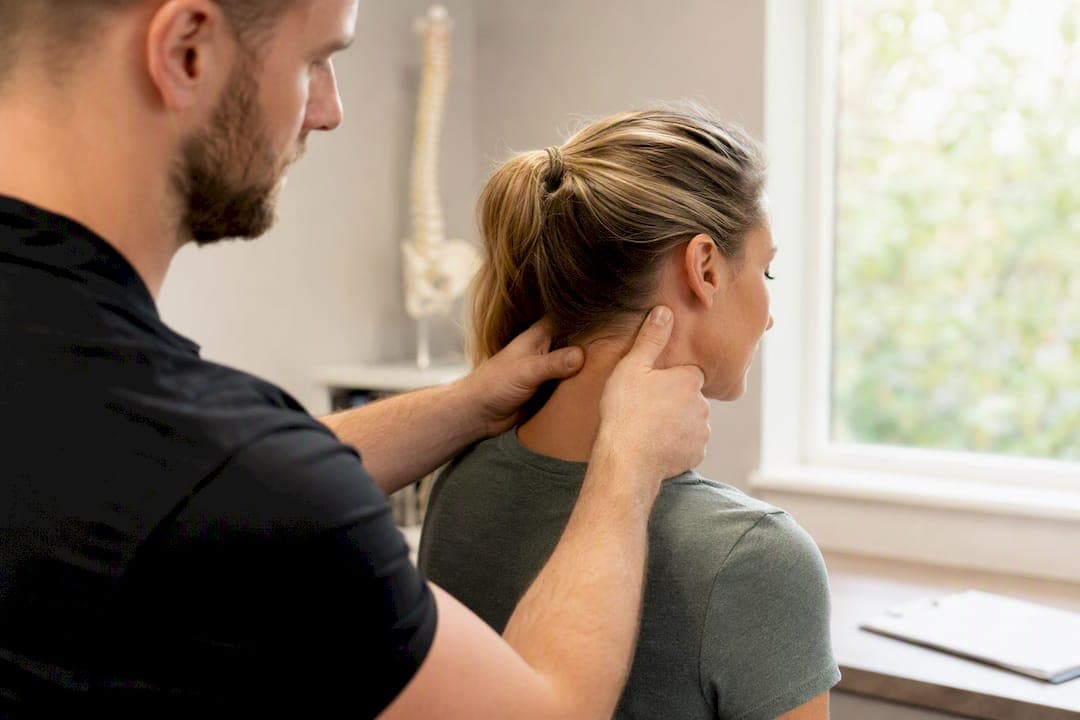
An accident injury evaluation is a focused medical exam to identify, document, and begin treating injuries from a crash or fall. It exists to do three things: protect your health by catching injuries that aren't obvious yet, build the treatment plan you'll actually follow, and create the medical record your insurance claim depends on. If you've been in a car accident, a workplace fall, or a slip-and-fall in the last few days, the single next move is to book this evaluation and bring every detail you remember about how it happened.
- Health check: find injuries before they get worse, including soft-tissue damage that doesn't hurt yet.
- Treatment plan: turn exam findings into a specific recovery roadmap, not generic advice.
- Documentation: create the paper trail insurers and, if needed, attorneys will review.
Why it matters right now: the secondary survey, a systematic head-to-toe reassessment done after initial stabilization, exists specifically because trauma is dynamic. Injuries that feel minor in the first hour can surface days later once adrenaline wears off.
Key Takeaways
An accident injury evaluation works because it pairs a structured physical exam with documentation precise enough to survive insurance scrutiny and guide real treatment decisions.
| Point | Details |
|---|---|
| Get evaluated fast | A delay between the accident and your first visit gives insurers a reason to question the claim. |
| Localize pain precisely | Point to the exact spot with one finger instead of gesturing broadly to help diagnosis and documentation. |
| Expect a two-stage process | An initial exam followed by reassessment within days catches injuries that weren't obvious at first. |
| Bring your own records | Photos, a police report, and a symptom diary strengthen both your treatment plan and your claim. |
| Watch for red flags | Worsening numbness, severe neurologic symptoms, or uncontrolled bleeding mean the ER, not a scheduled visit. |
Table of Contents
- What Happens During Your First Accident Injury Evaluation
- How Clinicians Structure the Exam: HOPS, SOAP, and the Secondary Survey
- Diagnostic Tests and Imaging: What Gets Ordered and Why
- Documentation and Insurance: What Gets Recorded and Why It Protects You
- Common Injuries This Evaluation Catches, and When to Skip It for the ER
- Your Next Steps After the Evaluation
- What to Bring: Preparing for Your Evaluation
- Why Most Advice on This Topic Misses the Point
- Frequently Asked Questions
- Sources
What Happens During Your First Accident Injury Evaluation
Walking in without knowing what to expect makes the whole process feel more intimidating than it needs to be. Here's the typical sequence:
- Check-in and urgency screening. Staff quickly assess whether you need emergency referral before anything else happens.
- Incident review. The clinician asks about the mechanism of injury: where you were sitting, which direction your head moved, whether the airbag deployed, and the direction of impact force. These details change what the provider looks for.
- Symptom interview. You'll be asked when symptoms started, how they've changed, and to point to the exact spot with one finger rather than gesturing broadly at "my back."
- Physical exam. This covers visual inspection, palpation (hands-on pressure to find tender points), range-of-motion testing, and basic neurologic checks like reflexes and grip strength.
- Same-day decisions. Depending on findings, you might get imaging ordered, start treatment immediately, or get referred to a specialist.
A few things worth knowing before you go in:
- Wear clothing that makes joints and your spine easy to examine.
- Don't downplay symptoms that feel minor. That's exactly the data a clinician needs.
- Expect the visit to run longer than a typical checkup. A thorough accident injury evaluation takes time because it's building a record, not just treating a complaint.
How Clinicians Structure the Exam: HOPS, SOAP, and the Secondary Survey
The questions can feel repetitive, but there's a system behind them. Clinicians commonly organize the exam using HOPS: History, Observation/Inspection, Palpation, and Special tests. History comes first because it tells the provider where to look. Observation means visually checking for swelling, bruising, or asymmetry. Palpation is the hands-on part, feeling for tender or tight tissue. Special tests are specific maneuvers, like moving your arm a certain way to check if it reproduces shoulder pain.
Everything from that exam gets written up using SOAP notes: Subjective (what you report), Objective (what the clinician measures), Assessment (the diagnosis), and Plan (the treatment path). This format isn't just paperwork. It's often the exact document an insurance adjuster or attorney reviews when deciding whether your claim holds up.
- The secondary survey happens after the initial exam, specifically to catch injuries that weren't obvious during the first pass.
- Many outpatient clinics schedule a reassessment at 48 to 72 hours because delayed symptoms are common, not rare.
- Localizing pain with one finger, rather than waving at a general area, helps a clinician tell new trauma apart from an old injury.
Pro Tip: Before your visit, write down exactly where it hurts using body-part specific language ("left side, just below the shoulder blade") instead of "my back hurts." It speeds up diagnosis and makes your file more precise.
Diagnostic Tests and Imaging: What Gets Ordered and Why
Not every evaluation includes imaging, and knowing which test does what helps you understand your provider's decisions instead of just following orders blindly.
- X-ray: the first choice when a fracture or dislocation is suspected. It shows bone clearly but has real limits for soft-tissue damage like ligament tears or muscle strain.
- CT scan: used for suspected serious head injury or trauma affecting multiple body systems at once. It's fast and detailed for bone and internal bleeding.
- MRI: the go-to when the concern is soft tissue, nerves, or spinal discs. This is where whiplash-related disc issues typically get confirmed.
- Concussion screening: cognitive and balance tests administered if you hit your head or report dizziness, confusion, or memory gaps, often followed by a follow-up check days later.
- Specialist referrals: orthopedics for fracture or joint concerns, neurology for persistent head or nerve symptoms, physical therapy once the acute phase settles and rehab becomes the focus.
Imaging isn't ordered automatically for every visit. It's based on what the history and physical exam turn up, which is exactly why the interview portion matters as much as the hands-on part.
Documentation and Insurance: What Gets Recorded and Why It Protects You
Every accident injury evaluation generates a paper trail, and that trail is what stands between you and a denied or underpaid claim.
- Mechanism of injury: how the accident happened, recorded in the clinician's own words based on your account.
- Timeline: when symptoms started and how they've progressed since the incident.
- Objective findings: measurable results like reduced range of motion, muscle spasm, or positive special tests.
- Imaging and test results: attached directly to your file as evidence.
- Treatment plan: the specific next steps prescribed, which shows continuity of care.
Prompt, continuous evaluation after a car accident matters because insurers look at timing gaps as a reason to question whether your injury is really accident-related. A two-week delay between the crash and your first visit gives an adjuster an easy argument to make.
Bring what you can: photos of vehicle damage and visible injuries, the police report if one exists, a short symptom diary, and a list of medications and prior conditions. For a fuller checklist, Sparkmed's guide on documenting accident injuries for chiropractic records walks through exactly what to preserve and when.
Common Injuries This Evaluation Catches, and When to Skip It for the ER
Some injuries show up in the exam room. Others need an ambulance, not an appointment.
Injuries commonly identified during evaluation:
- Whiplash and neck strain
- Soft-tissue sprains and muscle strains
- Shoulder and limb injuries from bracing or impact
- Mild concussion
- Spinal disc irritation or misalignment
Red flags that mean go straight to emergency care, not a scheduled visit:
- Worsening numbness or weakness in an arm or leg
- Uncontrolled bleeding
- Severe or progressive neurologic symptoms, like slurred speech or confusion
- Any loss of consciousness at the scene
- Severe neck or back pain that isn't relieved by rest
Field triage guidelines used by EMS teams rely on exactly these kinds of physiologic and anatomic red flags to decide who needs a trauma center immediately versus who can be evaluated on a normal timeline. If any new symptom shows up days after your evaluation, that's not something to wait out. Go back in.
Your Next Steps After the Evaluation
Once you leave the exam room, what you do in the following days matters almost as much as the visit itself.
- Follow the treatment plan exactly, and keep every scheduled follow-up. Reassessment is when hidden injuries surface.
- Keep copies of all records and imaging results in one place. You'll need them if a claim gets contested later.
- For acute swelling, ice and modified activity are the standard first move. Confirm any over-the-counter pain medication with your clinician first.
- Keep a short daily symptom diary. It's the easiest way to catch a worsening trend before it becomes an emergency.
Pro Tip: Set a recurring phone reminder to log your pain level each evening for the first two weeks. A pattern of "getting worse" is far more useful to your clinician than a single vague complaint at your next visit.
If a treatment plan following your evaluation includes chiropractic care, Sparkmed's overview of chiropractic methods that aid healing after car accidents explains what that recovery path typically looks like.
What to Bring: Preparing for Your Evaluation
Showing up prepared changes how much a single visit can accomplish. Clinicians work faster and more accurately when you arrive with specifics instead of a vague description of "the accident."
Bring a written timeline of what happened, in order: the moment of impact, what you did immediately after, and how symptoms have shifted since. Include photos of any visible injuries or vehicle damage if you have them. A copy of the police report, if one was filed, gives the clinician an independent account of the mechanism of injury to compare against your own.

List every medication you currently take, along with any prior neck, back, or joint issues, even old ones that seem unrelated. This matters more than most people expect: a provider needs to know your baseline to tell what's new versus what's a flare-up of something you already had. Skipping this step is one of the most common reasons an evaluation misses the mark.
If you've started a symptom diary since the incident, bring it. Even two or three days of notes on pain level, stiffness, or headaches gives a clinician real data instead of a memory reconstructed under stress. For a structured approach to gathering all of this before your appointment, Sparkmed's step-by-step injury documentation guide breaks down exactly what to track and how.
Don't worry about organizing everything perfectly. Bringing raw information, even messy notes and blurry photos, beats bringing nothing.
Why Most Advice on This Topic Misses the Point
Most guidance about post-accident evaluations focuses on the exam itself: what tests get ordered, what a clinician checks. That's useful, but it skips the part that actually determines whether your claim survives contact with an insurance adjuster: documentation discipline, not diagnostic sophistication.
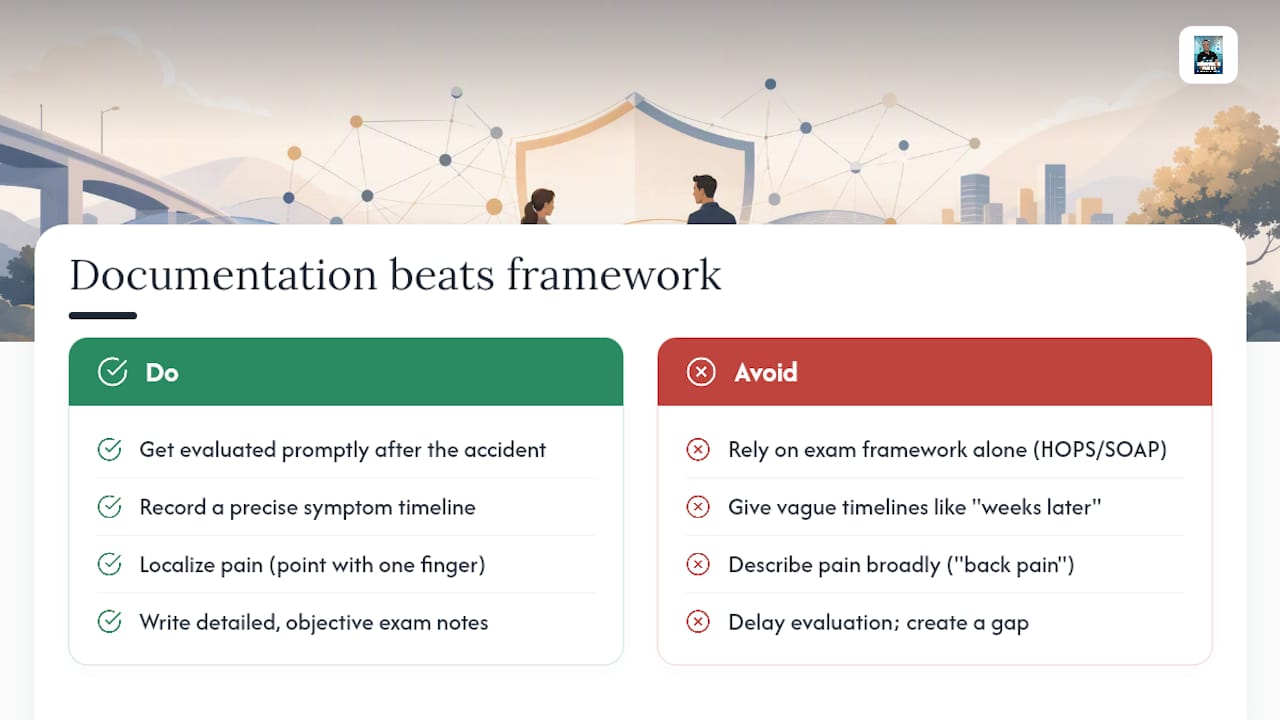
The clinical frameworks matter less to your outcome than most articles suggest. HOPS and SOAP are exam architecture, not magic. What actually protects you is the boring stuff: showing up early, giving a precise timeline instead of a vague one, and pointing to pain with one finger instead of a general shrug toward your torso. That single-finger detail sounds trivial. It isn't. It's the difference between a note that says "back pain" and one that says "tenderness at L4, reproducible on palpation," and adjusters read the difference immediately.
Where conventional advice really falls short is timing. Everyone says "get checked out." Almost nobody says the gap between accident and evaluation is itself evidence an insurer will use against you. Close that gap first. Everything else, imaging, referrals, treatment plans, follows from there.
Frequently Asked Questions
What is an accident injury evaluation, exactly? It's a structured medical exam that combines your incident history, a physical assessment, and sometimes imaging to identify injuries from a crash or fall and create a treatment and documentation plan.
How soon after an accident should I get an injury evaluation? As soon as possible, ideally within a few days. Prompt evaluation helps catch hidden injuries early and closes the documentation gap that insurers often use to question claims.
Does an accident injury evaluation always include X-rays or MRIs? No. Imaging is ordered based on what the history and physical exam suggest, not automatically for every visit. X-rays check for fractures, while MRIs are reserved for suspected soft-tissue or nerve involvement.
What should I bring to my accident injury evaluation? Bring a written timeline of the incident, photos of injuries or vehicle damage, a police report if one exists, your current medications, any prior related conditions, and a symptom diary if you've started one.
Why do clinicians ask me to point to my pain with one finger? Precise localization helps differentiate new trauma from a pre-existing condition and gives the clinician a specific, documentable finding rather than a vague complaint.
What happens if I feel fine right after the accident? Some injuries, especially soft-tissue and whiplash-type damage, don't produce symptoms immediately. That's exactly why a follow-up reassessment within 48 to 72 hours is standard practice in many outpatient settings.
This article is general information, not a substitute for advice from a qualified doctor. Consult a qualified healthcare professional about your own circumstances before acting on anything here.
Sources
- Secondary survey and trauma evaluation — NCBI Bookshelf