

A chiropractor can genuinely help with many types of shoulder pain, but the key word is many, not all. For rotator cuff tendinopathy, impingement syndrome, myofascial pain, and select cases of adhesive capsulitis, chiropractic care using multimodal methods, including spinal manipulation, soft-tissue therapy, and targeted exercise, often produces meaningful pain relief and restored movement. When the cause is a full-thickness rotator cuff tear, fracture, dislocation, or joint infection, you need a medical or surgical evaluation first.
Conditions that tend to respond well to chiropractic shoulder treatment:
- Rotator cuff tendinopathy and impingement (pain with overhead reach, no structural tear confirmed)
- Myofascial pain in the periscapular and rotator cuff muscles
- Adhesive capsulitis (frozen shoulder) in select cases, particularly when cervical or thoracic dysfunction is contributing
- Shoulder pain referred from the cervical spine (neck stiffness plus shoulder ache)
- Bursitis without infection
Conditions that need medical evaluation before or instead of chiropractic care:
- Full-thickness rotator cuff tears with significant loss of strength
- Suspected fracture or dislocation
- Signs of joint infection (fever, redness, warmth, rapid swelling)
- Unexplained shoulder pain with weight loss or night sweats (possible systemic cause)
A 2013 PMC case series of 50 patients with adhesive capsulitis reported a median pain-score reduction of 7 points on an 11-point scale after a chiropractic protocol targeting cervical and thoracic adjustments, with 16 of 50 patients reaching complete resolution in a median of 28 days. This is a case series, not a randomized trial, so it illustrates what is possible, not what is guaranteed.
Pro Tip: If your shoulder pain came on after a fall, collision, or sudden forceful movement, get an X-ray before your first chiropractic visit. A chiropractor will often order one anyway, but knowing ahead of time saves a visit and rules out fracture.
Key Takeaways
Chiropractic care offers a non-surgical, multimodal path for many shoulder conditions, but its effectiveness depends on accurate diagnosis, the right combination of techniques, and realistic expectations grounded in the available evidence.
| Point | Details |
|---|---|
| Chiropractic helps many, not all | Rotator cuff tendinopathy, impingement, myofascial pain, and select frozen shoulder cases respond well; fractures and full tears need medical care first. |
| Diagnosis drives treatment | A thorough exam including cervical spine assessment, orthopedic tests, and red-flag screening determines which methods are appropriate. |
| Multimodal care outperforms single techniques | Combining manipulation, soft-tissue therapy, and exercise produces better outcomes than any one approach alone, per systematic review evidence. |
| Evidence is promising but limited | Low-to-moderate quality evidence supports manual therapies for common shoulder conditions; high-quality RCTs isolating manipulation alone remain scarce. |
| Sparkmed offers accessible in-person care | North Miami clinic provides adjustments, shockwave, ultrasound, and rehab with a $25 cash-pay option and multilingual support. |
Table of Contents
- How a chiropractor diagnoses your shoulder pain
- Chiropractic treatment methods for shoulder pain
- Shoulder conditions chiropractors commonly treat
- What the research actually says about chiropractic and shoulder pain
- Safety, side effects, and when chiropractic is not appropriate
- What to expect during a course of chiropractic care
- Home care and prevention: what you can do between visits
- What we see in practice: clinic-level outcomes
- A clinician's perspective on shoulder care
- Shoulder pain care at Sparkmed in North Miami
- Sources
How a chiropractor diagnoses your shoulder pain
The diagnostic process at a shoulder pain chiropractor visit is more thorough than most patients expect. It starts with a detailed history: when the pain began, what movements provoke or relieve it, your occupation, any recent trauma, sport history, and whether neck stiffness accompanies the shoulder symptoms. That last point matters because a significant portion of shoulder pain originates in the cervical spine, not the glenohumeral joint itself.
The physical exam typically includes:
- Neer and Hawkins-Kennedy tests to screen for subacromial impingement
- Active and passive range-of-motion assessment using a goniometer (shoulder abduction, flexion, internal and external rotation)
- Resisted muscle testing to identify rotator cuff weakness patterns
- Cervical spine and thoracic mobility assessment, because restricted C4–C7 segments frequently refer pain into the shoulder girdle
- Scapular dyskinesis screen to catch altered scapular mechanics that load the rotator cuff
- Neurological screen (sensation, reflexes, grip strength) to rule out cervical radiculopathy
Red flags that prompt immediate medical referral rather than chiropractic treatment:
- Fever, chills, or skin changes over the joint (possible septic arthritis)
- Severe sudden weakness with no prior pain history (possible acute rotator cuff rupture)
- Obvious deformity or inability to move the arm after trauma (fracture or dislocation)
- Uncontrolled swelling that worsens over hours
- Shoulder pain in a patient over 50 with unexplained weight loss
Imaging is ordered when the exam findings suggest structural damage, when pain has not improved after 4–6 weeks of conservative care, or when a red flag is present. X-rays rule out fracture and calcific tendinitis. MRI is the standard for suspected full-thickness tears or advanced adhesive capsulitis staging.
Pro Tip: Before your first appointment, write down the exact movements that hurt, when the pain started, and any prior imaging you have had. Bringing those images on a disc or a digital file saves time and gives the chiropractor a clearer starting point.
A quick self-check before booking: if you have fever, obvious deformity, or sudden complete loss of arm function, go to urgent care first. If you have aching pain, stiffness, or pain with specific movements that has persisted more than a few days, a chiropractic evaluation is a reasonable next step.
Chiropractic treatment methods for shoulder pain
Chiropractic shoulder treatment is rarely a single technique. The methods below are selected based on what the exam reveals, not applied uniformly to every patient.
Spinal and extremity manipulation (HVLA/thrust) targets restricted joints in the cervical spine, thoracic spine, acromioclavicular joint, or glenohumeral joint. Cervicothoracic manipulation is particularly relevant when neck stiffness is driving referred shoulder symptoms. Medical News Today's clinical synthesis notes that addressing neck and upper-back contributions through manual therapy can produce neurophysiological changes, including muscle stretch responses and neuromuscular adaptation, that reduce shoulder pain.

Mobilization uses slower, oscillatory joint movements without a thrust. It is preferred when the patient is apprehensive, hypersensitive, or when the joint is acutely inflamed.
Soft-tissue techniques include ischemic compression on trigger points, cross-friction massage over tendon insertion sites, and myofascial release for the rotator cuff, pectoralis minor, and upper trapezius. These are often the primary intervention for myofascial shoulder pain.
Instrument-assisted adjusting (Activator-style devices) delivers a low-force mechanical impulse. It is particularly useful for elderly patients or those with hyperalgesia where high-velocity thrusts are poorly tolerated, as supported by PubMed case reports on adhesive capsulitis management.
Therapeutic exercise and motor control retraining addresses the rotator cuff and scapular stabilizers. Isometric holds progress to eccentric loading as pain allows. This component is what separates a short-term pain fix from a durable functional recovery.
Therapeutic modalities used alongside manual care include:
- Therapeutic ultrasound and phonophoresis to deliver anti-inflammatory agents into deeper tissue
- Shockwave therapy for calcific tendinitis and chronic tendinopathy
- Low-level laser therapy (LLLT) for tissue healing support
- Heat and cold therapy for acute vs. chronic presentations
- TENS for short-term pain modulation
A broad systematic review covering 25 systematic reviews and 44 randomized controlled trials found low-to-moderate evidence that manual therapies combined with exercise improve outcomes for rotator cuff disorders, impingement, and adhesive capsulitis better than passive care alone.
| Method | Typical goal | Session frequency | Time to noticeable change |
|---|---|---|---|
| Spinal/extremity manipulation | Restore joint mobility, reduce referred pain | 2–3x/week initially | 2–4 weeks |
| Soft-tissue therapy | Release trigger points, reduce muscle tension | 1–2x/week | 1–3 weeks |
| Therapeutic exercise | Strengthen rotator cuff, improve scapular control | Daily (home program) | 3–6 weeks |
| Ultrasound/shockwave | Reduce tendon calcification, promote healing | 1–2x/week | 4–8 weeks |
| Mobilization | Improve capsular flexibility (frozen shoulder) | 2–3x/week | 4 weeks |
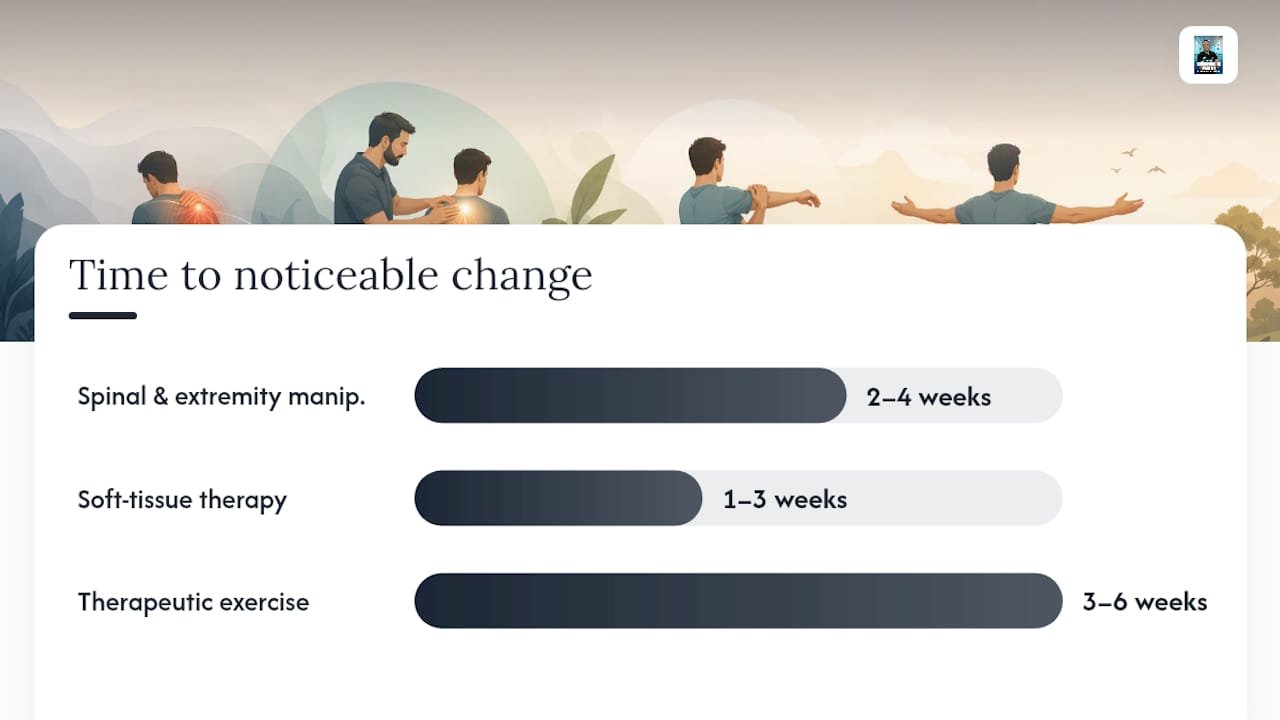
Multimodal care consistently outperforms any single technique in the clinical literature. A case series on shoulder impingement using combined soft-tissue therapy, ultrasound phonophoresis, spinal manipulation, and exercise reported full symptom resolution in all four patients, with outcomes maintained at one- and two-month follow-up.
Shoulder conditions chiropractors commonly treat
Most patients who see a shoulder pain chiropractor fall into one of these categories:
Conditions well-suited to chiropractic conservative management:
- Rotator cuff tendinopathy/tendinosis: chronic overuse changes in the supraspinatus or infraspinatus without full-thickness tear
- Subacromial impingement syndrome: pain with arm elevation caused by reduced subacromial space
- Subacromial bursitis: inflammation of the bursa, often co-existing with impingement
- Myofascial pain syndrome: trigger points in the rotator cuff, rhomboids, or upper trapezius
- Adhesive capsulitis (frozen shoulder): select cases, especially early-to-mid stage or when cervical dysfunction is a contributing factor
- Cervicogenic shoulder pain: pain referred from C4–C6 nerve roots, often mimicking rotator cuff symptoms
Conditions requiring medical or surgical co-management:
- Full-thickness rotator cuff tears with significant functional loss (surgery is often indicated)
- Glenohumeral dislocation (requires reduction and orthopedic evaluation)
- Fractures of the clavicle, humerus, or scapula
- Septic arthritis (urgent medical care)
- Shoulder pain from systemic disease (rheumatoid arthritis flare, cancer metastasis)
One practical note: many patients arrive with overlapping diagnoses, and labels like "impingement" or "bursitis" often describe the same underlying dysfunction from different angles. Clinicians increasingly use descriptive terms like "shoulder pain and dysfunction" to capture that overlap without over-committing to a structural label before imaging confirms it.
What the research actually says about chiropractic and shoulder pain
The evidence base is promising but genuinely limited, and patients deserve an honest read of it.
The strongest signal comes from multimodal approaches. The systematic review of nondrug, nonsurgical shoulder treatments found low-to-moderate quality evidence supporting manual therapies, particularly when paired with exercise, across rotator cuff disorders, impingement, adhesive capsulitis, and nonspecific shoulder pain. That is a meaningful finding, but "low-to-moderate" means the trials were often small, not blinded, or used inconsistent outcome measures.
For thrust manipulation specifically, the picture is thinner. A 2018 systematic review searching 2,088 articles found only one trial meeting eligibility criteria for thrust manipulation combined with another conservative intervention for rotator cuff conditions. The review concluded there is insufficient data to determine whether adding manipulation to another treatment produces additional benefit. Improvements were seen within treatment groups, but between-group comparisons were not statistically robust.
Statistic to know: The 50-patient adhesive capsulitis case series reported a median pain reduction of 7 points on an 11-point scale, with 16 patients reaching complete resolution in a median of 28 days. Those are striking numbers, but a retrospective case series has no control group, so the natural history of the condition cannot be separated from the treatment effect.
What patients should realistically expect: meaningful pain reduction and improved range of motion are plausible outcomes for the conditions listed above. The degree of improvement and how long it lasts vary considerably between individuals. More high-quality randomized trials are needed before firm conclusions about specific techniques can be drawn.
Safety, side effects, and when chiropractic is not appropriate
MedlinePlus and the NCCIH both note that chiropractic care is generally safe for musculoskeletal conditions when performed by a qualified practitioner who screens for contraindications. The most common reactions are mild and short-lived.
Typical post-treatment reactions (usually resolve within 24–48 hours):
- Localized soreness or stiffness at the treated area
- Mild fatigue
- Temporary increase in achiness before improvement
Contraindications and red flags that make chiropractic inappropriate or require modification:
- Unstable fracture at or near the treatment site
- Active joint infection (septic arthritis)
- Severe osteoporosis with high fracture risk
- Uncontrolled anticoagulation therapy (high bleeding risk with deep soft-tissue work)
- Acute severe neurological deficit (rapidly progressing weakness or numbness)
- Suspected malignancy in the treatment region
Practical safety checklist to bring to your first visit:
- List of current medications (especially blood thinners)
- Any prior imaging (X-rays, MRI) of the shoulder or cervical spine
- History of recent trauma, surgery, or injections in the area
- Any known bone density issues or systemic inflammatory conditions
Co-management with an orthopedic specialist or physical therapist is recommended when the diagnosis is unclear, when neurological signs are present, or when conservative chiropractic care has not produced measurable improvement after 4–6 weeks. A good chiropractor refers out when the situation calls for it. That is not a limitation; it is how the system is supposed to work.
What to expect during a course of chiropractic care
First visit (60–90 minutes):
- Intake paperwork covering health history, medications, and prior treatments
- Focused physical exam including shoulder orthopedic tests and cervical spine assessment
- Provisional diagnosis and explanation of findings
- Brief initial treatment (often gentle mobilization or soft-tissue work, not a full adjustment session)
- A home-care plan with 1–2 exercises or movement guidelines to start immediately
Typical treatment schedule:
- Acute or subacute phase: 2–3 visits per week for the first 2–4 weeks
- Improvement phase: taper to 1–2 visits per week as pain decreases and function improves
- Maintenance or discharge: weekly or biweekly visits, then self-managed with a home program
Adhesive capsulitis often requires a longer course, sometimes 8–16 weeks, though the case series data suggests some patients see rapid gains when cervical dysfunction is addressed early. For spinal adjustment outcomes and how progress is measured, pain scales (NPRS or VAS) and goniometric shoulder abduction measurements are the standard tools.
Cost and insurance:
- Chiropractic visits in the United States typically range from $65 to $200 per session depending on location and services included
- Many private insurance plans cover chiropractic care with a copay; Medicare covers manual manipulation for spinal conditions but coverage for extremity work varies
- Ask the clinic directly about cash-pay rates, package pricing, and what is included in each visit
- Transparency about pricing before the first visit is a reasonable expectation; any clinic worth your time will give you a clear answer
Home care and prevention: what you can do between visits
Recovery does not happen only in the clinic. What you do between sessions often determines how quickly you progress.
Rotator cuff conditioning:
- Isometric holds (pressing the arm against a wall in internal and external rotation) are the safest starting point when pain is acute
- Eccentric external rotation with a light resistance band, performed slowly through the lowering phase, builds tendon resilience over time
- Progress loading only when the movement is pain-free through a full range
Scapular activation and posture:
- Scapular retraction and depression exercises (think "tuck your shoulder blades into your back pockets") counteract the forward-rounded posture that compresses the subacromial space
- Desk workers should set a timer to stand and perform 10 scapular retractions every 45–60 minutes
Ice vs. heat:
- Ice (15–20 minutes) is appropriate for acute flare-ups with swelling or heat in the joint
- Heat works better for chronic stiffness and muscle tension before exercise or stretching
Return to activity:
- Avoid overhead pressing or throwing until you can perform a pain-free full range of motion with light resistance
- Gradual loading, not rest, is the goal; complete immobilization slows recovery for most shoulder conditions
For athletes managing shoulder recovery alongside training, the mobility restoration checklist from HTK Training provides a practical framework for reintroducing movement progressively.
Pro Tip: Attach your rotator cuff exercises to something you already do daily, like brushing your teeth or making coffee. Two minutes of isometric holds twice a day adds up faster than a dedicated gym session you skip.
What we see in practice: clinic-level outcomes
The research gives you averages. What follows reflects the kinds of presentations and outcomes a multimodal chiropractic clinic sees regularly.
Common presentation pattern:
- A patient reports 3–4 months of right shoulder pain with overhead reach, worse after desk work, with concurrent neck stiffness
- Exam reveals restricted C5–C6 mobility, positive Hawkins test, and weak external rotation
- Treatment: cervicothoracic manipulation, ischemic compression to the infraspinatus, and a home band-resistance program
- Outcome: meaningful pain reduction and improved abduction within 4–6 visits; full return to activity by week 8
Frozen shoulder presentation:
- Patient presents with global restriction in all planes, unable to reach behind the back
- Assessment focuses on cervical tone, scapular mechanics, and capsular end-feel
- Multimodal protocol: cervical adjustment, glenohumeral mobilization, ultrasound, and progressive stretching
- Outcome: gradual but consistent range-of-motion gains over 10–14 weeks, consistent with the OTZ case series findings
Clinic protocols at Sparkmed align with the research consensus: combining manipulation, soft-tissue work, and exercise consistently outperforms any single-technique approach. For a step-by-step look at how treatment plans are structured, the clinic's patient pathway covers intake through discharge.
Appointments are available in English, Spanish, and Creole, and Uber Health transport is available for patients who need it.
A clinician's perspective on shoulder care
Shoulder pain is one of the most diagnostically layered problems in a chiropractic practice. The shoulder does not work in isolation. The cervical spine, thoracic spine, scapula, and glenohumeral joint all contribute to how the arm moves, and a problem in any one of them can show up as pain in the others. That is why the exam always starts above the shoulder, not at it.
When deciding which techniques to use, the choice comes down to what the exam reveals, not a protocol. A patient with restricted C5 mobility and referred deltoid pain gets cervicothoracic manipulation first. A patient with a stiff, globally restricted shoulder and no neck findings gets glenohumeral mobilization and capsular stretching. A patient with a hot, swollen joint gets referred out before anything else.
Shared decision-making matters here. Patients who understand why a technique is being used, and what realistic improvement looks like in their specific case, tend to follow through with home programs and report better outcomes. When the situation is beyond conservative care, referring to an orthopedic surgeon or sports medicine physician is not a failure. It is the right call.
Shoulder pain care at Sparkmed in North Miami
Sparkmed offers a full multimodal shoulder treatment program at its North Miami clinic, including spinal and extremity adjustments, soft-tissue therapy, therapeutic ultrasound, shockwave therapy, and supervised rehab protocols. The clinic's $25 adjustment option does not require insurance, making it one of the more accessible entry points for shoulder pain care in the area.

The first visit includes a focused shoulder and cervical spine exam, a provisional diagnosis, and a clear explanation of the treatment plan before anything begins. If imaging or specialist co-management is needed, the clinic will tell you directly rather than continuing care that is not appropriate for your situation. Services are available in English, Spanish, and Creole, and Uber Health transport can be arranged for patients who need it.
To book an appointment or ask about pricing, visit Sparkmed's accessibility and booking page or call the North Miami clinic directly. Bring any prior imaging and a list of current medications to your first visit.
Sources
The sources below are the primary references used in this article. Case series provide real-world outcome data but lack control groups; systematic reviews synthesize multiple trials but are only as strong as the trials they include.
- Chiropractic management of frozen shoulder syndrome using a novel technique: a retrospective case series of 50 patients - PMC
- SYSTEMATIC REVIEW OF NONDRUG, NONSURGICAL TREATMENT OF SHOULDER CONDITIONS
- Chiropractic in depth - NCCIH
- Chiropractic - MedlinePlus
- Chiropractic care for shoulder pain: Can it help? - Medical News Today
This article provides general health information and is not a substitute for professional medical or chiropractic advice. Consult a qualified practitioner to confirm whether chiropractic care is appropriate for your specific condition.