

Shoulder pain after a car accident often points to a rotator cuff injury, labral tear, fracture, AC joint sprain, or soft-tissue strain, and it doesn't always show up right away. The single best move is getting evaluated promptly and making sure the crash gets documented in your medical record. Outcomes vary a lot by injury type, but early care consistently protects both your shoulder and your ability to prove what happened.
TL;DR:
- Most shoulder injuries from car accidents are soft-tissue strains or tears that may not be immediately visible and require prompt evaluation for accurate diagnosis.
- Red-flag symptoms like sudden weakness, deformity, or numbness need urgent medical attention, especially if pain worsens or does not improve over time.
- Delayed-onset shoulder pain is common due to adrenaline masking injuries at the scene and inflammation developing over days, making early checkups crucial even if feeling okay initially.
- MRI with an MR arthrogram is often necessary to detect labral tears that standard imaging might miss, especially when deep catching or instability persists after initial tests.
- Documenting your injury thoroughly and promptly can significantly strengthen insurance or legal claims, emphasizing the importance of detailed medical records and symptom tracking.
Table of Contents
- Common Shoulder Injuries After a Car Accident
- When Is Shoulder Pain After a Crash a Red Flag?
- Why Does Shoulder Pain Show Up Days After the Crash?
- How Do Doctors Diagnose a Shoulder Injury After a Crash?
- What Treatment Options Exist for Shoulder Pain After a Crash?
- How Long Does Shoulder Injury Recovery Take?
- Documenting Your Shoulder Injury: A Practical Checklist
- What a Clinic Visit for Shoulder Pain Looks Like at Sparkmed
- Sources
- FAQ
Common Shoulder Injuries After a Car Accident
The shoulder takes a beating in a collision because it absorbs force from three directions at once: the seatbelt locking across your chest, your arm bracing against the wheel or door, and the direct jolt of impact itself. Clinical reviews of crash injuries point to this combination as the reason rotator cuff tears, labral tears, dislocations, and fractures are among the most common shoulder injuries after car accidents.
Rotator cuff strains and tears. The rotator cuff is the group of four muscles and tendons that hold your upper arm bone in the shoulder socket. A sudden brace against the wheel or a seatbelt catching hard can strain or tear it. Telltale signs include pain when reaching overhead, aching that gets worse at night, and a weak feeling when you try to lift your arm away from your body.
Labral tears. The labrum is the ring of cartilage that cups the shoulder joint and keeps it stable. Damage here often feels different from a rotator cuff problem. Instead of a dull ache, people describe catching, popping, or a sense that the shoulder might slip out of place during certain movements. Labral tears are notoriously tricky to catch on standard imaging, which is worth knowing before you sit down with a doctor.
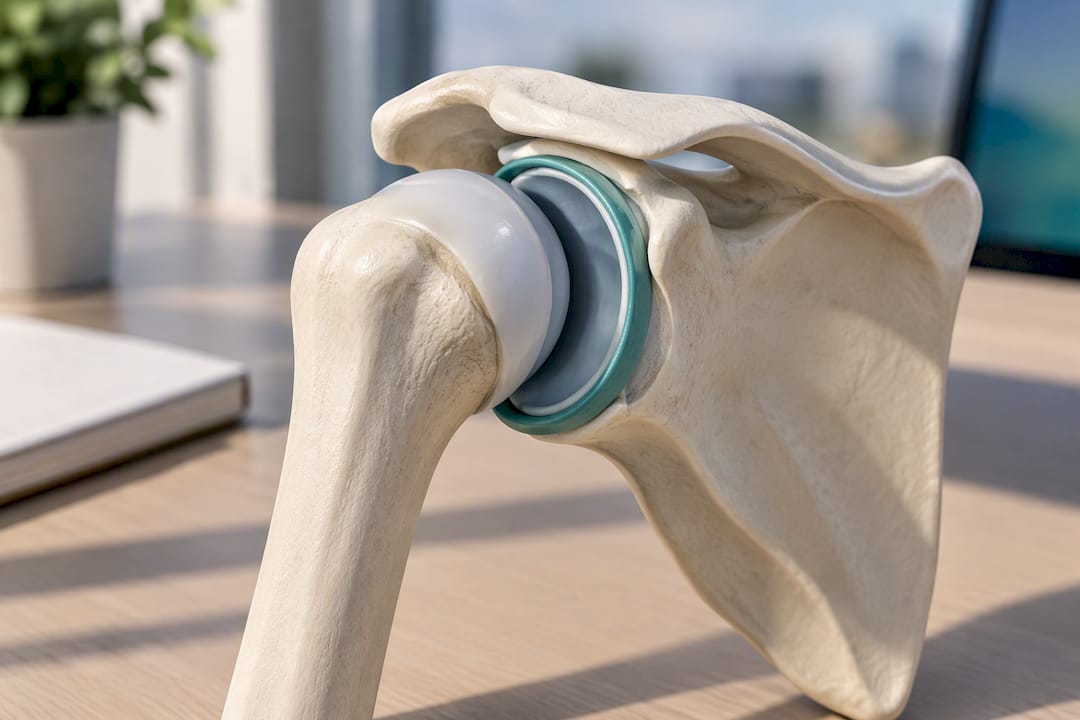
Dislocations and fractures. A hard impact can pop the shoulder joint out of its socket entirely, or break the clavicle, the top of the upper arm bone (proximal humerus), or the shoulder blade. According to OrthoInfo's overview of shoulder trauma and fractures, these injuries usually announce themselves clearly: visible deformity, an inability to move the arm, and pain sharp enough that there's no question something is seriously wrong.
AC joint separations. The acromioclavicular joint sits at the top of the shoulder where the collarbone meets the shoulder blade. A direct blow, common when your shoulder hits the door panel, can sprain or separate this joint, causing a distinct bump or step-off you can sometimes see or feel at the top of the shoulder.
Soft-tissue bruising and strains. Not every crash injury involves a torn structure. Seatbelt bruising and muscle strains around the shoulder and upper back are common and, while painful, typically resolve faster than structural injuries.
When you talk to a clinician, be specific. Note:
- Exactly where the pain is (front, top, back of the shoulder, or radiating down the arm)
- What movement triggers it (reaching overhead, reaching behind your back, lifting)
- Whether you feel weakness, catching, or a sense of instability
- Whether pain is worse at night or during rest
That level of detail speeds up an accurate diagnosis, according to OrthoInfo's clinical descriptions of common shoulder injuries.
When Is Shoulder Pain After a Crash a Red Flag?
Most accident-related shoulder pain is a musculoskeletal injury that responds to standard care. Some symptoms, though, mean you shouldn't wait for a scheduled appointment.
Seek urgent evaluation if you notice:
- Sudden, severe weakness where you can't lift or hold your arm
- Numbness or tingling running down the arm or into the hand
- Visible deformity or a shoulder that looks out of place
- Skin that's cold, pale, or discolored below the injury (a possible sign of blood flow disruption)
- Pain so severe that over-the-counter medication does nothing
Pro Tip: Track your pain on a simple 1 to 10 scale twice a day for the first week. A number that climbs instead of settling, especially at night, is one of the clearest signals that something structural is going on rather than routine soreness.
Timeline matters too. Pain that's flat or slowly improving over several days is typical for a strain. Pain that worsens, or weakness that progresses rather than stays the same, deserves a same-day call to a clinician rather than a wait-and-see approach. If you hit any of the red flags above, go to urgent care or an emergency department rather than scheduling a routine visit.
Why Does Shoulder Pain Show Up Days After the Crash?
It's genuinely common to walk away from a fender bender feeling fine, only to wake up two or three days later barely able to lift a coffee cup. There's a real physiological reason for that gap. Adrenaline floods your system during a crash, and it's a strong natural painkiller. It can mask a significant injury for hours, sometimes convincing people they're unhurt when a rotator cuff tear or labral injury is already there, a pattern clinical reviews of collision injuries note directly, since adrenaline can delay awareness of shoulder injuries sustained in the crash itself. Once adrenaline fades, inflammation moves in. Swelling and tissue irritation build over hours to days, which is often when pain actually peaks, not at the scene.
There's a second layer here worth understanding: whiplash. Neck injuries frequently cause pain that radiates into the shoulder and upper back, so what feels like a shoulder problem may partly be a neck problem. Mayo Clinic notes that whiplash can produce delayed symptoms in the upper extremities, which is exactly why an early exam matters. Getting checked within the first few days, even if you feel mostly okay, creates a medical record that ties your symptoms to the crash before delayed onset muddies the timeline.
How Do Doctors Diagnose a Shoulder Injury After a Crash?
A thorough exam starts before any imaging. Expect a clinician to ask about the mechanism of injury (how your arm was positioned, whether you braced against the wheel) and then run through specific physical tests: resisted range-of-motion checks for the rotator cuff, stability tests for the AC joint, and provocative maneuvers designed to reproduce catching or clicking associated with labral tears.
From there, imaging follows a fairly predictable order:
- X-rays come first when a fracture or dislocation is suspected. They're fast and show bone clearly, but they don't image soft tissue like tendons, ligaments, or cartilage.
- MRI is the standard next step for soft-tissue evaluation, showing rotator cuff tears, muscle strains, and most structural damage around the joint.
- MR arthrogram gets recommended specifically when a labral (SLAP) tear is suspected, because standard MRI can miss labral tears that an MR arthrogram, using injected contrast dye, picks up clearly.
- CT scans or EMG studies come into play for complex fractures or when nerve involvement is suspected alongside the shoulder injury.
Pro Tip: If a standard MRI comes back "normal" but you're still dealing with deep catching, locking, or a sense of instability, ask specifically about an MR arthrogram. Johns Hopkins Medicine's overview of shoulder labrum tears points out that this more detailed test is often what finally confirms a labral injury regular imaging missed.
What Treatment Options Exist for Shoulder Pain After a Crash?
Treatment almost always follows a step-up approach, starting conservative and escalating only when the injury demands it.
- Initial care. Rest, ice, compression, and gentle activity modification (the RICE approach) form the starting point for most soft-tissue injuries. NSAIDs or acetaminophen manage pain and swelling in the first days, taken according to label directions or a doctor's guidance.
- Physical therapy. For strains, mild tears, and post-injection recovery, PT is the workhorse. The goals are restoring range of motion, rebuilding scapular control (the small stabilizing muscles around the shoulder blade), and progressively loading the joint so strength returns without re-injury. OrthoInfo's guidance on rotator cuff tears frames conservative care, including PT, as the first-line approach for many of these injuries.
- Injections and emerging therapies. Corticosteroid injections can calm significant inflammation when pain limits participation in physical therapy. Platelet-rich plasma (PRP) injections are used in some cases, though the evidence supporting them is still developing and results vary by patient and injury type.
- Surgery. Full-thickness rotator cuff tears, displaced fractures, recurrent shoulder dislocations, and labral tears that don't respond to months of conservative care are the main reasons surgery gets discussed. Post-surgical rehab is a longer road, typically involving a structured PT program over several months to rebuild strength and motion safely.
Hands-on care, like chiropractic adjustment and myofascial work, often fits into the conservative phase alongside PT, particularly when neck and shoulder symptoms overlap after whiplash. A resource on chiropractic tips after a car accident walks through how that combination typically plays out.
How Long Does Shoulder Injury Recovery Take?
Recovery timelines vary widely depending on what's actually damaged, so treat these as general ranges rather than promises.
Soft-tissue strains and bruising typically settle within a few weeks. Rotator cuff tears treated without surgery often require several weeks or more to heal, while surgical repairs commonly need a recovery period lasting several months before full strength returns. Fractures and other surgical cases generally involve several months of healing, varying with severity and break location.
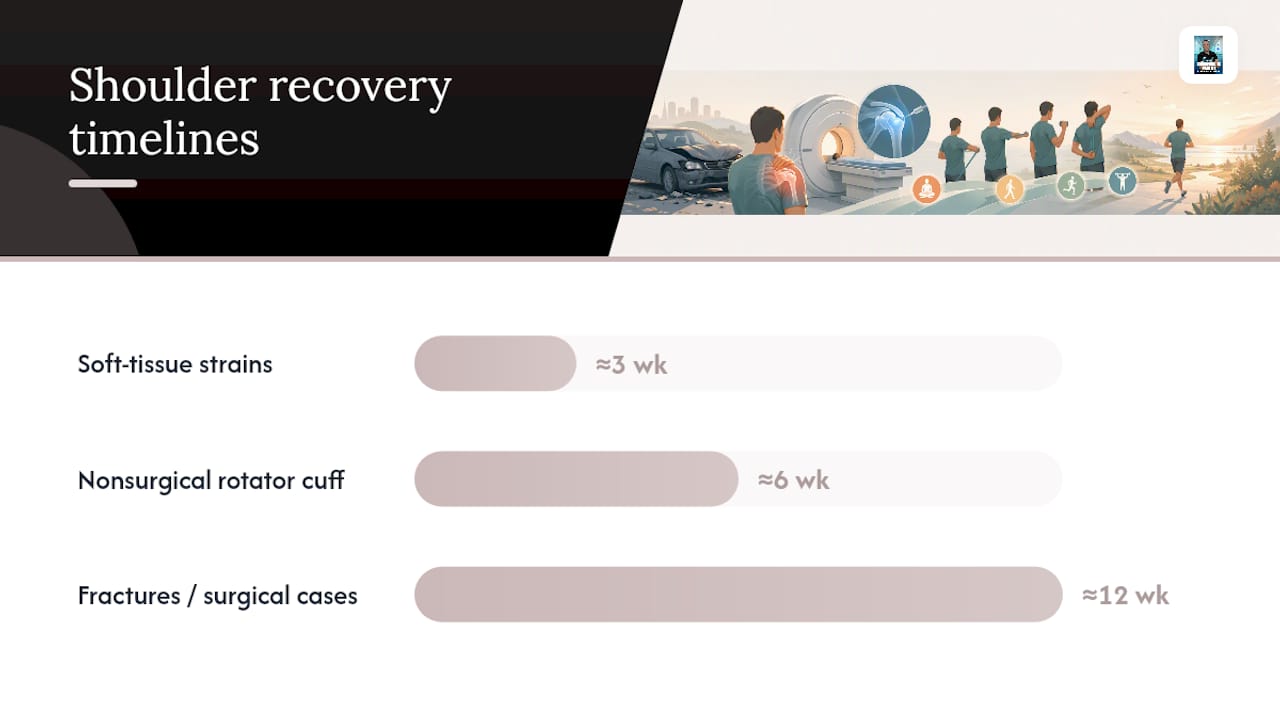
Several factors can stretch these timelines: older age, delayed treatment start, smoking (which slows tissue healing), and underlying conditions like diabetes all tend to push recovery toward the longer end.
Track your own progress against three markers: range of motion, strength on daily tasks like lifting or reaching, and whether night pain is fading or persisting. If you plateau or backslide on any of these, that's your cue to get re-evaluated rather than assuming more time alone will fix it.
Documenting Your Shoulder Injury: A Practical Checklist
What you do in the first weeks after the crash matters almost as much for a claim as for your recovery. Insurers and attorneys lean heavily on the medical record, so gaps or delays can weaken a case even when the injury itself is real and serious.
- Get evaluated promptly and make sure the visit notes state the mechanism of injury (the crash itself), not just your symptoms.
- Keep a daily symptom diary tracking pain levels, missed workdays, and sleep disruption from shoulder pain.
- Follow through on any imaging or specialist referrals your doctor recommends, and keep copies of every bill, visit summary, and imaging report.
- If your symptoms or missed work are significant, consider talking to an attorney or patient advocate early rather than after your file is already thin.
Pro Tip: A prompt, well-documented medical record that clearly links your shoulder pain to the crash is one of the strongest things you can have if you ever need to support an insurance claim or legal case.
Readers dealing with broader post-crash symptoms may also find it useful to review a symptom checklist covering the most common signs to watch for after any collision, since shoulder pain rarely shows up in isolation.
What a Clinic Visit for Shoulder Pain Looks Like at Sparkmed
At Sparkmed, an initial visit typically starts with a history of the crash, a focused exam of the shoulder and neck, and imaging referrals when warranted. Services relevant to shoulder recovery include chiropractic adjustments, shockwave therapy, massage therapy, ultrasound therapy, electrical stimulation, traction and decompression, and a dedicated auto accident evaluation. Scheduling is available with bilingual support. Choosing clinic care doesn't replace an initial medical evaluation, especially if you have any red-flag symptoms described above.
Sources
For deeper clinical detail, see OrthoInfo's shoulder trauma resource and the Mayo Clinic's whiplash overview.
This article is general information, not a substitute for advice from a qualified doctor. Consult a qualified healthcare professional about your own circumstances before acting on anything here.
- PMCID: PMC3977376
- Mayo Clinic — Whiplash: Symptoms and causes
- OrthoInfo — Common shoulder injuries
- Johns Hopkins Medicine — Shoulder labrum tear
FAQ
How Can I Tell If My Shoulder Injury Is Serious?
Weakness that keeps you from lifting your arm, numbness running into your hand, visible deformity, or pain that worsens instead of improving over several days are the clearest signs of a serious injury. Rotator cuff tears, labral tears, dislocations, and fractures are the main structural injuries behind these symptoms, and any of them warrants prompt medical evaluation rather than waiting it out.
What Is the Average Settlement for a Shoulder Injury Claim?
Settlement amounts vary too widely by injury severity, treatment cost, lost wages, and jurisdiction to state a single reliable figure. What consistently helps a claim is a well-documented medical record that ties your shoulder pain directly to the crash, starting with your very first visit.
What Level of Pain Is Normal After a Car Accident?
Mild to moderate soreness, stiffness, and bruising that gradually improve over the first one to two weeks are typical after a crash. Pain that's severe from the start, that worsens rather than fades, or that comes with weakness or numbness is not considered normal and needs evaluation.
Is Shoulder Pain a Common Symptom of Whiplash?
Yes. Whiplash and neck injuries frequently cause referred pain into the shoulder, and these symptoms can appear with a delay of hours to days after the crash. That overlap is one reason shoulder pain and neck pain are often evaluated together.