

You wake up two days after the crash feeling worse than you did on impact. Your neck is stiff, your lower back throbs, and the pain pills barely touch it. Rest is not working. Time is not helping. This is the reality for millions of accident victims who keep waiting for the pain to fade on its own, only to find themselves still struggling months later. Chiropractic spinal health care offers a clinically supported, affordable path forward that addresses the actual source of that pain rather than just masking it.
Table of Contents
- Understanding post-accident spinal health challenges
- What you need before starting chiropractic spinal recovery
- Step-by-step guide to chiropractic spinal recovery
- How to verify results and avoid setbacks
- Why combining chiropractic and exercise is your smartest next move
- Affordable spinal health solutions in North Miami
- Frequently asked questions
Key Takeaways
| Point | Details |
|---|---|
| Early care leads to better outcomes | Starting chiropractic treatment within a week of injury helps speed pain relief and boost function. |
| Chiropractic is safe and effective | Spinal manipulation typically offers meaningful pain relief with minimal risk and fewer side effects than medications. |
| Combine treatment for lasting health | Pairing chiropractic adjustments with exercise produces stronger, longer-term improvements. |
| Regular monitoring prevents setbacks | Tracking your progress and follow-up visits help catch problems before they become chronic. |
| Affordable options are available locally | North Miami resources provide accessible spinal health care and ongoing recovery support. |
Understanding post-accident spinal health challenges
Car accidents put massive force through your spine in a fraction of a second. Even a low-speed rear-end collision creates enough energy to strain ligaments, compress discs, and throw vertebrae (the individual bones of your spine) out of their normal alignment. The resulting damage does not always show up immediately, which is exactly why so many people underestimate their injuries in the days after a crash.
Whiplash is the most common accident-related spinal injury. It happens when the head snaps forward and backward rapidly, stretching and tearing soft tissue in the neck. Acute neck pain refers to sharp, sudden pain lasting less than three months. When that pain lingers beyond three months, it becomes chronic, and that transition is what you want to avoid. The importance of chiropractic care in preventing that shift from acute to chronic cannot be overstated.
Here is what makes accident-related spinal problems so stubborn:
- Ligament tears heal with scar tissue, which is less flexible than the original tissue
- Misaligned vertebrae cause ongoing nerve irritation that produces pain far from the injury site
- Muscle guarding (when surrounding muscles tighten to protect an injured area) reduces range of motion and creates secondary pain
- Inflammation builds pressure on spinal nerves, causing radiating pain into the arms or legs
Early intervention within one week of injury leads to faster pain relief and better function overall. Yet research shows that up to 50% of patients still report persistent symptoms one year after a whiplash injury. The people most at risk are those with high initial pain levels, older age, or pre-existing spinal conditions.
| Risk factor | Impact on recovery |
|---|---|
| High initial pain intensity | Strongly predicts chronic pain |
| Age over 50 | Slower tissue repair and healing |
| Prior neck or back problems | Baseline dysfunction worsens outcomes |
| Delayed treatment (beyond 1 week) | Higher risk of chronic symptoms |
| Psychological stress after injury | Amplifies pain perception |
Knowing these risk factors helps you understand why waiting is the worst strategy. Getting chiropractic terms explained early also helps you communicate clearly with your provider and take ownership of your recovery from day one.
After framing the ongoing challenges, let's see what you need to prepare for effective chiropractic recovery.
What you need before starting chiropractic spinal recovery
Walking into a chiropractic clinic right after an accident without any preparation can slow your recovery and create paperwork headaches down the road. A little organization upfront makes a significant difference.
Medical clearance first. Before any spinal manipulation begins, your chiropractor needs to rule out fractures, severe disc herniation with neurological deficit (meaning weakness or numbness in the limbs), and spinal cord injury. These conditions require different care. A quick review of your emergency room records or an X-ray handles this efficiently in most cases.
Spinal manipulation is recommended as a first-line, non-drug treatment for acute, subacute, and chronic low back pain by both the American College of Physicians and Cochrane systematic reviews. Its risk profile is far lower than long-term opioid or NSAID use. However, it is not appropriate for disc herniation with significant neurological deficit or spinal stenosis (a narrowing of the spinal canal). Your provider will screen for both.
What to bring to your first appointment:
- Accident report or police report number
- Photos of vehicle damage (useful for insurance documentation)
- Emergency room discharge papers and imaging results
- Insurance card and any personal injury protection (PIP) information
- A written list of your current symptoms, pain locations, and pain levels (0 to 10 scale)
- Any medications you are currently taking
Comparing chiropractic care to medication-only management shows clear differences in long-term outcomes:
| Factor | Chiropractic care | Medication only |
|---|---|---|
| Addresses root cause | Yes, through alignment correction | No, masks symptoms |
| Dependency risk | None | High with opioids |
| Typical cost per session | $25 to $100 | Variable with prescriptions |
| Insurance-free options | Available ($25 at SparkMed) | Often requires prescription |
| Long-term pain reduction | Strong evidence | Moderate short-term only |
| Functional improvement | Significant | Minimal without rehab |
Investing in the right chiropractic recovery equipment between sessions, such as cervical pillows, lumbar supports, and foam rollers, also accelerates your results. Your chiropractor can guide you on which tools match your specific injury pattern. Understanding affordable chiropractic techniques before you start helps you ask smarter questions and feel confident in the process.
Pro Tip: Take photos of your posture from the side and back before your first session. This gives you and your provider a baseline to compare against as your spine improves, and it motivates you when progress feels slow.
Once you're prepared and have everything in order, it's time to follow the chiropractic recovery steps for your spine.
Step-by-step guide to chiropractic spinal recovery
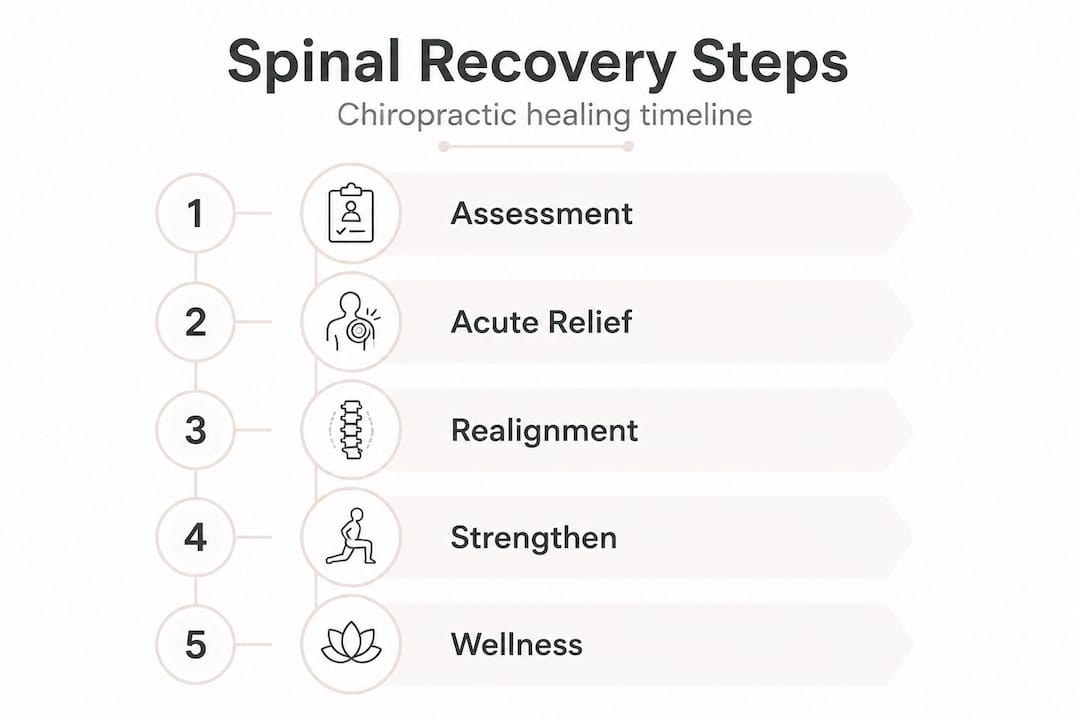
Recovery after a car accident is not a single event. It is a process with distinct stages, and understanding each one keeps you from feeling lost or frustrated when progress comes in waves.

Step 1: Initial evaluation (session one) Your chiropractor performs a full orthopedic and neurological exam. This includes range of motion testing, posture analysis, and hands-on assessment of spinal segments. Expect this session to be longer than any follow-up visit, typically 45 to 60 minutes.
Step 2: Acute pain phase (sessions two through six) The primary goal here is reducing inflammation and restoring basic joint movement. Adjustments during this phase are gentle and targeted to the most affected segments. Soft tissue therapy may accompany the adjustments. Most patients notice meaningful pain reduction within two to three sessions.
Step 3: Functional restoration phase (sessions seven through fifteen) Once acute pain decreases, the focus shifts to restoring full range of motion, correcting muscle imbalances, and rebuilding strength around injured structures. Therapeutic exercises become a core part of each session.
Step 4: Stabilization phase (sessions sixteen onward, if needed) This phase focuses on preventing relapse. Session frequency drops, and home exercise programs become more central to maintaining your results.
"A clinical trial comparing cervical specific adjustment technique to physiotherapy for acute whiplash grade II found both approaches produced comparable outcomes for pain, function, and mobility. What stood out: the adjustment group achieved similar results with just 3 sessions compared to 20 in the physiotherapy group." Source: Cervical specific adjustment technique for acute whiplash, PMC
This finding matters because it means targeted chiropractic adjustment is not just effective but also efficient. Fewer sessions translate to lower costs and faster return to normal life for you.
A large meta-analysis confirms that spinal manipulative therapy reduces pain with a mean difference of 1.53 points on a standard pain scale and reduces disability by 6.20 points, while also improving cervical (neck) range of motion in patients with acute neck pain. Serious adverse events were not reported across included studies.
The chiropractic methods for healing used during recovery include diversified adjustment (a hands-on thrust technique), instrument-assisted soft tissue mobilization, and traction. Each method serves a specific purpose depending on the injury type and severity. Knowing the chiropractic treatment types available allows you and your provider to create a plan that fits your exact situation.
Pro Tip: Keep a daily symptom journal. Rate your pain morning and evening on a 0 to 10 scale, and note activities that increase or decrease symptoms. Bring this to each session. Your chiropractor uses that real-world data to fine-tune your treatment.
The chiropractic wellness benefits extend beyond pain relief. Patients consistently report better sleep quality, reduced anxiety, and improved overall physical function as their spine heals. These improvements are not coincidental since the nervous system runs through your spine, and better alignment directly affects how your body functions overall.
Following these steps, it's important to know how to spot issues and avoid common setbacks.
How to verify results and avoid setbacks
Progress in chiropractic recovery is rarely a straight line. Some weeks you feel dramatically better; others you plateau or experience temporary soreness after adjustments. Understanding the difference between normal and problematic responses keeps you on track.
Signs your spinal health is improving:
- Pain score decreasing by at least 2 points on a 10-point scale over two weeks
- Increased range of motion (you can turn your head further, bend more easily)
- Less morning stiffness that resolves faster than it used to
- Returning to daily activities like driving, sleeping flat, and sitting without constant pain
- Reduced reliance on over-the-counter pain medications
When to be concerned:
- New numbness or weakness developing in arms or legs
- Sharp pain worsening after three or more sessions
- Bladder or bowel changes (requires immediate medical evaluation)
- Fever developing alongside spinal pain
A Cochrane review found that spinal manipulative therapy slightly reduces pain and moderately improves function compared to sham treatment for chronic low back pain. The most common side effects were mild and temporary, including soreness and stiffness at the treatment site. No serious adverse events were documented.
| Recovery milestone | Typical timeline | Action if delayed |
|---|---|---|
| Initial pain reduction | 1 to 2 weeks | Reassess technique or add soft tissue work |
| Improved range of motion | 3 to 4 weeks | Add stretching and mobility exercises |
| Return to light daily activity | 4 to 6 weeks | Modify activities, increase session frequency |
| Full functional recovery | 6 to 16 weeks (varies) | Discuss referral or additional imaging |
Common mistakes that stall recovery:
- Skipping sessions because you feel slightly better (the injury is still there; pain reduction is not the same as tissue healing)
- Ignoring chronic risk factors like poor posture at work or inadequate sleep
- Stopping exercises between sessions once acute pain drops
- Not communicating changes in symptoms to your provider
Consistent chiropractic follow-up is one of the strongest predictors of successful recovery. Patients who attend all scheduled sessions and complete their home exercise programs recover faster and experience fewer relapses. Planning for chiropractic long-term wellness from the beginning of your treatment rather than as an afterthought dramatically changes outcomes.
Now that you know how to monitor progress, let's consider our expert perspective on combining approaches.
Why combining chiropractic and exercise is your smartest next move
Here is something most patients do not hear clearly enough: chiropractic adjustment alone is powerful for early recovery, but it is not a complete solution on its own. The evidence says this directly and we think it is worth saying plainly.
Cochrane reviews confirm that spinal manipulative therapy is effective short-term but is not consistently superior to other conservative treatments over the long term. The strongest outcomes appear when manipulation is combined with exercise, lifestyle changes, and patient education. Relying on adjustments alone is one of the most common traps we see patients fall into.
Think of it this way: a spinal adjustment restores proper joint position and reduces nerve irritation. That is the foundation. But if the muscles surrounding that joint remain weak and the habits that caused compensatory posture remain unchanged, the spine drifts back toward dysfunction. The adjustment needs a structure to hold it in place.
We have seen patients complete a full treatment course, feel completely recovered, and return six months later with nearly identical complaints because they never followed through on the exercise component. It is frustrating for everyone involved. The adjustment is the spark; exercise and lifestyle management are the fuel that keeps recovery going.
A step-by-step chiropractic guide that integrates movement therapy from the beginning rather than treating it as optional consistently produces better long-term results. Walking 20 to 30 minutes daily, doing prescribed cervical strengthening exercises, and managing screen time posture are not complex demands. But they are the difference between a patient who stays well and one who cycles in and out of pain for years.
The research is clear. The clinical experience confirms it. If you are serious about recovering fully from your accident, combining chiropractic care with consistent therapeutic exercise is not optional. It is the actual plan.
Affordable spinal health solutions in North Miami
Your recovery should not stall because of cost concerns or confusion about where to turn next.

At SparkMed in North Miami, we specialize in chiropractic care for accident victims, and we offer a $25 spinal adjustment that requires no insurance. Our practitioners use modern equipment and evidence-based techniques to address whiplash, acute and chronic neck pain, and related spinal injuries. Whether you are in the early acute phase or working through a longer recovery, we build plans around your actual injury, your schedule, and your budget. Explore our spinal health blog articles for ongoing education, practical recovery tips, and guidance across multiple languages including Spanish and Creole. We are here to help North Miami recover, one spine at a time.
Frequently asked questions
Is chiropractic spinal manipulation safe after a car accident?
Yes, spinal manipulation is recommended as a first-line non-drug treatment for most accident-related spinal pain, with a low risk of serious adverse effects compared to medications, except in cases of disc herniation with neurological deficit or spinal stenosis.
How soon should I start chiropractic care after an accident?
Starting chiropractic treatment within one week of injury significantly improves pain relief and function, so earlier is better, as delays increase the risk of developing chronic symptoms.
How many sessions does chiropractic recovery typically require?
Many patients see meaningful results in as few as three targeted sessions, but session numbers depend on injury severity and whether rehabilitation exercises are included in the plan.
What signs show my spinal health is improving?
Increased neck and back mobility, consistently lower pain scores, and the ability to return to daily activities are the clearest signs of progress; most patients see measurable improvement after just a few weeks of treatment.
What are the risks of long-term symptoms after a car accident?
Research shows up to 50% of people may experience persistent symptoms one year after a whiplash injury, especially those with high initial pain levels, older age, or pre-existing spinal conditions.