
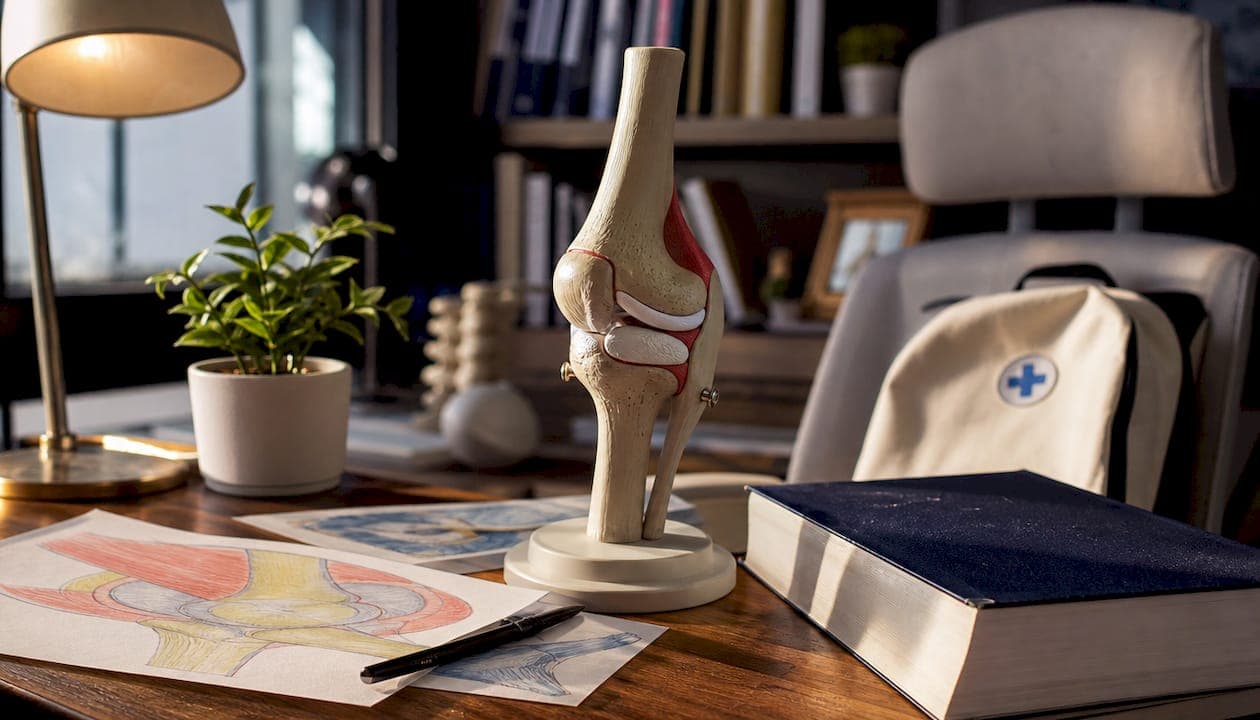
Joint misalignment is defined as the atypical positioning of bones within a joint, causing uneven stress distribution, impaired movement, and progressive tissue damage. Most people associate it with sudden injury, but the condition develops just as often from years of poor posture, repetitive strain, or structural imbalances that go unnoticed until pain appears. Up to 80% of adults experience vertebral subluxations, a recognized form of spinal joint misalignment, at some point in their lives. That figure tells you this is not a rare clinical problem. It is a widespread condition that affects how your body moves, loads its tissues, and ages over time.
What is joint misalignment and why does it matter?
Joint misalignment, also called malalignment in clinical settings, occurs when the bones forming a joint shift out of their correct anatomical position. The shift does not have to be dramatic to cause damage. Even subtle positional changes alter how forces travel through cartilage, ligaments, and surrounding muscles. Over time, that uneven loading accelerates cartilage wear, strains soft tissue, and can trigger early-onset arthritis. The condition affects every major joint in the body, from the cervical spine and shoulders to the hips, knees, and ankles.

The clinical term "joint centration" describes the opposite state: the position in which a joint achieves optimal biomechanical contact and maximum muscle efficiency. When a joint loses centration, the muscles that cross it must work harder to compensate, which creates fatigue, tension, and eventually pain. Understanding this mechanism is the foundation for understanding why misalignment causes so many downstream problems.
What causes joint misalignment?
Joint misalignment causes are multifactorial, ranging from single traumatic events to years of accumulated postural habits. No single cause applies to every patient, which is why accurate diagnosis requires looking at the full picture.
The most common causes include:
- Acute trauma. Car accidents, falls, and sports collisions can force a joint out of position instantly. Whiplash, for example, commonly displaces cervical vertebrae and disrupts the surrounding soft tissue in a single impact.
- Chronic poor posture. Sitting at a desk for eight or more hours a day with a forward head position places sustained abnormal load on the cervical and thoracic spine. Smartphone use compounds this by pulling the head forward repeatedly throughout the day.
- Repetitive strain. Occupational movements performed thousands of times, such as overhead reaching or asymmetrical lifting, gradually shift joint positioning through cumulative micro-stress.
- Structural conditions. Scoliosis, leg length discrepancies, and flat feet alter the mechanical baseline of the entire skeleton, making misalignment at multiple joints more likely.
- Osteoarthritis. As cartilage degrades, joint surfaces become irregular, which changes how bones sit against each other and accelerates further positional drift.
- Muscle imbalances. When one muscle group is chronically tight and the opposing group is weak, the joint they control gets pulled out of its neutral position. This is one of the most overlooked causes because it develops silently over months or years.
The body's compensation response makes this worse. When one joint shifts, neighboring joints absorb the extra load. A patient with a misaligned hip may develop knee pain months later, not because the knee was injured, but because it was compensating for the hip the entire time.
What are the symptoms of joint misalignment?
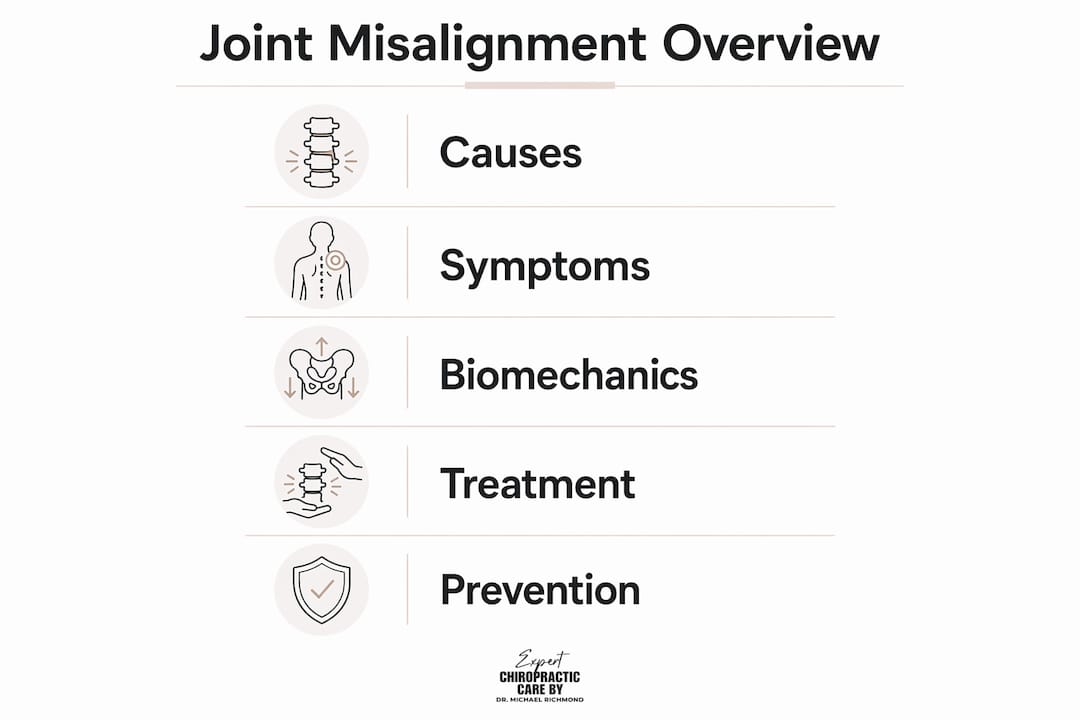
Recognizing the symptoms of joint misalignment early gives you a significant advantage in preventing long-term damage. Pain is often a late sign. By the time it appears, the joint has typically been under abnormal stress for weeks or months.
Common symptoms include:
- Localized joint pain that worsens during weight-bearing activities like walking, climbing stairs, or standing for extended periods.
- Stiffness, especially in the morning or after prolonged sitting, that takes more than a few minutes to ease.
- Mechanical sounds. Clicking, grinding, or catching sensations during movement are structural signals. Persistent mechanical symptoms that do not resolve with muscle treatment alone point to structural misalignment rather than simple muscle tension.
- Joint instability. A feeling that the joint might "give way" during normal movement indicates that the supporting structures are no longer functioning correctly.
- Swelling after activity, even without a specific injury event.
- Reduced range of motion in one direction compared to the other side of the body.
One early indicator that most people miss is uneven shoe sole wear. If one heel or one side of the forefoot wears down faster than the other, your lower body alignment is already compensating for something. This sign often appears before any pain develops.
Pro Tip: Place both of your shoes on a flat surface and look at the heel wear from behind. Uneven wear on one shoe compared to the other is a reliable early signal worth discussing with a chiropractor or physical therapist.
How does joint misalignment affect biomechanics and muscle function?
Misalignment does not stay local. It triggers a chain reaction through the body's kinetic chain, which is the linked system of joints, muscles, and connective tissue that work together during every movement.
Here is how that chain reaction typically unfolds:
- A joint loses centration. The bones shift slightly out of optimal position, reducing the surface area available for load distribution.
- Muscles compensate. Some muscles become hypertonic (chronically tight) to stabilize the unstable joint. Others become inhibited and weak because they are no longer positioned to fire correctly.
- Movement efficiency drops. The nervous system detects the altered joint position and modifies motor patterns to protect the area. These modified patterns feel normal to you but place abnormal stress on adjacent structures.
- Secondary joints absorb excess load. Restricted ankle mobility, for example, forces the knee to compensate during walking and squatting, increasing the risk of knee misalignment and cartilage damage over time.
- Tissue damage accumulates. Excessive shear forces from compensation patterns cause secondary injuries to tendons, ligaments, and cartilage that were never part of the original problem.
Achieving joint centration supports optimal muscle and ligament function, reduces strain on surrounding tissues, and slows cartilage wear. Losing it sets off a cascade that the body can mask for years before pain forces the issue into the open.
The most important takeaway from this chain reaction model is that treating only the painful joint often fails. The source of the problem may be one or two joints away from where you feel it.
What treatment and correction options exist for joint misalignment?
Treatment for joint misalignment depends on the severity of the positional shift, the joints involved, and how long the condition has been present. Most cases respond well to conservative care when addressed early.
| Treatment approach | Best suited for | Primary mechanism |
|---|---|---|
| Chiropractic adjustments | Spinal and peripheral joint misalignment | Restores joint centration through controlled manual force |
| Muscle energy techniques | Mild to moderate misalignment with muscle imbalance | Uses patient muscle contraction to reposition joints |
| Physiotherapy and exercise | Chronic misalignment with weakness or instability | Strengthens supporting muscles to maintain corrected position |
| Postural correction programs | Posture-driven misalignment from desk work or repetitive strain | Retrains movement patterns and reduces sustained abnormal load |
| Surgical intervention | Severe structural deformity or advanced joint damage | Mechanically corrects bone positioning when conservative care is insufficient |
Chiropractic adjustments are the most direct approach for restoring joint centration. A licensed chiropractor applies a controlled force to the affected joint, restoring its position and improving the surrounding tissue's ability to function. For spinal subluxations, this is often the first-line treatment because it addresses the structural problem directly rather than managing symptoms.
Postural correction is equally important for long-term results. Adjusting a joint without changing the habits that caused the misalignment leads to recurrence. Poor posture is one of the most consistent drivers of spinal and hip misalignment, and correcting it requires both awareness and targeted exercise.
Surgical correction is reserved for cases where the joint deformity is severe, the cartilage is extensively damaged, or conservative care has failed over a sustained period. Most patients with early to moderate misalignment never reach that threshold if they seek care promptly.
Pro Tip: When starting a correction program, ask your provider to assess the joints above and below the symptomatic area. Treating the entire kinetic chain, not just the painful joint, produces significantly better long-term outcomes.
How to recognize and address your joint misalignment
Early recognition gives you the best chance of correcting misalignment before it causes lasting damage. These are the signs and habits worth monitoring:
- Check your posture in a mirror. One shoulder sitting higher than the other, a head that sits forward of the shoulders, or hips that appear uneven are visible signs of postural misalignment.
- Watch for asymmetrical movement. If one knee tracks inward during a squat, or one arm swings less than the other when you walk, your body is already compensating.
- Monitor your pain patterns. Pain that consistently appears on one side of the body, or that worsens with specific movements, points to a structural rather than systemic cause.
- Inspect your shoes regularly. Uneven wear, as noted earlier, is one of the most reliable early indicators of lower-body alignment problems.
- Seek professional evaluation early. A chiropractor, orthopedic specialist, or physical therapist can perform a postural assessment, gait analysis, and range-of-motion testing to identify misalignment before it becomes symptomatic.
Daily habits matter as much as clinical treatment. Ergonomic adjustments at your workstation, regular movement breaks, and post-fracture recovery routines that prioritize joint loading all help maintain the corrections achieved in clinical care. Consistency between appointments is what separates patients who recover fully from those who cycle through recurring flare-ups.
Key Takeaways
Joint misalignment is a structural condition that disrupts biomechanics, triggers compensatory muscle patterns, and causes progressive tissue damage if left uncorrected.
| Point | Details |
|---|---|
| Definition matters | Joint misalignment is atypical bone positioning within a joint, not just pain or stiffness. |
| Causes are multifactorial | Trauma, poor posture, muscle imbalances, and structural conditions all contribute. |
| Pain is a late sign | Uneven shoe wear and mechanical sounds often appear before pain develops. |
| Treat the kinetic chain | Addressing only the painful joint frequently leads to failed outcomes and recurrence. |
| Early care works | Chiropractic adjustments, postural correction, and exercise resolve most cases before surgery is needed. |
What I've learned from treating misalignment every day
The biggest misconception I see is that joint misalignment is only a problem when it hurts. Patients come in after months or years of compensation, and by that point, we are not just correcting one joint. We are unwinding a whole pattern of adapted movement that the body has been protecting for a long time.
The second misconception is that an adjustment alone fixes everything. It does not. The adjustment restores the position. The exercise and postural work keep it there. Patients who commit to both recover faster and stay better longer. Those who treat the adjustment as a one-time fix tend to return with the same problem three months later.
What gives me confidence is that most people, even those with long-standing misalignment, respond well when the full picture is addressed. The body is remarkably adaptable in both directions. It compensates into dysfunction, and it responds to correction. The key is starting before the damage becomes irreversible. If you are reading this because something feels off, that awareness is worth acting on sooner rather than later.
— Spark
Chiropractic care and joint health resources from Sparkmed
Joint misalignment is treatable, and understanding it is the first step toward getting the right care. Sparkmed's blog covers the clinical topics that matter most to patients dealing with joint pain, from chiropractic therapy for relief to the mechanics of spinal subluxations and how posture drives long-term joint problems.

Sparkmed serves patients in North Miami with chiropractic adjustments starting at $25, no insurance required. The clinic's approach addresses the full kinetic chain, not just the symptomatic joint, which is exactly what the research supports. Sparkmed is committed to making care accessible to every patient, as outlined in its accessibility statement. If you are ready to understand what is driving your joint pain and get a clear plan for correcting it, Sparkmed is the place to start.
FAQ
What is the clinical term for joint misalignment?
The clinical term is malalignment or subluxation, depending on the joint and degree of displacement. Vertebral subluxation specifically refers to spinal joint misalignment affecting nerve function and mobility.
Can joint misalignment heal on its own?
Mild misalignment caused by muscle imbalance can improve with targeted exercise and postural correction. Structural misalignment from trauma or deformity typically requires professional intervention to correct fully.
How is joint misalignment diagnosed?
Diagnosis involves postural assessment, gait analysis, range-of-motion testing, and imaging such as X-rays or MRI when structural damage is suspected. A chiropractor or orthopedic specialist performs the evaluation.
What happens if joint misalignment goes untreated?
Untreated misalignment accelerates cartilage wear, causes secondary injuries through compensation, and increases the risk of early-onset arthritis. The longer it persists, the more joints become involved through kinetic chain effects.
Is chiropractic care effective for joint misalignment?
Chiropractic adjustments directly restore joint centration and are a recognized first-line treatment for spinal and peripheral joint misalignment. Results are strongest when combined with postural correction and strengthening exercises.