

If you're dealing with back pain, whiplash, or a musculoskeletal injury, you've probably heard that chiropractic care can help. What most people don't realize is that not all chiropractic care is created equal. Understanding why customize chiropractic plans matters could be the difference between genuinely recovering and simply managing symptoms indefinitely. Generic treatment protocols applied to every patient ignore a fundamental truth: your injury, your body mechanics, and your recovery goals are yours alone. This article breaks down exactly what personalized chiropractic care looks like, why it outperforms one-size-fits-all approaches, and how you can take an active role in your own plan.
Table of Contents
- Key Takeaways
- Why customize chiropractic plans: the case for personalized care
- What a customized chiropractic plan actually looks like
- The real benefits of personalized chiropractic plans
- Treatment components that make personalization work
- How to participate in building your own plan
- My take on why so many people accept generic plans
- Start your recovery with a plan built for you
- FAQ
Key Takeaways
| Point | Details |
|---|---|
| No universal treatment exists | Effective chiropractic care must account for your unique condition, history, and goals. |
| Structure drives outcomes | A well-built plan includes a clinical assessment, specific interventions, treatment frequency, and measurable benchmarks. |
| Personalization reduces drug dependency | Customized chiropractic care is linked to 56% lower opioid use among certain patient groups. |
| Patients are partners | Sharing feedback about pain, mobility, and lifestyle directly shapes how your plan evolves. |
| Cost-effectiveness follows customization | Tailored plans eliminate unnecessary treatments, reducing waste and improving recovery speed. |
Why customize chiropractic plans: the case for personalized care
Most people walk into a chiropractic office expecting an adjustment and a follow-up schedule. What they often receive is a treatment protocol that was designed for a category of condition rather than for them specifically. No one-size-fits-all approach works for musculoskeletal care. Effective plans are evidence-informed and flexible, adapting as the patient responds to treatment.
Here's what that actually means in practice. Two patients can walk in with lower back pain from a car accident and have entirely different clinical pictures. One might have a herniated disc with nerve involvement. The other might have muscular strain and postural compensation. Applying the same adjustment technique and frequency to both is not just inefficient. It can actively delay recovery.
Personalized chiropractic care involves analyzing each patient's unique needs and developing specific plans rather than applying uniform treatments. That analysis starts before any hands ever touch your spine.
What a customized chiropractic plan actually looks like
A structured, individualized chiropractic plan has four core components that separate it from a generic treatment schedule:
- Clinical assessment summary: This documents your presenting condition, injury history, range of motion findings, neurological screening results, and any imaging. It's the foundation everything else builds on.
- Proposed interventions: The specific techniques, modalities, and adjunct therapies selected based on your clinical findings. This might include spinal manipulation, soft tissue work, or instrument-assisted techniques.
- Treatment frequency and duration: How often you're seen and for how long, calibrated to the severity of your condition and your response to care.
- Outcome benchmarks: Measurable goals tied to functional improvement. Plans that include standardized outcome tools like the Oswestry Disability Index give both you and your chiropractor objective data to track progress.
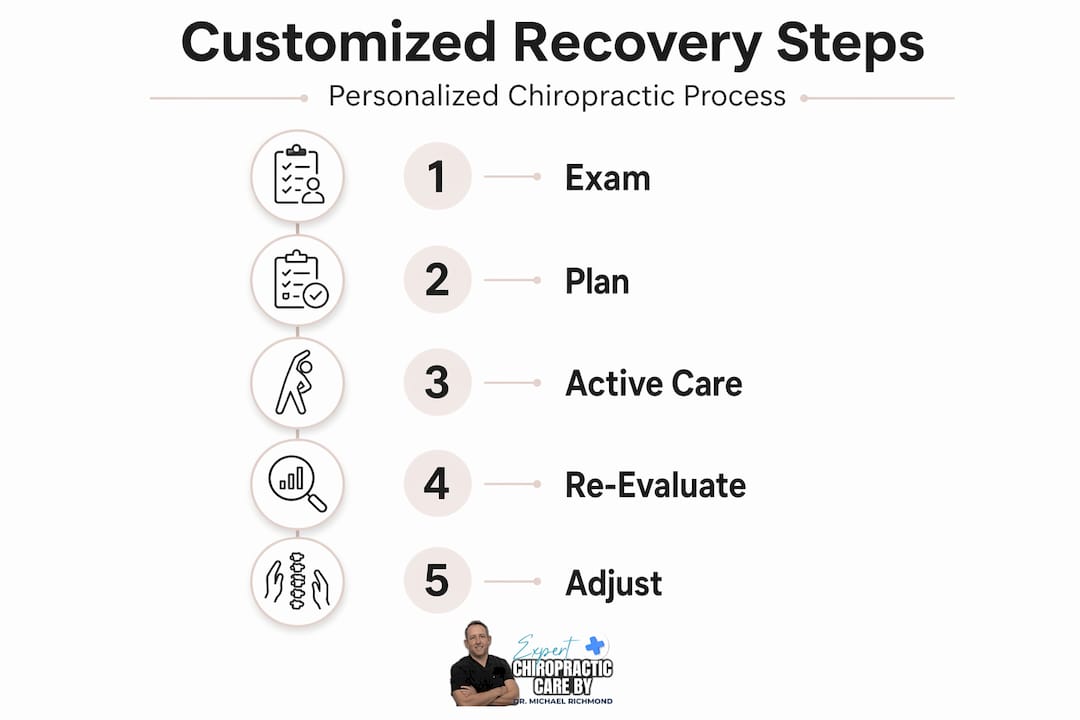
Beyond the initial structure, a personalized plan distinguishes between active care (where functional improvement is expected) and maintenance care (managing a stable condition). Medicare regulations actually require clear documentation of this distinction. Any ethical, quality practice applies the same standard. Re-evaluation dates are built in so the plan can pivot based on what's actually working.
Pro Tip: Ask your chiropractor when your first re-evaluation is scheduled before your second visit. If there's no scheduled reassessment, that's a signal the plan may not be as individualized as it should be.
A high-quality chiropractic workflow prioritizes examination first and diagnostic justification before any treatment begins. That commitment to process is what separates genuine customization from a template dressed up as one.
The real benefits of personalized chiropractic plans
The advantages of chiropractic plan customization go beyond comfort. The data is compelling.

| Benefit | Evidence |
|---|---|
| Reduced opioid dependency | 56% lower opioid use risk among Medicare beneficiaries receiving chiropractic care |
| Faster functional recovery | Tailored progression avoids plateaus that stall generic protocols |
| Better patient adherence | Shared decision-making improves motivation and follow-through |
| Lower overall cost | Eliminating unnecessary treatments reduces total care expenses |
| First-line pain treatment | Spinal manipulation is now guideline-recommended as a non-pharmacologic first option for several common pain conditions |
The opioid figure deserves more attention. A study of 9,356 Medicare beneficiaries found that those who utilized chiropractic care had a significantly lower likelihood of receiving opioid prescriptions. That's not a coincidence. When a care plan actually addresses the mechanical source of your pain with the right technique at the right frequency, you need less pharmaceutical support.
"Effective management must be ethical, evidence-informed, and transparent, with flexibility for changes as patient status evolves." — Canadian Chiropractic Guidelines
Patient engagement is another underappreciated benefit. When you understand why you're receiving a specific treatment on a specific schedule, you show up consistently and follow through with home exercises. Adherence is one of the strongest predictors of recovery outcomes, and adherence follows understanding. Generic plans that patients don't fully understand tend to fall apart by week three.
The cost argument is also straightforward. Customized chiropractic treatments target what you actually need. You're not paying for six weeks of ultrasound therapy because it's in the standard protocol. Every session has clinical justification, which means your time and money go toward what moves the needle.
Treatment components that make personalization work
Chiropractic plan customization is not just about choosing a technique and sticking with it. It's about continuously refining that choice. Here's how individualized chiropractic strategies actually get built:
-
Technique selection based on your condition. The diversified technique works well for patients with good joint mobility and no contraindications. The activator method (a low-force instrument approach) is better suited for patients with osteoporosis, acute inflammation, or significant pain sensitivity. Your chiropractor's job is to match the tool to the tissue, not apply one tool to everyone.
-
Exercise programming tailored to your deficits. After an auto accident, your stabilizing muscles often shut down as a protective response. A personalized plan identifies which muscle groups are underperforming and builds a corrective exercise sequence around those specific findings. Generic core exercises from a handout don't account for your compensation patterns.
-
Ergonomics and lifestyle coaching. If you sit at a desk for eight hours and then drive another hour home, that context changes what your chiropractor prescribes. Adjustments made in the office can be undone in hours if the contributing factors in your daily environment aren't addressed. Quality individualized chiropractic strategies include those real-world variables.
-
Progress evaluation driving plan adjustments. Treatment evolves over time with ongoing evaluation and patient feedback. If your pain has shifted from the lower back to the hip, that's clinically meaningful data. Your plan should shift with it.
-
Knowing when to refer. A well-designed plan includes criteria for referral if progress stalls. That might mean imaging, specialist consultation, or co-management with a physical therapist. A chiropractor who never refers is not practicing customized care. They're practicing routine.
Pro Tip: Keep a simple pain and mobility journal between visits. Note what movements feel better or worse, and what activities triggered any flare-ups. That data gives your chiropractor specific clinical information that changes how your plan gets adjusted.
You can see how different chiropractic methods combine within a personalized plan to address the layered effects of physical injury. The goal is always restoring function, not just reducing the number on a pain scale.
How to participate in building your own plan
Personalized chiropractic care is a two-way process. Your chiropractor brings clinical knowledge. You bring information that no examination can fully capture. Here's how to show up as an active participant:
- Be specific about your goals. "I want to sleep through the night without hip pain" is more useful clinically than "I want to feel better." Specific goals create specific benchmarks.
- Report changes honestly and promptly. If an adjustment made your neck feel worse for two days, say so. That response guides technique modification. Hiding discomfort to seem like a good patient slows your recovery.
- Ask about the reasoning behind your plan. A quality chiropractor will explain why you're being seen twice a week for the first month and then weekly after that. If the explanation is "that's just how we do it," push for more.
- Discuss your lifestyle. Sleep position, footwear, work setup, and stress levels all affect musculoskeletal function. The more context your practitioner has, the more precisely the plan can be calibrated.
- Know when to ask about referrals. Shared decision-making improves outcomes. If you're six weeks in and your functional scores aren't improving, it's fair to ask whether a different approach or specialist input makes sense.
The step-by-step recovery process works significantly better when you're an informed participant rather than a passive recipient of care.
My take on why so many people accept generic plans
I've watched patients with genuine, recoverable injuries spend months in care that wasn't moving them forward. Not because chiropractic didn't work. Because the plan wasn't built for them.
The most common reason people accept generic plans is that they don't know they can ask for something different. They assume the chiropractor knows best, so they defer completely. That deference is understandable. But it can cost you weeks of effective recovery time.
What I've seen work consistently is when patients come in with questions written down and ask for measurable goals from day one. The best chiropractors welcome that. The ones who don't are telling you something important about how they practice.
I also think the chiropractic profession has been evolving faster than public awareness. Clinical standards now emphasize individualized examination-first approaches, transparent goal-setting, and built-in re-evaluation points. That's a significant shift from the long-duration, preset plans that were common a decade ago. Patients who understand this are better equipped to recognize quality care and walk away from mediocre care.
The bottom line: your injury is yours. Your plan should be too. Advocate for it from the first visit.
— Spark
Start your recovery with a plan built for you
If this article changed how you think about chiropractic care, that's exactly the point.

Sparkmed's blog goes deep on every aspect of personalized recovery, from understanding drug-free healing approaches to knowing what questions to ask at your first appointment. If you've been in a car accident or are living with musculoskeletal pain, the next step is care that is actually designed around your condition. Sparkmed specializes in exactly that, serving North Miami patients with individualized chiropractic plans backed by thorough clinical assessment. Explore the full resource library at the Sparkmed blog and take the first step toward recovery that makes sense for your body, your lifestyle, and your goals.
FAQ
Why does chiropractic plan customization improve outcomes?
Customized plans match specific techniques, frequencies, and exercises to your clinical findings rather than a general protocol. That precision leads to faster functional recovery and better patient adherence.
What are the main benefits of personalized chiropractic care?
Personalized chiropractic care reduces opioid dependency, improves cost-effectiveness by eliminating unnecessary treatments, and increases patient engagement. Research links chiropractic care to a 56% lower risk of opioid use among Medicare beneficiaries.
How often should a chiropractic plan be re-evaluated?
Most quality plans include a formal re-evaluation every four to six weeks. The timeline depends on injury severity and how quickly you're responding to care. If your plan has no scheduled reassessment, ask your chiropractor to add one.
Can I request changes to my chiropractic treatment plan?
Yes. Shared decision-making is a recognized part of quality chiropractic practice. If a technique isn't working or your goals have changed, communicating that directly with your chiropractor should lead to a plan adjustment.
What makes a chiropractic plan truly individualized?
A genuinely individualized plan starts with a thorough examination, includes measurable outcome benchmarks, distinguishes between active and maintenance care, and builds in re-evaluation points tied to your specific functional goals.