

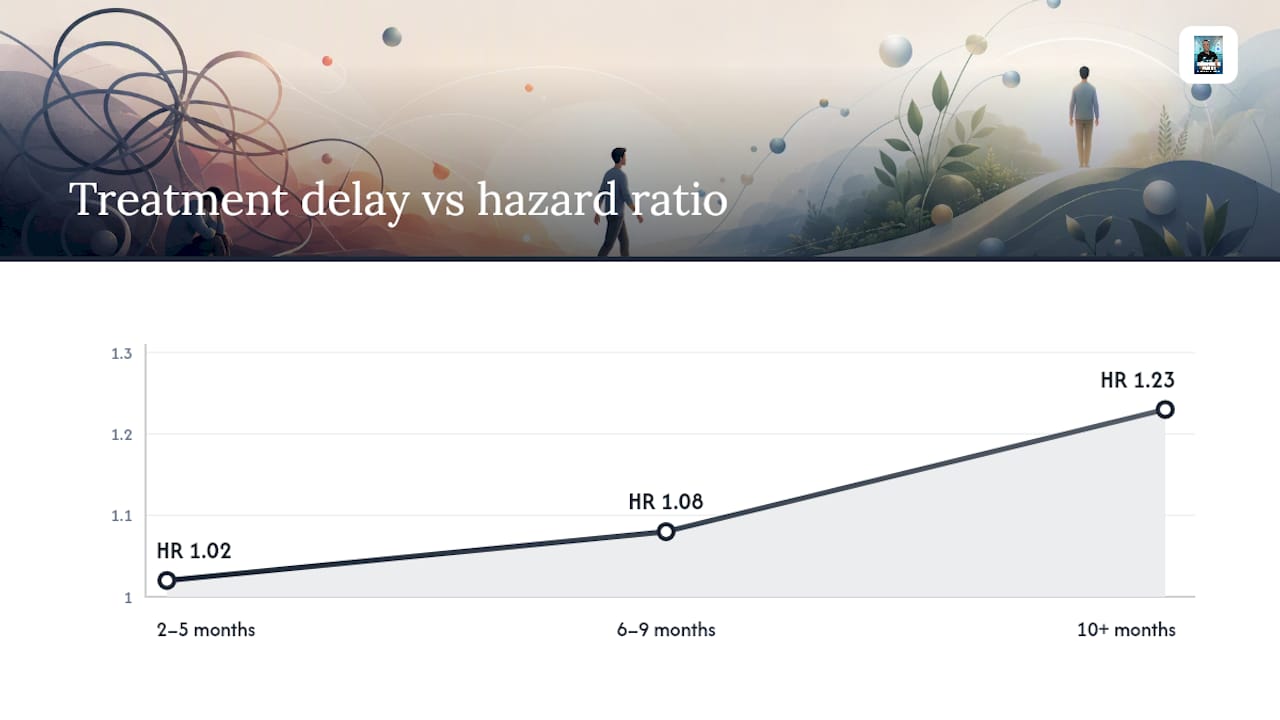
Early treatment improves your chance of full recovery and reduces the long-term harm a condition can cause. That's the short answer, and the evidence behind it is substantial. The CDC notes that acting on developmental concerns in the first three years of life is most effective precisely because the brain's neural circuits are most adaptable then. On the cancer side, a large analysis using the Surveillance, Epidemiology, and End Results (SEER) database found that longer time-to-treatment initiation was independently associated with higher all-cause mortality, with adjusted hazard ratios rising from approximately 1.02 for a 2–5 month delay to 1.23 for delays of 10 months or more, compared with treatment within one month.
Three effects show up consistently across conditions:
- Better prognosis: Catching and treating a problem early usually means less disease burden and more treatment options.
- Less invasive care later: Early, low-intensity interventions often prevent the need for surgery, hospitalization, or long-term medication.
- Reduced social and economic disruption: Conditions treated early tend to cause less lost work, less family strain, and lower total healthcare costs over time.
Key Takeaways
Early treatment consistently improves recovery outcomes, reduces long-term disability, and lowers total care costs across child development, cancer, mental health, and musculoskeletal injury.
| Point | Details |
|---|---|
| Act early for best outcomes | Delays in treatment are linked to higher mortality in cancer and worse functional outcomes across conditions. |
| Neural plasticity window | The birth-to-age-3 period is when developmental therapy has its greatest impact on long-term trajectories. |
| Cancer TTI hazard ratios | Adjusted mortality risk rises from HR 1.02 at 2–5 months to HR 1.23 at ≥10 months compared to treatment within 1 month. |
| Balance urgency with evidence | Not every finding needs immediate intervention; targeted, evidence-based early action avoids overtreatment harms. |
| Sparkmed for injury recovery | Same-day chiropractic care in North Miami starting at $25, no insurance required, for accident and injury patients. |
Table of Contents
- What "early treatment" actually means, and how it differs from screening
- How early treatment actually improves outcomes
- Condition-specific examples where early treatment makes the biggest difference
- Red flags and signs that should prompt early action
- Practical next steps to get timely care in the U.S.
- When not to rush: overdiagnosis, unnecessary testing, and harms of overtreatment
- Common barriers that delay care and practical ways to reduce them
- Quick evidence snapshot: key studies and statistics readers should know
- A clinician's view on timing and judgment
- Sparkmed: early care for injuries and pain in North Miami
- Sources
What "early treatment" actually means, and how it differs from screening
The terms get blurred constantly, so a quick map helps. Early treatment means starting a proven therapy soon after a diagnosis is confirmed or symptoms clearly emerge. Early intervention is the broader term used in developmental medicine for services (speech therapy, occupational therapy, physical therapy) delivered to children before their third birthday, when the brain is most plastic. Early detection refers to identifying a condition before it causes obvious symptoms, often through a test. Screening is a population-level tool that finds risk or early-stage disease in people who feel fine.
The distinction matters for decisions. Screening tells you a risk exists. Early treatment is what you do once a diagnosis is confirmed. Waiting for symptoms to become severe before acting is where most of the preventable harm happens.
"Early" also means different things depending on the condition. For a stroke or severe trauma, early means minutes to hours. For cancer, it often means weeks to a few months. For a developmental delay in a toddler, it means starting services before the third birthday. For a first episode of depression or psychosis, it means weeks rather than years of untreated symptoms.
How early treatment actually improves outcomes
Several distinct mechanisms explain why timing matters so much.
Neural plasticity in early childhood. The brain rewires itself most readily in the first three years of life. Therapy delivered during this window can redirect developmental trajectories in ways that become progressively harder to achieve later. This is why the CDC's Act Early program emphasizes prompt referral the moment a concern arises, not a wait-and-see approach.
Disease progression and tumor burden. Many cancers grow and spread over time. Treating a smaller, localized tumor is categorically different from treating one that has reached regional lymph nodes or distant organs. The SEER-based TTI analysis cited above shows the mortality risk climbing in a dose-response pattern with each additional month of delay, which is consistent with what oncologists see clinically.
Prevention of complication cascades. An untreated infection can become sepsis. An untreated sprain can lead to compensatory movement patterns that cause chronic pain in an entirely different joint. Inflammation left unchecked can damage tissue that was initially healthy. Early care interrupts these chains before they become self-sustaining.
Health-system effects. Timely access to care is one of the Institute of Medicine's recognized dimensions of care quality. A system that makes early access easy produces better outcomes partly because patients actually show up.
Key mechanisms at a glance:
- Neural plasticity peaks in infancy and early childhood, making early developmental therapy especially powerful.
- Tumor burden and disease stage worsen with delay, narrowing treatment options.
- Complication cascades (chronic pain, disability, secondary infections) are far easier to prevent than reverse.
- Scheduling friction reduces follow-through, so access itself is a clinical variable.
Condition-specific examples where early treatment makes the biggest difference
Early childhood development (birth to age 3)
Speech therapy, occupational therapy, and physical therapy delivered before a child's third birthday can meaningfully change communication, motor, and social outcomes. The developmental science here is well-established: earlier services yield better long-term potential because the brain's architecture is still being built. The CDC's Learn the Signs. Act Early. program provides free milestone checklists and referral guidance for parents and pediatricians.
Cancer
The SEER database analysis is worth sitting with. Across lung, breast, colorectal, and prostate cancers, every additional month of delay before treatment started was associated with a measurable increase in mortality risk. The hazard ratios in that study rose from 1.02 at 2–5 months to 1.08 at 6–9 months to 1.23 at 10 or more months. Not every cancer type responds identically, and stage at diagnosis matters enormously, but the directional signal is consistent: shorter time-to-treatment initiation correlates with better survival.
Mental health
Depression, psychosis, and bipolar spectrum conditions treated closer to symptom onset tend to have shorter and less severe episodes. Years of untreated mental illness can erode occupational functioning, relationships, and physical health in ways that are genuinely hard to reverse. The NIMH recommends early evaluation as a first step precisely because it clarifies diagnosis and opens the door to targeted treatment before chronicity sets in.
Acute injuries and musculoskeletal problems
Pain that becomes chronic often reflects central nervous system sensitization, a process that is much easier to prevent than to undo. Early, low-intensity assessment after a car accident, a fall, or a workplace injury, including movement education and gentle manual therapy, can stop compensation patterns from developing. Waiting until pain is severe enough to be "worth seeing someone about" is exactly when the window for simple intervention has often closed. Early chiropractic intervention after trauma is one example of conservative care that addresses the problem before it becomes structural.

Rare diseases and first-onset symptoms
For conditions like certain genetic disorders, autoimmune diseases, or rare cancers, early referral to a specialist or genetic testing can be the difference between a manageable condition and irreversible organ damage. The challenge here is that rare diseases often mimic common ones, which is why persistent or atypical symptoms warrant specialist evaluation rather than repeated rounds of symptomatic treatment.
Red flags and signs that should prompt early action
Some symptoms warrant a same-day call. Others can wait a week but should not wait a month. Here is a practical breakdown.
Call 911 or go to an emergency department immediately for:
- Sudden severe headache unlike any you've had before
- Chest pain, difficulty breathing, or signs of stroke (face drooping, arm weakness, speech difficulty)
- Suicidal ideation with a plan or intent
- High fever with stiff neck or altered consciousness
- Severe trauma with loss of consciousness or suspected spinal injury
Schedule within 48–72 hours for:
- A child missing two or more developmental milestones for their age (use the CDC Act Early checklists)
- Persistent pain after an injury that is not improving after 48 hours of rest
- A new or worsening mood change lasting more than two weeks
- Unrelenting pain after a car accident or fall, even if the initial adrenaline made it seem minor
- Any neurological symptom (numbness, tingling, weakness) that is new or spreading
A note on "wait-and-see." It is reasonable for a minor cold, a mild muscle ache after unusual activity, or a brief low mood after a stressful event. It is not reasonable when symptoms are worsening, when they affect daily function, or when they fit any of the red flags above. The clinician-aligned rule of thumb: if the symptom is getting worse instead of better after 48–72 hours, that is the signal to act.
Pro Tip: Write down when symptoms started, what makes them better or worse, and how they affect your daily activities. That 90-second summary cuts triage time significantly and helps the clinician prioritize your case correctly.
Also worth reviewing: the chiropractic red flags list for signs that require urgent medical evaluation before any manual therapy.
Practical next steps to get timely care in the U.S.
Acting early only works if you can actually get in. Here is a sequence that works:
- Identify the right entry point. For life-threatening symptoms, call 911. For urgent but non-emergency concerns, urgent care or a same-day primary care slot is usually faster than waiting for a specialist referral. For developmental concerns in children under three, call your state's early intervention program directly (no physician referral required in most states).
- Call and lead with urgency signals. When you call a clinic, say: "I've had [symptom] for [X days], it's getting worse, and it's affecting my ability to [work/sleep/care for my child]." Schedulers are trained to triage by functional impact, not just symptom type.
- Ask specifically for same-day or next-available slots. Many practices hold same-day appointments that are not visible online. Same-day access for acute injuries and pain is increasingly standard at clinics that prioritize timely care.
- Use telehealth as a bridge. If you cannot get an in-person appointment within a clinically appropriate window, a telehealth visit can start the documentation, order initial labs or imaging, and generate a referral, all of which shorten the total time to treatment.
- Understand your cost options before you go. Ask about self-pay rates when you call. Early outpatient care almost always costs less than an emergency department visit for the same problem treated later. Transparent pricing at clinics like Sparkmed means you know the cost before you walk in.
Insurance tip: if your insurer requires a referral for specialist care, ask your primary care provider to send it the same day as your visit. A referral that sits in a queue for two weeks is a two-week delay in treatment.
When not to rush: overdiagnosis, unnecessary testing, and harms of overtreatment
The case for acting early is strong, but it is not a case for acting on everything. Harvard Health's review makes the point directly: early detection and treatment are lifesaving for some conditions and actively harmful in others, through unnecessary procedures, anxiety, and costs.
Incidental findings from imaging are a common example. A scan ordered for one reason turns up an abnormality in another structure. Most of these findings are clinically insignificant, but they can trigger a cascade of follow-up tests, biopsies, and worry. Low-risk prostate cancer and certain small thyroid nodules are well-documented cases where active surveillance outperforms immediate intervention for many patients.
Questions to ask your clinician that reduce the chance of overtreatment:
- "What would change in your recommendation if we monitored this for 4–6 weeks instead of treating now?"
- "What are the noninvasive next steps before we consider a procedure?"
- "What is the evidence that treating this early improves outcomes for someone in my situation?"
- "What are the risks of the test or treatment itself?"
Pro Tip: Ask your clinician to distinguish between a condition that is progressing and one that is stable. A stable finding often supports watchful waiting; a progressing one usually does not.
Early intervention should be targeted and evidence-based, not reflexive. The goal is to act early on the right things, not on everything.
Common barriers that delay care and practical ways to reduce them
Knowing you should act early and being able to act early are two different problems. Barriers are real, and they fall unevenly across populations.
Common system barriers:
- Long appointment wait times, especially for specialists
- Insurance prior-authorization requirements that add days or weeks
- Transportation challenges, particularly in rural areas or for patients without a car
- Language barriers and distrust of the medical system
- Cost concerns that lead people to delay until symptoms are severe
Evidence on disparities is consistent: time-to-treatment initiation and outcomes vary by race, income, insurance status, and geography. These are not individual failures; they are system design problems. But there are practical workarounds available now.
What you can do:
- Ask specifically for advanced-access or same-day slots when you call. Many practices reserve them but do not advertise them.
- Request a professional interpreter at any federally funded clinic. This is a legal right under Title VI.
- Contact a patient navigator or social worker at a hospital or community health center. They exist specifically to remove access barriers.
- Use CDC Act Early resources for developmental concerns. Early intervention programs are federally mandated and free for eligible children under three.
- For mental health, NIMH's website provides condition-specific guidance and links to finding care.
If you are being told the next available appointment is months away, ask to be placed on a cancellation list, ask for a telehealth bridge visit, and ask whether a different provider in the same practice has earlier availability.
Quick evidence snapshot: key studies and statistics readers should know
The evidence for acting early is not uniform across conditions, and it is worth knowing where it is strongest.
Adjusted hazard ratios for all-cause mortality by TTI delay (vs. treatment within 1 month): 1.02 at 2–5 months, 1.08 at 6–9 months, 1.23 at ≥10 months — SEER database analysis
| Domain | Evidence strength | Key finding |
|---|---|---|
| Early childhood developmental therapy | Strong | Neural plasticity peaks birth–age 3; earlier therapy improves communication, motor, and school outcomes |
| Cancer time-to-treatment | Strong | Adjusted HRs rise progressively with each month of delay across lung, breast, colorectal, and prostate cancers |
| First-episode mental health intervention | Moderate | Umbrella reviews show reduced long-term burden and improved functioning |
| Acute musculoskeletal injury | Moderate | Early conservative care reduces chronic pain risk; aggressive early treatment not always required |
| Minor self-limiting complaints | Conditional | Watchful waiting often appropriate; early intervention may cause net harm through overdiagnosis |
The pattern across strong-evidence domains is consistent: the earlier the intervention, the better the trajectory. Where evidence is moderate or conditional, the right move is a targeted, evidence-based plan rather than either aggressive treatment or indefinite delay.
A clinician's view on timing and judgment
Timing is the variable that separates a straightforward recovery from a complicated one. At Sparkmed, the patients who do best after a car accident or a slip-and-fall are almost always the ones who came in within the first few days, before pain became chronic and before compensation patterns had time to set in. The ones who wait weeks or months are managing a harder problem by the time they arrive.
That said, early care does not mean aggressive care. For most musculoskeletal injuries, the right early intervention is a thorough assessment, movement education, and low-intensity manual therapy, not an immediate imaging order or an invasive procedure. The goal is to interrupt the progression toward chronicity, not to over-treat a problem that might resolve with guided conservative management. Sparkmed's approach to personalized care reflects exactly this: match the intensity of the intervention to the actual clinical picture, act early, and adjust as the patient responds.
The same principle applies across conditions. For developmental delays, act before age three. For cancer symptoms, do not wait for pain to become severe. For mental health, the first episode is the best time to intervene. Judgment matters, but the default error in most cases is waiting too long, not acting too soon.
Sparkmed: early care for injuries and pain in North Miami
If you have been in a car accident, a workplace incident, or a slip-and-fall in the North Miami area, the window for the most effective care is right now. Sparkmed offers same-day chiropractic appointments, spinal adjustments starting at $25 (no insurance required), and advanced therapies including ultrasound and shockwave treatment, all designed for patients who need to start recovery without waiting weeks for an opening.
The clinic is multilingual (English, Spanish, and Creole), and Uber Health transport is available for patients who need it. Early joint pain that goes unaddressed tends to become structural damage that is harder and more expensive to treat. Sparkmed's team evaluates your injury, builds a targeted plan, and gets you moving in the right direction from the first visit. Book your appointment at Sparkmed and start recovery before the delay becomes the problem.
Sources
- Why Act Early if You're Concerned about Development? | Learn the Signs. Act Early. | CDC
- Time-to-Treatment Initiation and Its Effect on All-Cause Mortality: Insights From the Surveillance, Epidemiology, and End Results Database - PMC
- Are early detection and treatment always best? - Harvard Health
- Early interventions for first onset of symptoms of mental health conditions: an umbrella review of systematic reviews
This article is general information, not a substitute for advice from a qualified doctor. Consult a qualified healthcare professional about your own circumstances before acting on anything here.