
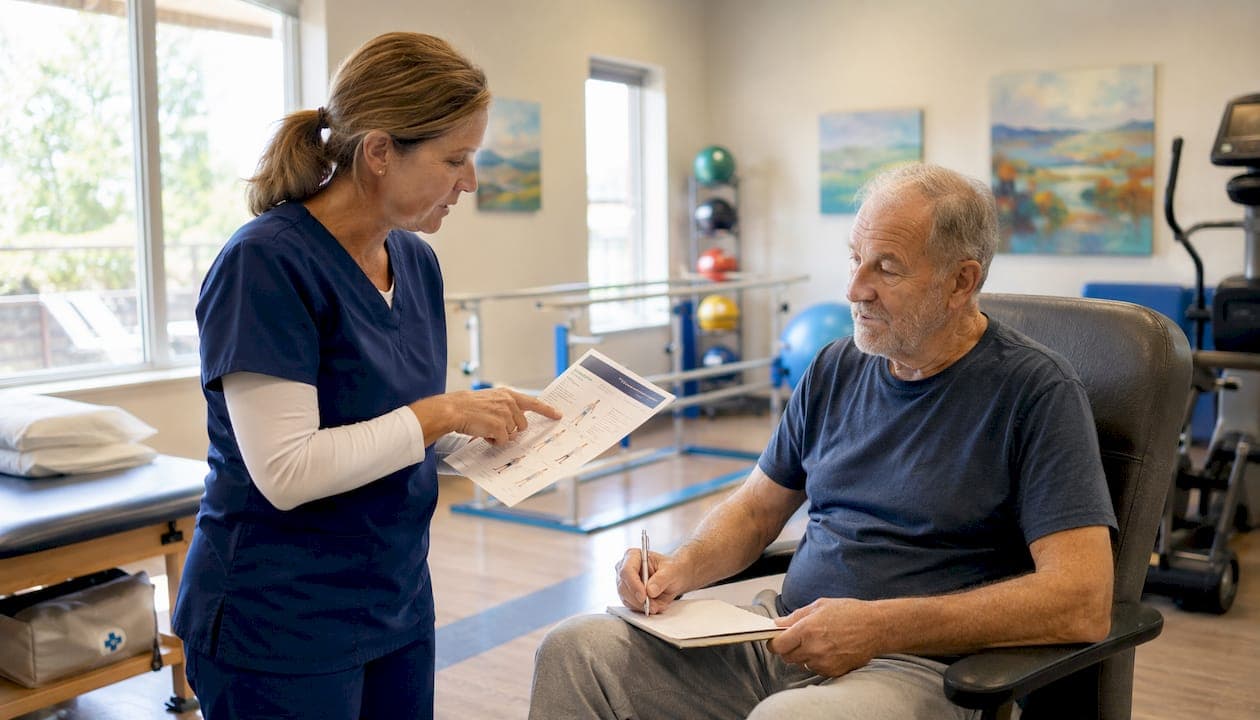
Why patient education sits at the center of recovery
Patient education directly shapes how well people recover from surgery, injury, and medical treatment. When patients understand what is happening in their bodies, what to expect, and what they need to do, they follow through. When they do not, complications rise, hospital stays lengthen, and readmissions climb. That is the short version of what decades of clinical research keep confirming.
The World Health Organization defines therapeutic patient education as a structured, person-centered learning process adapted to a patient's life and condition, carried out by trained health professionals across the full course of care. It is not a pamphlet handed over at discharge. It is an ongoing, personalized process built around the patient's specific situation.
Here is what effective patient education addresses in recovery:
- Treatment adherence: Patients who understand their care plan are far more likely to follow it, take medications correctly, and attend follow-up appointments.
- Self-management: Education builds the skills patients need to monitor symptoms, manage pain, and recognize warning signs at home.
- Anxiety and fear: Knowing what to expect before and after a procedure measurably reduces psychological stress.
- Complications and readmissions: Informed patients catch problems earlier and avoid behaviors that set back healing.
- Provider-patient communication: Education closes the gap between what clinicians assume patients know and what patients actually understand.
- Interdisciplinary coordination: Structured education programs distribute the teaching load across nurses, therapists, and physicians, keeping content consistent.
- Technology access: Digital tools now allow education to reach patients at the exact moment it is most relevant to their care.
The barriers are real too. Pain, fatigue, medication effects, and cognitive load during hospitalization all interfere with learning. Provider time constraints and inconsistent content compound the problem. Effective patient education programs are designed with those barriers in mind, not around them.
How patient education improves your recovery outcomes
The benefits of structured patient education go well beyond patient satisfaction scores. Clinical evidence points to measurable improvements across the full arc of recovery.
Preoperative education, specifically, shortens hospital length of stay and lowers postoperative stress and anxiety. Systematic reviews confirm that structured education within Enhanced Recovery After Surgery (ERAS) protocols accelerates recovery. ERAS is a multimodal care pathway used widely in American hospitals for procedures ranging from colorectal surgery to joint replacement, and patient education is one of its core components.

In musculoskeletal conditions, which include the back injuries, whiplash, and soft tissue damage that often follow car accidents, multiple clinical trials show moderate-certainty improvements in pain, disability, and fear of movement when therapeutic education is part of care. That last point matters: fear of movement is one of the most stubborn barriers to physical recovery, and education addresses it directly by reframing what pain means and what patients can safely do.
Pro Tip: If you are preparing for surgery or recovering from an injury, ask your care team specifically what educational materials are available before your procedure. Preoperative education is most effective when it happens early enough for patients to absorb and act on it.
The benefits extend to mental health. Patients who receive structured education report higher self-efficacy, meaning greater confidence in their own ability to manage their condition. That confidence translates into better adherence to physical therapy, medication schedules, and lifestyle modifications. Higher adherence, in turn, produces better clinical outcomes. The connection is direct, and it runs through education.
- Reduced postoperative anxiety and fear
- Shorter hospital stays within ERAS pathways
- Fewer unplanned readmissions
- Improved adherence to medication and rehabilitation
- Greater patient satisfaction and sense of control
- Measurable reductions in pain and disability in musculoskeletal recovery
- Stronger self-efficacy and mental health during recovery
For patients recovering from musculoskeletal injuries, understanding the relationship between movement, pain, and healing is often the turning point in recovery.
What makes patient education content actually effective
Not all patient education works. The content itself, how it is structured, and how well it fits the individual patient determine whether education produces results or gets ignored.
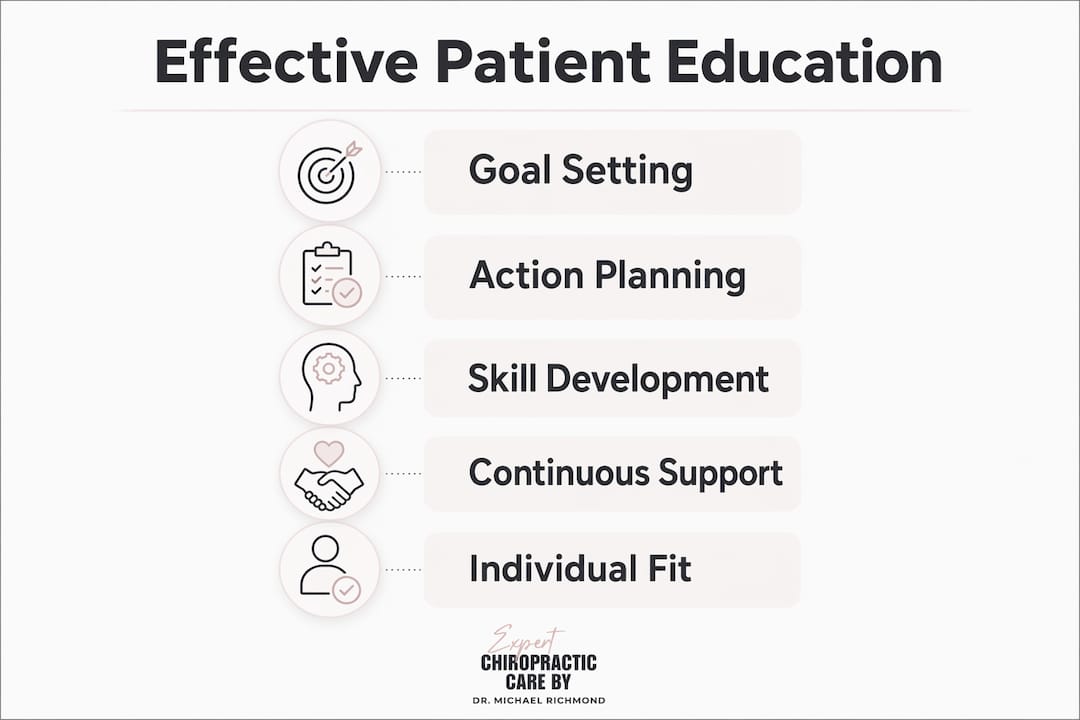
The WHO framework identifies two essential components of therapeutic patient education: goal setting, action planning, and shared decision-making on one side, and delivering educational interventions that build knowledge, skills, and confidence on the other. Both matter. Neither works as well without the other.
Personalization is the factor that separates effective programs from generic ones. A patient recovering from cardiac surgery needs different content than someone managing post-accident back pain. Research from Mayo Clinic on a mobile-based education platform found that patients used a large proportion of an aggressive multi-module education program over several days, and most patients reported understanding nearly all the content before discharge. That is a striking engagement rate, and it was driven by content tailored to each patient's specific surgery, medical conditions, and functional status.
Effective patient education content includes:
- Modular, condition-specific knowledge: Information organized around the patient's actual diagnosis and procedure, not generic health advice.
- Skills training: Practical instruction on wound care, mobility exercises, medication management, and recognizing complications.
- Goal setting and action planning: Structured conversations that help patients identify what they want to achieve and how they will get there.
- Shared decision-making: Patients and clinicians choosing treatment approaches together, based on clinical evidence and patient preferences.
- Health literacy adaptation: Materials written and presented at a level the patient can actually understand. The AHRQ Patient Education Materials Assessment Tool (PEMAT) gives providers a systematic way to evaluate whether written and audiovisual materials are clear and actionable.
- Cultural competence: Content that accounts for language, cultural beliefs, and community context. AHRQ's Health Literacy Universal Precautions Toolkit includes specific tools for addressing language differences and cultural customs.
- Just-in-time delivery: Education modules linked to specific care events of the day, so patients receive information when it is immediately relevant to what they are experiencing.
That last point deserves attention. Verbal instructions delivered once, out of sync with a patient's readiness or daily care routine, are frequently forgotten or remembered inaccurately. Timing education to match care events, the way the Mayo Clinic platform did with its "plan of day" structure, dramatically improves retention and relevance.
Best practices for delivering patient education that sticks
Knowing what to teach is only half the problem. How and when education is delivered determines whether it actually reaches patients.
Timing across the care continuum matters. Preoperative education sets expectations, reduces anxiety, and prepares patients for active participation in their own recovery. Perioperative education keeps patients oriented during hospitalization. Post-discharge education supports the transition home, which is often when adherence breaks down. Each phase requires different content and different delivery approaches. A personal wellness plan built around post-discharge education can be one of the most practical tools a patient has.
Interdisciplinary delivery is not optional. Systematic reviews endorse multidisciplinary education, involving nurses, physical therapists, and physicians, for better outcomes and to prevent any single provider from carrying an unsustainable teaching burden. When every member of the care team reinforces the same messages, patients receive consistent information and trust it more.
Teach-back is the gold standard for confirming understanding. Rather than asking "Do you have any questions?" and accepting silence as comprehension, teach-back asks patients to restate instructions in their own words. AHRQ identifies it as an evidence-based health literacy strategy that ensures providers have explained information clearly. The difference between the two approaches is not subtle: passive confirmation misses most misunderstandings, while teach-back surfaces them before they become complications.
Delivery best practices include:
- Begin education before the procedure, not at discharge.
- Use multiple formats: verbal, written, and digital, since patients retain information differently.
- Apply teach-back consistently, especially for medication instructions and warning signs.
- Use mobile platforms to deliver individualized, just-in-time content linked to daily care events.
- Address cognitive load barriers by spacing education across the hospital stay rather than front-loading it.
- Involve family members or caregivers in education sessions when possible.
- Follow up after discharge through patient portals, phone calls, or telehealth check-ins.
Technology has changed what is possible here. Mobile computing platforms allow education to be individualized, kept current, and delivered at the right moment, even in older adult populations who may be unfamiliar with the technology. The same research found that patients with an average age of 68, recovering from major cardiac surgery, quickly learned to use tablet-based education and engaged with it at high rates. Insights on patient engagement methods show that digital delivery also supports ongoing communication between patients and care teams, extending education beyond the hospital walls.
How education builds patient confidence and drives adherence
The deepest impact of patient education is not informational. It is psychological. Patients who understand their condition and their care plan feel more in control, and that sense of control is what drives adherence.
Qualitative research on preoperative education shows that personalized education builds what researchers call "situated understanding," connecting clinical information to a patient's daily life and circumstances. When patients can see how a medication schedule, a movement restriction, or a dietary change fits into their actual routine, they are far more likely to follow through. Abstract instructions, disconnected from context, tend to fade.
Explaining the "why" behind medical instructions is particularly powerful. When patients understand the reasoning behind a recommendation, not just the recommendation itself, trust increases and anxiety decreases. That connection between rationale and compliance is well-documented, and it is one of the reasons the WHO framework places shared decision-making at the center of therapeutic education rather than treating it as a courtesy.
The WHO guide frames this directly: therapeutic patient education transforms patients from passive care recipients into active partners in their own health management. That shift in role changes behavior. Patients who see themselves as participants, rather than subjects, ask better questions, report symptoms earlier, and stick to recovery plans longer. For conditions like chronic pain after an accident, where long-term self-management is the difference between recovery and disability, that shift is the whole game.
Education also works best when it is continuous, not episodic. A single preoperative class does not sustain adherence through six weeks of physical therapy. Meta-analyses on therapeutic education in musculoskeletal conditions consistently show that ongoing education, integrated into routine care, produces better outcomes than one-time interventions. The education has to follow the patient through recovery, adapting as their condition and needs change.
At Sparkmed, patient education is built into every stage of care. Whether you are recovering from a car accident, managing back pain, or working through a musculoskeletal injury, understanding your condition and your treatment plan is part of how Sparkmed helps you heal. Explore Sparkmed's approach to accessible, patient-centered care, and see how education and treatment work together at every step.
Key Takeaways
Patient education is the single most consistent driver of treatment adherence, reduced complications, and faster recovery across surgical and medical care settings.
| Point | Details |
|---|---|
| Education drives adherence | Patients who understand their care plan follow it more consistently, reducing complications and readmissions. |
| ERAS protocols depend on it | Structured preoperative education is a core component of Enhanced Recovery After Surgery pathways that shorten hospital stays. |
| Teach-back confirms comprehension | Asking patients to restate instructions in their own words catches misunderstandings before they become clinical problems. |
| Personalization and timing matter | Just-in-time, condition-specific education linked to daily care events produces far higher engagement than generic materials. |
| Continuous education sustains recovery | Ongoing education integrated across the full recovery timeline outperforms single-session interventions in clinical outcomes. |