
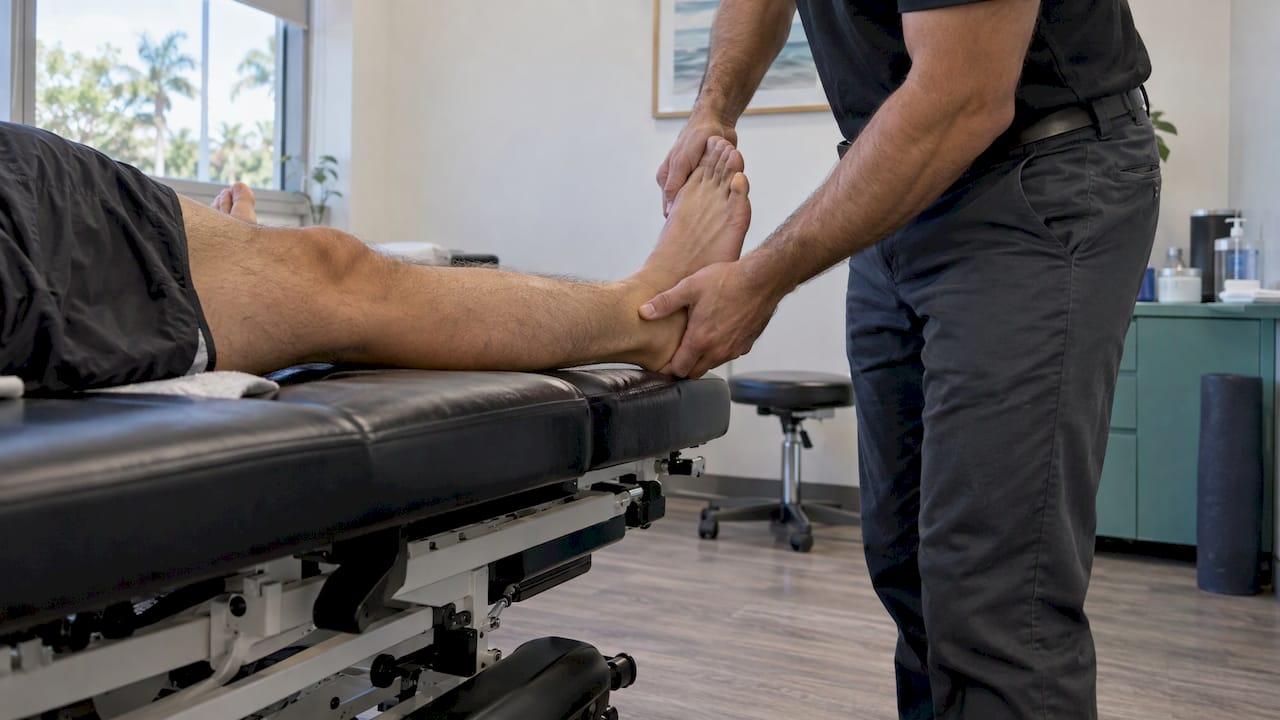
A chiropractor can be a good first stop for a sprained ankle, as long as the visit starts with a proper exam to rule out a fracture and grade the sprain. From there, care combines gentle joint work, soft-tissue therapy and a rehab plan that rebuilds balance and strength. At SPARK Chiropractic in North Miami, an adjustment is $45, and we also run auto accident evaluations for ankle injuries from collisions, work and slip-and-fall events.
This guide explains what the research says manual therapy can do for an ankle sprain, what a visit involves, how long recovery takes and which signs mean you need imaging or emergency care before anything else.
TL;DR
- A sprain is a stretched or torn ligament. Grades I and II respond well to conservative care, and a 2015 systematic review found that joint mobilization plus home exercise improved short-term function more than exercise and advice alone.
- Get checked early. Severe pain, trouble bearing weight or an unstable joint means an exam, and sometimes an X-ray, comes before any adjustment.
- Good care is more than an adjustment: swelling control, early pain-free movement, support and 8 to 12 weeks of balance and strength work to prevent the next sprain.
- After a car accident, document the injury early. Our clinic bills insurance directly and records the injury in detail for claims.
- An adjustment at SPARK is $45. Shockwave therapy is $75 per session.
Table of Contents
- What an ankle sprain actually is
- Can a chiropractor help an ankle sprain?
- What an ankle adjustment involves
- What a visit looks like
- Recovery steps that matter, week by week
- Ankle sprain from a car accident
- Safe use: when imaging or medical care comes first
- What treatment costs at SPARK
- Our perspective
- Book your ankle evaluation
- FAQ
- Sources
What an ankle sprain actually is
Ligaments are the tough bands that hold bones together. A sprain happens when one of them stretches or tears. Most ankle sprains hit the outer (lateral) ligaments when the foot rolls inward, which is what happens when you step off a curb, land awkwardly or plant a foot under a braking pedal in a crash.
Sprains are graded by severity:
- Grade I: mild stretching, little swelling, you can usually walk.
- Grade II: partial tear, noticeable swelling and bruising, walking hurts.
- Grade III: complete tear, severe swelling, and often you cannot bear weight.
The grade matters because it decides the plan. A Washington State Department of Labor & Industries guideline (2025) recommends modified pain-free activity, ice, compression and elevation for grade I, adds a brace or splint for grade II, and calls for two to three weeks of significant immobilization for grade III.
Can a chiropractor help an ankle sprain?
Yes, for the right sprain at the right time. A narrative review in the medical literature notes that most ankle sprains respond well to nonsurgical care from physical therapists, doctors of chiropractic and rehabilitation specialists, and that hands-on soft-tissue techniques can be applied to the ligament and surrounding tissue to support early healing.
The strongest numbers come from the OPTIMa Collaboration review, which screened 6,047 articles. For adults with grade I or II sprains, lower-extremity mobilization added to home exercise and advice produced greater short-term gains in activities and function than home exercise and advice alone. In the key trial it analyzed, the manual-therapy group scored clearly better at four weeks:
| Measure at 4 weeks | Extra improvement with manual therapy |
|---|---|
| Daily activities (FAAM, out of 100) | 11.7 points |
| Sports activities (FAAM, out of 100) | 13.3 points |
| Lower-limb function (LEFS, out of 80) | 12.8 points |
Those gains are the point of a visit: getting you walking, working and driving comfortably sooner.
The Journal of Orthopaedic & Sports Physical Therapy also notes that clinicians may use manual therapy when managing acute ankle sprains, and that return to full sport can take anywhere from a day to a few weeks for mild sprains, while complete recovery for worse ones may take months.
What an ankle adjustment involves
When people search for an ankle sprain adjustment, they usually picture a spinal crack. An ankle adjustment is different: a gentle, controlled movement of the ankle joint, often a glide of the talus (the bone that sits between your shin and heel). It is not forceful twisting.
A clinical perspective published through the National Library of Medicine describes two examples. A mortise separation adjustment increased the ankle's ability to flex upward (dorsiflexion) immediately in people with grade I and II sprains and improved function for up to a month. The same paper reports that a passive forward-to-back glide of the talus increased dorsiflexion more than rest, ice, compression and elevation alone.
Why does dorsiflexion matter? If you cannot bend the ankle fully, you walk with a shortened stride, shift weight to the other leg and strain the knee and hip. Restoring that motion is often the first practical win.
What a visit looks like
A careful sprain visit follows a sequence.
- History. How it happened, what you felt, whether you heard a pop, whether you could walk afterward.
- Exam and screening. Swelling, bruising, ligament tests, and a check for signs of a fracture. Continuing-education training for chiropractors teaches the Ottawa Ankle Rules to guide imaging and referral decisions. If the rules point to a possible break, you get an X-ray before any joint work.
- Timing. The American Family Physician review notes that waiting until 4 to 7 days after injury for the physical exam improves accuracy in judging severity, so a follow-up exam in the first week is normal.
- Treatment. Gentle mobilization, soft-tissue work, and therapies for swelling and pain, matched to the grade.
- Home plan. Support, movement and exercises you do between visits.
At our North Miami clinic, the therapies on the menu include massage, electrical stimulation, ultrasound, traction and decompression, and auto accident evaluation. Which ones you get depends on your exam, not a fixed package.
Recovery steps that matter, week by week
The first days: protect and control swelling
The familiar rest, ice, compression and elevation routine has been updated. The Washington guideline recommends MICE: modified pain-free activity, ice for 20 to 30 minutes three to four times daily, compression and elevation. It adds that the first week should focus on protection and swelling control, but current research supports bringing in pain-free movement quickly, and that delayed rehab is linked to repeat injury.
If you want to know how to time ice, see our guide to cold therapy for sprains in the first 48 to 72 hours. Some people also look into compression therapy for swelling as part of managing a swollen limb.
The Mayo Clinic says crutches may be needed until pain improves, and an elastic bandage, sports tape or ankle brace may be recommended depending on severity. The AFP review recommends external ankle supports for 5 to 10 days and says acetaminophen, NSAIDs and opioids are equally effective for pain in acute sprains. Ask your doctor which pain medicine is right for you, particularly if you have stomach, kidney or heart conditions or take blood thinners.

Weeks one to three: get moving
Early controlled motion is favored over long immobilization. The reason, according to the narrative review, is that early progressive rehabilitation restores ligament strength, helps lymphatic drainage, restores balance sense, reduces muscle wasting and limits scarring inside the joint. Our article on improving mobility after injury covers a safe starter approach.
Weeks three to twelve: rebuild balance
The part most people skip is the part that prevents the next sprain. The Washington guideline explains that poor proprioception, your joint's sense of its own position, is a major cause of repeat sprains and unstable ankles. The AFP review recommends a targeted neuromuscular rehabilitation program lasting 8 to 12 weeks and wearing a lace-up or semirigid brace during sports for up to 12 months to prevent recurrence.

Single-leg stands, wobble-board work, calf and peroneal strengthening and gradual return to walking, then jogging, are the usual building blocks.
Ankle sprain from a car accident
Ankles get hurt in crashes in ways that are easy to miss: a foot jammed against the pedals, a twist while bracing, or a fall getting out of the vehicle. University of Utah Health lists car crashes among common causes of ligament sprains. It advises emergency care for severe pain or an apparent dislocation, and urgent care if pain cannot be managed at home, symptoms persist or worsen after 24 to 48 hours, the joint feels unstable, or normal activities are affected despite home care.
In practice, that means:
- Go to the ER first if you cannot put weight on the foot, the ankle looks deformed, or the pain is severe. A fracture has to be ruled out.
- Get evaluated within a few days if it is a milder sprain. Ankle pain that shows up a day or two after a crash is common.
- Keep records. The date, how it happened, photos of bruising and every visit become the paper trail for your claim.
This is where choosing a clinic that treats accident patients every day helps. Our team has more than 20 years of experience treating accident victims, bills insurance directly and documents injuries thoroughly for claims. Many accident patients also have neck and back symptoms along with the ankle, and we can treat those in the same visit plan. For more, read why chiropractic care matters for auto accident recovery and what to expect from spinal adjustments after a car accident.
Work and slip-and-fall sprains follow the same logic: get examined, get the injury documented and start a graded plan early.
Safe use: when imaging or medical care comes first
Chiropractic care for a sprain works best when it is matched to the injury. Practical rules to follow:
- Pain directly over the ankle bones, inability to take steps right after the injury or obvious deformity needs imaging first. Absolute contraindications to forceful manipulation include acute fractures, and when risk is higher, gentle mobilization and soft-tissue therapy are the options.
- A suspected grade III sprain with severe swelling and inability to bear weight calls for a walking boot or orthosis, crutches, a re-exam in 3 days, and an MRI if there is no improvement, according to the narrative review.
- If recovery is not following the expected course, the AFP review says MRI should be performed to look for talar fractures and peroneal tendon injuries.
- The Mayo Clinic advises an appointment or emergency care when a sprained ankle does not improve with self-care or keeps causing pain or instability, and severe injuries may be referred to an orthopedic surgeon or a rehabilitation physician.
That screening is part of what an exam is for. Numbness, tingling, a foot that feels cold or discolored, or fever with a hot, red ankle should go to urgent care or the ER the same day.
What treatment costs at SPARK
Our published prices:
| Service | Price |
|---|---|
| Chiropractic adjustment | $45 one-off |
| Shockwave therapy | $75 per session |
| Essential plan | $149 per month |
| Performance plan | $249 per month |
| Elite plan | $399 per month |
Massage, electrical stimulation, ultrasound, traction and decompression, and auto accident evaluation have no published price, so see the services page or ask our front desk. Full pricing is on our pricing page.
Our perspective
Most ankle sprains we think about are not dramatic. A patient steps wrong, or is rear-ended and feels the foot twist under the pedal, and a week later the ankle is still stiff and the knee and low back have started to ache from limping.
We believe the fastest route back is a clear exam first, then hands-on care that restores motion, then a plan that rebuilds balance so the ankle does not roll again. A single adjustment is a start, not the whole plan, and that is why our care combines adjustments with therapies such as ultrasound, electrical stimulation, shockwave and massage, along with exercises you can do at home.
Accident patients also carry paperwork. Our over 20 years of experience treating accident victims means we document the injury carefully and bill insurance directly, so you can focus on healing. We speak English, Spanish and Creole, and we offer free transportation so a hurt ankle does not keep you from coming in.
Spark
Book your ankle evaluation
If your ankle has been swollen, stiff or unstable since a crash, a fall or a workday injury, start with an evaluation. Adjustments are $45 each, and our team handles the exam, the treatment plan and the documentation under one roof in North Miami. See our pricing and book.

If you also want to understand how a full course of care unfolds, our step-by-step guide to chiropractic treatment walks through it.
FAQ
Can a chiropractor help an ankle?
Yes. For grade I and II sprains, research shows that joint mobilization added to home exercise improves short-term function more than exercise and advice alone. A good visit starts with an exam to rule out a fracture, then combines gentle joint work, soft-tissue therapy and a rehab plan.
Is it okay to massage a sprained ankle?
Gentle soft-tissue work is one of the techniques used on sprains, including transverse friction massage, to support early healing. Timing and pressure depend on swelling and grade, so have the ankle examined first. See our article on massage therapy after a car accident.
How long does an ankle sprain take to heal?
It varies widely with the grade. Mild sprains may allow a return to activity in days to a few weeks, while serious ones can take months. A neuromuscular rehab program typically runs 8 to 12 weeks, so finishing the exercises matters even after the pain fades.
Should I go to the ER or a chiropractor after a car accident ankle injury?
Go to the ER if you cannot bear weight, the ankle looks deformed or the pain is severe, because a fracture must be ruled out. For a milder sprain, book an evaluation within a few days. If symptoms worsen after 24 to 48 hours or the joint feels unstable, get seen promptly.
Sources
- The effectiveness of manual therapy for the management of musculoskeletal disorders of the upper and lower extremities (OPTIMa review), Chiropractic & Manual Therapies, 2015
- Evidence-based treatment for ankle injuries: a clinical perspective
- Lateral and syndesmotic ankle sprain injuries: a narrative literature review
- Washington State Department of Labor & Industries, Work-Related Mechanical Foot and Ankle Conditions, 2025
- Mayo Clinic, Sprained ankle: diagnosis and treatment
- Journal of Orthopaedic & Sports Physical Therapy, Ankle Sprains: What Updated Guidelines Mean for You, 2021
- American Family Physician, Management of Acute Ankle Sprains, 2025
- University of Utah Health, Ligament Sprain Treatment
- Cleveland Clinic Journal of Medicine, Collaborative musculoskeletal care, 2025
- Evidence-Based Management of Ankle Sprain Injuries, continuing-education course
- Compression therapy and swelling