
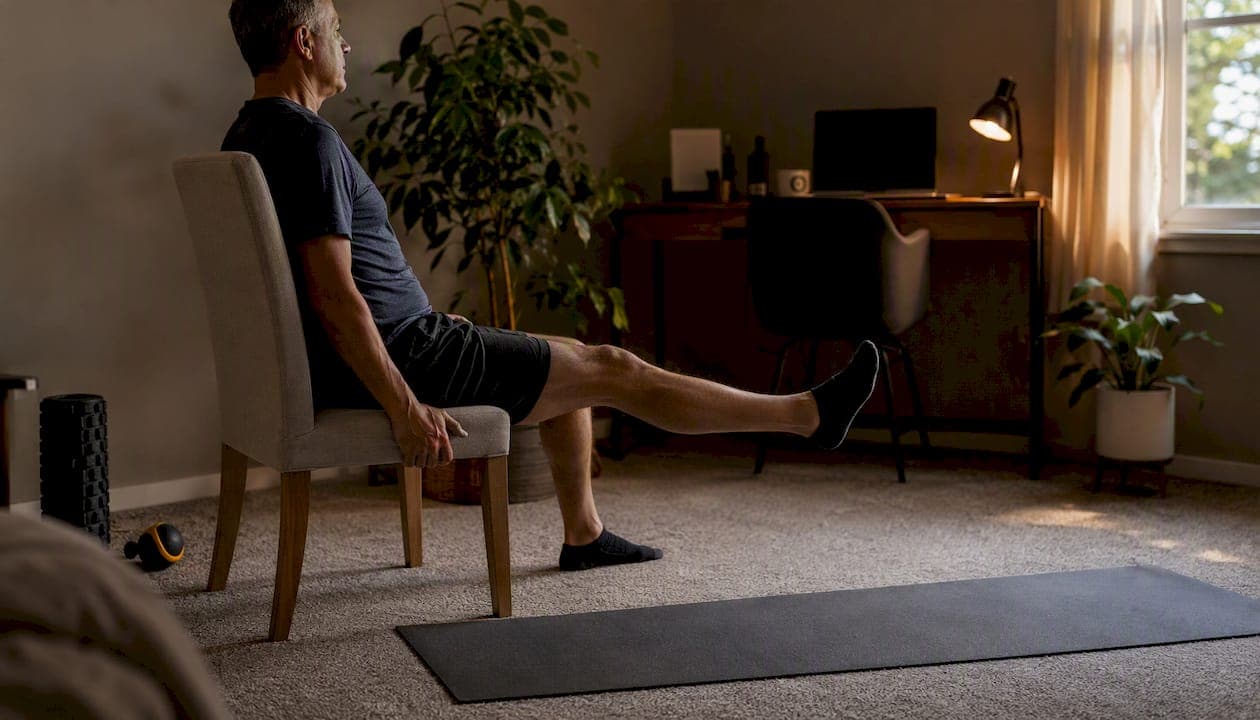
The fastest way to regain mobility after injury is to start controlled, pain-guided movement as early as your body allows — not to rest and wait. Early mobilization speeds healing and reduces long-term stiffness compared with strict immobilization for most soft-tissue injuries. The U.S. Department of Health and Human Services, as summarized by Harvard Health, recommends 150–300 minutes of moderate aerobic activity per week plus muscle-strengthening exercises at least two days weekly — a target that guides how you rebuild once you're cleared to move.
Start here, today:
- Begin with gentle range-of-motion exercises: heel slides, shoulder circles, or cat-cow, depending on your injury site.
- Add light aerobic movement (stationary bike, walking) to keep circulation up without stressing the injured area.
- Use isometric holds (quad sets, glute squeezes) to maintain muscle activation when full movement is still painful.
- Stop immediately for sharp, shooting, or worsening pain. A 0–3/10 ache during movement is acceptable; anything above that is a signal to back off.
- Get medical clearance before starting any home program if you've had surgery, a fracture, or a significant ligament injury.
Table of Contents
- What does a safe 2-week home mobility program look like?
- Exercises organized by injury region
- How do you progress safely without reinjuring yourself?
- What timeline should you expect for regaining mobility?
- When should you see a physical therapist or chiropractor?
- How does supervised clinic rehab accelerate your recovery?
- Key Takeaways
- What recovery actually looks like from the inside
- Sparkmed can help you recover with hands-on care in North Miami
- Useful sources and further reading
What does a safe 2-week home mobility program look like?
This plan works for most mild-to-moderate soft-tissue injuries once you have basic medical clearance. It follows a phase-based structure that moves from isometric holds to active range-of-motion and then light resistance — the same progression framework used in structured military rehabilitation programs like Rx3.
Progression table
| Milestone | When to progress | Next step |
|---|---|---|
| 10 reps pain-free (assisted) | End of Day 3–5 | Remove support, go active |
| 10 active reps at 2/10 pain | End of Week 1 | Add light resistance band |
| 12 reps with band, no pain | End of Week 2 | Increase band resistance or add ankle weight |
| Full pain-free range in daily tasks | Week 2–3 | Begin functional drills (step-ups, light squats) |
Before each session, run this quick check:
- Is swelling visibly worse than yesterday? Pause and ice.
- Any new numbness, tingling, or joint instability? Stop and call your provider.
- Did last session's soreness resolve within 24 hours? If not, reduce load today.
Equipment options: A light resistance band (loop or long), a foam roller for soft-tissue work, and a sturdy chair for balance support cover most of what you need. A stationary bike or pool access is a strong substitute for walking when impact is still painful.
Exercises organized by injury region
How do you progress safely without reinjuring yourself?
Pain is your primary feedback tool, and conservative pain management is the foundation of safe progression. The 0–3/10 rule is simple: mild discomfort during movement is acceptable, but sharp, shooting, or joint-specific pain above 3/10 means stop.
The safe progression sequence:
- Frequency first: Add a session before adding load. Go from 3 days/week to 5 before increasing resistance.
- Range second: Increase range of motion before adding weight.
- Load third: Once full range is pain-free, introduce resistance bands, then bodyweight, then external load.
- Speed last: Functional speed and sport-specific drills come only after full range and adequate strength are restored.
Red flags that require clinician contact:
- Fever, warmth, or redness around the joint (possible infection)
- New or worsening numbness, tingling, or weakness in a limb
- Joint instability or a feeling that the joint "gives way"
- Swelling that increases rather than decreases after exercise
- Pain that does not return to baseline within 24 hours of a session
To learn more about preventing chronic pain after an accident, pacing and load management are the two most important variables to control.
Pro Tip: Use a 3-second exhale during the hardest part of every exercise (the lift, the hold, the eccentric). Breath control reduces perceived effort, improves motor control, and keeps you from bracing so hard that you spike your blood pressure. It's one of the simplest things clinicians teach — and almost nobody does it at home.
What timeline should you expect for regaining mobility?
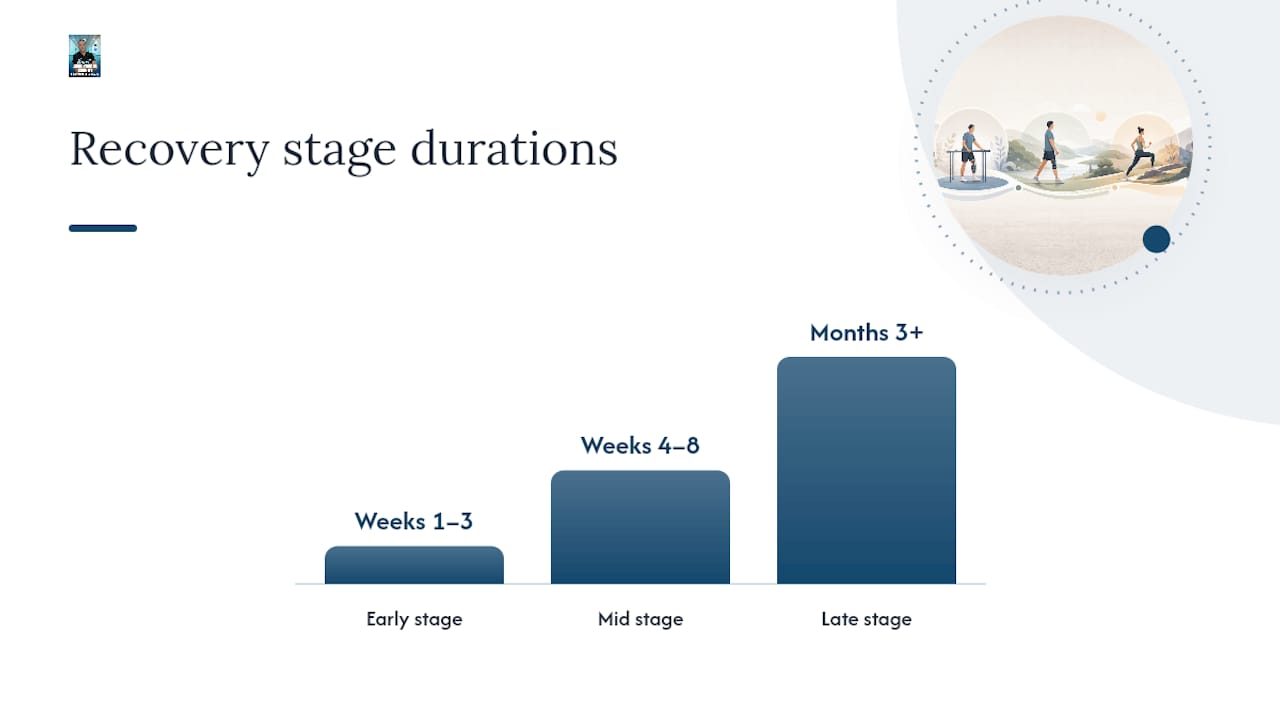
Recovery does not follow a calendar — it follows tissue biology. That said, phased rehabilitation reviews give useful windows for planning.
| Injury type | Early stage (Weeks 1–3) | Mid stage (Weeks 4–8) | Late stage (Months 3 and beyond) |
|---|---|---|---|
| Minor muscle strain | Pain-free rest positions; gentle ROM | Full active ROM; light resistance | Return to full activity |
| Moderate ligament sprain | Controlled weight-bearing; isometrics | Progressive loading; balance work | Sport-specific drills; full strength |
| Post-surgical (e.g., ACL, rotator cuff) | Surgeon-guided; swelling control | PT-supervised strengthening | Functional testing; return-to-sport |
| Chronic stiffness / deconditioning | Daily gentle mobility; 5–10 min sessions | Gradual load increase; 20–30 min sessions | Maintenance routine; 2–4 sessions/week or 5–10 minutes daily |
| Milestones matter more than dates. Aim for pain-free full weight-bearing before progressive loading, full range of motion in daily tasks before sport-specific drills, and consistent 24-hour pain recovery before increasing session intensity. |
Age, comorbidities like diabetes or osteoporosis, and baseline fitness all affect speed. A 25-year-old athlete and a 60-year-old recovering from a fall may follow the same sequence but on very different timelines. For a fuller picture of musculoskeletal injury recovery pathways, the injury type and tissue involved matter as much as the severity rating.
When should you see a physical therapist or chiropractor?
Home programs work well for mild injuries with clear mechanisms and no red flags. But several situations call for professional evaluation before or instead of self-directed rehab.
Seek care if you have:
- Persistent severe pain that does not improve after 48–72 hours of gentle movement
- Any joint instability, locking, or giving-way sensation
- Progressive weakness in a limb (not just soreness)
- Swelling that does not reduce within 3–5 days
- Numbness or tingling that radiates down an arm or leg
- Signs of infection: fever, warmth, redness, pus
- A fracture, surgical repair, or significant ligament tear (these require supervised progression)
At a first PT or chiropractic visit, expect a movement screen, manual assessment of joint mobility and muscle strength, and a discussion of your goals and timeline. Good clinicians will give you a home exercise program from day one, explain what they're measuring, and set clear milestones for progress. Ask them: What are we measuring to know I'm improving? What should I avoid at home? What's the earliest realistic milestone?
The Mayo Clinic's pain medicine guidance and HHS activity guidelines both reinforce that supervised progressive loading reduces reinjury risk compared with unsupervised self-management for moderate-to-severe injuries. For patients recovering from auto accidents, chiropractic recovery guidance adds specific context on spinal and soft-tissue injuries that often present after collisions.
How does supervised clinic rehab accelerate your recovery?
Supervised rehab does something a home program cannot: it adjusts load and technique in real time, based on what your body is actually doing. Targeted mobility and strengthening programs reduce pain, restore function, and lower the chance of chronic disability after most injuries — but the benefit scales with how well the program is matched to the individual.
What clinic-based care typically includes:
- Manual therapy (joint mobilization, soft-tissue work) to restore range before exercise
- Guided exercise progressions that advance week-by-week based on objective measurements
- Modalities like ultrasound and shockwave therapy to control inflammation and support tissue repair
- Multimodal pain control that reduces reliance on medication while keeping you moving
At Sparkmed, the clinical team uses spinal adjustments, supervised exercise progressions, ultrasound, and shockwave therapy as part of a structured recovery approach for patients dealing with car accident injuries, work injuries, and slip-and-fall trauma. The clinic serves patients in North Miami and offers a $25 chiropractic adjustment with no insurance required.
Key Takeaways
Controlled, pain-guided movement started early — not rest — is the single most effective strategy to restore mobility after injury and prevent long-term stiffness.
| Point | Details |
|---|---|
| Start moving early | Early controlled movement reduces stiffness and speeds return to function more than strict rest. |
| Follow the pain rule | Keep exercise intensity at 0–3/10 pain; stop for sharp pain, new swelling, or numbness. |
| Progress in sequence | Advance frequency, then range, then load, then speed — never skip a step. |
| Know your red flags | Fever, joint instability, progressive weakness, or radiating numbness require clinician evaluation. |
| Sparkmed for hands-on care | For injuries needing supervised rehab, Sparkmed in North Miami offers chiropractic adjustments, ultrasound, and shockwave therapy starting at $25. |
What recovery actually looks like from the inside
Most people expect a straight line. You do the exercises, the pain fades, the range comes back, and you return to normal. What actually happens is more like a staircase with occasional landings where nothing seems to change for a week. Those plateaus are not failure — they're tissue remodeling. The biology of healing does not care about your schedule.
The thing clinicians see most often is not people who pushed too hard. It's people who stopped too soon. They felt 80% better, skipped the last phase of rehab, and came back six months later with the same problem because the joint never fully regained its strength or proprioception. Finishing the program when you feel good is harder than starting it when you're in pain.
One practical tip that actually works for adherence: tie your mobility session to something you already do every day. Morning coffee, lunch break, before your shower. A 10-minute routine attached to an existing habit is more durable than a 45-minute session that requires motivation to start. Consistency beats intensity at every stage of recovery.

Sparkmed can help you recover with hands-on care in North Miami
If your injury needs more than a home program, Sparkmed offers a direct path to supervised recovery without the barrier of insurance paperwork. The clinic provides chiropractic adjustments, spinal mobilization, ultrasound therapy, and shockwave treatment — the same modalities that accelerate tissue repair and restore range of motion in clinic-based rehab programs. A first adjustment starts at $25, no insurance required.
Patients recovering from car accidents, workplace injuries, and slip-and-fall trauma can book in-person at the North Miami clinic. Multilingual support (English, Spanish, and Creole) and Uber Health transport options are available for patients who need them. To book your visit or learn more about what a first session includes, contact Sparkmed directly or visit the clinic at 2840 North Miami.
Useful sources and further reading
- Improving your mobility - Harvard Health
- Should You Rest or Move After an Injury? | UHealth Collective
- Rehabilitation Exercises | Strength & Flexibility After Injury
- PMC article on eccentric loading and tendon rehabilitation
- Mayo Clinic — Pain medicine overview
- Rx3 Rehabilitation guide (USUHS)
- 5 simple mobility exercises to improve flexibility - Kaiser Permanente
- NCBI books — rehabilitation review (NBK555914)
This article provides general information for educational purposes and does not substitute for professional medical advice. Confirm current guidelines and your specific treatment plan with a licensed clinician before starting any rehabilitation program.