
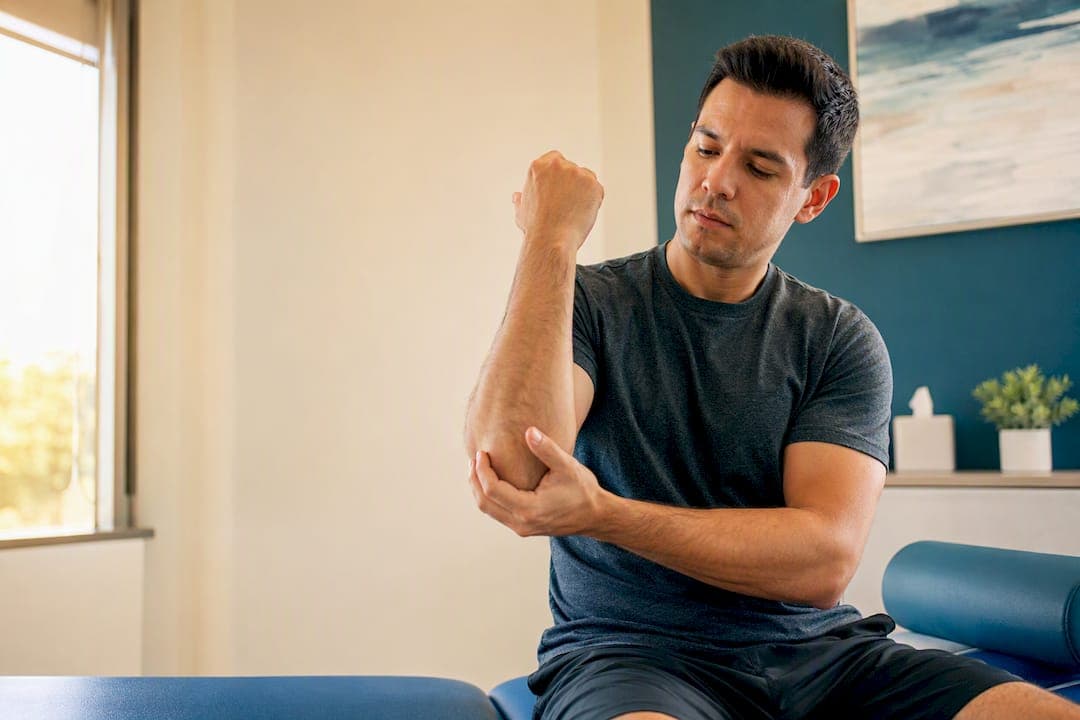
Arm pain after a car accident usually traces back to one of a handful of mechanisms: direct impact against the door or dashboard, the arm bracing on a wheel or armrest at the moment of collision, seatbelt or airbag force, or nerve involvement from the neck down through the shoulder. It can mean anything from a strained muscle to a fracture, a torn rotator cuff, or a brachial plexus injury. Two things matter immediately: get a medical exam that names what's actually wrong, and document the injury while it's still clearly tied to the crash. If there's visible deformity, numbness that won't quit, or a hand losing circulation, skip the wait and get to an emergency room.
TL;DR:
- Fractures commonly occur in the humerus, forearm bones, or wrist from direct impact or bracing during a collision.
- Nerve injuries, such as brachial plexus damage, can range from temporary stretches to severe root avulsions with poor recovery prospects.
- Soft tissue injuries like strains or contusions often peak in pain and swelling days after the crash, not immediately.
- Visible deformities, uncontrollable pain, limb pale or cold, or loss of sensation require immediate emergency medical attention.
- Early documentation through photos, records, and medical exams improves insurance claims and ensures proper treatment of the injury.
Table of Contents
- What Causes Arm Pain After a Car Accident
- Symptoms of Arm Injury: What Shows Up Right Away vs. Days Later
- How Doctors Diagnose Arm Injuries After a Crash
- Treatment Options and What Recovery Actually Looks Like
- When Arm Pain Means You Need Emergency Care Now
- Documenting Your Injury for Insurance and Legal Follow-Up
- How Coordinated Care Supports Arm Injury Recovery
- Living With Arm Pain: Daily Impact and Coping
- Is the Pain From the Arm Itself or From Your Neck?
- A Clinician's Take on What Patients Get Wrong
- Getting Evaluated for Arm Pain After Your Accident
- Sources
What Causes Arm Pain After a Car Accident
The arm takes a beating in a crash in more ways than people expect. It's not just the point of impact. It's also the arm's own reflexive reaction to a collision, the seatbelt locking across the shoulder, and forces traveling down from a jolted neck.
Fractures show up most often in the humerus, the forearm bones (radius and ulna), and the wrist. They happen from a direct hit against the door or dashboard, or from bracing the arm rigidly against the wheel right before impact. Bracing transmits enormous force through a locked joint, and bone often loses that fight before soft tissue does.
Dislocations hit the shoulder and elbow most frequently. A shoulder dislocation often presents with a visibly squared-off shoulder and an arm that looks like it's hanging at the wrong angle. Elbow dislocations tend to come from an outstretched arm catching the full force of a crash.
Rotator cuff and tendon tears develop when the shoulder absorbs sudden overload, especially if the arm was gripping the wheel and got wrenched during impact.
Brachial plexus injuries deserve special attention because they range so widely in severity. This nerve network runs from the spinal cord through the neck and into the arm, and traffic accidents are a leading cause of traumatic brachial plexus injuries. The damage spectrum runs from a stretch that heals in weeks to a root avulsion, where the nerve tears away from the spinal cord itself. Avulsions are usually caused by trauma such as motor vehicle accidents and often carry a poor prognosis for full recovery.
Cervical radiculopathy is worth ruling out too. A compressed or irritated disc in the neck can send pain, tingling, or weakness straight down the arm, even when the arm itself is structurally fine.
Other common findings:
- Soft-tissue strains and contusions from seatbelt or airbag contact
- Swelling severe enough to raise concern for compartment syndrome, a pressure buildup inside muscle compartments that needs urgent attention
- Bruising and tenderness along the collarbone from seatbelt loading
Symptoms of Arm Injury: What Shows Up Right Away vs. Days Later
Adrenaline is a terrible judge of injury severity. In the minutes after a crash, it can mask real damage, which is why pain, swelling, and stiffness often peak days after impact rather than immediately. Someone can walk away from a collision feeling mostly fine and wake up the next morning barely able to lift a coffee cup.
Watch for these patterns, since they usually point to something more specific than a bruise:
- Numbness or tingling that spreads down the arm or into the fingers, especially if it doesn't fade within a day
- Burning or electric-shock sensations, which tend to signal nerve irritation or brachial plexus involvement rather than a simple strain
- Progressive weakness or an arm that feels increasingly hard to lift overhead, a red flag for rotator cuff tears or plexus injuries
- Visible deformity, swelling that keeps expanding, or skin that looks pale, cold, or blue
- Loss of hand function, like trouble gripping or buttoning a shirt
Pro Tip: Don't use pain intensity as your only gauge. Clinicians routinely see cases where a structural injury or nerve problem shows up with only mild discomfort at first, while a straightforward muscle strain hurts far worse in the moment.
Symptom timing matters for diagnosis, too. A dull ache that builds slowly over 48 hours often points to inflammation and soft-tissue injury. A sharp, immediate pain paired with an obvious shape change points to fracture or dislocation. Numbness that starts at the neck and radiates outward suggests the problem may not be in the arm at all.
How Doctors Diagnose Arm Injuries After a Crash
Diagnosis starts with a hands-on exam: checking pulses and skin temperature to rule out circulation problems, testing range of motion, and palpating for tenderness or an obvious step-off where a bone might be broken. This neurovascular check comes first because it flags emergencies before anything else does.
From there, imaging fills in the picture. Different tools answer different questions:
- X-ray confirms or rules out fractures and shows joint alignment after a suspected dislocation
- CT scan gets called in for complex or comminuted fractures where a plain X-ray doesn't show enough detail
- MRI is the go-to for rotator cuff tears, ligament damage, and other soft-tissue injuries that bone imaging can't capture
- Ultrasound offers a quick, real-time look at tendon tears, often used alongside or before MRI
When numbness, weakness, or a suspected brachial plexus injury enters the picture, doctors turn to EMG and nerve conduction studies to assess nerve and muscle function and guide the timing of any specialist referral. These nerve studies are sometimes delayed several weeks after injury, since nerve damage patterns take time to show up clearly on testing.
Getting imaging early does double duty. It shapes the treatment plan, and it creates a dated medical record that ties the injury directly to the crash, which matters later if an insurer questions what caused what.
Treatment Options and What Recovery Actually Looks Like
Treatment depends entirely on what's actually torn, broken, or compressed, and recovery timelines vary just as widely. Here's the general path by injury severity:
- Conservative care first. Sprains, strains, and mild soft-tissue injuries usually respond to immobilization with a sling or brace, NSAIDs for inflammation, alternating ice and heat, and short-term activity modification. Most resolve in a few weeks.
- Multimodal rehab for functional recovery. Pain relief alone rarely restores full motion or strength. Practitioners increasingly favor combining manual therapy, guided exercise, and structured physical therapy and rehab to rebuild range of motion and joint stability together, rather than treating pain in isolation.
- Surgery when the damage demands it. Displaced fractures, major rotator cuff tears, and certain brachial plexus ruptures or avulsions often need surgical repair. Post-surgical recovery typically runs through immobilization, then a graded strengthening phase, then a return to full function, spread across several months.
- Interventional options for stubborn cases. Platelet-rich plasma (PRP) injections and other regenerative treatments sometimes come into play for chronic tendon injuries that don't respond fully to standard rehab, usually under a specialist's guidance rather than as a first-line option.
Timelines split roughly by injury type: soft-tissue strains often clear up in a few weeks, fractures typically need 6 to 12 weeks or longer depending on location and whether surgery was involved, and major nerve injuries can take months to years, with some severe avulsion cases never fully recovering neurological function.
Pro Tip: Ask your provider specifically whether your injury is being treated as a pain problem or a function problem. Those require different plans, and a good rehab program addresses both.
When Arm Pain Means You Need Emergency Care Now
Some signs mean stop reading and go to the ER. Here's the priority list:
- Visible deformity or an open wound with bone showing. This is not a wait-and-see situation.
- A hand that's pale, cold, or has no detectable pulse. That's a circulation emergency.
- Sudden paralysis or total loss of sensation in the arm or hand.
- Pain that's severe and uncontrollable, or pain paired with chest pain or trouble breathing.
Before transport, immobilize the arm in whatever position causes the least movement, and if you're able, snap photos of the injury, the vehicle damage, and get a witness's contact information. Tell the ER team the exact time of the crash, how the injury happened, and how symptoms have changed since impact. That detail shapes both your treatment and your documentation of what happened.
Documenting Your Injury for Insurance and Legal Follow-Up
A medical record created close to the crash date is worth more than any explanation you give weeks later. Insurers and attorneys both look for a clean timeline connecting the collision to the diagnosis, and gaps in that timeline get used against claims constantly.
Start collecting now, even if the process feels premature:
- Photos of the visible injury and the vehicle damage from multiple angles
- Repair estimates for the vehicle, which help establish crash severity
- Every medical bill, imaging report, and visit summary
- Records of missed work or reduced hours tied to the injury
- A simple daily symptom diary noting pain level, numbness, and what you couldn't do that day
Notify your insurer promptly, and follow through on every recommended treatment. Skipping physical therapy sessions or ignoring follow-up appointments gives an adjuster an easy argument that the injury wasn't serious. If an insurer disputes that the arm pain came from the crash, or offers a settlement that doesn't come close to covering the real cost, a personal injury attorney is a resource worth exploring. That's a legal decision outside the scope of medical care, but it's one many people in this position end up considering.
How Coordinated Care Supports Arm Injury Recovery
Isolated pain management rarely gets someone back to full function on its own. Practitioners consistently see better outcomes when manual therapy, guided exercise, and rehab work happen together as one coordinated plan rather than as separate, disconnected appointments.
Sparkmed structures care around that principle for patients recovering from crash-related arm and shoulder pain. Initial assessment establishes a baseline, chiropractic adjustment work addresses joint restriction and muscle guarding, and rehab progresses in step with what the body can actually tolerate at each stage.
A few things worth knowing about accessing that kind of care early:
- A low-cost initial adjustment option lowers the barrier to getting evaluated quickly, without requiring insurance to walk through the door
- Common in-clinic modalities include ultrasound therapy, shockwave therapy, and heat/cold therapy, coordinated alongside manual work
- Multilingual support (English, Spanish, and Creole) removes a real barrier for patients who'd otherwise struggle to describe symptoms accurately
- Cases involving major fractures, significant nerve damage, or surgical candidates get referred out to the appropriate specialist rather than treated beyond scope
Living With Arm Pain: Daily Impact and Coping
An injured arm changes more of daily life than people expect going in. Dressing, driving, carrying groceries, typing, even sleeping on one side all get harder when the arm can't move or bear weight normally. That disruption often compounds the physical injury with frustration and, for some, real anxiety about how long the limitation will last.
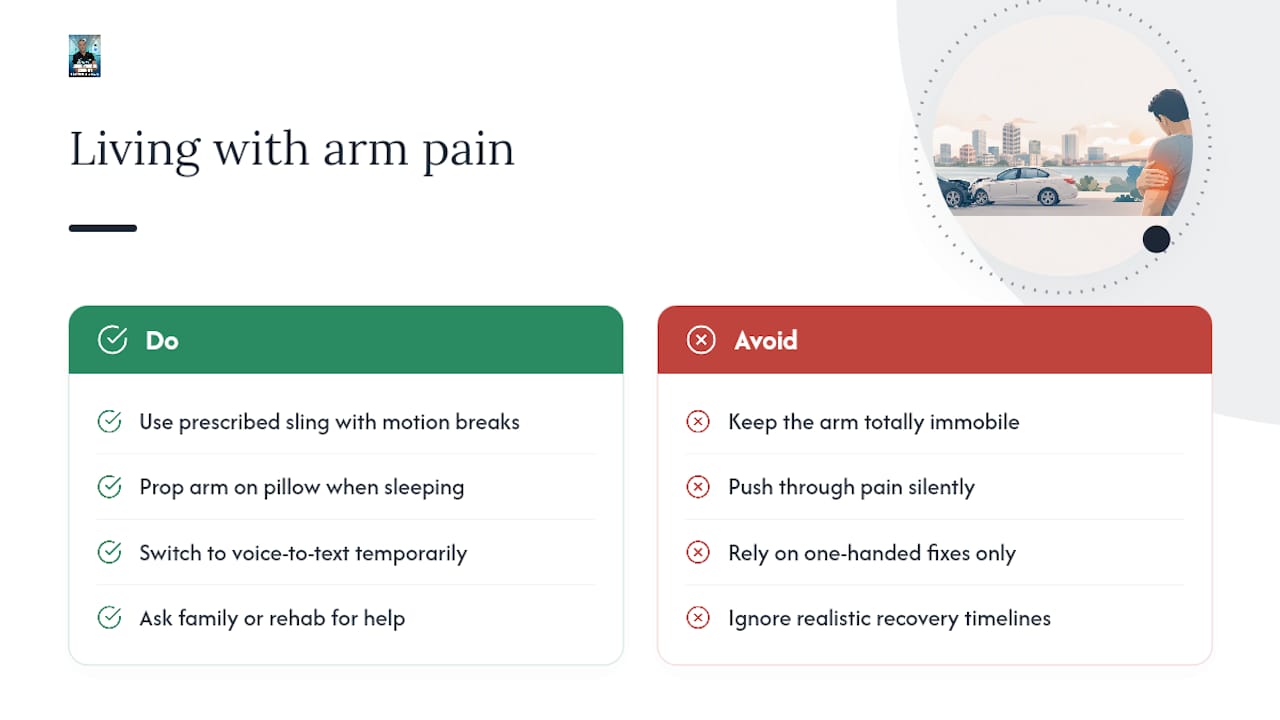
A few adjustments make the stretch more manageable. Sling use during the day, if prescribed, should be paired with brief, doctor-approved range-of-motion breaks rather than total immobility, since prolonged stiffness is its own setback. Sleeping propped up with the arm supported on a pillow reduces the nighttime throbbing that comes from blood pooling in a dependent limb. Simple ergonomic swaps, like switching to voice-to-text for a while or using a rolling bag instead of carrying, cut down on the small movements that keep reinjuring a healing joint.
Emotional coping matters just as much as the physical side. Losing the ability to do routine tasks independently, even temporarily, is genuinely hard, and it's worth naming rather than pushing through silently. Leaning on rehab providers for realistic timelines helps counter the frustration of a recovery that feels slower than expected. Support groups for accident survivors, or simply enlisting family for the two or three tasks that are truly impossible one-handed, keeps daily function from being the thing that suffers most while the arm heals.
Is the Pain From the Arm Itself or From Your Neck?
Not every ache running down the arm starts in the arm. This distinction changes the entire treatment approach, so it's worth sorting out early rather than assuming.
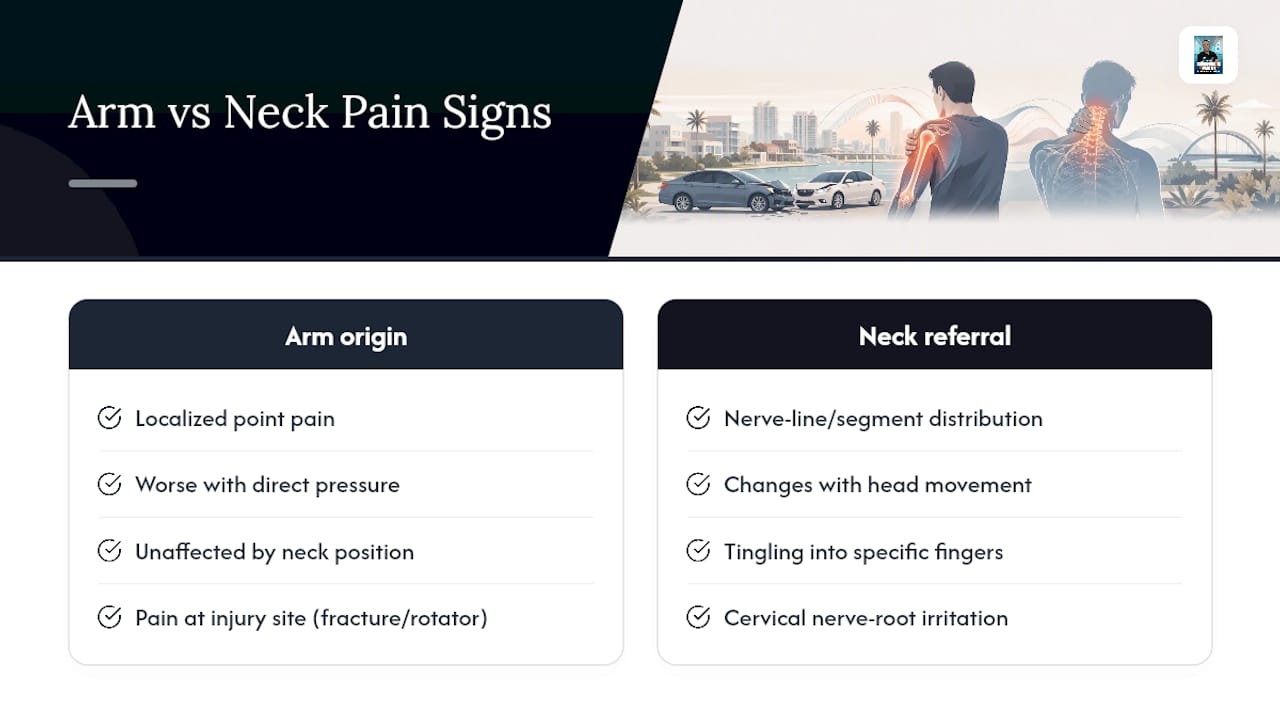
Signs pointing to the arm itself: pain that's localized to a specific point, worsens with direct pressure or movement of the joint, and stays consistent regardless of neck position. A rotator cuff tear hurts more when you lift the arm overhead. A fracture hurts at the fracture site, full stop.
Signs pointing to the neck (referred pain): discomfort that changes when you turn or tilt your head, numbness or tingling that follows a specific line down the arm into particular fingers rather than the whole hand, and neck stiffness or headaches accompanying the arm symptoms. This pattern usually means a cervical disc is irritating a nerve root as it exits the spine, a condition called cervical radiculopathy, and it can mimic a shoulder problem convincingly enough to fool a quick exam.
The complication is that both can happen at once. A hard enough collision can fracture a wrist and irritate a cervical nerve root simultaneously, and treating only the obvious injury leaves the other one to become a chronic problem. This is exactly why a thorough exam checks the neck even when the arm is the obvious complaint, and why whiplash-related nerve irritation deserves the same attention as a visible arm injury. Getting the source right the first time saves months of treating the wrong structure.
A Clinician's Take on What Patients Get Wrong
The biggest mistake isn't ignoring pain entirely, it's downplaying it just enough to skip the exam or stop rehab the moment things feel "better." Numbness in particular gets under reported constantly, because it's less alarming than sharp pain, even though it's often the more serious sign.
The single step that changes outcomes most is getting a documented assessment early and sticking with a coordinated rehab plan instead of bouncing between isolated treatments. Patients who start structured care within the first week or two consistently regain function faster than those who wait to see if things resolve on their own.
— Spark
Getting Evaluated for Arm Pain After Your Accident
Sparkmed gives North Miami patients a direct path to evaluation without the usual hurdles of insurance paperwork or long wait times. A $25 chiropractic adjustment makes that first visit accessible even before a claim is settled, and the clinic coordinates adjustments, guided rehab, and advanced modalities like ultrasound and shockwave therapy under one roof instead of scattering appointments across separate providers.
Bring what you have: the date and details of the crash, any imaging or ER paperwork already on file, and a quick note on how symptoms have changed since impact. Multilingual staff (English, Spanish, and Creole) mean language isn't a barrier to describing exactly what hurts and where. If your arm pain started with a collision, the next right move is getting it looked at now, not after it's had weeks to settle into something harder to treat.
This article is general information, not a substitute for advice from a qualified doctor. Consult a qualified healthcare professional about your own circumstances before acting on anything here.
Sources
- Brachial plexus injury | Cleveland Clinic
- Brachial plexus injury: Symptoms and causes | Mayo Clinic
- Shoulder pain after car accident | NeoSurgical Group