

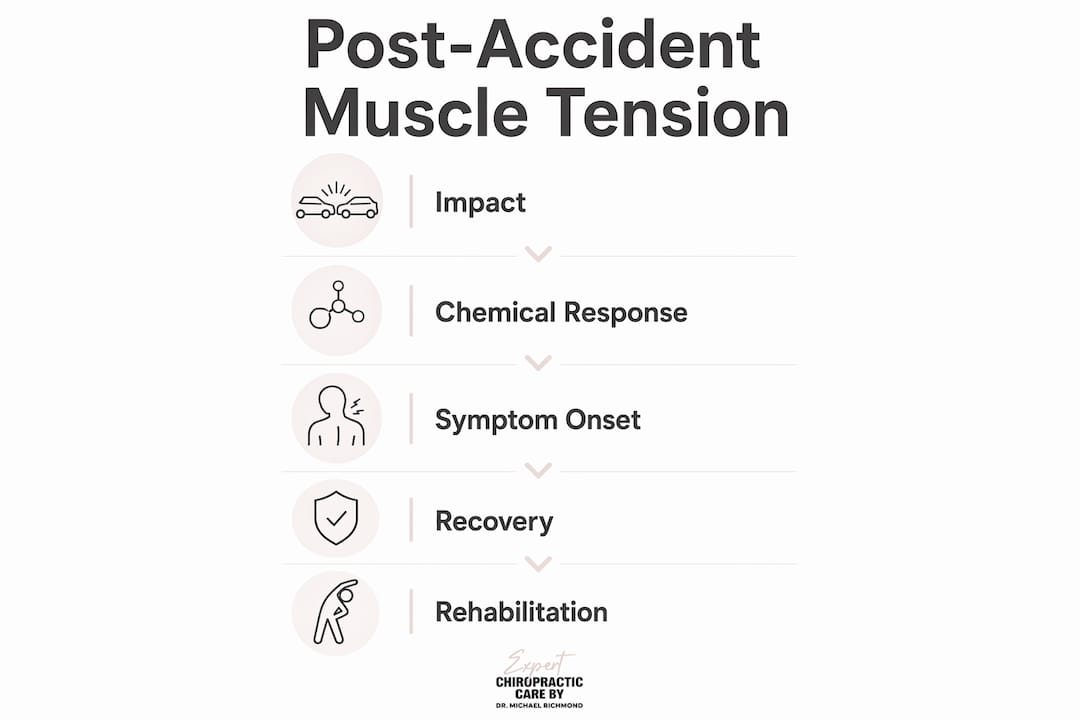
Muscle tension after accidents is your body's automatic protective response to trauma, not a sign that something is permanently wrong. Your muscles contract reflexively to guard injured tissue, and that reaction kicks in before you even feel pain. What surprises most patients is that the worst tightness often arrives 24–72 hours after the crash, not at the moment of impact. Understanding why this happens is the first step toward managing it well and avoiding the chronic pain that follows when early symptoms go untreated.
Why muscle tension after accidents occurs: the physiology
Muscle tension after an accident is a reflex, not a choice your body makes consciously. The moment a collision or fall threatens your body, your nervous system fires a protective contraction across nearby muscle groups. This is called a guarding reflex, and it exists to limit movement around a potentially damaged joint or tissue.
At the same time, your body floods your system with adrenaline and endogenous opioids. These chemicals suppress pain signals through a process called stress-induced analgesia. That is why many patients walk away from a car accident feeling fine, only to wake up the next morning barely able to turn their neck.

The physical damage underneath that chemical mask is real. Micro-tears in muscle fibers trigger localized inflammation, which causes swelling, heat, and tightness in the affected area. That inflammatory response is actually part of healing, but it also feeds the cycle of pain and spasm that makes accident recovery and muscle pain so difficult to manage.
Here is what is happening inside your muscles during this phase:
- Reflexive bracing: Your muscles contract hard at the moment of impact to protect joints and the spine.
- Micro-tears: Rapid force stretches muscle fibers beyond their normal range, causing small internal tears.
- Inflammation: Your immune system sends fluid and repair cells to the injury site, creating pressure and soreness.
- Nervous system activation: Your brain stays on high alert, continuing to signal muscles to guard the area even after the immediate threat is gone.
- Delayed onset: Pain and tension appear 24–72 hours post-impact as adrenaline fades and the full extent of tissue damage becomes apparent.
Pro Tip: If you feel fine right after a crash, do not skip a medical evaluation. Adrenaline masks symptoms, and hidden micro-tears can develop into serious injuries if left untreated.
How long does muscle tension last after an accident?
Recovery time depends heavily on the severity of the injury and how quickly you start appropriate care. Mild muscle strains typically resolve within a few weeks with conservative management. Severe grade III strains, where the muscle or tendon is significantly torn, can take six weeks or longer and often require clinical intervention.
The table below outlines typical recovery windows based on injury grade:
| Injury grade | Description | Typical recovery time |
|---|---|---|
| Grade I (mild) | Minor micro-tears, minimal strength loss | 1–3 weeks |
| Grade II (moderate) | Partial tear, noticeable weakness and pain | 3–6 weeks |
| Grade III (severe) | Complete or near-complete tear | 6+ weeks, clinical care needed |
Several factors affect how long muscle tightness after trauma persists beyond these general ranges:
- Age: Older patients heal more slowly due to reduced tissue regeneration.
- Pre-existing conditions: Prior injuries or chronic inflammation extend recovery.
- Treatment timing: Starting care within the first 48–72 hours consistently produces better outcomes than waiting.
- Nervous system state: Patients whose nervous systems remain in high-alert mode after tissue repair often experience prolonged stiffness even when imaging looks normal.
The last point is one that many patients do not expect. You can have a clean MRI and still feel significant muscle pain post-accident. That is not imaginary. It reflects a nervous system that has not yet received the signal that the threat is over.
How to relieve muscle tension after an accident
Effective recovery from post-accident muscle tension requires a layered approach. No single treatment resolves all the mechanisms involved.
-
Start gentle movement early. Controlled, gentle activity within a pain-free range prevents excess scar tissue from forming and supports proper muscle fiber realignment. Complete bed rest actually slows recovery by allowing stiffness to set in.
-
Use ice and heat strategically. Ice reduces acute inflammation in the first 48–72 hours. Heat increases blood flow and relaxes muscle spasm after the acute phase passes. Alternating both under professional guidance works well for many patients.
-
Be cautious with NSAIDs early on. Overuse of NSAIDs very early after injury may interfere with the inflammatory response your body needs to begin healing. Use them for pain management, but do not rely on them as a primary recovery tool in the first 48 hours.
-
Seek manual therapy or chiropractic care. Spinal adjustments, fascial release, and manual therapy address both the mechanical and neurological components of muscle tension. These approaches work on the joints and soft tissue simultaneously, which is why chiropractic methods are widely used in accident recovery protocols.
-
Address nervous system overactivity. Techniques like diaphragmatic breathing, progressive muscle relaxation, and specific manual therapies target the nervous system's protective mode directly. Resetting this overactivity is often the missing piece for patients stuck in a cycle of chronic guarding.
-
Get a professional evaluation. Muscle strain recovery tips only go so far without knowing what you are actually dealing with. A clinical assessment rules out fractures, disc injuries, and nerve damage that can mimic or worsen muscle tension.
Pro Tip: Physical therapists consistently find that early movement reduces long-term stiffness and prevents restrictive scar tissue. Ask your provider for a pain-free movement protocol within the first week of injury.
Light therapy devices have also shown promise in supporting muscle healing after trauma, particularly for reducing inflammation and accelerating tissue repair in the early recovery phase.
How does the nervous system drive ongoing muscle tension?
The nervous system's role in post-accident muscle pain is the most underappreciated part of recovery. Most patients focus entirely on the muscle itself. The real driver of persistent tension is often the nervous system staying locked in protection mode long after the tissue has healed.
Persistent muscle tension after injury frequently reflects a nervous system stuck in high-alert state, requiring therapies that target nervous regulation rather than muscle tissue alone. This explains why patients can complete a full course of massage and still feel stiff and sore.
"Pain may persist despite normal imaging results when the nervous system continues to generate protective muscle guarding. Treating the muscle without addressing the nervous system is like turning off a smoke alarm without finding the fire."
Techniques like the Primal Reflex Release Technique (PRRT) work by interrupting the reflex arc that keeps muscles in a contracted state. PRRT targets the startle and withdrawal reflexes that the nervous system activates during trauma. By manually releasing these reflexes, practitioners can reduce guarding patterns that conventional massage or stretching cannot reach.
The stress impact on muscles goes beyond the physical. Psychological stress after an accident, including anxiety about pain, fear of re-injury, and financial stress from medical bills, keeps the sympathetic nervous system activated. That activation feeds directly back into muscle tension. Addressing both the physical and psychological dimensions of recovery produces faster and more complete results.
For patients who want to understand how to prevent chronic pain from developing after an accident, nervous system regulation is the key variable most often overlooked in standard care plans.
Key Takeaways
Post-accident muscle tension is a nervous system and tissue response that requires both physical and neurological treatment to resolve fully.
| Point | Details |
|---|---|
| Delayed symptom onset | Pain and tension typically peak 24–72 hours after impact as adrenaline fades. |
| Injury grade determines timeline | Mild strains resolve in weeks; severe grade III injuries need 6+ weeks of clinical care. |
| Early movement beats rest | Gentle, controlled activity prevents scar tissue and speeds muscle fiber recovery. |
| NSAIDs need careful timing | Using NSAIDs too early may blunt the inflammation needed to start healing. |
| Nervous system is often the root cause | Persistent tension after tissue repair usually signals nervous system overactivity, not ongoing damage. |
What most patients get wrong about post-accident pain
The biggest mistake I see is patients assuming that no pain at the scene means no injury. Adrenaline is a powerful masking agent. By the time it wears off, the window for the easiest and most effective early intervention has often passed. That delay turns a manageable strain into weeks of chronic guarding.
The second mistake is fear of movement. Patients who stay still to "protect" themselves often develop more stiffness and scar tissue than those who start gentle, guided movement within the first few days. Fear of pain is understandable, but immobility is not the answer. The research on chiropractic care after accidents consistently shows that early, appropriate movement outperforms rest for soft tissue recovery.
What I find most interesting is how many patients are surprised to learn their pain is neurological, not structural. When imaging comes back clean and they are still hurting, they feel dismissed. The truth is that a nervous system in protection mode is a real and treatable condition. It just requires a different approach than treating a torn muscle. Integrated care that addresses both the tissue and the nervous system consistently produces better outcomes than either approach alone.
— Spark
Sparkmed's approach to post-accident muscle recovery
Recovering from muscle tension and pain after an accident takes more than rest. Sparkmed specializes in chiropractic care for accident victims in North Miami, with treatment plans built around the specific mechanisms driving your pain.
Sparkmed's practitioners assess both the structural and neurological components of your injury, then build a recovery plan that addresses the root cause rather than just the symptoms. Whether you are dealing with acute muscle spasm or persistent tension weeks after your accident, Sparkmed offers spinal adjustments, manual therapy, and wellness plans starting at $25 per adjustment with no insurance required. Read more about recovery after a car accident or book a consultation directly through Sparkmed's patient services to get started.
FAQ
Why does muscle tension appear days after an accident?
Adrenaline and endogenous opioids released at impact suppress pain signals through stress-induced analgesia. As these chemicals fade over 24–72 hours, the full extent of muscle damage and inflammation becomes apparent.
Should I worry about muscle tension after an accident?
Muscle tension is a normal protective response, but it warrants professional evaluation to rule out fractures, disc injuries, or nerve damage. Tension that persists beyond a few weeks without improvement needs clinical assessment.
How long does muscle soreness last after a car accident?
Mild strains typically resolve within a few weeks with conservative care. Severe grade III injuries can take six weeks or longer and require clinical intervention to heal properly.
Can stress make post-accident muscle tension worse?
Yes. Psychological stress keeps the sympathetic nervous system activated, which directly feeds muscle guarding and tension. Addressing anxiety and fear of movement is part of effective accident recovery and muscle pain management.
Does chiropractic care help with post-accident muscle tension?
Chiropractic care addresses both the mechanical and neurological components of muscle tension. Spinal adjustments and manual therapy reduce guarding patterns and support faster soft tissue recovery after trauma.