

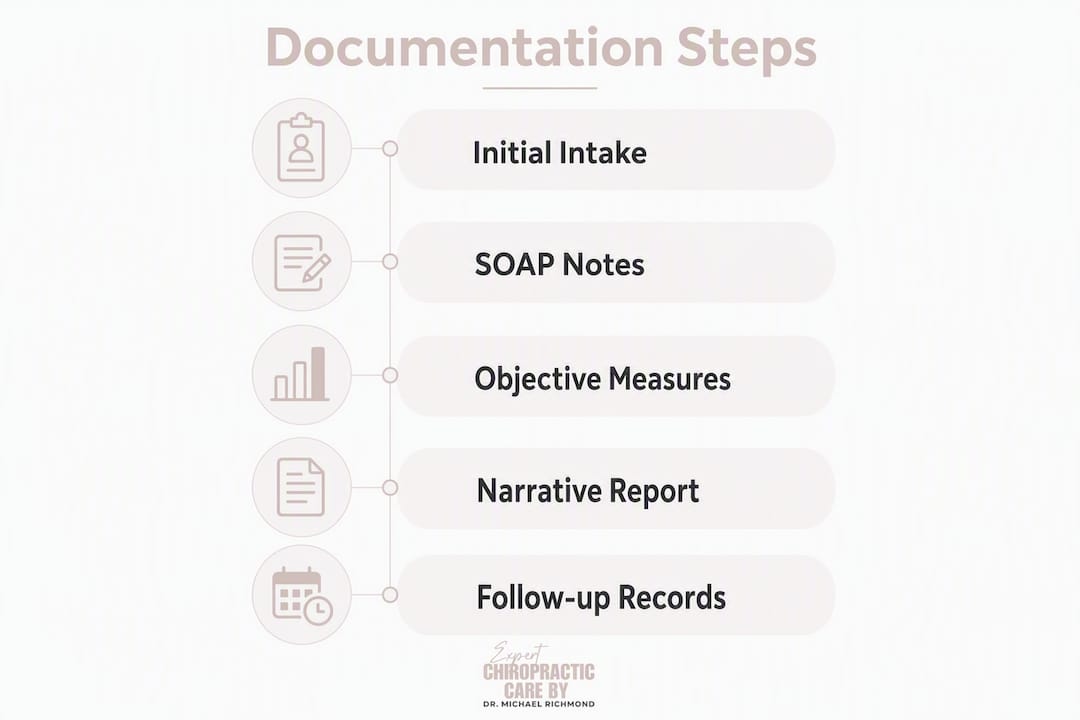
At every visit, a defensible chiropractic medical record requires five things: the mechanism of injury in specific detail, causation language that links findings to the crash, measurable objective data, documented functional losses, and a narrative report that synthesizes all of it for insurers and attorneys. Miss any one of these, and the record loses credibility with adjusters and clinical reviewers.
Here is what to capture at intake and every follow-up visit:
- Mechanism specifics: Patient role (driver, passenger, pedestrian), direction of impact (rear-end, side, head-on), approximate speed or vehicle behavior, seatbelt and airbag status, headrest position, and whether the patient braced for impact or was distracted
- Symptom onset timeline: Whether pain began immediately or was delayed, and the exact date and time of the accident
- Causation language: Phrases like "consistent with" or "compatible with" rather than "caused by," linking findings to the crash mechanics
- Objective measures: Cervical and lumbar range of motion (ROM) in degrees, named orthopedic tests with positive/negative results, neurologic findings
- Functional losses: Specific activities of daily living (ADLs) the patient can no longer perform, described in scoreable language
- Narrative report: A written synthesis of mechanism, diagnosis, functional limitation, treatment plan, and prognosis, with patient identifiers and the clinic's contact information (Sparkmed, North Miami)
Table of Contents
- How to document accident injuries at the first visit
- How to write SOAP notes for accident injuries
- Writing the insurer-facing narrative report
- How to document daily-life and functional impacts
- What objective evidence strengthens a chiropractic record?
- Timing, record retention, and Florida PIP practicalities
- How to prepare and send records to insurers
- Ready-to-use templates and a clinician checklist
- Key Takeaways
- What Sparkmed sees in North Miami accident cases
- Sparkmed's auto-injury intake: what you get from visit one
- Useful sources and further reading
How to document accident injuries at the first visit
The initial intake is a high-stakes moment; precise details captured then reduce later disputes and anchor the causal timeline. Two things make it high-stakes: it timestamps the accident date and documents whether symptoms were immediate or delayed. Both directly affect PIP eligibility and the strength of causation in the record.
Essential intake fields
Collect every one of these at the first visit:
- Patient role: driver, front passenger, rear passenger, pedestrian
- Impact direction and approximate speed or vehicle behavior
- Seatbelt use (lap only, three-point, or none) and airbag deployment (yes/no, which bags)
- Headrest position and body posture at moment of impact
- Whether the patient saw the collision coming or was caught off guard
- Immediate vs. delayed symptom onset, with the patient's own words when possible
Pro Tip: Ask specific questions rather than open-ended ones. Instead of "Where does it hurt?" try "When did the pain start relative to the crash? Can you turn your head fully to check your blind spot? Which work duties are you skipping or doing differently?" Specific answers create scoreable records; vague answers create disputes.
For patients with prior conditions, document the baseline: how often symptoms occurred before the crash, their severity, and what treatment was used. Then explicitly state how the current presentation differs from or exceeds that baseline. Causation must be established through linking language, not just a note that an MVA occurred.
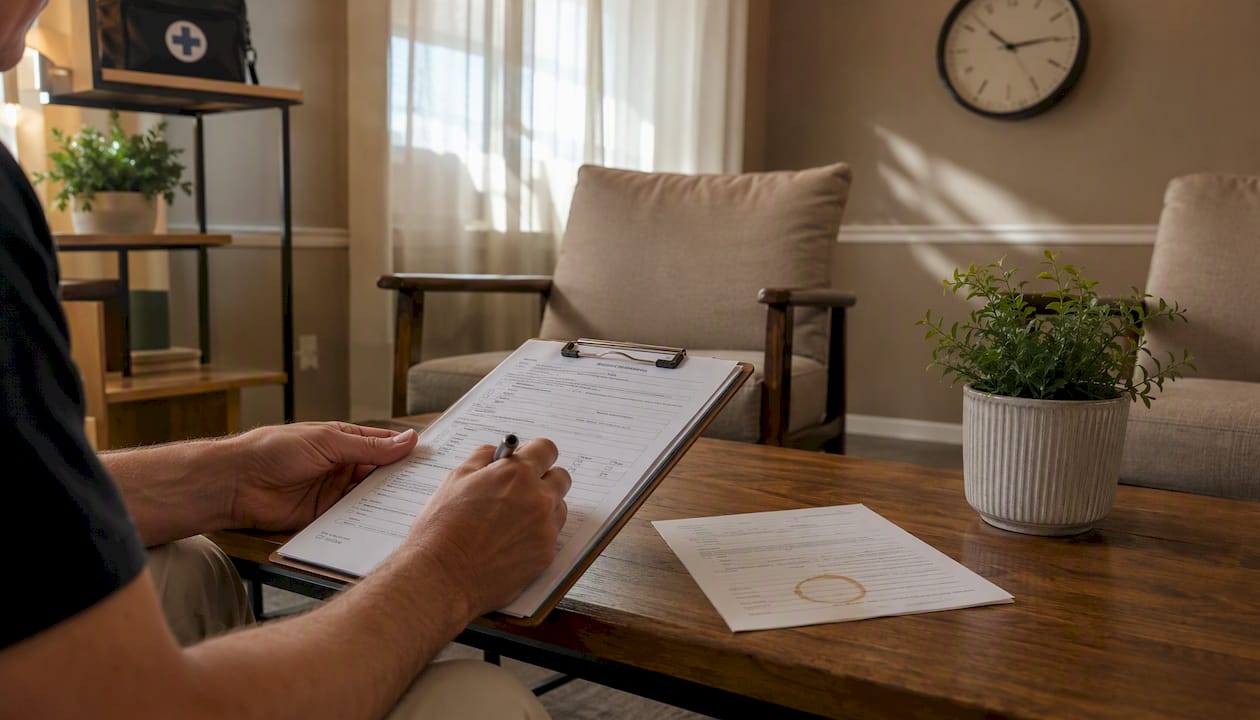
Streamlining the intake process for auto-injury patients means having these fields pre-built into your intake form so nothing gets missed under time pressure.
How to write SOAP notes for accident injuries
A well-built SOAP note does three things at once: it documents the clinical encounter, justifies continued care, and creates a timestamped record that holds up to insurer review. Here is the field-level structure:
-
Subjective (S): Quote the patient's own words for onset and symptom character. State the mechanism using causation language: "Patient reports onset of cervical pain immediately following a rear-end collision; findings are consistent with acceleration-deceleration forces." Document immediate vs. delayed onset explicitly, since delayed onset is common with soft-tissue injuries and must appear in the record to protect the causal link.
-
Objective (O): Record cervical and lumbar ROM in degrees at every visit. Name each orthopedic test performed (Spurling's, Straight Leg Raise, Kemp's) and note the result as positive or negative with laterality. Include neurologic findings: reflexes, dermatomal sensory changes, and grip strength when relevant. Objective measurements reduce an adjuster's ability to argue exaggeration and give re-exams something concrete to compare against.
-
Assessment (A): Use ICD-10 S-codes for acute injury diagnoses initially. List primary and secondary diagnoses and state how each links to the mechanism. Avoid vague diagnostic language; "cervical sprain/strain consistent with whiplash mechanism" is more defensible than "neck pain."
-
Plan (P): Justify frequency and duration with medical necessity language tied to objective findings and functional losses. List each modality with parameters (e.g., ultrasound at 1 MHz, 5 minutes, cervical paraspinals). Schedule re-examinations with measurable goals and state them explicitly.
Pro Tip: At each re-exam, capture at least one measurable change, whether improvement or plateau. A record that shows no change for three visits without clinical explanation looks stale to reviewers. Document why treatment continues even when progress slows.
Scheduled follow-up visits are not just good clinical practice; they create the documented timeline of measurable change that makes a record clinically accountable.
Writing the insurer-facing narrative report
The narrative report is built for forensic clarity. Attorneys and adjusters use it directly in demand packets, so it must be readable by someone who is not a clinician. A complete narrative includes: patient demographics, accident date and location, mechanism details tied to tissue injury, objective findings at intake and re-exam, ICD-10 codes, treatment provided, functional losses, prognosis, and impairment rating when applicable.
Sample paragraph:
"On [date], [Patient Name] sustained a rear-end motor vehicle collision while restrained as the driver. Acceleration-deceleration forces are consistent with the cervical strain pattern documented at intake: restricted ROM (flexion 35°, normal 60°), positive Spurling's test on the right, and reported inability to rotate the head fully for driving. Diagnosis: S13.4XXA, cervical sprain. Treatment: spinal manipulation, ultrasound, and therapeutic exercise three times weekly. Prognosis: good with continued care; measurable ROM improvement expected within six weeks."
Generate the initial narrative within 48 hours of intake when requested by counsel, and keep all drafts dated in the chart. Maximizing insurance coverage for continued chiropractic care depends heavily on how well this document is written.
How to document daily-life and functional impacts
Insurance reviewers prioritize functional limits over pain scores. A patient who scores 7/10 on a VAS but can describe exactly which work duties they cannot perform gives the adjuster something to evaluate. A patient who only reports pain gives them nothing to score.
Specific, scoreable ADL entries look like this:
- "Patient unable to rotate head fully to check blind spot while driving; requires frequent stops and mirror-only checks"
- "Patient cannot lift objects above shoulder height; unable to perform stocking duties at work"
- "Patient wakes 3–4 times nightly due to cervical pain; unable to sleep more than 2 hours consecutively"
Generic statements fail Colossus-style scoring. "Patient has difficulty with daily activities" is invisible to a reviewer. The specific entries above are not.
Use validated patient-reported outcome (PRO) tools at intake, re-exam, and discharge: the Neck Disability Index (NDI) for cervical complaints, the Oswestry Disability Index (ODI) for lumbar, and the Visual Analog Scale (VAS) for pain intensity. Consistent PRO tracking at scheduled intervals provides objective trend data that supports medical necessity across the full course of care. Documenting the patient's life before and after the crash, framed as measurable deficits rather than pain descriptions, helps reviewers understand the real impact.
What objective evidence strengthens a chiropractic record?
Core objective measures to record at every visit: ROM in degrees for all planes tested, named orthopedic tests with laterality and positive/negative result, neurologic findings (reflexes graded, dermatomal sensory changes, motor strength). A thorough chiropractic assessment documents all of these systematically so re-exams have a clear baseline to compare against.
When imaging is indicated, document the clinical reason for ordering it, the exact findings from the report, and how those findings relate to the mechanism and symptoms. File copies of ER reports, specialist notes, and imaging results in the chart and summarize them in the narrative with dates and key findings. Avoid vague language throughout: "positive Spurling's test, right side, reproducing radicular symptoms to the right hand" is a record entry; "neck test positive" is not. Understanding how chiropractors approach post-accident recovery helps patients bring the right information to support this documentation process.
Timing, record retention, and Florida PIP practicalities
Florida's no-fault system makes timing a clinical priority. Delays beyond 14 days may trigger reduced PIP benefits; early documentation helps resist pre-existing condition defenses and supports full benefit eligibility. Aim for evaluation within 72 hours of the accident when possible.
| Item | Guideline |
|---|---|
| Initial evaluation | Within 72 hours of accident; 14-day PIP threshold |
| Record retention | Keep all original intake forms, SOAP notes, narratives, and imaging reports |
| Timestamps | Date and time every entry; never backdate |
| Record request response | Provide complete chart with signed release; redact unrelated PHI |
| Typical copy fees | Florida law caps medical record copy fees; confirm current rate with your billing team |
Respond to insurer and attorney record requests with the complete chart, a signed HIPAA release, and redaction of any PHI unrelated to the accident claim.
How to prepare and send records to insurers
A records packet that arrives incomplete or disorganized gives the reviewer a reason to delay or deny. Pack the file so it answers every question before it is asked.
- Cover letter with patient name, date of birth, accident date, claim number, and reason for release
- Table of contents listing every included document
- Intake note with full mechanism-of-injury details
- All SOAP notes in chronological order, each with visit-specific findings (no copy-forwarded notes without updated objective data)
- Re-examination comparisons showing intake vs. current ROM and PRO scores
- PRO score sheets (NDI, ODI, VAS) at each interval
- Imaging reports with dates and ordering clinician noted
- Narrative report
- Treatment chronology and billing statements if requested
- Signed HIPAA release for third-party disclosure
Every page should carry the patient's name, date of birth, and the date of that specific visit. Prefer searchable PDF format. EMR templates with PI-specific prompts reduce missing elements by forcing mechanism, causation language, PRO fields, and re-exam comparisons into each note automatically.
Ready-to-use templates and a clinician checklist
SOAP note template (accident injury)
| Field | Suggested content |
|---|---|
| S — Mechanism | Patient role, impact direction, seatbelt/airbag, onset (immediate/delayed), patient quote |
| S — Symptoms | Location, character, severity (VAS), aggravating/relieving factors, ADL limitations |
| O — ROM | Cervical: flexion/extension/rotation/lateral flexion in degrees; lumbar: flexion/extension |
| O — Orthopedic tests | Test name, laterality, result (positive/negative), reproduction of symptoms |
| O — Neurologic | Reflexes (graded), dermatomal sensory, motor strength |
| A — Diagnosis | ICD-10 S-codes, primary and secondary, linked to mechanism |
| P — Plan | Modalities with parameters, frequency/duration, measurable goals, re-exam date |
Intake checklist (first visit)
- Accident date, time, and location
- Patient role and seating position
- Impact direction and approximate speed
- Seatbelt use and airbag deployment
- Headrest position; braced or unaware
- Immediate vs. delayed symptom onset
- Prior condition baseline (frequency, severity, treatment)
- Current ADL limitations (specific tasks affected)
- PRO scores: NDI, ODI, VAS at intake
- Attorney/insurer contact information
Clinician quick-check (every visit)
- ICD-10 codes consistent with intake diagnosis
- ROM recorded in degrees
- Named orthopedic tests with laterality and result
- ADL update with specific functional language
- PRO score updated at re-exam intervals
- Re-exam scheduled with measurable goals stated
Key Takeaways
Defensible chiropractic records after a car accident require mechanism specifics, causation language, measurable objective data, and documented functional losses captured from the very first visit.
| Point | Details |
|---|---|
| Mechanism details at intake | Record patient role, impact direction, seatbelt/airbag status, and symptom onset at the first visit. |
| Causation language | Use "consistent with" or "compatible with" to link findings to the crash; never assert "caused by." |
| Objective measures every visit | Document ROM in degrees and named orthopedic tests with results at each appointment. |
| Functional losses in ADL language | Describe specific tasks the patient cannot perform; generic pain scores alone do not satisfy insurer review. |
| Sparkmed for North Miami patients | Sparkmed provides rapid auto-injury intake, PI-ready SOAP documentation, narrative reports, and multilingual support in North Miami. |
What Sparkmed sees in North Miami accident cases
Most documentation gaps we encounter at Sparkmed are not about effort. They are about timing and specificity. A patient who arrives two weeks after a crash with only a vague memory of the impact direction is harder to document accurately than one who comes in within 72 hours with a police report in hand. The record built on that first visit either supports the full course of care or creates friction at every insurer review that follows.
What makes the difference in North Miami cases specifically is the multilingual dimension. Many of our patients describe symptoms in Spanish or Haitian Creole, and the clinical record has to capture those descriptions accurately in English for insurer review. Sparkmed's multilingual intake process, available in English, Spanish, and Creole, means the mechanism-of-injury details and functional loss descriptions get recorded precisely, not approximated through a language barrier.
The $25 adjustment offer exists because the first visit is the most important one. Getting a patient through the door within 72 hours, with a complete intake and a timestamped record, protects their PIP eligibility and starts building the clinical timeline that the narrative report will eventually rely on.
Sparkmed's auto-injury intake: what you get from visit one
If you were injured in a car accident in North Miami, the record built at your first chiropractic visit determines how well your care and your insurance claim are supported going forward. Sparkmed specializes in exactly this: rapid auto-injury intake with PI-ready SOAP documentation, narrative reports prepared for attorney demand packets, imaging referrals when indicated, and multilingual support in English, Spanish, and Creole.
Bring your accident date and time, the police report if you have it, and your insurance or attorney contact information. Sparkmed handles the rest, including insurer-ready records and lien management coordination. The $25 adjustment offer makes it easy to start care immediately, without waiting on insurance authorization.
Book your intake appointment at Sparkmed and get a complete, timestamped record from day one.
Useful sources and further reading
Documentation standards and PRO tools used in this article:
- Chiropractic EMR Documentation for Personal Injury Cases: Comprehensive guide to PI-specific SOAP fields, causation language, and PIP timing rules
- Auto Accident Chiropractic Documentation | ChiroScribe: Causation phrasing standards and EMR template guidance for MVA cases
- How to Write SOAP Notes: A Chiropractor's Guide | ChiroScribe: PRO instrument frequency, NDI/ODI/VAS usage, and re-exam documentation
- Chiropractic Documentation for PI Cases | Quality Life Chiropractic: Narrative report structure, functional limitation scoring, and re-examination standards
- MVA SOAP Note Structure | Aduvera: Field-level MVA SOAP note guidance and EHR drafting tools
- Motor Vehicle Accidents | Shephard Health: Practical strategies for capturing functional impacts and daily-life deficits in accident records
- How to Prepare for Your Chiropractic Visit After an Accident | Sparkmed Blog: Patient-facing checklist of documents to bring to the first visit
For EHR selection, look for systems that support case-type prompts, auto-insert PI-specific causation language fields, and flag missing PRO scores at re-exam intervals. These features reduce documentation errors without adding time to each visit.