

Getting chiropractic care after a car accident in North Miami should be straightforward, but for most patients, the intake process feels like a maze. Between insurance paperwork, accident documentation, Florida's strict PIP deadlines, and medical history forms, many people delay treatment simply because they don't know where to start. That delay can cost you thousands of dollars in lost benefits and weeks of unnecessary pain. This guide walks you through every step of the chiropractic patient intake process so you can move from the accident scene to your treatment table as quickly as possible.
Table of Contents
- Why efficient intake matters after an accident
- What to gather before your appointment
- Step-by-step intake workflow for chiropractic patients
- Avoid common intake mistakes
- What to expect after a successful intake
- A modern take: Why the best intake workflows go digital
- Get expert guidance for your auto accident recovery
- Frequently asked questions
Key Takeaways
| Point | Details |
|---|---|
| Act fast for PIP benefits | Start your intake within 14 days of an auto accident to get the full insurance coverage in Florida. |
| Prepare documents early | Having insurance, accident, and health records ready will speed up your intake process and treatment. |
| Digital forms are best | Digital workflows reduce errors, save time, and improve your overall chiropractic experience. |
| Avoid common mistakes | Careful documentation of your accident and injuries prevents delays and claim denials. |
| Ongoing check-ins matter | Expect regular re-evaluations during your chiropractic recovery to meet medical and insurance requirements. |
Why efficient intake matters after an accident
Most people think the hard part of recovering from a car accident is the physical pain. But for many North Miami patients, the real obstacle is paperwork. Missing a single field, submitting a form late, or failing to document the right details can stall your care for days or even disqualify you from maximum insurance benefits.
Florida is a no-fault state, meaning your own auto insurance pays for your initial medical care regardless of who caused the accident. Under the state's PIP (Personal Injury Protection) rule, you must seek treatment within 14 days of the accident. The difference between acting fast and waiting is enormous. Full PIP benefits reach $10,000, while delayed intake often limits you to just $2,500. That gap is the financial cost of a slow intake process.
Beyond money, delays mean your injuries go untreated. Whiplash, spinal misalignment, and soft tissue damage worsen when left unaddressed. Chiropractic care works best when started early, before scar tissue forms and inflammation becomes chronic.
Here's what a disorganized intake process actually costs you:
- Treatment delays of three to five business days from incomplete insurance verification
- Claim denials when accident causation is not clearly linked to your injuries
- Reduced benefits from failing to meet Florida's 14-day PIP window
- Extra office visits caused by missing information that must be re-collected
The good news is that clinics using optimized digital intake workflows solve most of these problems before you even walk through the door. Digital intake forms capture 34% more data and reduce completion time by 40% compared to traditional paper methods. Pair that with better accuracy and direct EHR (electronic health record) integration, and you have a system that actively protects your access to care and your insurance coverage.
Understanding how to use this system well is exactly how you can protect your own recovery. Learning how insurance for chiropractic care works after an accident gives you a real head start, and reviewing chiropractic tips after a car accident helps you know what to expect from the clinical side.
What to gather before your appointment
Think of your first chiropractic appointment like a legal proceeding. The more organized your documentation, the stronger your position. Your intake forms are not just administrative paperwork. They are the foundation of your treatment plan and your insurance claim. Missing pieces slow everything down.

The standard intake workflow for chiropractic patients includes pre-visit digital forms covering health history, your chief complaint, and insurance details. Then comes an in-office clinical exam with orthopedic tests, followed by a formal diagnosis and treatment plan. To move through each stage smoothly, you need to arrive prepared.
| Document | Why it's needed | Tip for accuracy |
|---|---|---|
| Police or accident report | Establishes date, location, and cause | Request it within 48 hours of the accident |
| Health insurance card | Required for billing and PIP claims | Confirm the policy number is current |
| Auto insurance card | Needed for PIP processing | Note the claim number if already assigned |
| Health history form | Guides the clinical exam | List all prior injuries, surgeries, and chronic conditions |
| Medication list | Screens for contraindications | Include supplements and over-the-counter drugs |
| Attorney contact info | Required if you have legal representation | Email and phone number both |
| Accident description | Confirms accident specifics like impact direction and seatbelt use | Write it down while memory is fresh |
The accident description is one of the most overlooked items on that list. Your chiropractic provider needs to know the direction of impact (rear-end, side, front), whether you were wearing a seatbelt, and whether any airbags deployed. These details directly influence your diagnosis and the type of treatment recommended.
Pro Tip: Create a digital folder on your phone right after the accident. Drop in photos of the accident scene, a scan of the police report, your insurance cards, and a voice memo describing what happened. When your clinic sends pre-visit forms, you can pull everything up instantly.
Getting prepared for your chiropractic visit early means less scrambling the morning of your appointment and a faster path to your first adjustment.
Step-by-step intake workflow for chiropractic patients
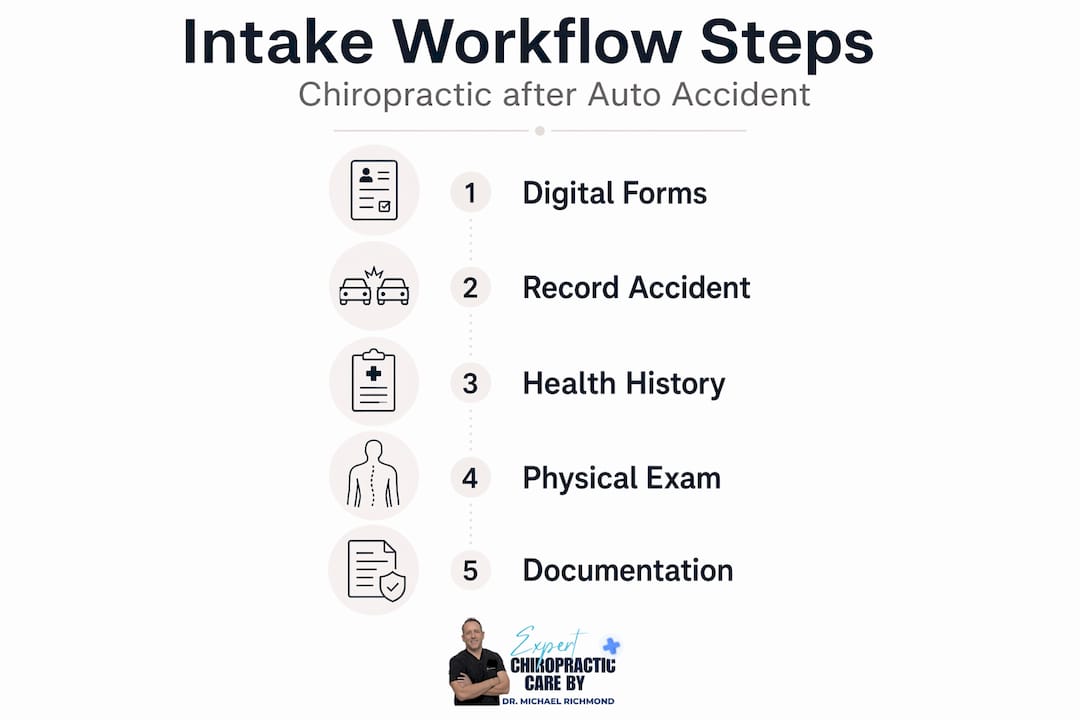
Knowing the sequence of the intake process removes the guesswork. Here is exactly how it should unfold for a North Miami auto accident patient:
- Receive and complete digital pre-visit forms (do this within 24 hours of scheduling)
- Verify all accident and insurance details are entered accurately, including PIP claim number
- Confirm your appointment and bring all physical documents as backup
- Complete the in-office exam, including orthopedic and neurological testing
- Review your diagnosis and treatment plan with your provider before leaving
- Obtain documentation copies for your attorney or insurance adjuster if needed
Initial visits typically last 30 to 60 minutes, covering your chief complaint, functional history, and physical examination. Low back pain affects about 8% of adults in the U.S. and is one of the most common post-accident complaints, along with neck pain and headaches. Your provider uses this intake data to design a care plan targeted to your specific injuries.
Comparing paper vs. digital intake shows just how much the format matters:
| Factor | Paper intake | Digital intake |
|---|---|---|
| Average completion time | 25 to 40 minutes | 10 to 15 minutes |
| Error rate | High (missing fields, illegible writing) | Low (required fields enforced) |
| EHR integration | Manual data entry required | Automatic upload |
| PIP compliance tracking | Manual review needed | Built-in prompts and alerts |
| Patient satisfaction | Lower | Higher |
Pro Tip: Complete your digital forms within 24 hours of scheduling your appointment. This gives your provider's office time to review everything before your visit, which helps meet Florida's 14-day PIP window without cutting it close.
Safety alert: If you experienced head trauma, lost consciousness, or suspect a fracture after your accident, tell your provider immediately. Do not wait until your scheduled appointment. Certain spinal injuries require imaging before any manual treatment begins. Always disclose these details upfront, both in your forms and verbally at check-in.
Proper ongoing documentation follows a strict format too. SOAP notes, functional limitations, and objective measures such as VAS (Visual Analog Scale for pain) and ROM (Range of Motion) are required at every visit. Re-evaluations happen every 10 to 12 visits or every 30 days. Understanding this helps you see why consistency matters, both for your recovery and your claim.
For a deeper look at what happens during the physical exam, the chiropractic assessment explained guide is worth reading. You can also review chiropractic terms explained if you want to understand the language your provider uses.
Avoid common intake mistakes
The intake process has several failure points, and most patients hit at least one. The result is delayed treatment, reduced benefits, or outright claim denial. Knowing what trips people up is half the battle.
The most dangerous mistake is failing to link your injuries directly to the accident. PI/auto cases require causation linkage in every clinical note. If your intake forms don't clearly establish that your back pain started after the collision and not before, an insurance adjuster can argue the injury is pre-existing. That's a denied claim.
Other common errors include:
- Missing the accident date, time, or location on intake forms
- Omitting the direction of impact (rear-end vs. side collision affects diagnosis)
- Failing to list all symptoms, even minor ones like tingling, dizziness, or jaw pain
- Leaving out attorney or lien information when legal representation is involved
- Not updating forms when new symptoms appear days after the accident
- Skipping the medication list, which can delay treatment if contraindications are missed
Screening for contraindications is one area where patients often assume the clinic will catch everything automatically. But the more complete your self-reported history, the more accurate the clinical screening. Fractures and spinal instability require immediate identification before any manipulation begins.
Pro Tip: Before submitting your intake forms, re-read your accident description one more time. Make sure every event is listed in order, including if you had a secondary collision or if your vehicle was hit more than once. Timeline accuracy protects your claim from gaps that adjusters look for.
Exploring the methods that aid healing after auto accidents can also help you understand why thorough documentation connects directly to better treatment outcomes.
What to expect after a successful intake
Once your intake is complete and verified, your recovery gains real momentum. Most patients who submit accurate digital forms before their appointment can start treatment the same day or within one to two business days. That speed is not just convenient. It directly impacts how well you heal.
Here's what the post-intake journey typically looks like:
- Same day or next day: First adjustment or treatment session begins
- Within one week: Insurance verification and PIP claim processing initiated
- Every 10 to 12 visits or 30 days: Re-evaluations are required to track progress and update your treatment plan
- Ongoing: SOAP notes and functional assessments document your improvement for both clinical and legal purposes
The financial stakes of a clean intake are significant. Proper and timely documentation can secure up to $10,000 in PIP benefits versus the reduced $2,500 available to those who miss the intake window or submit incomplete forms. That's not a small margin. It's the difference between fully funded care and paying out of pocket.
Your attorney, if you have one, will also benefit from well-organized intake records. Consistent, detailed documentation that links every symptom back to the accident makes your legal case stronger and speeds up settlement negotiations.
Understanding why chiropractic care matters after a collision and planning for long-term wellness after accidents helps you commit to the full recovery process, not just the initial phase.
A modern take: Why the best intake workflows go digital
Here's an opinion you won't hear from every clinic: paper intake forms are not just inconvenient. They are a genuine threat to your recovery and your claim. Every illegible field, every forgotten signature, every manually re-entered data point is a point of failure that slows down your access to care. We've seen it play out repeatedly with patients who come to us weeks after an accident still untreated because a paper-based intake got lost in the shuffle.
Digital workflows are now essential for HIPAA compliance, accuracy, and the speed modern patients expect in 2026. Paper is not a neutral option. It actively disadvantages the patient. Real-time error prompts prevent you from accidentally skipping a required field. Conditional logic shows you follow-up questions based on your answers. And everything flows directly into the provider's system without a staff member manually typing it in.
Clinics still using paper forms in 2026 are not just behind the times. They are creating friction that can ultimately hurt your insurance outcome. Patients deserve to demand better. If a clinic hands you a clipboard and a pen as your first touchpoint after a traumatic accident, that's a signal about how the rest of your experience will go.
The shift to digital intake also supports a more thorough chiropractic assessment guide process, because providers enter your care already knowing your full history and can focus on you rather than deciphering handwriting.
Get expert guidance for your auto accident recovery
If you've been in a car accident in North Miami, you don't have to figure this out alone. The right information and the right provider make a measurable difference in how fast and completely you recover.
At Spark Medical, we've built our intake process specifically for accident patients who need to move fast, stay compliant, and protect their insurance benefits. Our digital forms, Spanish and Creole language support, and experienced team make the first step as smooth as possible. Browse more recovery resources to keep building your knowledge, or read through patient testimonials in North Miami to see how real patients navigated their recovery with us. Your first adjustment can be as low as $25, no insurance required.
Frequently asked questions
What information should I bring to my first chiropractic appointment after an accident?
You should bring your accident report, insurance information, health history, current medications, and attorney contact if involved. The standard intake workflow also includes your chief complaint and any prior injury history that could affect your diagnosis.
Why is the Florida 14-day PIP rule important for chiropractic patients?
You must begin your chiropractic intake within 14 days of your accident to qualify for the full $10,000 in personal injury protection benefits. Waiting beyond 14 days limits your PIP coverage to just $2,500, which may not cover your full course of treatment.
How does a digital intake workflow help speed up my treatment?
Digital forms eliminate manual data entry, reduce errors, and send your information directly to the provider's system before your visit. Pre-appointment digital forms capture more data in 40% less time, which means less delay between your intake appointment and your first treatment.
What documentation is required for proper accident chiropractic claims?
Every visit requires SOAP notes, objective measures like pain scale scores and range of motion readings, and re-evaluations every 10 to 12 visits. Additionally, causation linkage connecting your injuries to the accident must appear in every clinical note to prevent claim denials.
What happens after my chiropractic intake is complete?
You can typically begin treatment the same day or within one to two business days once your forms are verified. Your provider will schedule regular follow-ups, and initial visits last 30 to 60 minutes to cover your full clinical picture before treatment begins.