

Back pain isn't just an inconvenience. It's a global health crisis. Low back pain affects 619 million people worldwide right now, with that number projected to reach 843 million by 2050. Knowing how to maintain spinal health isn't reserved for athletes or seniors with bad backs. It applies to anyone who sits at a desk, drives a car, carries a child, or spends long hours on their feet. The good news is that the most effective spinal health tips aren't complicated. Small, consistent habits protect your spine better than any single intervention.
Table of Contents
- Key takeaways
- How to maintain spinal health: understanding your spine first
- Daily habits that protect the spine
- Exercise strategies for a strong, mobile spine
- Posture and body mechanics that protect the spine
- When to monitor progress and seek professional care
- My take on spinal health: what actually works
- Explore more spinal health resources at Sparkmed
- FAQ
Key takeaways
| Point | Details |
|---|---|
| Movement beats rest | Short movement breaks every 30 minutes maintain disc hydration and prevent stiffness better than prolonged sitting. |
| Sleep is disc recovery time | Spinal discs rehydrate only during deep sleep, so 7 to 9 hours each night is non-negotiable for spine health. |
| Functional core training wins | Exercises that mimic real-life movements protect the spine more effectively than traditional sit-ups or crunches. |
| Posture variation matters | Staying in any single posture too long strains the spine. Movement diversity throughout the day is the real goal. |
| Know when to get help | Persistent stiffness, radiating pain, or numbness after 2 to 3 weeks are signals to consult a professional. |
How to maintain spinal health: understanding your spine first
Most people treat their spine like a problem to fix rather than a system to support. Understanding its basic structure changes that mindset permanently.
Your spine is made up of 33 vertebrae stacked in an S-shaped curve. Between each vertebra sits a disc, which acts like a shock absorber filled with a gel-like core. Surrounding this column are layers of muscles, ligaments, and nerves. Every one of those components needs movement, hydration, and load to stay healthy.
Here is what quietly damages the spine over time:
- Prolonged sitting compresses discs unevenly and weakens the deep stabilizing muscles that support spinal alignment
- Poor posture shifts mechanical load onto passive structures like ligaments and cartilage, which aren't designed to bear it
- Dehydration reduces the fluid content inside discs, making them less resilient and more prone to injury
- Sedentary behavior cuts off circulation to deep spinal muscles, which don't have direct blood supply and depend on movement to receive nutrients
One of the most persistent myths in spinal care is that rest heals back pain. In reality, movement improves circulation and nutrient delivery to spinal discs, while prolonged inactivity lets stabilizer muscles weaken and stiffen. Rest has a narrow role in acute injury. Movement has a much broader role in everything else.
"A misaligned or poorly supported spine doesn't just cause local pain. It stresses the nervous system, increases inflammation, and can impair sleep quality and cognitive performance."
That connection between spinal health and systemic wellbeing is why preventing back pain is worth your full attention, not just when something hurts.
Daily habits that protect the spine
Spinal degeneration rarely happens overnight. It accumulates through hundreds of small daily decisions. The ways to improve spine health that actually stick are the ones built into routines you already have.
Here is a practical sequence to work through:
-
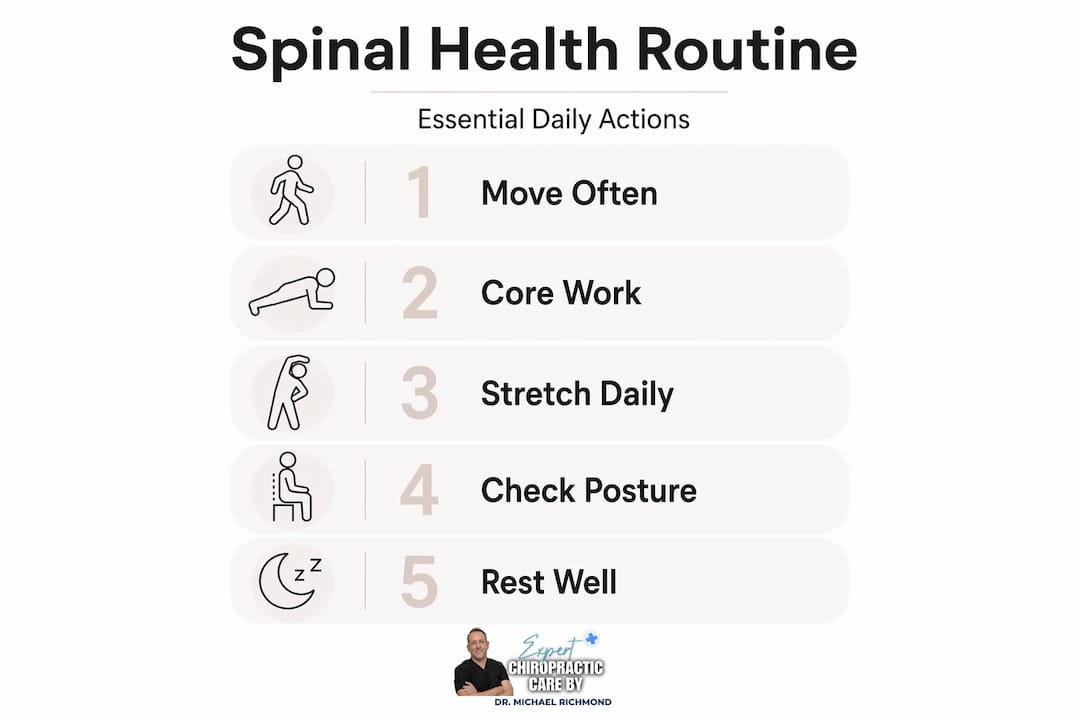
Set a movement timer. Movement breaks every 30 minutes maintain fluid exchange in spinal discs and prevent the stiffness that builds up with prolonged sitting. Stand, walk to the kitchen, do a few shoulder rolls. It doesn't need to be a workout.
-
Hydrate with intention. Adults need roughly 8 cups of water per day to maintain disc hydration and elasticity. If your urine is dark yellow by mid-morning, your discs are already working at a deficit.
-
Audit your furniture. A spine surgeon scoring common sofas found that lumbar support furniture scores 10 out of 10 for spinal health, while beanbags score zero. The chair you spend the most time in matters more than most people realize.
-
Prioritize sleep position. Sleep on your side with a pillow between your knees, or on your back with a pillow under your knees. Both positions maintain the natural curve of your lumbar spine while your discs recover overnight.
-
Cut inflammatory inputs. Smoking restricts blood flow to spinal discs through nicotine's vasoconstrictive effect, which accelerates disc degeneration and slows healing. Diets high in processed foods and refined sugar promote systemic inflammation that compounds spinal stress.
Pro Tip: If you work from home, use a timer app to enforce your movement breaks. People underestimate how much time they lose track of while focused on screens. Two hours of uninterrupted sitting undoes a lot of the good from a morning stretch routine.
Exercise strategies for a strong, mobile spine
Exercise is where spinal health gets built. Not just maintained, actually built. The goal is to develop a spine that can handle load, absorb shock, and move freely in every direction.

Low-impact aerobic movement
Walking 20 to 30 minutes most days is one of the most effective exercises for spinal health. It strengthens postural muscles, reduces spinal pressure through rhythmic motion, and improves circulation to discs. Swimming and cycling offer similar benefits with even less joint impact.
Core stabilization
Here is where most people get it wrong. Sit-ups and crunches train the rectus abdominis, the superficial "six-pack" muscle, while the deep stabilizers that actually protect the spine remain undertrained. Functional loading, meaning exercises that mimic real-life movement patterns, builds the transverse abdominis and multifidus muscles that act as your spine's natural brace.
Spinal mobility work
These movements address the flexibility side of the equation:
- Cat-Cow stretches: Performed on hands and knees, alternating between arching and rounding the spine. Excellent for loosening the thoracic spine and restoring segmental mobility.
- McKenzie extensions: Lying face down and pressing up onto your forearms or hands. Particularly useful for people with disc-related lower back pain.
- Hip flexor stretches: Tight hip flexors pull the pelvis forward and exaggerate lumbar lordosis. Releasing them directly reduces strain on the lower back.
- Thread-the-needle: A thoracic rotation stretch that addresses the stiff mid-back region most desk workers develop.
Pro Tip: Do your mobility work in the morning before your spine is compressed by the day's load. Flexibility and mobility exercises are more effective when discs are fully hydrated after sleep.
| Exercise type | Primary benefit | Frequency |
|---|---|---|
| Walking (20 to 30 min) | Strengthens postural muscles, improves circulation | 5 to 6 days per week |
| Planks and bird-dog | Deep core stabilization | 3 to 4 days per week |
| Cat-Cow, McKenzie extensions | Spinal mobility and disc pressure relief | Daily |
| Swimming or cycling | Low-impact aerobic conditioning | 2 to 3 days per week |
| Hip flexor and hamstring stretches | Reduces pelvic tilt and lumbar strain | Daily |
Posture and body mechanics that protect the spine
Good posture isn't about standing rigidly straight. It is about maintaining your spine's natural curves while reducing unnecessary mechanical strain. The best practices for spinal wellness around posture center on one concept: neutral spine.
Neutral spine means your lumbar curve is present but not exaggerated, your thoracic spine has a gentle rounding, and your head sits directly over your shoulders. Any position that moves significantly away from this, for a prolonged period, starts accumulating stress.
Here is how neutral spine applies in practice:
- Sitting: Feet flat on the floor, knees at 90 degrees, a small lumbar roll or chair support behind your lower back. Screen at eye level, ears aligned over shoulders.
- Standing: Weight distributed evenly between both feet. Avoid locking the knees or thrusting the hips forward.
- Sleeping: Side or back sleeping with pillow support as described earlier. Stomach sleeping flattens the lumbar curve and strains the neck.
- Lifting: Hinge at the hips, not the waist. Keep the object close to your body. Never twist while bearing load.
Looking down at screens causes forward head posture, which significantly increases mechanical strain on the cervical spine and upper back. Each inch your head moves forward from its neutral position adds roughly 10 pounds of effective load to your neck.
Frequent postural variation throughout the day is more protective than holding any single "correct" posture. Standing desks are only useful if you alternate between sitting and standing. Locked into standing all day produces its own set of problems.
| Posture habit | Spinal impact |
|---|---|
| Screen at eye level | Reduces forward head posture and cervical strain |
| Lumbar support when sitting | Maintains natural lumbar curve and reduces disc pressure |
| Hinge-based lifting | Protects lumbar discs from shear forces |
| Alternate sitting and standing | Reduces cumulative spinal load throughout the day |
When to monitor progress and seek professional care
Most people notice spinal stress through stiffness in the morning, tightness after sitting, or occasional aching after exertion. These are signals, not sentences. Adjusting your habits at the first signs of stress is far more effective than waiting until the pain becomes disabling.
Use this sequence when something feels off:
- Identify the trigger. Did the stiffness begin after a new chair, a longer commute, or a new exercise? Isolating the cause makes fixing it faster.
- Modify, don't stop. If a specific movement hurts, reduce the range or load rather than avoiding all activity. Total rest weakens the spine further.
- Give it two to three weeks. Most acute spinal discomfort resolves with movement, improved habits, and better sleep. If it doesn't, that is your window to seek professional input.
- Recognize red flags. Radiating pain down the leg, numbness or tingling, bladder or bowel changes, or pain that wakes you from sleep all warrant immediate evaluation, not watchful waiting.
"Chiropractic care and rehabilitation approaches play a significant role in restoring spinal function, particularly after trauma or prolonged postural strain. Chiropractic care for spine recovery works best when combined with active participation in the lifestyle changes described throughout this guide."
My take on spinal health: what actually works
I've seen the full range of approaches to spinal care, from obsessive ergonomic setups to people who do nothing and are convinced their back "just went out" spontaneously. The truth is almost always in the accumulated small stuff, not a single incident.
The concept I find most useful is what some clinicians call the "stress bucket." Your spine tolerates a certain volume of load each day. Poor sleep, poor posture, too much sitting, dehydration, stress, and inadequate movement all pour into that bucket. When it overflows, pain appears. It rarely looks like one thing caused it.
What I've learned from observing this is that you don't need a perfect routine. You need a bucket that doesn't overflow most days. One good night of sleep matters. One walk matters. Sitting less for two hours matters.
The other thing I'd push back on is the idea that furniture is a secondary concern. I've seen more people turn around chronic neck and lower back pain by switching their office chair than by any other single change. The right lumbar support in a chair you sit in for six hours a day compounds over weeks in a way that no weekly stretch class can fully offset.
Start with the boring stuff. Fix your sleep. Drink more water. Move every 30 minutes. Then layer in the exercises. The spine rewards consistency over intensity every time.
— Spark
Explore more spinal health resources at Sparkmed
If you found this guide useful, Sparkmed has a full library of articles covering spinal wellness, recovery, and chiropractic care for all kinds of back pain situations. Whether you are dealing with the after-effects of an accident or simply want to stay ahead of spinal problems, expert guidance makes a real difference.

The Sparkmed blog covers everything from chiropractic care myths to step-by-step treatment guides, written for people who want real answers. And if you are ready to talk to a professional, Sparkmed offers chiropractic adjustments starting at $25, no insurance required. Explore the full range of spinal health articles and take the next step toward a stronger, healthier spine.
FAQ
How often should you do exercises for spinal health?
Aim for daily mobility work like Cat-Cow and hip flexor stretches, with core stabilization exercises three to four times per week and low-impact cardio like walking five or more days per week for best results.
Why does spinal health matter beyond just back pain?
A misaligned or poorly supported spine stresses the nervous system, which can increase systemic inflammation and impair both sleep quality and cognitive function, making spinal health a whole-body concern.
What are the best daily spinal health tips for desk workers?
Set a timer to stand or move every 30 minutes, position your screen at eye level, use a chair with lumbar support, and drink at least 8 cups of water daily to maintain disc hydration.
When should you see a chiropractor or doctor for back pain?
Seek professional care if pain persists beyond two to three weeks, radiates into the leg, or is accompanied by numbness, tingling, or any changes in bladder or bowel function.
Can improving sleep really help with preventing back pain?
Yes. Spinal discs lose fluid throughout the day and rehydrate only during deep sleep, so getting 7 to 9 hours of quality sleep directly restores the shock-absorbing capacity of your discs.