
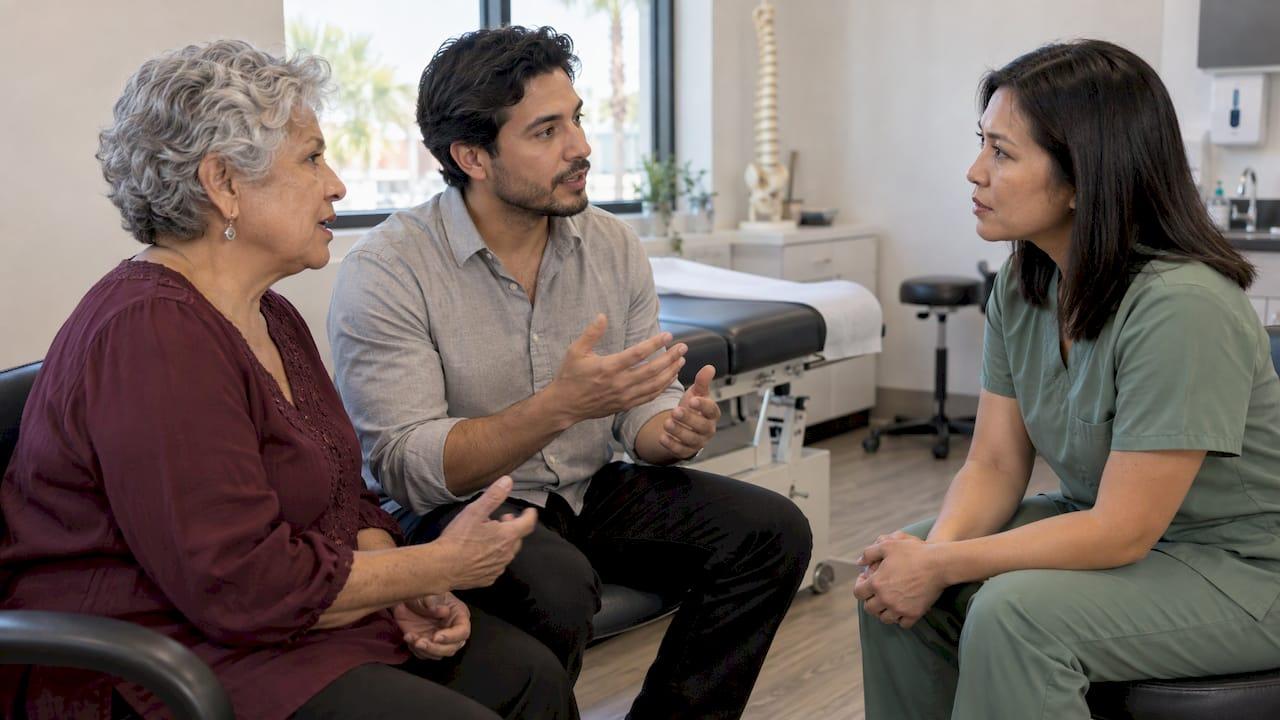
Language access in healthcare means you can understand your diagnosis, your treatment and your paperwork, and your provider can understand you, in the language you speak best. After a car accident or a fall, that is not a courtesy. It decides whether your symptoms are recorded correctly, whether you follow your care plan and whether your claim file tells the true story of your injury. At Sparkmed in North Miami, we treat accident patients in English, Spanish and Haitian Creole, so you can explain where it hurts without searching for words.
TL;DR
- Language access means interpretation, translation and other aids that let you take part fully in your care. People with limited English proficiency (LEP) are the ones who most often need it.
- Communication problems are linked to misunderstandings, misdiagnosis and poorer follow-through on treatment, according to peer-reviewed research.
- Family members, and especially children, are not a safe substitute for a qualified interpreter, according to the federal Agency for Healthcare Research and Quality (AHRQ).
- Clinics that receive federal funds must provide equal access, and national standards say language help should be offered at no cost.
- Sparkmed offers care in English, Spanish and Creole in North Miami, with chiropractic adjustments at $45 and an auto accident evaluation for injury recovery.
Table of Contents
- What language access in healthcare means
- Why language barriers matter more after an injury
- Your rights: what the law and national standards say
- Who can interpret for you, and who should not
- How to communicate clearly at an injury appointment
- Language access for people with disabilities
- What good language access looks like inside a clinic
- Perspective
- Care in your language in North Miami
- How to tell if a clinic really offers language access
- FAQ
- Sources
What language access in healthcare means
The term sounds technical, but the idea is simple. A health system has language access when a person who speaks little or no English can still read, speak, hear and understand everything that matters in their care. UW Medicine's policy describes it as meaningful exchange in reading, writing, speaking and understanding, supported by interpretation, translation, alternative formats and auxiliary devices.
Two terms come up often:
- Limited English proficiency (LEP): a person who does not speak English as a first language and has a limited ability to read, speak or understand it.
- Interpretation vs. translation: interpretation is spoken (in person, by phone or by video). Translation is written, such as intake forms, consent forms and discharge instructions.
The same policy applies to people who are Deaf, hard of hearing or otherwise have a communication disability. Language access covers them too.
In South Florida, this is an everyday matter. Many North Miami residents speak Spanish or Haitian Creole at home, and many of them are the patients who walk into a clinic after a crash with pain, stress and a pile of forms.
Why language barriers matter more after an injury
An accident puts you in a situation where precise communication counts. You are asked to describe pain location, pain level, when it started, whether it spreads, what you were doing and how the collision happened. You then sign consent forms, insurance forms and treatment plans.
Research shows what is at stake when that exchange goes wrong:
- A peer-reviewed patient safety article reports Joint Commission data showing that communication was the root cause of almost 65% of sentinel events between 1995 and 2002. It lists misunderstandings, misdiagnosis, unnecessary testing and poor follow-up among the results of ineffective communication.
- A 2019 systematic review of 33 studies found that about 25 million people in the U.S. are limited English proficient. In 25 of the 33 studies, at least one outcome was better for LEP patients who received care in a language they shared with their clinician.
- The Oregon Health Authority's December 2025 workbook says language barriers can lead to misunderstandings, reduced treatment adherence and poorer health outcomes.
The same 2019 review points out a trap worth knowing. When a clinician and patient share only a little of a language, both may believe they understand each other when they do not. That false sense of understanding can contribute to errors. If you have ever nodded along to be polite, you know how easily it happens.
What this looks like in a musculoskeletal case
Imagine a driver rear-ended on NW 7th Avenue. Two days later she has neck stiffness and tingling in one hand. If she says "it hurts a little" because she lacks the English words for the type of pain, the note in her chart may understate it. A tingling arm and a dull ache point to different problems. Weeks later, her records are what an insurance adjuster reads. Clear, accurate language at the first visit protects both her care and her claim.
Your rights: what the law and national standards say
You do not need to memorize statutes. These are the points that matter to a patient.
- Federally funded providers must ensure equal access. AHRQ states that all health care providers receiving federal funds must ensure equal access to services under the Civil Rights Act. Offering a qualified medical interpreter free of charge, plus translated written materials, is its recommended way to meet that duty.
- Help should be free. The revised National CLAS Standards (June 2025, HHS Office of Minority Health) say organizations should offer language assistance to people with limited English proficiency at no cost. They also say individuals should be told, in writing and out loud, that it is available.
- Interpreters should be competent. The same standards call for interpreter training and certification, and they discourage using untrained people and minors to interpret.
- HHS publishes guidance for patients. Its page on limited English proficiency resources points individuals to material explaining their right to language assistance.
If you want to know how a particular provider handles language help, ask at scheduling. A good office answers this question easily, and you can ask it before you ever book.
Who can interpret for you, and who should not
The Oregon Health Authority's learning module lists four kinds of people who provide language services: same-language providers, bilingual staff, health care interpreters (in-house, contracted or through language service companies), and friends or family. It says friends and family should be used only when no other interpreter is available and care cannot wait.

The reason is practical. AHRQ explains that unqualified interpreters, such as family members, minor children, friends or untrained staff, are more likely to cause misunderstandings and medical errors. Think about a teenager translating a description of their parent's back pain, or a spouse softening bad news. Neither is fair to them, and neither is reliable for you.
The best arrangement is a clinician or staff member who speaks your language directly. When that is not possible, a trained interpreter is the next best. If you prefer to bring a relative, AHRQ suggests the provider also use its own interpreter.
When a qualified interpreter matters most
UW Medicine's policy lists encounters that call for a qualified language service provider. Among them are diagnosis and treatment plan discussions and consent. Casual conversation with no health consequences can happen without one. In an injury case, the moments that count are the first evaluation, the explanation of your treatment plan and any form you sign.
How to communicate clearly at an injury appointment
Whatever language you speak, a few habits make the visit more accurate.
- Say your language when you book. Tell the office what language you prefer, so they can plan for it. The Oregon workbook recommends that providers record language needs at intake and flag them in the medical record, and recheck them over time, since needs can change by appointment type.
- Describe the accident in order. Where you were hit, which direction, whether you saw it coming, what you felt right away and what you noticed later.
- Use your own words for pain. Burning, stabbing, pressure, tingling, numbness, electric shock. If you only know the word in your language, say it. A staff member who speaks it can capture it exactly.
- Mention every area. People often report the neck and forget the low back, hips or headaches. Name them all.
- Repeat the plan back. Ask, "So I come three times a week for two weeks, correct?" Repeating back catches misunderstandings early.
- Ask for written instructions in your language. Home care and appointment instructions are easy to forget.
For documentation that supports an insurance claim, see our guide on how to document accident injuries for chiropractic records. If you want to know how intake works for crash patients, read about how to streamline chiropractic patient intake after auto accidents.
Language access for people with disabilities
Language access is not only about foreign languages. Patients who are Deaf, hard of hearing or unable to speak are also entitled to effective communication help at no cost. UW Medicine's policy says such patients are advised of this right around the clock. Phone lines are one place where this shows up in practice, since a patient who cannot easily use a standard call needs another way to reach the office. Resources on accessible telephone support show how healthcare offices think about scheduling calls for patients with different needs.
What good language access looks like inside a clinic
For those curious about what a well-run office does, federal guidance is specific. The CMS guide to developing a language access plan says organizations should post multilingual notices that interpreters are available at no cost, train staff who deal with patients on interpreter procedures, and monitor and evaluate the plan periodically. Its training advice covers everyone who meets patients, from receptionists to clinicians, including how to capture a patient's language need and where translated materials are kept.
The Oregon workbook adds that no single approach is enough on its own. Most organizations use a mix of language-matched providers, bilingual staff, credentialed interpreters and technology. For a patient, the practical test is simple: from the first phone call to the final instruction sheet, can you follow what is happening?

For Haitian Creole speakers, a list of common phrases from arrival to discharge shows how this works at the front desk and in the exam room: Haitian Creole medical phrases for clinicians.
Perspective
After an accident, most of our patients are not just hurt. They are overwhelmed. They have to explain a crash, deal with an adjuster and describe pain they have never felt before, all while sorting out forms. When any of that has to happen in a second language, details get lost.
That is why we treat language as part of the care itself. We offer care in English, Spanish and Creole, and we have more than 20 years of experience treating accident victims. When you can describe your symptoms in your own words, the evaluation is more accurate, the plan makes sense to you and your records reflect what really happened.
We also know that getting to the clinic can be a barrier for some patients, which is why we provide free transportation services, and we bill insurance directly with thorough injury documentation for claims. Care that you can understand, reach and afford is the standard we hold ourselves to.
Spark
Care in your language in North Miami
If you were hurt in a car crash, at work or in a slip and fall, Sparkmed is a chiropractic clinic in North Miami where you can start in English, Spanish or Creole. Our auto accident evaluation is where we document your injury and plan your recovery, and a chiropractic adjustment is $45. Shockwave therapy is $75 per session, and our monthly wellness plans are $149 (Essential), $249 (Performance) and $399 (Elite). You can see the details on our pricing page and the full list of therapies, including ultrasound, traction and decompression, massage and electrical stimulation, on our services page.
If you are wondering how many visits an accident usually takes, our article on how many chiropractic visits after a car accident walks through it, and our guide to maximizing your insurance for chiropractic care after an accident explains how claims and care fit together.
How to tell if a clinic really offers language access
Use these questions when you call any health provider after an injury.
| Question to ask | What a good answer sounds like |
|---|---|
| Do you have staff who speak my language? | Yes, and a name or role you can ask for. |
| Is language help free? | Yes, with no extra charge to you. |
| Will my forms and instructions be in my language? | Yes, or someone will go through them with you out loud. |
| Do I need to bring a relative to translate? | No, you should not have to. |
| Can I get help with transportation? | The office can explain what is available. |
A clinic that answers these confidently has thought about its patients. One that hesitates may leave you to translate for yourself at the worst moment.
FAQ
Do I have a right to an interpreter at a medical appointment?
Federally funded providers must ensure equal access to services, and the national CLAS Standards say language assistance should be offered at no cost. Ask the office about language help when you book, so it can be arranged in advance.
Can my child or a friend interpret for me?
It is not advisable. AHRQ says family members, minor children, friends and untrained staff are more likely to cause misunderstandings and medical errors. A staff member who speaks your language, or a trained interpreter, is the safer choice.
Does Sparkmed treat patients who speak Spanish or Creole?
Yes. We offer care in English, Spanish and Creole at our North Miami clinic, so you can describe your accident and your symptoms in the language you are most comfortable with.
Why does clear communication matter for my accident claim?
Your records describe your symptoms, your injury and your treatment. When your explanation is captured accurately at the start, the documentation behind a claim is stronger. We provide thorough injury documentation and bill insurance directly.
Sources
- UW Medicine, Language Access and Cultural Advocacy policy (2024)
- Patient Safety and Healthcare Quality (PMC, 2013)
- Systematic review of patient-physician language concordance (PMC, 2019)
- Increasing Language Access: A Workbook for Providers (Oregon Health Authority via NORC, December 2025)
- AHRQ, The SHARE Approach, overcoming communication barriers
- National CLAS Standards, revised June 2025 (HHS Office of Minority Health)
- HHS, Limited English Proficiency resources
- Oregon Health Authority, Language Access Learning Module, Chapter 1
- CMS, Guide to Developing a Language Access Plan (August 2023)
- Accessible telephone support guide