

This page gives you a working set of Haitian Creole medical phrases with phonetics for arrival, triage, exams, and discharge, built for the moments when a certified interpreter isn't standing next to you yet. It draws on hospital-adapted communication cards and recorded pronunciation guides from ALTA Language Services. One rule sits above every phrase here: for consent, diagnosis, or anything complex, stop and call a qualified interpreter.
TL;DR:
- Phrase cards are useful for greetings, triage, and basic instructions but cannot replace a qualified interpreter for consent or diagnosis-related conversations.
- Emergency phrases should be kept accessible in laminated redcards and be spoken loudly and clearly during urgent situations to ensure patient safety.
- Short, simple clinical questions about pain, symptoms, and medications are effective, but complex explanations require interpreter involvement to avoid miscommunication.
- Translation tools may fail to accurately capture Haitian Creole register and regional variations, so pronunciation checks with native speakers are necessary before use in clinical settings.
- Supplementing phrase cards with visual gestures and multimedia materials can enhance understanding, but certified interpretation remains essential for legal and safety-critical decisions.
Table of Contents
- Greetings, Identity Checks, and Offering an Interpreter
- Triage and Emergency Commands: FAST, Breathing, Staying Alert
- Asking About Pain, Onset, and Symptoms
- Guiding an Exam and Explaining Vital Signs
- Checking Medications, Allergies, and Current Treatment
- Explaining Tests, Discharge, and What to Watch For
- Interpreter Rules, Legal Duties, and What the Research Shows
- Where to Find Ready-Made Phrase Sheets and Audio
- Why Sparkmed Treats Multilingual Communication as Part of Care
- Sources
- FAQ
Greetings, Identity Checks, and Offering an Interpreter
The first thirty seconds set the tone for the whole visit. A patient who feels rushed or unheard rarely opens up about symptoms later, so start with something simple and warm rather than jumping straight to clinical questions.
- Hello / Good morning — Bonjou (bohn.ZHOO). Works for any time before noon; swap to Bonswa (bohn.SWAH) in the afternoon or evening.
- What is your name? — Ki jan ou rele? (kee zhahn oo reh.LAY)
- What is your date of birth? — Ki dat nesans ou? (kee daht neh.SAHNS oo)
- Do you prefer to speak Creole or English? — Ou pito pale Kreyòl oswa Anglè? (oo pee.TOH pah.LAY kreh.YOHL oh.SWAH ahn.GLEH)
- I'm going to get you an interpreter. — Mwen pral chèche yon entèprèt pou ou. (mwehn prahl SHEH.sheh yohn ehn.teh.PREHT poo oo)
Document the answer to that language question in the chart every time. It saves the next clinician a repeat conversation and flags the file for interpreter scheduling. Many clinics laminate a one-line version of these five phrases and keep it at check-in and at the nurses' station, where staff can glance at it without breaking eye contact with the patient for long.
Triage and Emergency Commands: FAST, Breathing, Staying Alert
Emergencies don't leave room for full sentences. Short, firm commands work better than polite requests, and you should default to the loudest, clearest version of the phrase rather than a softened one.
- Stay awake, look at me — Rete leve, gade m (reh.TAY leh.VAY, gah.DAY muh)
- Can you move this arm? — Ou ka bouje bra sa a? (oo kah boo.ZHAY brah sah ah) — a core FAST/stroke check alongside face drooping and slurred speech
- Does your face feel numb? — Figi ou anba? (fee.GHEE oo ahn.BAH)
- Are you having trouble breathing? — Ou gen difikilte pou respire? (oo gehn dee.fee.keel.TAY poo reh.spee.RAY)
- Do you have chest pain? — Ou gen doulè nan lestomak ou? (oo gehn doo.LEH nahn less.toh.MAHK oo)
- Squeeze my hand — Peze men mwen (peh.ZAY mehn mwehn)
Loss of consciousness, severe respiratory distress, and chest pain are the three red flags that override everything else on this list. Get EMS or a code team moving first, then use phrases to keep the patient oriented while help arrives.
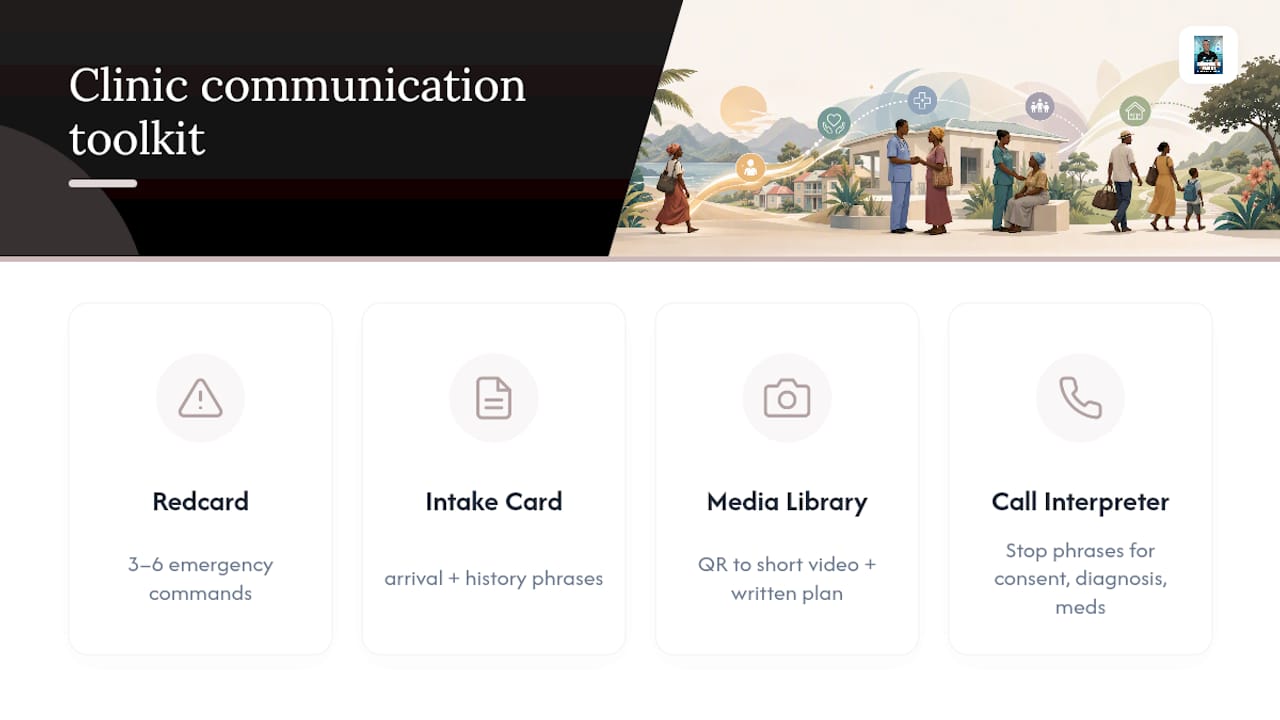
Pro Tip: Keep a laminated "redcard" with these six emergency lines taped inside the crash cart or triage station. In a code, nobody has time to scroll a phone app.
Asking About Pain, Onset, and Symptoms
History-taking in a language you don't speak fluently comes down to short questions and close listening. Keep each question to one idea; a patient answering under stress won't parse a compound sentence any better than you will parse their reply.
- Where does it hurt? — Ki bò ki fè ou mal? (kee boh kee feh oo mahl)
- How long have you had this? — Depi kilè ou gen sa? (deh.PEE kee.LEH oo gehn sah)
- On a scale of zero to ten, how bad is the pain? — Sou yon echèl 0 a 10, ki jan doulè a rèd? (soo yohn eh.SHEHL zeh.roh ah dees, kee zhahn doo.LEH ah rehd)
- Do you have a fever? — Ou gen lafyèv? (oo gehn lah.FYEHV)
- Have you vomited? — Ou vomi? (oo voh.MEE)
Expect short, direct replies. A patient pointing at the abdomen and saying "la" (here) is common. Someone answering a pain-scale question with "anpil" (a lot) instead of a number isn't being difficult. Follow up with a simpler comparison: "worse than yesterday?" often works better than repeating the 0 to 10 scale. Practice saying these phrases aloud before your shift; the rhythm matters more than textbook grammar for being understood.
Guiding an Exam and Explaining Vital Signs
Patients tense up during physical exams more when they don't know what's coming next. A short heads-up phrase before you touch anything goes a long way toward keeping the exam smooth.
- Please take a deep breath — Tanpri respire pwofondeman (tahn.PREE reh.spee.RAY pwoh.fohn.deh.MAHN)
- Open your mouth and say "ahh" — Louvri bouch ou epi di "ah" (loo.VREE boosh oo eh.PEE dee "ah")
- I'm going to check your blood pressure — Mwen pral tcheke tansyon ou (mwehn prahl CHEH.kay tahn.SYOHN oo)
- This might feel cold — Sa ka santi frèt (sah kah SAHN.tee freht)
- Is it okay if I touch here? — Li ekè si m manyen la a? (lee eh.KEH see muh mah.NYEHN lah ah)
For older adults or patients with low literacy, pair the phrase with a gesture (tapping your own chest for "breathe deep," pointing to your own wrist for "blood pressure") rather than relying on the words alone. If the exam involves anything beyond routine vitals, like explaining a biopsy or an invasive procedure, pause and bring in an interpreter before continuing. A phrase card gets you through the mechanics of an exam; it doesn't cover informed consent.
Checking Medications, Allergies, and Current Treatment
Medication history is where a rushed phrase can cause real harm, so keep this section narrow and factual rather than trying to counsel through it.
- Are you allergic to any medicine? — Ou gen alèji ak nenpòt medikaman? (oo gehn ah.LEH.zhee ahk nehn.poht meh.dee.kah.MAHN)
- What medicine do you take? — Ki medikaman ou pran? (kee meh.dee.kah.MAHN oo prahn)
- Did you take this today? — Ou pran sa jodi a? (oo prahn sah zhoh.DEE ah)
- When did you last take it? — Kilè ou te pran li dènye fwa? (kee.LEH oo tay prahn lee dehn.YEH fwah)
- Please show me the bottle — Tanpri montre m boutèy la (tahn.PREE mohn.TRAY muh boo.TAY lah)
Patients often answer allergy questions with the reaction instead of the drug name, saying something like "li fè m gonfle" (it made me swell up). That's useful information; write it down even without the drug name attached. Do not give new dosing instructions through a phrase card. Any change to a medication regimen needs an interpreter on the line, and the chart should note the patient's language preference so pharmacy and follow-up staff don't repeat the gap.
Explaining Tests, Discharge, and What to Watch For
Discharge instructions fail more often from unclear language than from bad advice. A short script beats a long one, and a teach-back question at the end tells you whether it landed.
- We are going to do a test called X — Nou pral fè yon egzamen ki rele X (noo prahl feh yohn ehg.zah.MEHN kee reh.LAY X)
- Do not eat or drink anything — Pa manje ni bwè anyen (pah mahn.ZHAY nee bweh ahn.YEHN)
- Come back to the emergency room if this happens — Retounen nan ijans si sa rive (reh.too.NEHN nahn ee.ZHAHNS see sah ree.VAY)
- Can you tell me in your own words what you should do at home? — Ou ka di m nan pwòp mo ou ki sa ou dwe fè lakay? (oo kah dee muh nahn pwohp moh oo kee sah oo dway feh lah.KYE)
That last question is the teach-back check, and it's the single most useful phrase in this whole list. If the patient can't restate the instruction back to you, the discharge plan isn't ready, regardless of how clearly you think you explained it. Anything involving new consent, a change in medication, or a complex referral still needs a certified interpreter on the call before the patient walks out the door.
Interpreter Rules, Legal Duties, and What the Research Shows
Providers who receive federal funding have language access obligations under Title VI that generally require meaningful assistance for patients with limited English proficiency, including access to IFHP dental coverage for newcomers and refugees in Canada, which in practice means a qualified interpreter for anything beyond routine, low-stakes exchanges. Phrase cards are a bridge for greetings, vitals, and triage. They are not a substitute for interpretation when consent, diagnosis, or medication changes are on the table.
Haitian Creole remains underrepresented in natural language processing, and existing translation systems frequently fail to capture register differences and code-switching, which raises real mistranslation risk in clinical settings.
That finding comes from ACL Anthology research on NLP for Haitian Creole, and it's a direct warning against leaning on an app to translate anything clinically important. Haitian Creole also varies by region and register; a phrase that sounds natural in Port-au-Prince may land oddly for a patient from the countryside. Phonetic guides help, but they should be checked against native speakers in your own patient population before they go on a laminated card.
The upside is real when translation gets done right. A Miami pilot project translated an Asthma Action Plan into Creole and paired it with a short video accessed through an EHR-linked QR code, and it improved caregiver engagement and provider satisfaction with the education process. That's a template worth copying for other chronic conditions: written instructions plus a short video, reachable by a QR code at the point of discharge.
A workable clinic checklist looks like this: one emergency redcard with three to six commands, one intake phrase card for arrival and history, and a QR-linked audio or video library for education materials, with staff trained on exactly when to stop using phrases and call for interpretation. Sparkmed's own patient education work follows a similar principle, treating multilingual materials as a supplement to real conversation, not a replacement for it, as described in our approach to patient education in recovery.
Where to Find Ready-Made Phrase Sheets and Audio
You don't need to build this phrase bank from scratch, and you shouldn't rely on memory alone during a busy shift.
- ALTA Language Services hosts recorded Haitian Creole medical phrase audio adapted from Red Cross emergency materials, good for practicing pronunciation before you ever use a phrase on a patient.
- Krenglish organizes phrases by clinical scenario and pairs each one with an expected patient reply, which helps you anticipate the conversation instead of just reciting a line.
- The Miami-Dade hospital communication cards give you a printable Creole/English reference PDF built specifically for ED and EMS use.
- HaitianCreoleAlliance offers certified interpreter services in Miami for booking ahead of scheduled visits or connecting same day.
Laminate the essentials at the nurses' station, add a QR code linking to audio or video inside your EHR, and keep the emergency redcard within arm's reach of triage. Before anything goes into clinical use, have a native Creole speaker on staff check the pronunciation and note where you sourced each phrase.
Why Sparkmed Treats Multilingual Communication as Part of Care
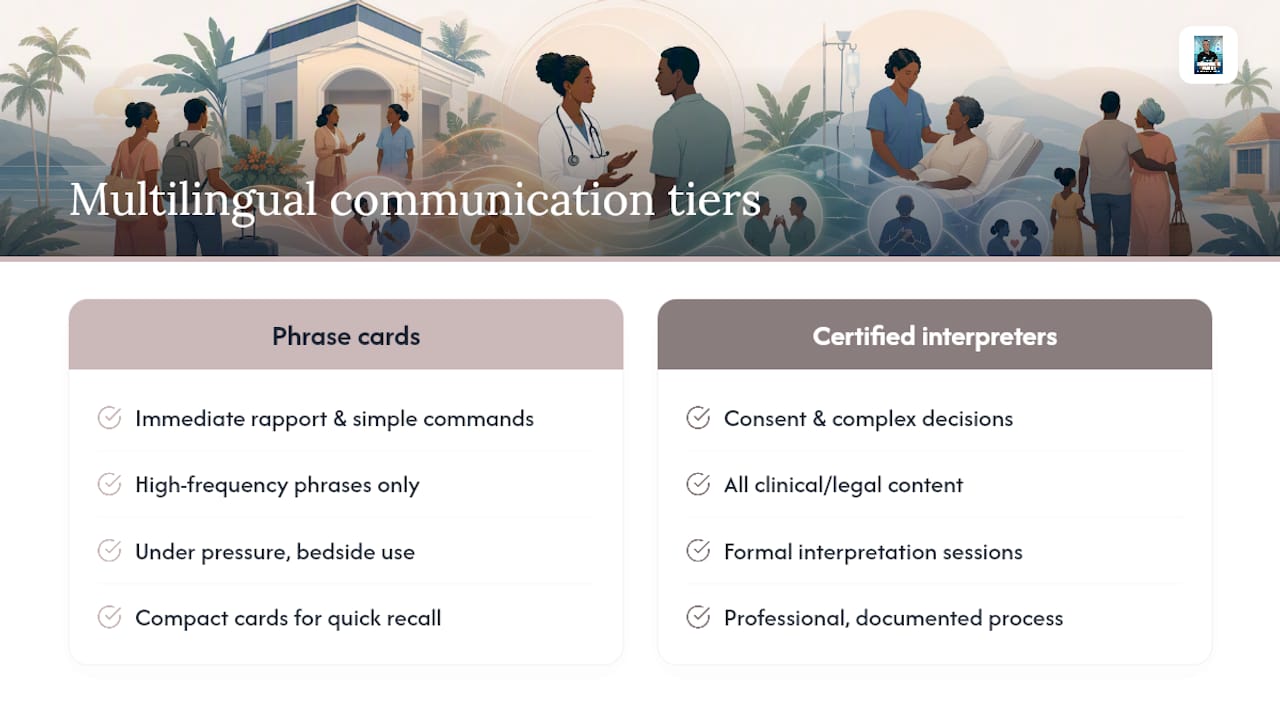
Phrase cards work because they're small enough to actually use under pressure. We'd rather see a clinician confidently say five accurate lines than fumble through fifty half-remembered ones, so the phrases on this page were chosen for frequency, not completeness. That's a deliberate trade-off, and it means a patient in real distress gets a clear, familiar-sounding command instead of silence while someone hunts for an app.
None of that replaces certified interpretation for anything with legal or clinical weight. Sparkmed builds its own patient education around that same split: simple language for rapport and basic instructions, real interpretation for consent and complex decisions. Our multilingual materials, described in what a chiropractic health hub offers patients, follow the same logic, whether the language on the page is English, Spanish, or Creole. If you're coordinating multilingual care in North Miami and want to see how a local clinic structures that access, our accessibility commitments and chiropractic services page lay out how we handle it day to day.
— Spark
Sources
- Challenges and innovations in NLP for Haitian Creole (ACL Anthology)
- Florida hospital communication cards (Haitian Creole and English) PDF
- Haitian Creole medical phrase pronunciation guide (ALTA)
- Quality improvement: Creole AAP and education video (University of Miami project)
FAQ
What are some useful Haitian Creole phrases for a clinic?
The highest-value phrases cover greetings ("Bonjou"), pain location ("Ki bò ki fè ou mal?"), and asking for consent to touch a patient ("Li ekè si m manyen la a?"). Pair each with phonetics and practice them aloud before using them clinically.
What is "I love you" in Haitian Creole?
"I love you" is Mwen renmen ou (mwehn rehn.MEHN oo), though it has no clinical use and isn't part of the medical phrase set covered here.
What does "zozo" mean in Haitian Creole?
Zozo is an informal, childlike term for male genitalia, similar to how English speakers might use a casual nickname with children. In a clinical setting, use the neutral anatomical term and rely on an interpreter if a patient uses informal or regional vocabulary you don't recognize.
What is the Haitian Creole word for buttocks?
The common word is dèyè (deh.YEH), which also means "behind" or "back" depending on context. Confirm meaning with the patient's gesture or an interpreter if the context is ambiguous.
When should I stop using phrase cards and call an interpreter?
Call a certified interpreter for anything involving consent, diagnosis, medication changes, or a complex procedure. Phrase cards are appropriate for greetings, triage, vitals, and basic exam instructions, not for clinical decisions with legal or safety weight.