
Muscle spasms after a car accident are usually your body's protective response to soft-tissue or joint injury, not a sign of something catastrophic. Most cases improve steadily with early conservative care over one to six weeks. That said, a handful of symptoms mean you should skip the wait-and-see approach entirely.
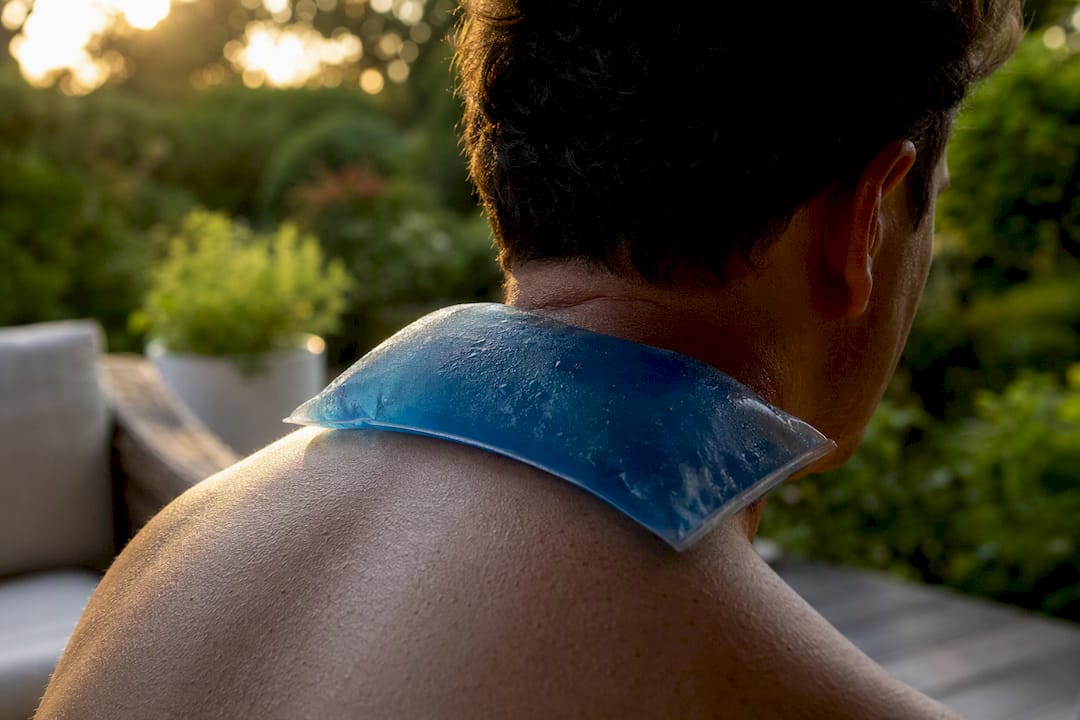
For the first 48 to 72 hours, keep movement gentle, avoid positions that reload the injured area, and apply ice rather than heat to calm the acute inflammation. If you notice any of the following, get evaluated urgently rather than waiting it out:
- Progressive numbness or weakness in an arm or leg
- Any change in bowel or bladder control
- Spasms that worsen sharply instead of easing after several days
Key Takeaways
Muscle spasms after a car accident are typically a protective response to soft-tissue or joint injury that resolves faster with early, active conservative care than with rest alone.
| Point | Details |
|---|---|
| Spasms are protective, not random | Your nervous system tightens muscles to guard injured soft tissue or unstable joints. |
| Onset is often delayed | Adrenaline can mask pain for hours; inflammation and spasm often peak 48 to 72 hours after impact. |
| Watch for red flags | Progressive numbness, weakness, or bowel/bladder changes require urgent evaluation, not home care. |
| Active care beats passive rest | Combining manual therapy with movement and stretching lowers the risk of spasms turning chronic. |
| Sparkmed offers a conservative path | Its $25 adjustment offer and multilingual support give North Miami accident patients an accessible way to start early treatment. |
Table of Contents
- What Causes Muscle Spasms After a Car Accident?
- Where Do Post-Accident Spasms Usually Show Up?
- How Long Do Muscle Spasms Last After a Car Accident?
- How Do You Relieve Muscle Spasms and Treat the Root Cause?
- When Should You Seek Urgent Care for Spasms?
- What Does Recovery Actually Look Like Week by Week?
- How Sparkmed Approaches Post-Accident Muscle Spasms
- Why Rushing Past the Spasm Is the Wrong Instinct
- How to Book Care for Post-Accident Spasms With Sparkmed
- Sources
What Causes Muscle Spasms After a Car Accident?
A spasm is your nervous system hitting the brakes. When soft tissue tears microscopically or a joint loses its normal stability, surrounding muscles contract involuntarily to splint the area and prevent further damage. It is guarding, not malfunction.
The mechanical triggers are straightforward: sudden deceleration strains muscles and ligaments beyond their normal range, joints briefly lose alignment, and nearby nerves can get irritated in the process. Whiplash from even low-speed collisions commonly produces this kind of neck and upper-back spasming, and Rush University Medical Center notes that symptoms can take hours or days to fully surface.
That delay trips people up constantly.
- Adrenaline masks pain in the first hour or two after impact.
- Inflammation and swelling typically build over the following one to three days.
- Nerve irritation and reduced local circulation can keep muscles in a heightened, reactive state well after the initial trauma.
There's also a subtler mechanism at play called central sensitization, where the nervous system essentially turns up its own volume dial after trauma, making muscles more reactive to normal movement. Trigger points, those small, tender "knots" you can feel under the skin, often form in this same window. Cleveland Clinic classifies most spasms as benign, but persistent or worsening ones deserve a closer look.
Where Do Post-Accident Spasms Usually Show Up?
Spasms after a collision follow fairly predictable patterns depending on how force traveled through your body during impact.
- Neck and upper back. Whiplash territory. Expect stiffness, reduced range of motion, and headaches that start at the base of the skull.
- Lower back. Common after any accident involving twisting or bracing against the seatbelt. Spasms here often come with a deep, achy tightness rather than sharp pain.
- Shoulders and upper trapezius. Frequently the site of visible "knots" and referred pain that travels up into the head.
- Gluteal and piriformis region. Can mimic sciatica, since a tight piriformis muscle sits right next to the sciatic nerve.
The distinction that matters clinically: myofascial trigger-point pain is usually localized, reproducible when you press on the knot, and eases somewhat with stretching. Radicular pain, from an irritated nerve root, tends to shoot down a limb, follows a specific nerve pattern, and often comes with tingling or numbness rather than just tightness.
How Long Do Muscle Spasms Last After a Car Accident?
Most spasms follow a fairly predictable arc, though the timeline shifts based on how the injury is managed early on.
| Timeframe | What typically happens |
|---|---|
| First 48–72 hours | Inflammation peaks; spasms are often at their most intense during this window |
| 1–2 weeks | Pain and stiffness usually start easing with active conservative care |
| three to six weeks | Most soft-tissue spasms resolve substantially; residual tightness may linger |
| beyond six weeks | Risk of chronic patterns rises, especially with untreated joint dysfunction |
Delayed treatment, unresolved joint instability, and central sensitization are the usual reasons spasms drag past the six-week mark. Comorbidities like prior neck injuries or high baseline stress levels can extend that window further. Early active care measurably lowers the risk of symptoms sliding into a chronic pattern compared with passive rest alone.
How Do You Relieve Muscle Spasms and Treat the Root Cause?
Relief and repair are two different jobs, and treating post-accident spasms well means doing both without confusing one for the other.
Ice works best in that first 48 to 72 hour inflammatory window; heat and gentle mobilization take over once the acute swelling settles. Over-the-counter analgesics can blunt pain in the short term, but Collision Care Clinic points out that passive modalities are adjuncts, not fixes, for the underlying mechanical issue.
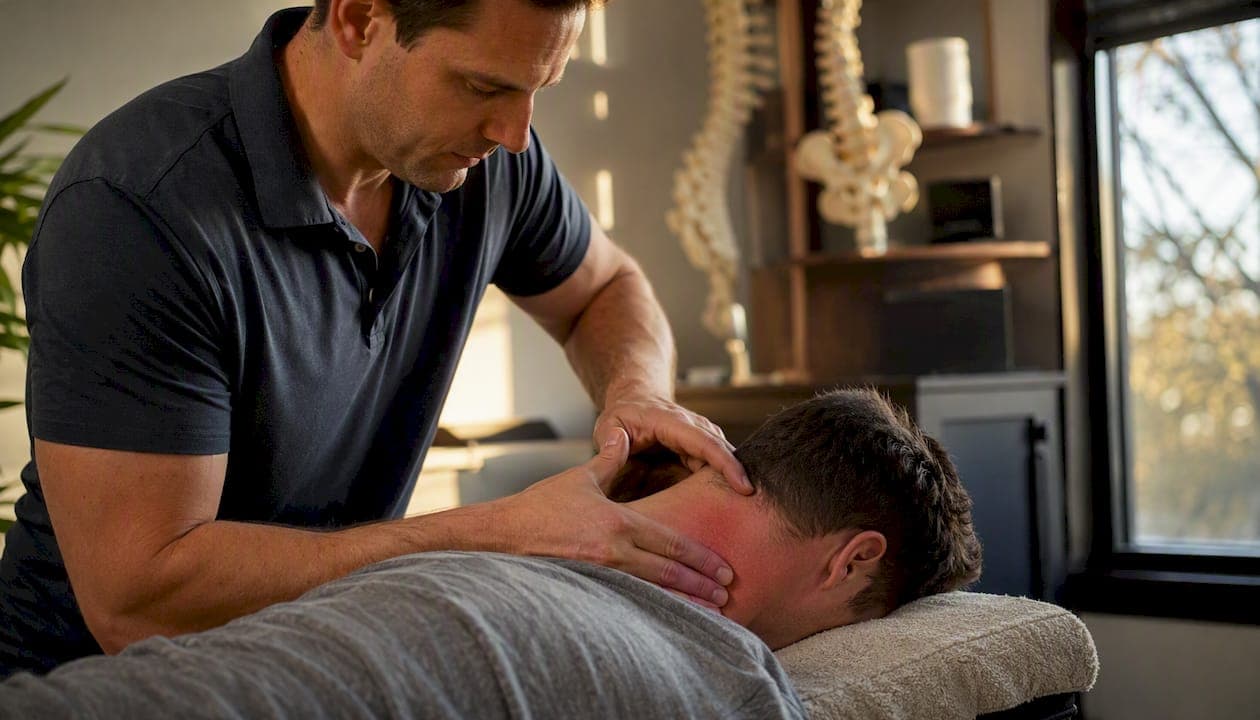
Manual therapies do more of the structural work. Spinal adjustment addresses joint restrictions that are keeping muscles in a guarded state, while soft-tissue massage and trigger-point work target the knots directly. A case report on chronic thoracic muscle spasm found that combining manipulative therapy with home exercises reduced spasm frequency and severity over several weeks, though that's a single case and not a guarantee of outcome.
Rehab closes the loop: progressive stretching, targeted strengthening, and posture retraining teach the area to move normally again instead of staying braced.
- Ice for acute swelling, heat for later stiffness
- Manual therapy and chiropractic adjustment for joint mechanics
- Stretching and progressive strengthening for long-term stability
- Trigger-point injections or imaging when a discrete, stubborn knot doesn't respond to conservative work
Pro Tip: Muscle relaxants can make you feel better for a few hours, but they do nothing to correct the joint restriction or postural pattern causing the spasm in the first place. Use them as a bridge to active treatment, not a substitute for it.
When Should You Seek Urgent Care for Spasms?
Most post-accident spasms are manageable, but certain signs mean you need medical evaluation immediately rather than home care.
- Progressive weakness or numbness spreading down an arm or leg
- Numbness in the groin or inner thighs (saddle anesthesia)
- New bowel or bladder dysfunction
- Signs suggesting a fracture, such as severe localized pain with swelling, or any head injury symptoms
A clinical exam typically includes range-of-motion testing, palpation for trigger points, and neurological screening for reflexes and strength. Imaging gets ordered when those findings suggest something beyond soft tissue. Getting checked early isn't just about ruling out the rare serious case. It also means starting active care sooner, which Premier Injury Specialists' clinical resources indicate correlates with faster overall recovery.
What Does Recovery Actually Look Like Week by Week?
Tracking progress against realistic checkpoints helps you know whether to keep going with home care or push for more targeted treatment.
- 48 to 72 hours in: Acute pain should plateau rather than keep climbing; sharp, escalating pain is a signal to get checked.
- One to two weeks in: Stiffness and range of motion should be visibly improving with consistent stretching and manual therapy.
- Three to six weeks in: Most soft-tissue spasms have substantially resolved; lingering tightness at this stage often points to an unaddressed joint restriction.
If progress stalls at any checkpoint, that's the cue to reassess mechanics rather than just increasing pain medication, and to consider more targeted interventions like trigger-point therapy.
How Sparkmed Approaches Post-Accident Muscle Spasms
Sparkmed's first-visit process for accident patients starts with a hands-on assessment of joint mechanics and muscle guarding, then moves into a treatment plan that typically combines spinal adjustment, soft-tissue therapy, and modalities like ultrasound or heat and cold therapy, backed by a home exercise program.
Case-report evidence on chronic muscle spasm shows that manipulative therapy paired with home exercises can reduce spasm frequency and severity over several weeks, the same conservative framework Sparkmed builds its accident-recovery plans around.
Sparkmed offers a $25 chiropractic adjustment with no insurance required, plus multilingual support in English, Spanish, and Creole for North Miami patients navigating post-accident care.
Why Rushing Past the Spasm Is the Wrong Instinct
The instinct after a crash is to push through the tightness or wait for it to fade on its own. That's the part of conventional advice that falls short: rest alone doesn't resolve a joint restriction, and it often lets guarding patterns calcify into something harder to unwind weeks later.
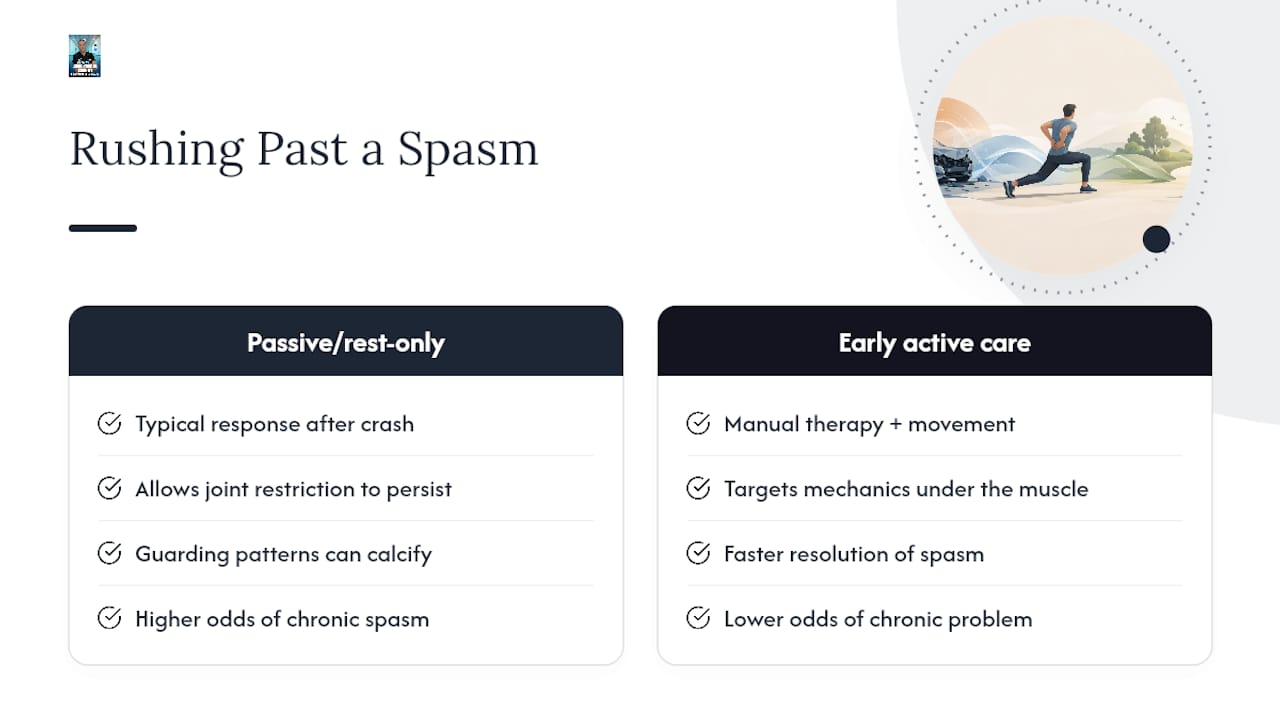
What the evidence actually supports is more specific than "see a doctor eventually." Active, multi-modal care started early, meaning manual therapy paired with movement rather than either alone, consistently tracks with faster resolution and lower odds of the spasm turning chronic. The mistake I see people make isn't ignoring pain. It's treating the muscle relaxant or the ice pack as the whole plan instead of a bridge to something that fixes the mechanics underneath.
If you take one thing from this: prioritize getting the joint and soft-tissue assessment done in the first week, not the fourth. The window where active care makes the biggest difference is early, and it closes faster than most people expect.
— Spark
How to Book Care for Post-Accident Spasms With Sparkmed
If you're still bracing every time you turn your head or reach for something, waiting rarely makes that better on its own. Sparkmed gives North Miami accident patients a direct path to conservative care without the insurance runaround: a $25 adjustment offer with no coverage required, plus multilingual support in English, Spanish, and Creole so language never gets in the way of getting seen.
A typical first visit starts with a hands-on exam of your neck, back, or shoulder mechanics, followed by a plan that might combine spinal adjustment, soft-tissue work, and modalities suited to where you are in the 48-hour to six-week recovery window. Bring your accident report if you have one, a list of your current symptoms, and any imaging you've already had. You don't need a referral to start. Check Sparkmed's accessibility information and reach out to get your assessment scheduled while you're still in that early, high-value treatment window.
Sources
- 5 facts about whiplash — Rush University Medical Center
- Muscle spasms and muscle cramps — Cleveland Clinic