
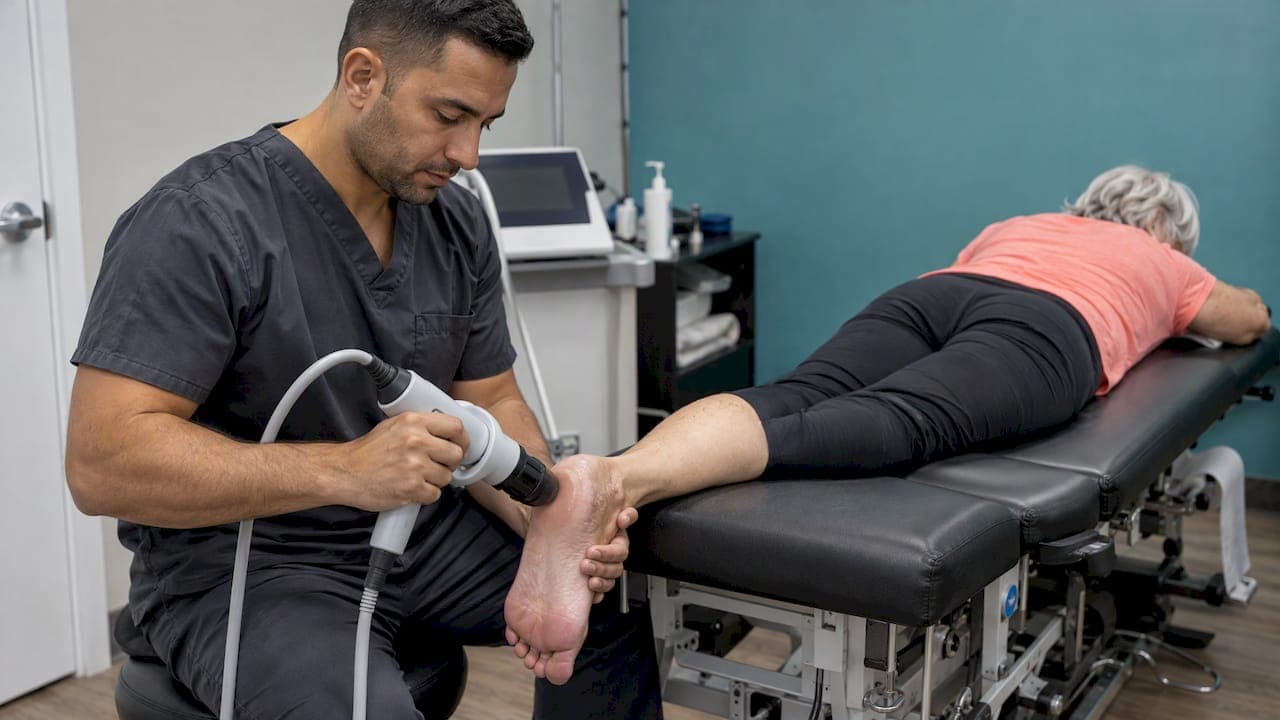
Shockwave therapy (extracorporeal shockwave therapy, or ESWT) is a non-invasive, outpatient treatment for stubborn plantar fasciitis. A clinician presses a small hand-held probe to the sole of your foot and sends acoustic waves through the skin to the irritated tissue. It is usually delivered as a short series of visits, not a single appointment. At our North Miami clinic, a shockwave session is $75 per session. Below is how it works, what the visits feel like, how it compares with other care, and who should hold off.
TL;DR
- ESWT sends sound waves through the skin to the plantar fascia to increase blood flow and reduce pain. It is an outpatient procedure with no incisions.
- Plan on a series, usually three to six sessions spaced three to seven days apart.
- Mild soreness, redness or bruising are the common side effects. Active infection and pregnancy are reasons to avoid it.
- Conservative care such as stretching, supportive shoes and icing usually comes first, and shockwave is typically considered for heel pain that has lingered.
- Our shockwave sessions are $75 each. Call us or book online to find out whether it fits your foot.
Table of Contents
- What plantar fasciitis is, and why it lingers
- How shockwave therapy works on the heel
- What the evidence says about results
- What happens during a session
- How many sessions you will need
- Side effects and who should avoid it
- Where shockwave fits among other treatments
- Perspective: why we pair shockwave with a full exam
- Plantar fasciitis after an accident or a fall
- How to prepare for your first visit
- Our offer: shockwave and wellness plans in North Miami
- FAQ
- Sources
What plantar fasciitis is, and why it lingers
The plantar fascia is the band of tissue that connects your heel to the ball of your foot. Plantar fasciitis is chronic irritation from repeated small tears in that band. The pain can be sharp, burning or aching. It sits in the heel and can spread into the arch.
The classic pattern is pain with the first steps out of bed in the morning, or after you have been sitting for a long time. It often eases once you warm up, then returns after a long day on your feet. That on-again, off-again rhythm is why many people tolerate it for months before they ask for help.
The fascia has a limited blood supply, and you load it with every step. That is one reason it can be slow to heal. A treatment that aims to bring blood flow and healing activity back into the area makes sense on paper, and that is the idea behind shockwave.
How shockwave therapy works on the heel
ESWT is a non-invasive outpatient procedure that uses mechanical, acoustic sound waves applied through the skin to stimulate healing and reduce pain in conditions such as chronic plantar fasciitis. Mayo Clinic describes the goal as jump-starting healing, increasing blood flow and metabolism, and reducing pain and inflammation.
Researchers have also proposed a second effect. Shockwaves may change how cell membranes behave and so interrupt pain signals, which could add to the pain relief people report. This is a proposed mechanism, not a settled one, so treat it as a working theory.
Radial and focused devices
Not every shockwave machine is the same. Per Mayo Clinic, radial devices create pressure waves at the skin, with effects closer to the surface, while focused treatment uses electromagnetic induction and reaches deeper. The plantar fascia sits near the sole, so the choice of device and settings depends on where your pain is and how your tissue responds. Ask which type your provider uses and why.

What the evidence says about results
A review of the literature concluded that high-quality evidence points to a large effect on pain and function in plantar fasciitis, with significant short- and long-term effects. The U.S. Department of Veterans Affairs, in its community care guidance, notes that a 2022 meta-analysis found ESWT superior to ultrasound therapy for pain, pain intensity and patient satisfaction in plantar fasciitis.
ESWT is also often used as an alternative to surgery for people with long-term, stubborn heel pain. That is the group most likely to benefit from a conversation about it.
No treatment works for everyone, and outcomes depend on the patient, the device and the settings. A clinician should consider individual patient characteristics when selecting ESWT parameters. That is why a proper exam comes before the first pulse.

What happens during a session
A session is short and simple. Sessions at most clinics run about 15 to 20 minutes, though the exact time depends on the provider and the area treated.
- Exam and mapping. Your clinician checks your heel, arch and calf, and finds the spot where the pain is strongest. Published best-practice guidance recommends clinical focusing on the areas of maximal pain and identifying primary and secondary injury sites.
- Gel and probe. Contact gel is applied to the skin and a hand-held probe delivers the energy waves.
- Intensity adjustment. You may feel discomfort. The clinician manages this by adjusting the intensity, so tell them when it becomes too much.
- Walk out. There is no cutting, no sedation and no recovery room. Most people go straight back to their day, though you may notice some soreness.
The guidance cited above favors working without anesthetics, so that your feedback can steer the probe to the real source of pain. A numbed foot hides that signal.
If you want to read more about how clinicians choose settings and what the technique is used for, our own guide covers shockwave therapy uses for injury recovery.
How many sessions you will need
Shockwave therapy is generally done as a series of three to six sessions, typically spaced three to seven days apart. Some providers also offer a maintenance treatment four to six weeks later. Many articles you will find describe roughly weekly visits, which fits inside that range.
Here is what that means for your calendar and your budget. These are the arithmetic of our published per-session price, not a promise of how many visits you will need.
| Sessions in your plan | Cost at $75 per session |
|---|---|
| 3 | $225 |
| 4 | $300 |
| 5 | $375 |
| 6 | $450 |
Your clinician sets the actual number after the exam. For a closer look at what drives cost in general, see our guide to what shockwave therapy really costs.
When improvement starts
Most patients do not feel a switch flip on day one. Soreness after a session is common, and pain often changes gradually across the series. Tell your clinician how your first-step-in-the-morning pain compares from week to week. That is the most useful measure for deciding whether to continue, change settings or try something else.
Side effects and who should avoid it
Mayo Clinic describes shockwave therapy as carrying minimal risks or side effects, such as slight bruising or mild swelling at the treatment site. A best-practice review in the academic literature calls ESWT generally safe and lists pain, redness, bruising, hematoma, nerve irritation and swelling as reported effects.
Put these safety points on your checklist before booking:
- Active infection, pregnancy: the same review says to avoid ESWT in these situations. Tell us if either applies to you.
- Bleeding disorders: discuss high-energy treatment with your clinician if you have a coagulopathy. The same applies to treatment near nerves, lung or growth plates.
- Medications: anti-inflammatory medications may need to be stopped while you receive ESWT. Ask your prescribing doctor or pharmacist before you change anything.
- Tendon problems near the heel: two cases of Achilles tendon rupture were reported within two weeks of the first focused treatment in women older than 60. If you are in that group, or have had Achilles trouble, raise it at the exam.
Call your clinician if pain sharply worsens, swelling grows, or you notice numbness or tingling after a session. Our article on shockwave therapy side effects walks through what is normal afterward and what to report.
Where shockwave fits among other treatments
Most plans start with the basics. The VA's guidance lists inserts or night splints, NSAIDs, supportive shoes, physical therapy, stretching and icing as conservative care. The same document says six months of failed therapy is required before high-energy ESWT may be considered under that program. Other payers and clinics set their own rules, so treat that as one benchmark.
A practical order for most people looks like this:
- Calf and plantar fascia stretching, shoes with good support, and activity changes.
- Ice, inserts or night splints, and short-term anti-inflammatories if your doctor agrees.
- Hands-on care and supportive therapies such as massage, ultrasound or electrical stimulation. See our services.
- Shockwave therapy, when heel pain keeps coming back despite the steps above.
If you are exploring other energy-based options for pain, the research on PEMF for pain explains what that approach does and who it tends to suit. For a wider view of why many patients prefer care without surgery, read the benefits of non-invasive therapy for pain recovery.
Perspective: why we pair shockwave with a full exam
We treat people in North Miami whose pain did not start in a gym. Many of them were hurt in a car accident, on the job or in a fall, and their heel pain is one piece of a larger picture: a stiff back, a tight hip, a changed way of walking.
That is why we do not hand you a probe and a number. We examine your foot, your gait and the joints above it, then decide how shockwave fits. We use it as one tool next to adjustments, ultrasound, electrical stimulation, traction and massage, because the heel often improves faster when the rest of the chain is working too.
Our team has more than 20 years of experience with accident victims, we speak English, Spanish and Creole, and we document injuries thoroughly so your claim file is complete. Shockwave is $75 a session, posted openly, because you should know the price before you lie down on the table.
Spark
Plantar fasciitis after an accident or a fall
Heel pain is not only a runner's problem. A sudden stop in a collision braces the legs against the floor. A slip can twist the foot. A job that puts you on concrete all day can inflame the fascia over time. In each case the pain may show up days or weeks later.
If your foot pain began after a collision, keep a note of when it started and tell every provider you see. We cover how the technique applies to crash injuries in shockwave therapy for car accident injuries in North Miami. We bill insurance directly where it applies, and we document injuries so claims have the detail they need.
Shockwave is also discussed for scar tissue. Our guide with three questions to ask before treating scar tissue is a good primer if soft tissue from an older injury is part of your problem.
How to prepare for your first visit
A little preparation makes the first session more useful.
- Wear shoes you use most. Bring the pair you stand in all day. Worn or unsupportive soles tell us a lot.
- Write down your pain pattern. When is it worst? First steps, end of shift, after driving? Give a score from 0 to 10.
- List medications and conditions. Include blood thinners, anti-inflammatories, pregnancy, infection or any tendon history.
- Tell us what you have already tried. Inserts, stretching, injections or physical therapy all matter to the plan.
- Ask about transport. Getting there should not be a barrier. We offer Uber Health transport in North Miami.
Our offer: shockwave and wellness plans in North Miami
We offer shockwave therapy at $75 per session. If you also want regular hands-on care, our monthly plans on the same page are Essential at $149 per month, Performance at $249 per month and Elite at $399 per month. Chiropractic adjustments are $45, and you can see them on our home page. Other therapies, including ultrasound, electrical stimulation, traction and massage, are described on our services page.

Heel pain that has dragged on is worth an exam. Book a visit, bring your questions and your everyday shoes, and we will tell you plainly whether shockwave is a good fit and how many sessions we would expect to plan for.
FAQ
Is shockwave therapy for plantar fasciitis painful?
You may feel discomfort while the probe is on the tender area. Clinicians try to manage this by adjusting the intensity, so speak up as soon as it is too much. Sessions are short, and mild soreness or redness afterward is common.
How many shockwave sessions does plantar fasciitis need?
Mayo Clinic describes a typical series as three to six sessions, three to seven days apart. Your clinician sets the number after an exam and adjusts as your pain changes. Some providers add a maintenance session four to six weeks later.
Who should not have shockwave therapy?
Avoid it with an active infection or during pregnancy. Discuss it first if you have a bleeding disorder or if the treatment area is near nerves, lung or growth plates. If you take anti-inflammatory medication, ask your prescriber whether it should pause during treatment.
Is shockwave better than ultrasound therapy for heel pain?
A 2022 meta-analysis summarized in VA guidance found ESWT superior to ultrasound therapy for pain and patient satisfaction in plantar fasciitis. Ultrasound can still have a role as a supporting therapy. Your clinician can build a plan that fits your foot.
Do I need to see a doctor before trying it?
Get an exam first, because heel pain has several causes and the treatment depends on the cause. We evaluate your foot, gait and history at your first visit. If anything suggests a problem outside our scope, we will refer you.
Sources
- Plantar Fasciitis, Milton Keynes University Hospital
- Mayo Clinic Q and A: Shockwave therapy may help relieve foot problem
- Extracorporeal Shockwave Therapy Versus Ultrasound Therapy, PMC
- Effectiveness of shockwave therapy, PMC
- Extracorporeal Shock Wave Therapy for Musculoskeletal Conditions, U.S. Department of Veterans Affairs
- Shockwave Therapy patient information, Wrightington, Wigan and Leigh NHS
- Best practices for extracorporeal shockwave therapy, PMC
- Efficacy and tolerability of extracorporeal shock wave therapy, PMC
- PEMF for Pain: What the Research Shows and Who It Suits