
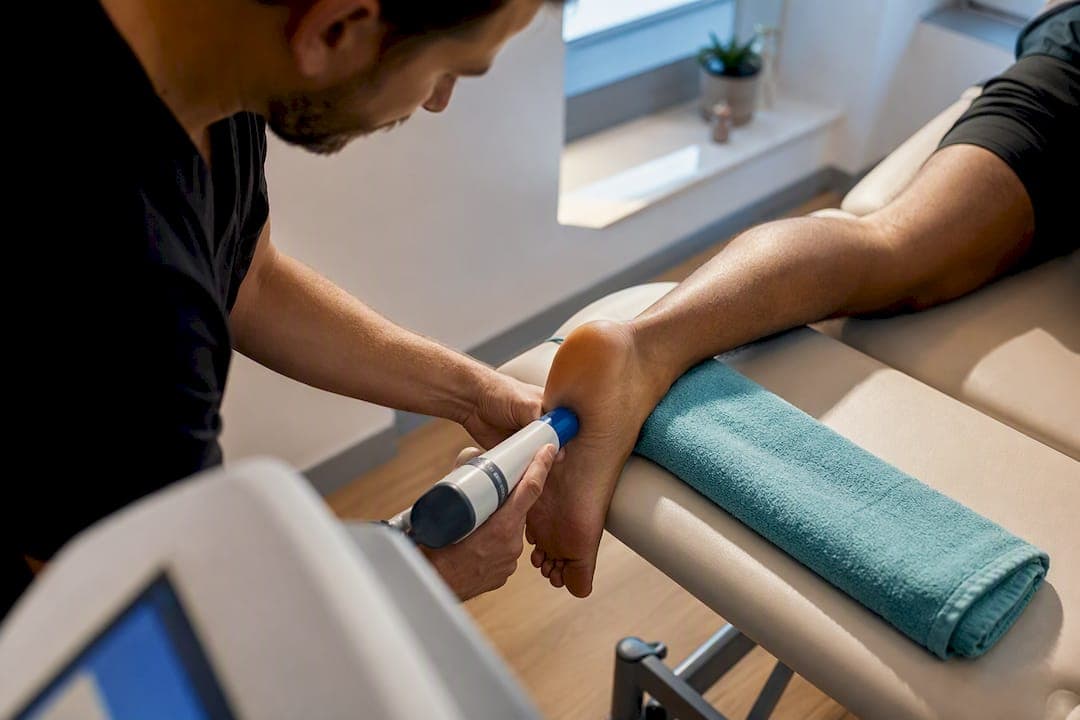
Shockwave therapy has solid evidence behind a specific list of conditions: chronic tendinopathies (including plantar fasciitis), certain bone-healing problems like delayed union and stress fractures, and a growing set of emerging uses including spasticity and select urologic conditions such as erectile dysfunction. The tendon and plantar fasciitis applications are well supported by clinical research. Bone-healing and neurologic uses are promising but still developing. Talk to a qualified clinician before assuming it fits your specific diagnosis.
TL;DR:
- Shockwave therapy is most effective for plantar fasciitis, calcific shoulder tendinopathy, and certain bone-healing issues, with consistent evidence supporting these uses.
- Protocols vary widely, with high-energy focused devices necessary for bone applications and softer treatments using radial waves for superficial tendinopathies.
- Results usually appear within 3 to 12 weeks, and most treatments involve weekly sessions with limited, temporary side effects like soreness or redness.
- It should be used cautiously or avoided over malignant tumors, pregnancy, active infections, severe bleeding disorders, and specific sensitive areas such as the brain or open growth plates.
- Combining shockwave therapy with rehabilitation exercises and proper diagnosis confirmation improves success, but insurance coverage remains inconsistent even for FDA-approved indications.
Table of Contents
- What Is Shockwave Therapy and How Does It Work?
- What Conditions Does Shockwave Therapy Actually Treat?
- How Strong Is the Evidence for Each Condition?
- What Happens During a Shockwave Therapy Session?
- What Are the Risks and Contraindications?
- Is Shockwave Therapy Right for You?
- How Spark Handles Shockwave Therapy in Recovery Plans
- Get Shockwave Therapy at Sparkmed in North Miami
- Sources
- FAQ
What Is Shockwave Therapy and How Does It Work?
Shockwave therapy delivers acoustic pressure waves into damaged tissue to trigger a biological repair response, a process called mechanotransduction. The mechanical energy switches on cellular signaling that drives new blood vessel formation, wakes up coenocytes (the cells that rebuild tendon tissue), and stimulates bone-forming cells. It also produces an analgesic effect, which is part of why patients often feel some relief within a few sessions. This mechanism is what makes shockwave more of a tissue-remodeling tool than a simple pain-masking treatment, which is why it appeals to active patients who want to get back to training rather than just feel better temporarily.
Not all devices work the same way, and the distinction matters for treatment planning:
- Focused shockwave (F-SWT) concentrates energy at a precise depth, reaching bone and deep tendon insertions with higher peak pressure.
- Radial pressure wave (RPW) disperses energy from the applicator surface outward, working best on broader, more superficial soft-tissue areas.
- Energy flux density (EFD) comes in low, medium, and high categories. Clinicians typically match low-to-medium EFD to soft-tissue conditions and reserve high-energy focused waves for bone pathology, according to practice-management guidance from PMC.
What Conditions Does Shockwave Therapy Actually Treat?
The International Society for Medical Shockwave Treatment (ISMST) maintains an official list of standard indications, and it's the closest thing to a consensus roadmap in this field.
Standard, well-supported indications:
- Calcific tendinopathy of the shoulder
- Lateral epicondylopathy (tennis elbow)
- Greater trochanteric pain syndrome
- Patellar tendinopathy
- Achilles tendinopathy
- Plantar fasciitis
- Delayed bone healing, nonunion, and stress fractures
- Select non-healing skin wounds
Commonly treated but variable-evidence applications:
- Rotator cuff tendinopathy without calcification (moderate evidence, usually RPW)
- Trigger finger and mild carpal tunnel syndrome (emerging, low-energy RPW)
- Knee osteoarthritis (emerging, mixed results)
- Erectile dysfunction and Peyronie's disease (emerging urologic use, low-intensity focused waves)
Bone-related applications almost always require high-energy focused devices and a physician trained in precise targeting, since underdosing bone tissue produces little benefit and overdosing risks damage, a point ISMST's own indications page stresses explicitly.
How Strong Is the Evidence for Each Condition?
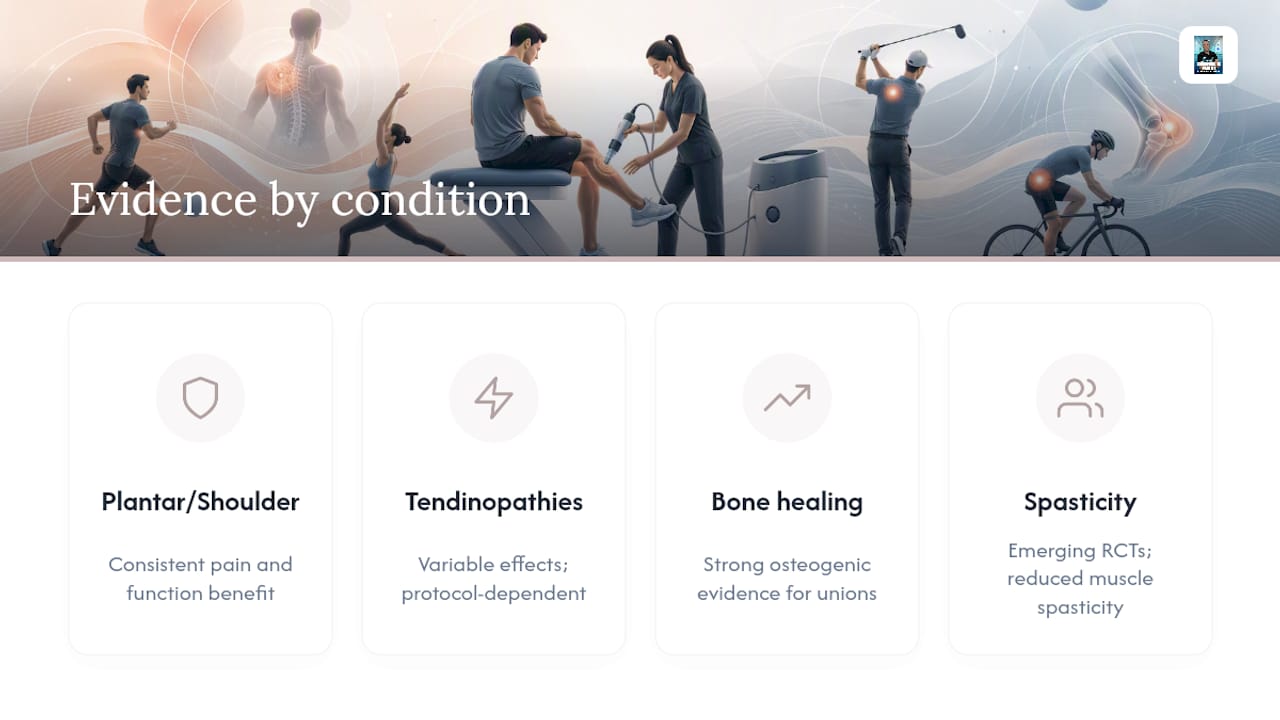
Plantar fasciitis and calcific shoulder tendinopathy have the deepest evidence base among musculoskeletal applications. Systematic reviews consistently show clinically meaningful improvements in pain and function compared to placebo, with most patients noticing change a few weeks after starting treatment, and benefits that can persist long term in some trials, according to clinical evidence summaries on ESWT.
Lateral epicondylopathy and Achilles or patellar tendinopathy show real but more variable effect sizes. Much of that inconsistency traces back to protocol differences between studies. One trial's "high energy, five sessions" is another trial's "low energy, ten sessions," and those choices change outcomes enough to muddy pooled results, a pattern documented in practice-management research on ESWT protocols.
Bone healing is where high-energy focused shockwaves earn their keep. For delayed union, nonunion, and stress fractures, evidence supports genuine osteogenic benefit, not just pain reduction, backed by documented upregulation of bone-forming markers in reviews of shockwave's biologic effects.
Spasticity treatment is the newest frontier. Randomized trials report measurable reductions in muscle spasticity and improved range of motion, positioning shockwave as a noninvasive alternative worth considering alongside or instead of botulinum toxin injections in certain neurologic cases.
The honest caveat across all of this: protocol heterogeneity is real, insurance coverage remains inconsistent even where the FDA has approved specific uses like plantar fasciitis, and matching the right device and energy setting to the right condition still depends heavily on clinician experience.
What Happens During a Shockwave Therapy Session?
A typical session runs 5 to 15 minutes. The clinician locates the point of maximal tenderness, applies coupling gel, and delivers pulses through the applicator directly over that spot.
- Initial low-energy pulses to gauge tolerance and confirm the correct target site.
- Energy escalation to the therapeutic range appropriate for the diagnosis, typically a few thousand impulses per session.
- Session spacing, usually one treatment per week for 3 to 5 sessions for tendinopathies, though bone applications may use fewer, more spaced-out sessions.
- Post-treatment observation for a few minutes to check for excessive soreness before discharge.
One detail surprises a lot of patients: clinicians generally avoid routine local anesthesia during treatment, because numbing the area can blunt the treatment's effectiveness by interfering with the feedback loop that helps guide energy placement. Mild discomfort during the session, followed by temporary soreness, redness, or a dull ache for a day or two afterward, is normal and expected.
Pro Tip: Ice the treated area for 10 to 15 minutes if soreness lingers past 24 hours, but skip anti-inflammatory medication in the first few days. NSAIDs can blunt the exact inflammatory signaling the treatment is trying to trigger.
What Are the Risks and Contraindications?
Shockwave therapy is noninvasive, but it isn't risk-free, and it isn't right for every patient or every body region.
- Absolute contraindications: malignant tumor in the treatment field, pregnancy with the fetus in the field, severe bleeding disorders, and, for high-energy focused applications specifically, the brain, spinal cord, lungs, or open growth plates in the field.
- Relative contraindications: pacemakers or implanted defibrillators near the treatment area, depending on the specific device's manufacturer guidance.
- Common side effects: transient pain during treatment, skin redness, and minor bruising that resolves within a few days.
- Rare complications: localized hematoma or temporary nerve irritation, both uncommon with proper technique.
High-energy bone applications carry more precision demands than soft-tissue treatments, which is why ISMST guidance specifically calls for a qualified physician operating focused-wave equipment with proper positioning technology for those cases.
Is Shockwave Therapy Right for You?
Good candidates typically have chronic symptoms, usually present for at least 3 to 6 months, that haven't resolved with rest, stretching, or basic conservative care. Imaging confirmation of the underlying pathology helps when it's available, particularly for tendinopathies and bone-healing cases.
Before starting, ask your clinician:
- Which device type and energy level will they use for your specific diagnosis?
- How many sessions should you expect, and what's the realistic timeline for improvement?
- What's the out-of-pocket cost, and does insurance cover any portion?
- Will shockwave be combined with therapeutic exercise or manual therapy?
Shockwave rarely works best as a standalone fix. Most successful outcomes pair it with a broader rehab plan, since surf coaches and athletic trainers alike emphasize that proper warm-up and movement prep reduces the reinjury risk that brings patients back to square one.
How Spark Handles Shockwave Therapy in Recovery Plans
Shockwave therapy is commonly used for patients recovering from car accidents, work injuries, and slip-and-falls where chronic tendon pain or slow-healing soft tissue is holding up progress. It's rarely used alone. We typically pair it with spinal adjustments, therapeutic exercise, and soft tissue work as part of one recovery plan. If you're considering a consult, bring any imaging or prior treatment records, and expect a full assessment before shockwave gets added to your plan.
— Spark
Get Shockwave Therapy at Sparkmed in North Miami
If you've been dealing with plantar fasciitis, tendon pain, or slow-healing injuries from an accident, shockwave therapy can be offered as part of a transparent, session-based treatment plan, without surprise billing or complicated insurance processes. Treatment may combine shockwave with spinal adjustments and rehab exercises tailored to specific injuries, including those from car accidents, workplace falls, or sports strain.
Curious what a course of treatment actually costs? Our shockwave therapy pricing breakdown lays out real numbers before you commit to anything. When you're ready to find out if you're a candidate, check our full list of services and schedule a consult. We'll assess your injury, walk you through device options, and build a plan around what your body actually needs.
FAQ
Where Should You Not Use Shockwave Therapy?
Avoid shockwave over malignant tumors, a fetus during pregnancy, active infection, or in patients with severe bleeding disorders. High-energy focused treatment also should not target the brain, spinal cord, lungs, or open growth plates.
What Are the Downsides of Shockwave Therapy?
Sessions can cause temporary pain, bruising, or redness at the treatment site, and results often take 3 to 12 weeks to show up rather than offering instant relief. Insurance coverage is also inconsistent even for FDA-approved uses like plantar fasciitis.
How Often Should You Do Shockwave Therapy?
Most tendinopathy protocols call for one session per week over 3 to 5 weeks, though bone-healing applications may use fewer, more widely spaced sessions depending on the diagnosis and device used.
Does Shockwave Therapy Actually Work?
For plantar fasciitis and calcific shoulder tendinopathy, evidence consistently shows meaningful pain and function improvement over placebo. Results for other conditions like rotator cuff tendinopathy or knee osteoarthritis are more mixed and still considered emerging.