
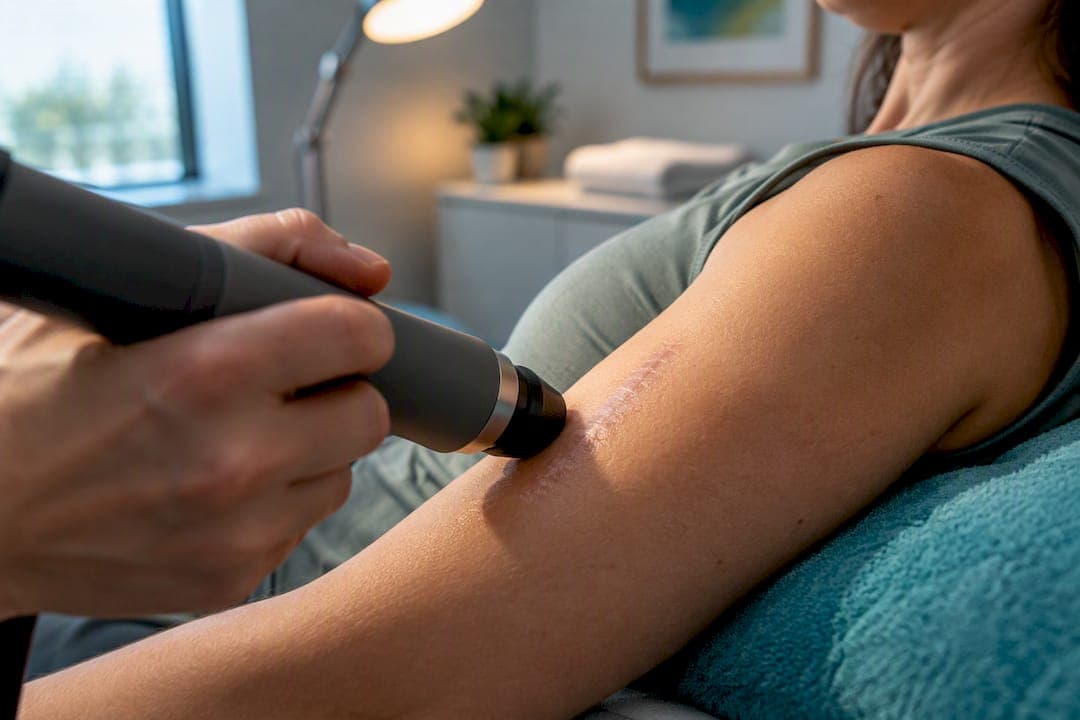
Clinical trials show extracorporeal shockwave therapy (ESWT) often improves scar pliability, pain, and sometimes thickness in hypertrophic scars and select keloids, based on randomized studies and systematic reviews. Results vary by scar type, device settings, and how many sessions a patient completes. It is not a one-visit fix, and it works best as part of a plan your clinician builds around your specific scar and screens for contraindications first.
TL;DR:
- Shockwave therapy typically requires 8 to 12 weekly sessions with 800 to 3,000 impulses each to show measurable improvements in scar pliability, pain, and thickness.
- The treatment works by creating mechanical stress that downregulates fibrogenic markers, increases blood flow, and promotes collagen alignment for better tissue remodeling.
- Ideal candidates are scars that impair function, such as restricting movement or causing pain, rather than entirely cosmetic scars that are flat and old.
- Contraindications include active malignancy, infection, bleeding disorders, pregnancy, and open growth plates in children, with screening essential before treatment begins.
- Combining ESWT with manual therapy, stretching, or steroid support can enhance outcomes, but treatment should be part of a personalized care plan tailored to each scar's characteristics.
Table of Contents
- What the Clinical Research Shows on Shockwave Therapy for Scar Tissue
- How Does Shockwave Therapy Work on Scar Tissue?
- Who Is a Good Candidate for This Treatment?
- What Does a Shockwave Therapy Protocol Actually Look Like?
- What Are the Side Effects and Safety Risks?
- How Does ESWT Compare to Other Scar Treatments?
- How Spark Evaluates Scars Before Recommending Shockwave Therapy
- Ready to Talk to Someone About Your Scar?
- Sources
- FAQ
What the Clinical Research Shows on Shockwave Therapy for Scar Tissue
The evidence for shockwave therapy for scar tissue is stronger than most people expect, though it is still developing. A double-blind randomized controlled trial on hand burn scars found statistically significant gains in pain scores, joint range of motion, grip strength, and skin elasticity after a full course of treatment using a Duolith SD-1 device on 120 patients over 12 weekly sessions. Systematic reviews looking at keloids and hypertrophic scars report similar patterns: improvements in POSAS and Vancouver Scar Scale (VSS) scores, reduced ultrasound-measured scar thickness, and less patient-reported pruritus.
Here is what shows up consistently across the trials:
- Scar pliability and elasticity improve on standardized scales like POSAS and VSS.
- Pain and itching (pruritus) drop measurably after multi-week courses.
- Ultrasound imaging often shows reduced scar thickness following treatment.
- Range of motion improves in scars that were restricting joint movement.
A closer look at the numbers: Trials typically deliver 1,000 to 3,000 impulses per session, with measurable improvement reported after 8 to 12 weekly sessions in the reviewed studies.
The catch is consistency. Studies use different devices (radial versus focused), different energy levels, and different session counts, which makes it hard to say there is one "correct" dose. A broader review of ESWT across soft tissue conditions noted this same heterogeneity, concluding that ESWT reduces pain and improves function reliably, but standardized dosing recommendations remain elusive. That is a real limitation, but it is also true of most physical medicine interventions at this stage of research.
How Does Shockwave Therapy Work on Scar Tissue?
The mechanism behind ESWT comes down to mechanotransduction. Acoustic pulses delivered through the skin create controlled mechanical stress inside scar tissue, and cells respond to that stress by changing their behavior at a molecular level.
Specifically, the pulses appear to:
- Downregulate fibrogenic markers like TGF-β1 and alpha-SMA, which drive excess collagen production.
- Upregulate matrix metalloproteinases (MMPs) that help break down disorganized collagen.
- Boost VEGF and nitric oxide, improving blood flow and vascularity in scar tissue.
- Reduce myofibroblast activity, which is what causes scars to contract and tighten.
The net effect on tissue is collagen bundles that lie flatter and more parallel instead of the thick, tangled mass typical of hypertrophic scarring. This is also why dosing is not something a clinician eyeballs. Lower energy densities tend to stimulate cell proliferation and healthy remodeling, while pushing pulse counts or energy too high risks damaging cells rather than repairing them. That dose sensitivity is exactly why protocols vary so much between studies and clinics.
Who Is a Good Candidate for This Treatment?
The evidence supports ESWT most clearly for scars causing functional problems, not just cosmetic ones. If a scar is limiting joint movement or causing ongoing pain, you have a stronger case for treatment than someone with an old, flat scar that just looks different from surrounding skin.
Scars with reasonable evidence behind ESWT include:
- Hypertrophic scars, especially those restricting movement or function.
- Some keloids, particularly when combined with other treatments.
- Post-burn scars on the hands involving contracture, where trial data is strongest.
There are firm reasons to avoid treatment, and your provider should screen for these before you ever get on the table:
- Malignancy at or near the treatment site.
- Active infection in the area.
- Uncorrected bleeding disorders.
- Pregnancy, when treatment would be over the abdomen or pelvis.
- Open growth plates in children, since the mechanical stress can affect developing bone.
Relative cautions worth flagging to your clinician include recent steroid injections in the same spot, blood-thinning medication, and implanted electronic devices near the treatment zone.
Pro Tip: Bring a list of every injection, medication, and prior scar treatment you have had in the last six months to your first visit. This single detail changes how a clinician sets the energy level and timing of your first session.
What Does a Shockwave Therapy Protocol Actually Look Like?
Trial protocols give a realistic template for what treatment involves, even though your clinician will adjust it to your scar.
- Device selection. Radial devices cover broader, shallower areas at lower peak energy; focused devices reach deeper into thicker or more localized scars.
- Energy dosing. Studies commonly use energy flux density (EFD) around 0.05 to 0.33 mJ/mm², adjusted based on scar depth and your tolerance.
- Impulse count. Most sessions deliver 800 to 3,000 impulses, depending on scar size and device type.
- Frequency and duration. A typical course runs once weekly for 8 to 12 weeks. One well-cited trial used exactly 12 weekly sessions and documented functional gains in grip strength and joint motion.
- Outcome tracking. Clinicians measure progress using POSAS or VSS scoring, ultrasound thickness readings, pain on a visual analog scale, and range-of-motion tests.
What this means for your timeline: Do not expect dramatic change after one visit. Most people notice gradual shifts in pliability and pain over several weeks, with the clearest gains showing up near the end of a full course and holding at short-term follow-up.
What Are the Side Effects and Safety Risks?
ESWT is a low-risk procedure when it's done by a trained operator on a properly screened patient, but it is not sensation-free.
Expect these common, short-lived reactions:
- Localized pain during and immediately after treatment, usually described as a deep ache rather than sharp pain.
- Redness at the treatment site.
- Petechiae, or small red pinpoint marks from tiny broken capillaries.
- Mild bruising, particularly with higher-energy focused devices.
These typically resolve within days. Rarer but more serious issues can occur in patients with bleeding disorders or when the device is used over infected or malignant tissue, which is exactly why pre-treatment screening matters. FDA device documentation for ESWT systems outlines these same adverse event patterns from clinical trials. Before your first session, disclose all medications and prior injections, confirm your provider follows proper device cleaning and sterilization, and never allow treatment directly over an open wound. You can read more about what to expect after a session if you want the full rundown on recovery.
How Does ESWT Compare to Other Scar Treatments?
Shockwave therapy does not replace every standard scar treatment, and it is not meant to. Silicone sheeting and compression garments remain reasonable first-line options for new or mild scars, particularly in the early months after an injury heals.
Where ESWT earns its place is with persistent, symptomatic, or contractile scars that have not responded to conservative care. A systematic review comparing ESWT to intralesional steroid injections found comparable functional and cosmetic results in several studies, and combining ESWT with steroids outperformed steroids alone in others.
- Silicone and pressure garments: reasonable first choice for early, mild scarring.
- Intralesional steroids: effective, but ESWT shows similar results in some trials with fewer needle sessions.
- ESWT plus steroids: better outcomes than either approach alone in combination studies.
- Laser and surgery: often reserved for scars unresponsive to non-invasive options, sometimes used alongside ESWT rather than instead of it.
For many patients, ESWT functions as a bridge. It can reduce how often you need repeat steroid injections and complements a surgical or laser plan rather than competing with it.
How Spark Evaluates Scars Before Recommending Shockwave Therapy
A scar assessment worth trusting starts with function, not just appearance. When our clinicians evaluate a scar candidate for shockwave therapy, they look at how much the scar restricts movement, what has already been tried, and whether imaging or a closer skin exam is warranted before setting any device parameters.

Shockwave therapy rarely stands alone in an effective plan. At Spark, it is typically paired with manual therapy, targeted stretching, and, depending on the scar's stage, silicone or steroid support alongside it. That mirrors what the comparative research shows about combination approaches outperforming single interventions. We track progress the same way the trials do, using pain scales, mobility checks, and scar appearance over the course of treatment, not just a single before-and-after photo.
Complementary manual therapy, like the kind described in our overview of soft tissue treatment, often runs alongside shockwave sessions to support the tissue changes happening underneath the skin.
— Spark
Ready to Talk to Someone About Your Scar?
Sparkmed treats shockwave therapy as one tool inside a bigger recovery plan, not a stand-alone gadget you book once and hope works. If you are weighing ESWT against repeat steroid injections or a wait-and-see approach, the real advantage of coming to a clinic like ours is that you get a functional assessment first and an individualized protocol second.
Before you book anywhere, ask three things: what device type they use (radial or focused), how many patients with your scar type they have treated, and what a full course of sessions costs. You can review shockwave therapy pricing and our broader service catalog, including massage and ultrasound therapy that often pair with ESWT, directly on our site. Ready to find out if you're a candidate? Book a consultation and bring your scar history, current medications, and any prior treatment records to your first visit.
This article is general information, not a substitute for advice from a qualified doctor. Consult a qualified healthcare professional about your own circumstances before acting on anything here.
Sources
- Shock Wave Therapy for Wound Healing and Scar Treatment — NCBI Bookshelf
- Clinical utility of extracorporeal shock wave therapy in restoring hand function — PMC
- Extracorporeal shockwave therapy for scar management — PubMed entry
FAQ
Where Should You Not Use Shockwave Therapy?
Avoid ESWT over active malignancy, infected tissue, and open growth plates in children. Pregnant patients should not receive treatment over the abdomen or pelvis, and people with uncorrected bleeding disorders need medical clearance first.
When Is It Too Late to Break Up Scar Tissue?
There is no fixed expiration date, but older, flat, purely cosmetic scars tend to respond less predictably than scars still causing pain or restricting movement. Scars with active functional symptoms, even years old, are usually still reasonable candidates for evaluation.
What Therapy Breaks Up Scar Tissue Most Effectively?
Extracorporeal shockwave therapy has some of the strongest clinical trial support among non-invasive options for reducing scar thickness and improving pliability, according to research on hand burn scars and keloid management. Manual therapy and stretching often support the same goal alongside it.
What Is the Best Treatment for Deep Scar Tissue?
For thicker or deeper scars, focused ESWT devices tend to reach the target tissue better than radial devices, which work best on broader, shallower areas. Many clinicians combine ESWT with intralesional steroids or manual therapy for deep, contractile scars rather than relying on one method alone.
Does Sparkmed Offer Shockwave Therapy for Scar Tissue?
Yes, Sparkmed provides shockwave therapy sessions priced at $75 per session, along with complementary services like massage and ultrasound therapy. Pricing for wellness plans and other advanced treatments is also listed on the pricing page.