

Shockwave therapy is generally safe. Most patients get only mild, short-lived side effects, including pain during the pulses, temporary redness, mild bruising, and some swelling that clears up within a few days. Rare but serious complications, such as tendon damage or infection, do turn up in the research, but they're uncommon. If something feels off after treatment, call your provider rather than waiting it out.
TL;DR:
- Serious complications from shockwave therapy are rare and are usually linked to pre-existing conditions, improper technique, or high energy levels.
- Short-term side effects like skin reddening, bruising, and pain are common but tend to resolve within a few days to weeks, with pain potentially rebounding after treatment.
- Patients with active infections, malignancies, pregnancy, or pacemakers should avoid the therapy, and those on blood thinners need to disclose their medication beforehand.
- Progressive energy dosing, careful technique, and open communication during sessions can significantly reduce discomfort and improve safety outcomes.
- Most adverse effects are predictable, mild, and transient, with systematic review data showing serious complications are uncommon within the first year post-treatment.
Table of Contents
- Common Short-Term Side Effects Of Shockwave Treatment
- Rare But Serious Shockwave Therapy Complications
- Who Should Avoid Or Delay Shockwave Therapy
- What Happens During And After A Shockwave Session
- How To Reduce And Manage Shockwave Therapy Side Effects
- What The Research Says About Shockwave Safety
- SparkMed's Approach To Safer Shockwave Treatment
- Why Shockwave Side Effects Get Overblown Online
- Get Screened Before Your First Shockwave Session
- Sources
Common Short-Term Side Effects Of Shockwave Treatment
The side effects of shockwave treatment that patients report most often are predictable and temporary. Pain during the actual pulses is the most consistent complaint. It usually feels like a sharp, rhythmic tapping or a deep ache at the treatment site, and it tends to ease within the first minute as your tissue adjusts.
After the session, expect one or more of these:
- Skin reddening or small red spots (petechiae) over the treated area
- Mild to moderate bruising or a small hematoma
- Localized swelling that peaks within a day or two
- Brief numbness or tingling near the treatment zone
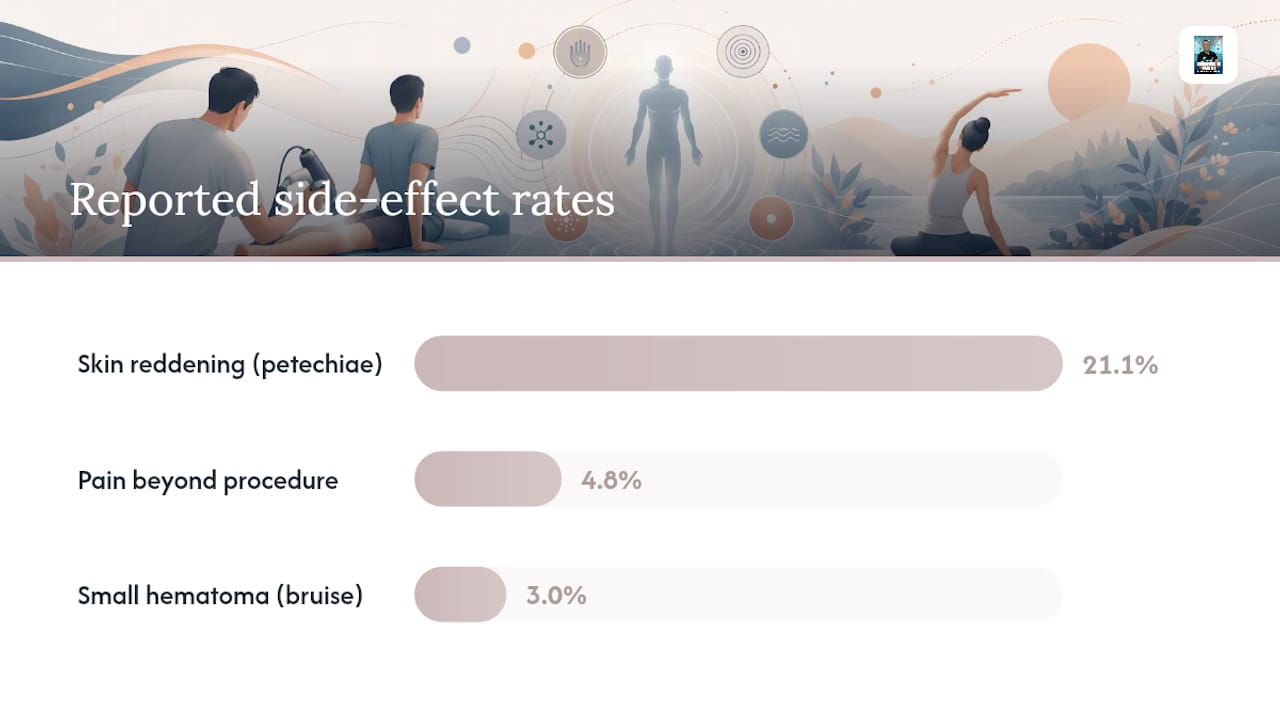
One clinical trial puts numbers on this. In a randomized, placebo-controlled study on tennis elbow, about 21.1% of shockwave patients developed transient skin reddening, 4.8% reported pain as a distinct side effect beyond the procedure itself, and 3.0% developed small hematomas, all notably higher than the placebo group.
The timeline matters more than any single symptom. Discomfort typically peaks right after treatment, fades over the next 72 hours, and then something counterintuitive can happen: pain can return around the one to two week mark before the deeper healing kicks in. Ohio State's sports medicine program describes this rebound as a normal part of the process, not a sign that treatment failed. Most people need several sessions before they notice lasting improvement, so one rough week doesn't mean the plan needs to change.
Rare But Serious Shockwave Therapy Complications
Serious complications exist, but they show up far less often than the bruising and soreness most patients experience. Reports in the literature include:
- Tendon rupture at the treatment site
- Infection following regional anesthesia
- Syncope (fainting) during or after treatment
- Migraine episodes triggered by the procedure
- Precordial (chest wall) pain when treating areas near the torso
Systematic-review evidence across multiple indications finds that serious complications remain uncommon within the first year of follow-up, though long-term complication data are still limited, and the tennis elbow trial that documented reddening and hematomas also recorded a handful of syncopal and migraine events in the treatment group.
Causation isn't always clean here. Tendon rupture reports, in particular, get complicated by confounders like prior corticosteroid injections, which weaken tendon tissue independent of shockwave exposure, along with technique variation and energy dose. Short follow-up windows and inconsistent reporting standards across studies make it hard to say with confidence how often these rare events trace back to the treatment itself versus a patient's underlying tissue condition.
Who Should Avoid Or Delay Shockwave Therapy
Certain conditions rule shockwave therapy out entirely; others just call for a conversation with your provider first. The ISMST guidelines lay out both categories clearly.
Absolute contraindications (treatment should not proceed):
- Malignancy located in the treatment field
- Pregnancy, when the fetus is in or near the treatment field
- Pacemaker or defibrillator positioned in the treatment field
- Active infection at the treatment site
Relative contraindications (proceed only with caution and provider judgment):
- Bleeding disorders or anticoagulant medication use
- Recent corticosteroid injection at the target site
- Treatment areas directly over major nerves or lung tissue at high energy levels
Tell your provider about every medication, implant, and prior injection before your first session. Patients on blood thinners face a higher chance of bruising and hematoma, and clinical guidance from major medical centers recommends disclosing anticoagulant use upfront so the provider can adjust the plan or decline treatment if bleeding risk is too high.
What Happens During And After A Shockwave Session
A shockwave session starts with your provider locating the exact injury site, often by pressing along the area until they find the point of maximum tenderness. Once they find it, they apply gel and place the handpiece against your skin. You'll hear a rapid clicking or popping sound as pulses fire, and you'll feel each one as a quick, sharp tap.
Here's what typically happens next:
- Sessions run 5 to 20 minutes, depending on the area and device
- Providers deliver anywhere from 1,500 to 4,000 pulses per session
- Most treatment courses involve multiple sessions, typically spaced about one to two weeks apart
- Focused devices target deeper tissue with more precision; radial devices spread energy over a broader, shallower area
Pain control comes down to how the energy is delivered. Providers typically start at a low intensity and ramp up gradually rather than starting at full strength, and some use local anesthesia for particularly sensitive areas. If you're weighing this against a multi-session treatment plan and wondering what the total cost and time commitment looks like, it helps to know upfront that most protocols aren't a one-visit fix.
How To Reduce And Manage Shockwave Therapy Side Effects
You have more control over your experience than you might think. A few deliberate choices before, during, and after treatment can meaningfully cut down on discomfort and speed up recovery.
Before your session:
- List every medication you take, especially blood thinners, for your provider
- Mention any corticosteroid injections in the treatment area within the past few weeks
- Disclose implants like pacemakers, and confirm you're not pregnant if the treatment field is near the abdomen
During the session, speak up. Ask your provider to ramp the energy up gradually rather than starting at a high setting. Evidence from trial subgroup analyses shows that low-dose, progressive dosing and focused technique produce measurably less procedural pain than high-dose or direct application. If a pulse feels unbearable rather than uncomfortable, say so immediately. That's not a sign you're being sensitive. It's useful feedback your provider needs.
After treatment, ice the area for 15 to 20 minutes, rest it for the day, and take acetaminophen if needed for soreness. Avoid heavy loading on the treated area unless your provider clears you for it, and follow any structured recovery guidance they give you.

Pro Tip: Keep a simple symptom log for the first 48 hours after each session, noting pain level, swelling, and anything unusual. Bringing that log to your next appointment helps your provider fine-tune the energy settings instead of guessing.
Seek medical attention right away if you notice worsening numbness, spreading redness with warmth or fever, swelling that keeps growing rather than peaking, or pain that stays severe past the first few days.
What The Research Says About Shockwave Safety
The incidence numbers from controlled trials back up what clinics tell patients anecdotally: side effects are common in a mild form and rare in a severe one. The tennis elbow trial found roughly 21% of treated patients had transient skin reddening compared to a much lower rate in the placebo arm, with a documented odds ratio of 4.3 for side effects overall in the shockwave group.
Key patterns from the evidence:
- Pain during treatment and transient skin changes are the most consistently reported effects across indications
- Serious complications are uncommon in the first year after treatment, based on systematic-review data
- Progressive dosing and focused-technique application correlate with less procedural pain than high-dose or unmodulated delivery
- ISMST guidelines call for consistent complication reporting to close the long-term data gap that still limits the field
That data gap is real. Most studies track patients for months, not years, and reporting standards for adverse events vary between trials. Ongoing work through registries like Mayo Clinic's clinical trials program continues to refine dosing protocols and safety data, which is one reason providers lean conservative with energy settings rather than pushing for faster results.
SparkMed's Approach To Safer Shockwave Treatment
Shockwave therapy is offered as part of a broader set of noninvasive recovery options for patients dealing with musculoskeletal pain, including those recovering from car accidents, work injuries, and slip-and-falls. Screening for contraindications happens before treatment starts, not as an afterthought.
That means asking directly about medications, implants, recent injections, and pregnancy status, then using progressive energy dosing to keep discomfort manageable rather than defaulting to a fixed protocol. Follow-up between sessions lets the care team catch rebound pain or unusual reactions early. If you're weighing whether shockwave therapy fits your situation, reach out through Sparkmed's services page to talk through your specific risk factors before booking a session.
Why Shockwave Side Effects Get Overblown Online
Search results tend to swing one of two ways on this topic: breezy reassurance that nothing ever goes wrong, or alarmist lists of every complication ever documented, stripped of context. Neither serves the patient trying to decide whether to book a session.
The honest read is that the risk profile looks a lot like most outpatient procedures involving physical force on tissue: predictable minor reactions in a meaningful share of patients, and rare severe events that show up in the literature precisely because researchers are looking hard enough to catch them. That's a sign of good reporting, not a sign the treatment is more dangerous than it seems. What gets underweighted is the role of technique. A provider who ramps energy gradually and adjusts based on your feedback during the session is making a real difference in your outcome, not just following protocol for its own sake. Patients who ask questions and speak up mid-session tend to have a better experience than those who grit their teeth through it.
If you're comparing this against other noninvasive paths for pain recovery, it helps to look at the full range of options rather than treating shockwave therapy as an isolated decision. And for aftercare basics like icing protocols, resources such as Cool Relief's recovery guides offer practical detail that applies well beyond the specific procedure they're written for.
— Spark
Get Screened Before Your First Shockwave Session
Patients receive screening for the contraindications covered above, medications, implants, recent injections, and pregnancy status before a provider begins shockwave therapy.

Screening, progressive energy dosing, and follow-up between sessions can help keep side effects in the mild, expected range for most patients rather than the rare-but-serious category. Whether recovering from a car accident, a workplace injury, or ongoing musculoskeletal pain, patients can discuss whether shockwave therapy fits their specific case. Visit Sparkmed's services page to book a consultation and get your questions answered before your first appointment.
This article is general information, not a substitute for advice from a qualified doctor. Consult a qualified healthcare professional about your own circumstances before acting on anything here.
Sources
- Side-effects of extracorporeal shock wave therapy (ESWT) in the treatment of tennis elbow - PubMed
- Complications of extracorporeal shockwave therapy in ... (systematic review)
- Shockwave Therapy | Ohio State Medical Center
- ISMST Guidelines for ESWT (PDF)