
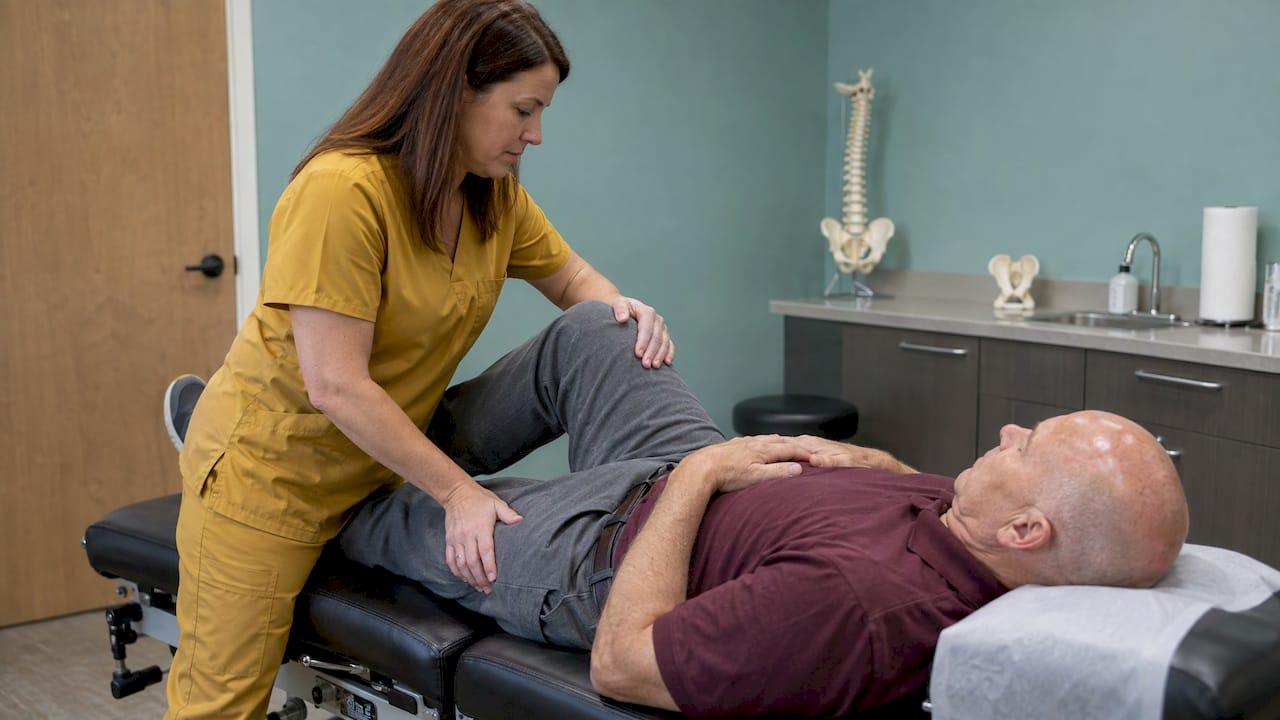
A chiropractor can examine your sacroiliac (SI) joint, find out whether it is the source of your low back, buttock or pelvic pain, and treat it with spinal and pelvic adjustments, soft-tissue work and guided exercise. Research on manual therapy for SI joint pain points to a meaningful improvement in how well people move and function. If you live in North Miami, or your pain started after a car accident, a work injury or a fall, our clinic can evaluate the joint and build a plan around it, with adjustments listed at $45.
TL;DR
- The SI joint links your spine to your pelvis, and it can refer pain to the low back, buttock, hip and groin. A hands-on exam is how a chiropractor tells it apart from a disc or hip problem.
- A 2024 meta-analysis of 16 randomized trials found that manual therapy for SI joint pain had a moderate, statistically significant effect on reducing disability.
- Care usually combines adjustments, soft-tissue therapy and active exercise, so you keep the gains between visits.
- Certain symptoms, such as numbness, leg weakness or pain after serious trauma, need medical evaluation first. Tell your chiropractor about them at the first visit.
- At Sparkmed in North Miami, an adjustment is $45 and shockwave therapy is $75 per session.
Table of Contents
- What the SI joint does and why it hurts
- Can a chiropractor help with sacroiliac joint dysfunction?
- How a chiropractor works out whether it is your SI joint
- What treatment usually includes
- When the SI joint pain began after an accident
- Related problems readers ask about
- Safe use: who should tell the chiropractor first
- What it costs at Sparkmed
- Book an SI joint evaluation in North Miami
- Our perspective
- FAQ
- Sources
What the SI joint does and why it hurts
You have two sacroiliac joints, one on each side of the base of your spine, where the sacrum meets the pelvis. They transfer load between your upper body and your legs every time you walk, climb stairs or get out of a car. They move only a little, which is exactly why they depend so heavily on the ligaments and muscles around them.
A review of SI joint anatomy and biomechanics points to the same practical conclusion: treatment should aim at improving the stability of the surrounding soft tissues and reducing mechanical stress from poor posture. That is a useful way to think about your own care. The goal is not only to move the joint, but to calm the tissue around it and train it to hold steady.
Common triggers include:
- A car collision, especially a rear-end or side impact, where the pelvis is loaded suddenly
- A slip and fall onto the buttocks or hip
- Repetitive lifting or twisting at work
- Pregnancy and the months after it
- Long periods of sitting, or uneven weight bearing from a leg or foot problem
Typical complaints are a deep ache on one side of the low back or over the buttock, pain when you stand up from a chair, pain rolling over in bed, and discomfort standing on one leg. Because a disc, a hip or a muscle can feel similar, the exam matters more than the label you give yourself.
Can a chiropractor help with sacroiliac joint dysfunction?
Yes, and the evidence is encouraging on the point that matters in daily life: function. A 2024 systematic review and meta-analysis of 16 randomized trials covering 421 adults found a statistically significant, moderate effect of SI joint manual therapy on disability. In plain terms, people moved and managed daily tasks better after manual therapy.
A randomized trial of 60 patients with sacroiliac joint syndrome gave four chiropractic adjustments over two weeks. Both groups, one receiving a manual high-velocity adjustment and one a mechanical-force instrument adjustment, improved significantly in pain and disability, with no meaningful difference between the two techniques. That matters if you prefer a gentler approach: instrument-assisted and lower-force methods are options, and a good chiropractor will match the technique to you.
The broader low back literature points the same way. A VA systematic review of spinal manipulative therapy found moderate-quality evidence that manipulation improved pain and function in acute low back pain. And the American College of Physicians guideline lists spinal manipulation, along with superficial heat, massage and acupuncture, among first-line non-drug options for acute and subacute low back pain.

How a chiropractor works out whether it is your SI joint
Imaging rarely shows an irritated SI joint clearly, so the diagnosis is built at the exam table. A good evaluation has four parts.
1. History
Expect questions about when the pain started, what makes it worse, whether it crosses into the leg, and whether there was any trauma. After a collision or fall, the details of the impact help guide what to check.
2. Pain provocation tests
The SI joint is assessed with a cluster of movements that stress it and reproduce your pain. According to the Illinois Chiropractic Society, having three of six provocation tests positive showed 93.8% sensitivity and 78.1% specificity, and the thigh thrust and distraction tests were the most sensitive and specific. The same anatomy review notes that, among SI joint tests, pain provocation tests are the ones with validity, which is why a clinician relies on the cluster rather than on a single finding.
3. Ruling out other sources
Low back pain can come from several places. The VA/DoD low back pain guideline reminds clinicians to consider referred pain from the SI joint, the hip joint and the trochanteric bursa, and notes that a small share of cases involve conditions such as compression fracture (4%), spinal stenosis (3%) or a symptomatic herniated disc (4%). Your chiropractor checks strength, reflexes and sensation in the legs for exactly this reason.
4. Imaging only when it changes the plan
The American Chiropractic Association's 2023 best practices guideline advises against routine imaging without red flags, and suggests considering it if there is no improvement after 4 to 6 weeks of care, if red flags are present, if there are severe or progressive neurologic deficits, or if there was severe spinal trauma. If your case fits any of those, you should get the imaging.
What treatment usually includes
A 2019 evidence-based chiropractic decision aid for sacroiliac joint pain lists education about the condition, spinal manipulation, regional muscle strengthening, motor control exercise, heat, massage, low-level laser and self-care advice. That menu is close to what a well-rounded visit looks like.
| Approach | What it does for the SI joint area | Where we offer it |
|---|---|---|
| Spinal and pelvic adjustment | Restores motion and reduces stiffness around the joint | Chiropractic adjustment, $45 |
| Massage therapy | Relaxes tight glutes, piriformis and low back muscles | Massage therapy |
| Ultrasound therapy | Deep warming of soft tissue | Ultrasound therapy |
| Electrical stimulation | Calms muscle guarding and spasm | Electrical stimulation |
| Traction / decompression | Gentle unloading of the lower spine | Traction / decompression |
| Shockwave therapy | Targets stubborn, tight soft tissue | Shockwave therapy, $75 per session |
A 2025 critically appraised topic by Joyce and colleagues found level B evidence supporting exercise therapy, manual therapy, or both for SI joint dysfunction, and suggested that a combination may serve long-term pain reduction better. This is why we pair hands-on care with an active plan: stabilizing exercises, posture changes and movement habits you can use at home and at work. You can read more on how this works in our guide to the role of manual therapy in musculoskeletal recovery and our roadmap to non-surgical back pain care.
What a first visit and a typical course look like
The first visit is an evaluation: history, orthopedic and neurological checks, and a movement assessment. If the SI joint is involved, treatment often starts the same day with an adjustment and soft-tissue work. The trial above used four adjustments over two weeks, which gives you a sense of how short, focused courses are structured, though your own plan depends on your exam. The ACA guideline's 4 to 6 week checkpoint is a sensible moment to review progress together.
When the SI joint pain began after an accident
If your pain started after a collision, a fall at a store or an injury at work, a few things change. First, the pelvis and low back are often injured together with the neck, hips and surrounding muscles and ligaments. Second, documentation matters: a clear record of your symptoms, exam findings and progress supports an injury claim.
Our clinic emphasizes more than 20 years of experience treating accident victims, direct insurance billing and thorough injury documentation for claims. We also offer an auto accident evaluation, and our team supports patients in English, Spanish and Creole. For patients who need a ride to the clinic, we offer Uber Health transport in North Miami. See our overview of chiropractic methods that aid healing after car accidents and our page on shockwave therapy for car accident injuries in North Miami.
If you were seriously hurt, with severe pain, loss of feeling, weakness or loss of bladder or bowel control, go to an emergency room first. Once you are medically cleared, chiropractic care can be part of recovery.

Related problems readers ask about
Herniated disc or SI joint?
The two can overlap, and sometimes occur together. Pain that runs below the knee with numbness or weakness points to the nerve and calls for a careful neurological exam. A 2022 study using US health records of adults aged 18 to 49 with a new lumbar disc herniation or radiculopathy found that those who received chiropractic spinal manipulation had lower odds of later needing a lumbar discectomy, at one year (OR 0.69) and two years (OR 0.77). If your symptoms suggest a disc, your chiropractor will say so, tailor the technique, and coordinate imaging when it is warranted.
Soft-tissue injuries
Sprains, strains and contusions in the low back, hip and glute muscles often accompany an SI joint problem, particularly after an impact. Treatment typically combines gentle mobilization, heat or ultrasound, electrical stimulation, massage and a graded return to activity. Our article on massage therapy after a car accident covers the soft-tissue side in more detail.
Muscle spasm
When the joint is irritated, the surrounding muscles tighten to protect it, and that guarding can feel like the main problem. A 2009 systematic review of chiropractic management of myofascial trigger points found moderately strong evidence for manipulation and ischemic pressure for immediate pain relief, along with strong evidence for laser therapy and moderate evidence for TENS in myofascial pain. Treating the spasm and the joint together is the logical approach.
Safe use: who should tell the chiropractor first
Chiropractic care is generally used safely, and a thorough intake is how it stays that way. The Merck Manual states that serious complications from spinal manipulation are rare, and that manipulation is not recommended for patients with osteoporosis or symptoms of neuropathy. The VA review above notes that mild, temporary soreness after manipulation is common, so expect to feel it for a day or so.
Tell your chiropractor before any adjustment if you have:
- Osteoporosis or a history of fractures
- Numbness, tingling or weakness in a leg or foot
- Unexplained weight loss, fever or a history of cancer
- Pain after significant trauma
- Loss of bladder or bowel control (seek emergency care right away)
A 2020 guideline on chiropractic care for chronic musculoskeletal pain calls for carefully screening for contraindications and red flags before high-velocity thrust techniques, and for combining passive care with active interventions and self-care. A thorough screening is part of every evaluation we do, and technique can be adjusted to your situation.
What it costs at Sparkmed
Our prices are published, so you can plan before you book. Prices below were read from our site in 2026 and the pricing page is always current.
| Service | Price |
|---|---|
| Chiropractic adjustment | $45 |
| Shockwave therapy | $75 per session |
| Essential plan | $149 per month |
| Performance plan | $249 per month |
| Elite plan | $399 per month |
Massage therapy, electrical stimulation, ultrasound therapy, traction/decompression and the auto accident evaluation are on our services page. Compare the monthly plans on the pricing page.
Book an SI joint evaluation in North Miami
If one-sided low back or buttock pain is limiting how you sit, walk or sleep, an evaluation is the fastest way to know whether the SI joint is the cause. We examine the joint, explain what we find in English, Spanish or Creole, and start a plan built on adjustments, soft-tissue care and active exercise. Adjustments start at $45, and if your pain followed an accident, we bill insurance directly and document your injuries thoroughly.

Book a chiropractic adjustment or see all treatment options and plans.
Our perspective
The SI joint is a good example of why we do not treat a diagnosis, we treat a person. Pain on one side of the low back after a collision or a fall is rarely just one structure: the joint, the ligaments and the muscles around it are all involved.
That is why our care combines adjustments with soft-tissue therapy, ultrasound, electrical stimulation, traction and shockwave where they fit. The research supports this mix: manual therapy improves function in people with SI joint pain, and pairing it with exercise is associated with better long-term results.
After more than 20 years of working with accident victims, our priority is to make care easy to start: transparent prices, direct insurance billing, support in English, Spanish and Creole, and transport help through Uber Health. If you have been putting off a visit, the evaluation is the step that turns guessing into a plan.
Spark
FAQ
Can a chiropractor fix sacroiliac joint dysfunction?
A chiropractor can treat it and help you move and function better. A 2024 meta-analysis found a moderate improvement in disability with SI joint manual therapy. Results vary by person, so the plan is built from your exam and reviewed as you progress.
How many visits will I need for SI joint pain?
It depends on the cause, how long you have had symptoms and what your exam shows. A published trial used four adjustments over two weeks, and the ACA guideline suggests reviewing progress after 4 to 6 weeks. We set expectations at your first visit and adjust as you respond.
Is a chiropractic physician a real doctor?
Doctors of chiropractic are licensed health care professionals who examine, diagnose and treat musculoskeletal conditions, with a focus on the spine and joints. They do not prescribe surgery. If your exam points to a problem that needs another specialist, the chiropractor will tell you.
What are the red flags before an adjustment?
Numbness or weakness in a leg, loss of bladder or bowel control, fever, unexplained weight loss, osteoporosis, and severe pain after trauma. Tell your chiropractor about any of these before treatment. Sudden loss of bladder or bowel control is an emergency.
Do I need insurance to be seen?
No. Adjustments are listed at $45 without insurance. If your pain follows a car accident, we bill insurance directly and document your injuries for your claim.
Sources
- Efficacy of manual therapy for sacroiliac joint pain (2024 meta-analysis)
- A randomized clinical trial of manual versus mechanical force manipulation for sacroiliac joint syndrome
- The sacroiliac joint: a review of anatomy and biomechanics
- Diagnosis of Sacroiliac Joint Pain, Illinois Chiropractic Society
- VA systematic review: effectiveness and harms of spinal manipulative therapy
- American College of Physicians guideline on noninvasive treatments for low back pain
- VA/DoD Clinical Practice Guideline for low back pain
- Best Practices for Chiropractic Management of Adult Patients With Mechanical Low Back Pain
- Evidence-based chiropractic clinical decision aid for sacroiliac joint pain
- The effects of exercise and manual manipulation on sacroiliac joint dysfunction
- Chiropractic spinal manipulation and lumbar discectomy cohort study
- Chiropractic management of myofascial trigger points
- Merck Manual Professional: Chiropractic
- Best Practices for Chiropractic Management of Patients with Chronic Musculoskeletal Pain