
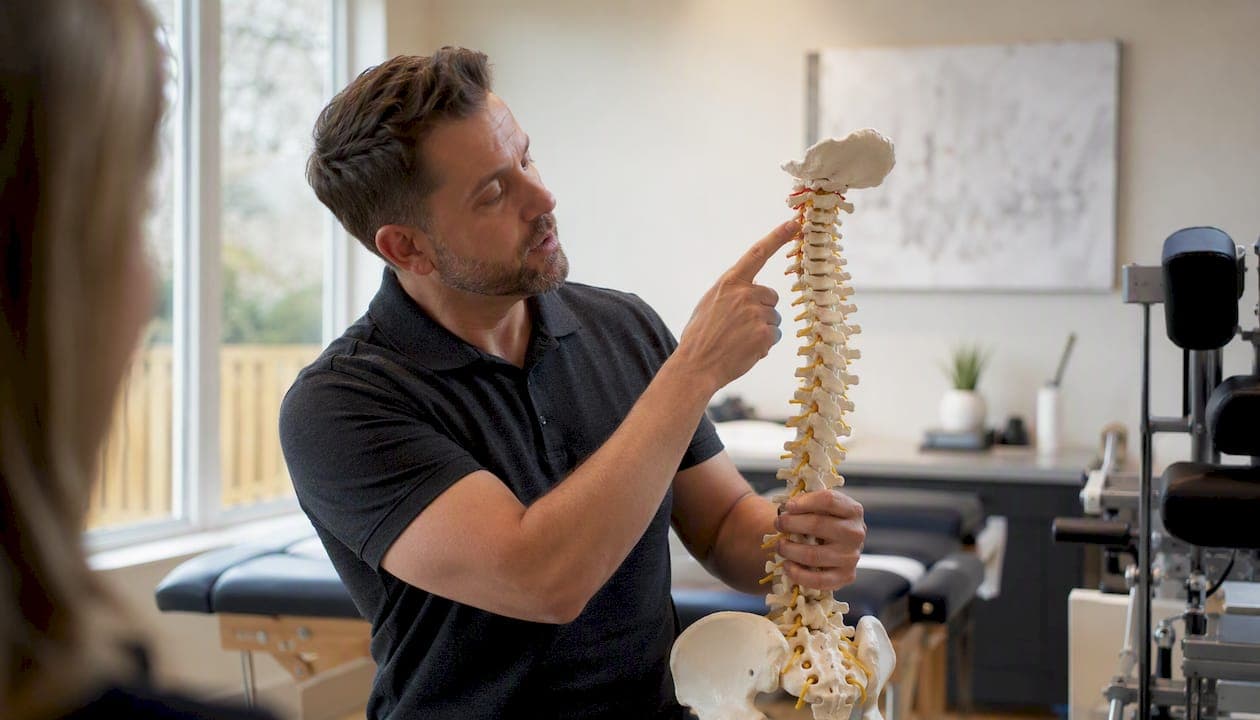
A herniated disc happens when the soft inner core of a spinal disc pushes through a crack in its tougher outer ring, often pressing on nearby nerves and triggering pain, numbness, or weakness that radiates down an arm or leg. Most cases are not emergencies and respond to time and conservative care.
Call 911 or go to the nearest ER right away if you notice sudden loss of bladder or bowel control, numbness in the saddle area (inner thighs, groin), or rapidly worsening leg weakness. These signs may point to cauda equina syndrome, and delayed surgery risks permanent nerve damage.
If none of those apply, your next steps are more routine:
- Schedule a visit with a primary care doctor or spine specialist within the next few days.
- Try short-term activity modification and over-the-counter pain relief.
- Expect a physical exam that checks reflexes, strength, and sensation before any imaging gets ordered.
Key Takeaways
A herniated disc occurs when the inner core of a spinal disc tears through its outer ring and presses on a nerve, and most cases improve with conservative, non-surgical care over several weeks.
| Point | Details |
|---|---|
| Definition matters | A herniation involves a torn outer ring, unlike a bulge, which stays intact but sags outward. |
| Red flags require ER care | Loss of bladder/bowel control or saddle numbness signals a possible surgical emergency. |
| MRI needs clinical correlation | Imaging alone can mislead, since many people show herniations with no symptoms at all. |
| Conservative care works first | Activity modification, NSAIDs, and physical therapy resolve most cases before injections or surgery. |
| Recovery is usually fast | Many patients improve substantially within several weeks without surgical intervention. |
Table of Contents
- What Is a Herniated Disc, Anatomically Speaking?
- What Does Herniated Disc Pain Actually Feel Like?
- What Causes a Herniated Disc?
- How Do Doctors Diagnose a Herniated Disc?
- What Treatment Options Exist for a Herniated Disc?
- How Long Does Herniated Disc Recovery Take?
- How Can You Lower Your Risk of a Herniated Disc?
- When Is a Herniated Disc a Medical Emergency?
- What Happens During a Chiropractic Visit for a Herniated Disc?
- Where Can You Read More About Herniated Discs?
- A Clinic Note on Getting Evaluated Early
- Sources
What Is a Herniated Disc, Anatomically Speaking?
Your spine stacks 33 vertebrae with a cushioning disc between most of them. Each disc has a tough outer ring, the annulus fibrosus, wrapped around a gel-like center called the nucleus pulposus. Picture a jelly donut: the dough is the annulus, the filling is the nucleus.
A bulging disc happens when that dough sags outward evenly, still intact, usually from age or minor wear. A herniated disc (also called a slipped or ruptured disc) is different: the annulus actually tears, and nucleus material squeezes out through the crack. That escaped material is what irritates or compresses nearby spinal nerve roots, which is why herniation tends to cause sharper, more localized nerve pain than a simple bulge.
Location matters too:
- Lumbar (lower back) herniations are by far the most common, since this region carries most of your body weight and twisting load.
- Cervical (neck) herniations rank second, often from repetitive strain or whiplash-type injury.
- Thoracic (mid-back) herniations are rare, largely because the rib cage limits movement in that section of the spine.
What Does Herniated Disc Pain Actually Feel Like?
Symptoms depend heavily on which disc is affected and whether it's leaning on a nerve root. Some people feel only local, achy back or neck pain. Others get a jolt of nerve pain that makes them want to sit perfectly still.

For lumbar herniations, the classic pattern is sciatica: sharp or burning pain that starts in the lower back or buttock and travels down one leg, sometimes reaching the foot. It often comes with numbness, tingling, or a leg that feels weaker than usual, especially when you try to lift your toes or walk on your heel.
Cervical herniations produce a similar pattern in the upper body: neck pain that radiates into the shoulder, arm, or hand, frequently paired with tingling in specific fingers depending on which nerve is pinched.
A few patterns help confirm a disc is the culprit rather than a muscle strain:
- Pain that worsens with coughing, sneezing, or straining (these all raise pressure around the spinal discs).
- Pain that intensifies when bending forward or sitting for long periods.
- Numbness or weakness that follows a specific nerve pathway rather than a vague, general ache.
Call a clinician promptly if weakness is progressing week over week rather than easing up.
What Causes a Herniated Disc?
Age-related degeneration is the dominant driver. As you get older, discs gradually lose water content and become less flexible, and the outer annulus develops small tears from decades of normal wear. Once that structural integrity weakens, even an everyday movement can trigger a tear, which surprises a lot of patients who assume herniation only happens from dramatic trauma.
Acute triggers do exist. Heavy lifting with poor form, a sudden twisting motion, a car accident, or a hard fall can all cause a disc to rupture on the spot, especially if the disc was already weakened.
Risk climbs with several overlapping factors:
- Age, with a peak incidence in the 30s through 50s, when degeneration has progressed but bone density hasn't yet reinforced the spine the way it sometimes does later in life.
- Smoking, which reduces blood flow and oxygen to disc tissue.
- Excess body weight, adding mechanical load to the lumbar spine.
- Sedentary habits or, conversely, occupations involving repetitive lifting, bending, or vibration (think delivery drivers and machine operators).
How Do Doctors Diagnose a Herniated Disc?
Diagnosis starts with a conversation, not a scan. A clinician will ask when the pain started, whether it followed an injury, and how it behaves with movement. That history is followed by a neurologic exam checking reflexes, muscle strength, and sensation, often including a straight-leg raise test where lifting your leg while lying flat reproduces nerve pain if a lumbar disc is involved.
Red-flag screening happens at this stage too, ruling out cauda equina symptoms before anything else moves forward.
Imaging isn't always the first step. Plain X-rays mainly rule out fractures or alignment problems, since they can't show disc material directly. MRI is the preferred imaging test when a clinician suspects significant nerve compression or is considering surgery, because it shows soft tissue detail that X-rays miss. CT scans and EMG (nerve conduction studies) get used selectively, usually when MRI is unavailable or when nerve damage needs more precise mapping.
- History and neurologic exam come first, almost always.
- MRI is ordered for suspected nerve compression or pre-surgical planning.
- X-ray and CT are used more narrowly, for bone-related questions.
- EMG helps pinpoint which specific nerve is affected in complex cases.
Pro Tip: Don't panic if an MRI report mentions a herniated disc you never knew you had. Imaging frequently shows herniations in people with zero symptoms, so a good clinician always matches the scan to your actual exam findings before recommending treatment.
What Treatment Options Exist for a Herniated Disc?
Most treatment plans start conservative and escalate only if needed. That order matters, both for outcomes and for avoiding unnecessary procedures.
Conservative care is the first line for the majority of patients. This usually means short-term activity modification (not complete bed rest), over-the-counter or prescription NSAIDs for inflammation, and occasionally a short course of oral steroids for more intense flare-ups. Physical therapy plays a central role here, teaching movements that relieve nerve pressure and strengthen the muscles that support the spine. Modern clinical guidance actively discourages extended bed rest beyond a day or two, since lying still too long tends to stiffen muscles and slow recovery rather than speed it up. A structured, evidence-informed approach like the one outlined in types of spinal therapies can help you understand what a full recovery plan looks like.
Epidural steroid injections come into play when pain and nerve symptoms don't improve enough with conservative care alone. These deliver anti-inflammatory medication directly around the irritated nerve root, often reducing pain enough to make physical therapy tolerable and effective. They're not a permanent fix, but they buy time and comfort while the disc heals.
Surgery is reserved for a smaller group of patients: those with severe, persistent pain that hasn't responded to weeks of conservative treatment, or anyone with progressive neurologic deficit like worsening leg weakness. The most common procedure is a microdiscectomy, a minimally invasive surgery that removes the portion of disc material pressing on the nerve. Outcomes are generally good when surgery is matched to the right candidate, with many patients seeing significant pain relief within weeks of the procedure.
Here's the rough picture on outcomes:
- Most cases improve substantially with conservative care alone, often within weeks.
- Injections help bridge the gap for patients stuck in a painful plateau.
- Surgery is typically reserved for severe, persistent, or worsening neurologic symptoms, not for pain alone.
Pro Tip: When your clinician brings up injections or surgery, ask directly what happens if you wait another two to four weeks. For most non-emergency herniations, that answer helps you weigh real risk against real benefit instead of rushing a decision under pain-driven pressure.
How Long Does Herniated Disc Recovery Take?
Many patients notice meaningful improvement within days to a couple of weeks as inflammation settles down. From there, most people see significant improvement within four to six weeks of starting conservative treatment, with continued gains over the following months.
Recovery speed depends on a handful of variables: the size and location of the herniation, how much a nerve root is actually compressed, your age, other health conditions, whether you smoke, and how consistently you stay active without overdoing it. Interestingly, the body often reabsorbs herniated disc material over time on its own, which helps explain why so many non-surgical cases keep improving well past the initial flare-up.
If symptoms plateau or worsen past the six-week mark, that's the signal to revisit your treatment plan rather than wait it out longer.
How Can You Lower Your Risk of a Herniated Disc?
Prevention comes down to reducing daily mechanical stress on your spine. Core and glute strengthening exercises support the discs by taking load off them during everyday movement, and consistent physical activity paired with a healthy body weight is one of the most reliable ways to protect your lower back long term.
Lifting technique matters more than most people realize: bend at the knees, keep the object close to your body, and avoid twisting while lifting. Small workstation adjustments and better daily posture habits reduce cumulative strain, too. A daily spinal health checklist can make these habits stick instead of fading after a week.
Quitting smoking also helps, since it improves blood flow to disc tissue.
Pro Tip: Build a two-minute core routine into your morning, even on busy days. Consistency beats intensity here, since discs respond better to steady, moderate loading than to occasional hard workouts.
When Is a Herniated Disc a Medical Emergency?
Certain symptoms mean you should stop reading and get to an ER: sudden loss of bladder or bowel control, saddle-area numbness, or leg weakness that's rapidly getting worse or making it hard to walk. These point toward cauda equina syndrome, and prompt surgery can prevent permanent nerve damage.
Outside of a true emergency, worsening pain or a new neurologic symptom (like fresh numbness that wasn't there before) still deserves a same-week medical evaluation rather than a wait-and-see approach. Our red flags checklist breaks these signs down in more detail.
What Happens During a Chiropractic Visit for a Herniated Disc?
A typical visit starts with an intake conversation about your symptoms, followed by a focused exam checking range of motion, reflexes, and nerve function. From there, care usually involves targeted manual therapy or gentle adjustments aimed at reducing nerve irritation, paired with guidance on active movement that supports healing rather than stiffening you up further.
Chiropractic care tends to fit best for mild-to-moderate nerve irritation without red-flag symptoms, not for cases involving progressive weakness or bladder and bowel changes. A responsible chiropractor will screen for those warning signs at every visit and refer you for imaging or surgical evaluation immediately if they appear, rather than continuing conservative treatment on their own.
At Sparkmed in North Miami, that evaluation process includes access to advanced modalities like ultrasound and shockwave therapy alongside spinal adjustments, and the clinic's $25 adjustment option gives new patients an affordable way to get assessed without waiting on insurance approval first.
Pro Tip: Bring a simple symptom timeline to your first visit, noting when pain started and what makes it better or worse. It speeds up the exam and helps your provider decide faster whether conservative care is appropriate or a referral is needed.

Sparkmed's team in North Miami works with patients recovering from car accidents, workplace injuries, and slip-and-falls, offering multilingual support in English, Spanish, and Creole along with Uber Health transport for those who need a ride to their appointment. If a disc issue is limiting your movement, booking an evaluation is a practical first step toward a tailored recovery plan rather than guessing at home care alone.
Where Can You Read More About Herniated Discs?
- Mayo Clinic covers symptoms, causes, and the red-flag warning signs of cauda equina syndrome.
- Cleveland Clinic explains typical recovery timelines and conservative-care success rates.
- NIH / StatPearls (NCBI Bookshelf) offers the clinical definition and mechanism behind nerve root compression.
- Harvard Health details the limits of imaging and why MRI findings need clinical correlation.
- AAOS (OrthoInfo) provides prevention guidance built around core strength and lifting technique.
- MedlinePlus breaks down where herniations most commonly occur along the spine.
A Clinic Note on Getting Evaluated Early
Patients tend to wait too long before getting a herniated disc checked, usually hoping the pain will just fade on its own. Sometimes it does. But a short evaluation early on, one that checks reflexes, strength, and nerve function, gives you and your provider a real baseline to work from instead of guessing weeks later whether things are improving or quietly getting worse.
What we'd push back on is the instinct to either panic at the word "herniated" or ignore it completely. The evidence is clear that most cases respond well to conservative care, and equally clear that a small subset of red-flag symptoms need same-day attention. Knowing which category you're in is the whole game, and that only comes from an actual exam, not from matching your symptoms to a list online.
This article is general information, not a substitute for advice from a qualified doctor. Consult a qualified healthcare professional about your own circumstances before acting on anything here.
Sources
- Herniated disk - Symptoms and causes
- Herniated Disk - Cleveland Clinic
- Disk Herniation - StatPearls - NCBI Bookshelf - NIH
- Herniated Disk - Harvard Health
- Herniated disk - OrthoInfo (AAOS)