

Sciatica pain is nerve pain that shoots from your lower back or buttock down one leg, caused by irritation or compression of the sciatic nerve or the nerve roots that feed it. Mayo Clinic and MedlinePlus both describe this as a symptom, not a standalone disease, usually traced back to a herniated disc or bone overgrowth pressing on a lumbar nerve root.
If it just started, your first move is simple: avoid positions that flare it up, take a short walk if you can tolerate it, and use an over-the-counter anti-inflammatory if you have no contraindications. Most cases ease up without dramatic intervention.
Watch for signs that push this from "annoying" to "urgent":
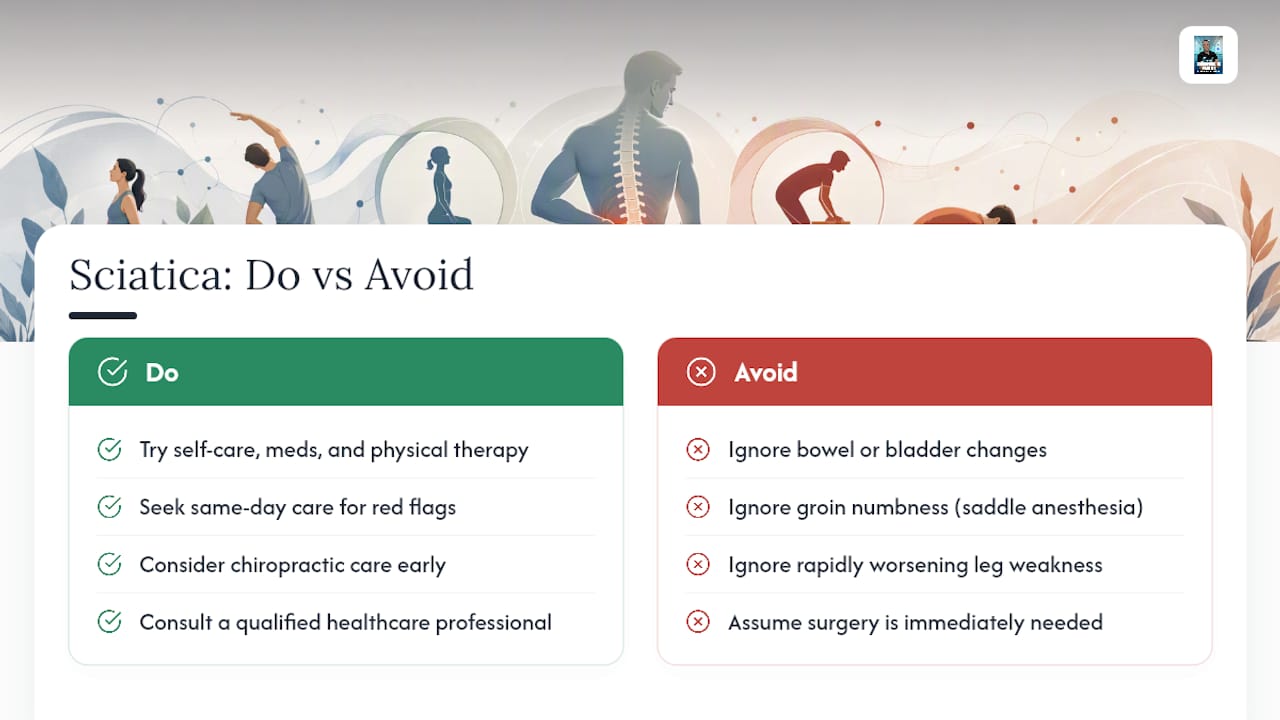
- New loss of bladder or bowel control
- Numbness spreading across your inner thighs or groin (saddle anesthesia)
- Rapidly worsening leg weakness
Any of those means same-day medical evaluation, not a wait-and-see approach.
Key Takeaways
Sciatica is nerve pain from an irritated or compressed sciatic nerve root, most often caused by a herniated disc, and it typically improves within weeks to months with staged conservative care.
| Point | Details |
|---|---|
| Definition matters | Sciatica describes radiating one-sided leg pain from nerve root irritation, not a diagnosis on its own. |
| Know the red flags | Bowel/bladder changes, saddle numbness, or rapid weakness need same-day medical evaluation. |
| Start conservative | Most people recover with activity changes, short-term medication, and physical therapy before anything more invasive. |
| Recovery has a timeline | Most substantial improvement happens by 6 to 12 weeks, with surgery reserved for severe or unresponsive cases. |
| Hands-on care helps early | Sparkmed's chiropractic evaluations and non-invasive therapies fit naturally into early and mid-stage sciatica management. |
Where to Read More About Sciatica
- Mayo Clinic's overview covers the clinical definition and common spinal causes in plain language.
- MedlinePlus explains the sciatic nerve's anatomy and typical symptom distribution.
- NICE CKS guidance frames how UK clinicians approach diagnosis and imaging thresholds.
- Garden State Medical Group lists practical signs it's time to see a doctor about back pain.
- Merck Manual offers a deeper look at mechanism and prevalence among back pain patients.
Table of Contents
- What Is Sciatica and How Does It Develop in the Spine?
- What Are the Symptoms of Sciatica Pain?
- What Causes Sciatica Pain?
- How Do Doctors Diagnose Sciatica?
- How Do You Treat Sciatica? A Staged Approach
- How Can You Relieve Sciatica Pain at Home?
- Who Treats Sciatica: Comparing Care Options
- What's the Outlook for Sciatica, and Can You Prevent It?
- Get Hands-On Evaluation for Sciatica in North Miami
- Frequently Asked Questions
- Sources
What Is Sciatica and How Does It Develop in the Spine?
The sciatic nerve is the thickest nerve in your body. It forms from nerve roots exiting your lower spine between the levels of L4 and S1, bundles together in your pelvis, and runs behind each hip, down the back of the thigh, and splits near the knee into branches that reach the calf and foot. MedlinePlus notes it controls muscles behind the knee and lower leg while carrying sensation from the thigh, part of the lower leg, and the sole of the foot.
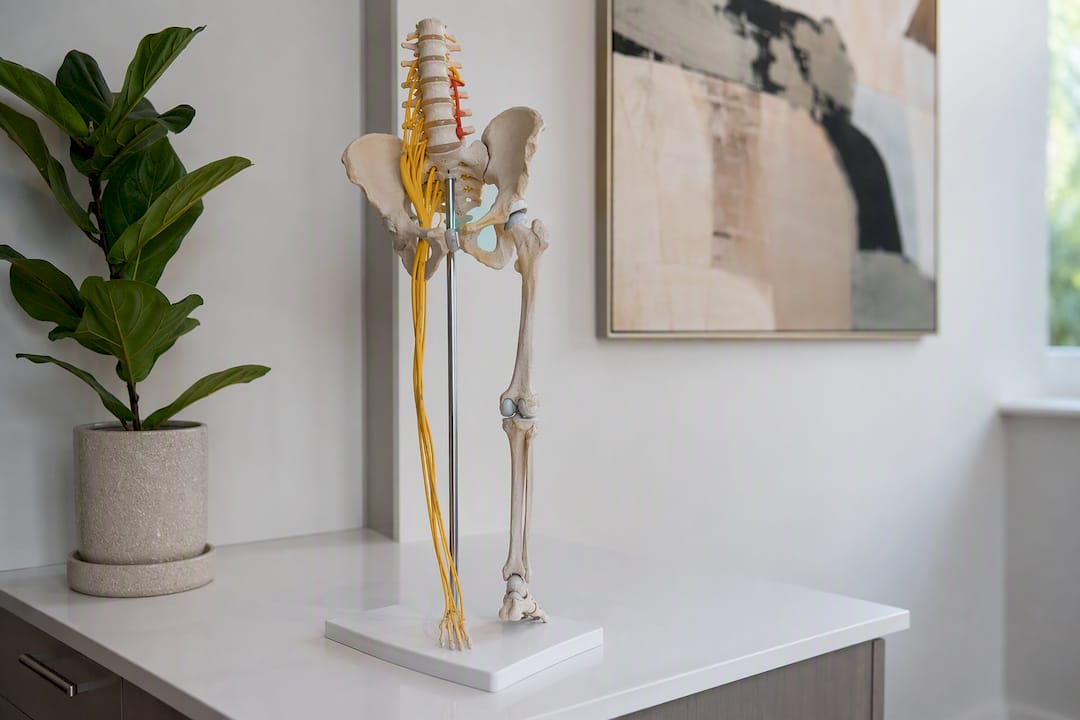
When something presses on or inflames one of those nerve roots, typically a bulging disc, the medical term is radicular pain: pain that radiates along the nerve's path rather than staying put where the irritation occurs. That's the key difference between sciatica and a simple muscle strain. A strain stays local; radicular pain travels.
Pro Tip: Trace the pain path in your head: buttock, back of thigh, then calf or toes. If your discomfort follows roughly that route on one side, that pattern itself is a strong clue you're dealing with sciatica rather than general back soreness.
Because sciatica almost always affects one leg at a time, bilateral symptoms should make you (and your clinician) consider other causes.
What Are the Symptoms of Sciatica Pain?
Classic sciatica shows up as one-sided leg pain that travels below the knee, often described as sharp, burning, or electric rather than a dull ache. It frequently comes with numbness, tingling, or noticeable weakness in the same leg.
Certain moments make it worse. Coughing, sneezing, or straining increases pressure around the irritated nerve root, and prolonged sitting tends to aggravate symptoms rather than relieve them. Standing up and moving briefly often helps more than staying still.
Common symptom pattern:
- Pain radiating from low back or buttock into the leg, usually one side only
- Numbness or tingling along the back of the thigh, calf, or foot
- Leg weakness, especially when lifting the foot or standing on toes
- Pain that worsens with sitting, coughing, or sudden movement
According to the NHS, red flags requiring urgent evaluation include sharp burning pain paired with new numbness or weakness, bowel or bladder problems, and saddle numbness. Those symptoms warrant same-day care. Everything else, even if painful and disruptive, usually fits into routine follow-up with a primary care provider or chiropractor within a few days.
What Causes Sciatica Pain?
A herniated or "slipped" disc pressing on a lumbar nerve root causes most sciatica cases. Spinal stenosis (narrowing of the spinal canal), bone spurs, and spondylolisthesis (one vertebra slipping forward over another) account for most of the rest. Tumors and spinal infections can compress the nerve too, but those are rare and usually come with other warning signs like fever or unexplained weight loss.
One condition often gets mislabeled as sciatica: piriformis syndrome. Here the piriformis muscle in the buttock irritates the sciatic nerve directly rather than a spinal nerve root causing the problem, which means treatment approaches can differ even though the leg pain feels similar.
Risk factors that raise your odds:
- Age-related disc degeneration, typically starting in your 30s and 40s
- Physically demanding work involving heavy lifting or repeated twisting
- Obesity, which increases load on the lower spine
- Diabetes, which can affect nerve health over time
- Smoking, linked to faster disc degeneration
- Pregnancy, due to weight shifts and ligament changes
Most people dealing with sciatica fall into the "common cause" bucket. Tumors and infections are worth knowing about, but they're the exception, not the rule.
How Do Doctors Diagnose Sciatica?
Diagnosis usually starts with a physical exam, not a scan. A clinician will check your reflexes, test muscle strength in your leg and foot, and check sensation along the nerve's path. The straight-leg raise test, where you lie down while the clinician lifts your straightened leg, reproduces radiating pain in many true sciatica cases and helps confirm nerve root involvement.
Imaging isn't the first step for most patients. An MRI becomes appropriate when:
- Red flag symptoms are present (bowel/bladder changes, saddle numbness, progressive weakness)
- Neurologic deficits are worsening rather than improving
- Symptoms persist or intensify despite several weeks of conservative treatment
Sciatica needs to be distinguished from other conditions that mimic it: hip joint arthritis causes groin pain rather than the classic below-knee radiation, and vascular claudication (poor blood flow) causes leg pain tied to walking distance rather than posture. A primary care visit typically covers history and basic exam; if red flags or a stalled recovery show up, referral to a spine specialist or physical therapist usually follows.
How Do You Treat Sciatica? A Staged Approach
Treatment for sciatica almost always starts conservative. Cleveland Clinic notes that most people recover with stretching, medication, or physical therapy, and surgery is reserved for severe or unresponsive cases.
Stage one: self-care and conservative treatment. This means modifying activities that provoke pain, using NSAIDs or acetaminophen short-term, and starting structured physical therapy. A physical therapist builds a program around your specific movement pattern rather than generic stretches, which matters because the wrong exercise can aggravate an irritated nerve root.
Stage two: escalation when conservative care stalls. If pain persists past several weeks, some clinicians add oral neuropathic medications designed for nerve pain specifically. Epidural steroid injections are another option here, delivering anti-inflammatory medication directly near the irritated nerve root to reduce swelling and pain long enough for physical therapy to work.
Stage three: surgical referral. Surgery enters the conversation for a minority of patients, specifically those with progressive neurologic deficits, severe pain unresponsive to 6 to 12 weeks of conservative treatment, or red flag symptoms suggesting significant nerve compression.
Recovery timelines vary but follow a pattern:
- Many people notice improvement within 2 to 6 weeks
- Most see substantial recovery by the 6 to 12 week mark
- A smaller group develops longer-lasting or chronic symptoms requiring ongoing management
Pro Tip: If you've done 6 to 12 weeks of consistent conservative care with no real improvement, or if you notice new or worsening weakness at any point, ask for a specialist referral instead of waiting it out longer. Progressive weakness in particular is not something to sit on.
How Can You Relieve Sciatica Pain at Home?
For the first 48 to 72 hours after a flare, ice calms acute inflammation better than heat. After that window, heat tends to help more by loosening tight muscles around the irritated nerve. Avoid sitting for long stretches either way, and take short walks as your pain allows.
A few exercises show up consistently in physical therapy programs for sciatica:
- Knee-to-chest stretch: Lying on your back, pull one knee toward your chest and hold 20 to 30 seconds, gently opening space around the lower spine.
- Pelvic tilts: Flatten your lower back against the floor by tightening your abdominal muscles, then release, repeating slowly.
- Nerve glides: Gently straighten and bend the affected knee while seated, moving the irritated nerve through a small, pain-free range.
- Piriformis stretch: Cross the affected ankle over the opposite knee and lean forward gently to stretch the buttock muscle.
- Gentle hamstring stretch: Extend the leg with a slight bend and lean forward from the hips, stopping well short of pain.
Stop immediately if any movement causes new numbness, sudden weakness, or a sharp increase in pain. These exercises help a lot of people, but a physical therapist or chiropractor can tailor them to your specific presentation rather than leaving you guessing.
Who Treats Sciatica: Comparing Care Options
Different providers play different roles depending on how far along your sciatica has progressed and how it's responding to care.
| Provider | Role in sciatica care |
|---|---|
| Primary care physician | Initial assessment, short-term medication, coordinates referrals |
| Physical therapist | Guided exercise programs, manual therapy, functional recovery |
| Pain specialist | Imaging-guided injections, procedural pain management |
| Spine surgeon | Decompression or discectomy when conservative care fails |
| Chiropractor | Spinal adjustments, hands-on evaluation, adjunctive modalities like ultrasound and heat therapy |
Chiropractic care fits well into the early and middle stages of a sciatica case, particularly when the goal is hands-on evaluation paired with structured, non-invasive treatment. When symptoms point toward surgical criteria, a chiropractor's role shifts toward co-management alongside a referral, not standing in the way of one.
What's the Outlook for Sciatica, and Can You Prevent It?
Recovery from sciatica usually follows a predictable curve. Many people feel noticeably better within a few weeks, and most reach the bulk of their recovery by the 6 to 12 week mark, according to Cleveland Clinic. A smaller share develop symptoms that linger longer and need ongoing management.
Prevention centers on reducing load and strain on your lower spine over time:
- Strengthen your core and glutes to support the lumbar spine
- Maintain a healthy body weight to reduce spinal load
- Use proper lifting mechanics, bending at the knees rather than the waist
- Quit smoking, since it accelerates disc degeneration
- Adjust your workstation to avoid prolonged awkward postures
Recurrence is common once you've had one episode, which is why a daily spinal health routine and graded return to normal activity matter more than a one-time fix. The Merck Manual estimates sciatica occurs in roughly 5% of people with low back pain, a reminder that most back pain is not sciatica at all.
A Clinic Note on Sciatica Care
At Sparkmed, we see sciatica most often respond well to a staged approach: a thorough hands-on evaluation first, then a treatment plan built around what that exam reveals rather than a one-size template. Quick, affordable access to that first evaluation is often what separates a two-week recovery from a two-month one.
Get Hands-On Evaluation for Sciatica in North Miami
If home stretches and rest haven't moved the needle on your leg pain, a hands-on evaluation catches things a self-check can't. Sparkmed offers spinal adjustments starting at $25 with no insurance required, alongside advanced therapies like ultrasound and shockwave treatment built for exactly this kind of nerve irritation, plus wellness plans that support longer recovery.

Booking is straightforward: call the clinic or schedule online, and if you're coming in for the first time, bring any recent imaging you have, a list of current medications, and a rough timeline of when your symptoms started. If you're recovering from a car accident or work injury and getting to the clinic is a barrier, Sparkmed also coordinates Uber Health transport in North Miami so a ride issue doesn't delay care. Take a look at the clinic's accessibility information and book your first visit to get an evaluation started this week.
Frequently Asked Questions
Is sciatica the same as a pinched nerve? Sciatica is a type of pinched nerve specifically involving the sciatic nerve or its lumbar nerve roots, most commonly from a herniated disc pressing on the nerve.
Can sciatica go away on its own? Yes, in many cases. Most people improve with self-care, medication, and physical therapy within weeks to a few months, without needing injections or surgery.
What does sciatica pain feel like? It usually feels sharp, burning, or electric, radiating from the lower back or buttock down one leg, often past the knee, and sometimes with numbness or tingling.
When should I worry about sciatica? Seek same-day care if you notice bowel or bladder changes, numbness around your groin (saddle anesthesia), or rapidly worsening leg weakness.
Can a chiropractor help with sciatica? Yes. Chiropractic evaluation and spinal adjustments are commonly used for sciatica in the early and middle stages, often alongside other conservative treatments like physical therapy.
This article is general information, not a substitute for advice from a qualified doctor. Consult a qualified healthcare professional about your own circumstances before acting on anything here.
Sources
- Sciatica - Symptoms and causes - Mayo Clinic
- Sciatica: What It Is, Causes, Symptoms, Treatment & Pain Relief - Cleveland Clinic
- Sciatica - MedlinePlus
- Sciatica - Merck Manual Consumer Version
- Sciatica - NHS